
The British Pioneer Battalions And Labour Corps on the Western Front
The earliest record of British 'Pioneers' is on a payroll of the British Garrison at Calais, France, in the middle of the 14th Century. Pioneer contingents were also present at many engagements around the world at various times up to the Great War. But, in 1914, there were no Pioneer formations at all in the British Army, and when the British Expeditionary Force (BEF) sailed for France in August 1914 there were no contingent of Pioneers aboard.
Pioneers and the BEF in France in 1914
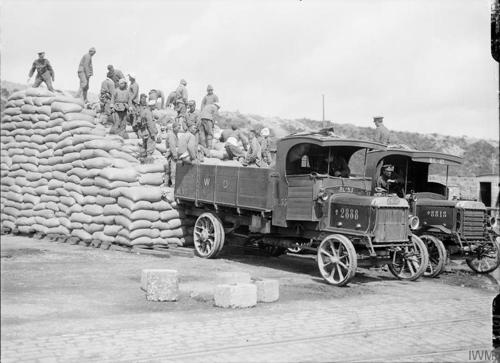
Without Pioneers aboard, the BEF commanders were obliged to rely French civilian labour provided by the French Government to unload the BEF's ships. But this supply of labour quickly proved to be inadequate and the first tranche of 300 labourers were despatched from England by the British War Office to fill the gap.
More British labour followed, and by December 1914 they had been formed into five Army Service Corps Labour Companies (ASCLC). Each company had a strength of six officers and around 500 men.
On the battlefront itself, much of the role of the Pioneer was undertaken as part of the 'fatigue' routine common to all British battalions. This meant that in addition to their fighting duties, squads of infantrymen were routinely set various tasks that included: trench digging; installation of barbed wire entanglements; moving of supplies and munitions and any other pioneer type duty that had to be carried out.
This fatigue routine became established as an essential part of the infantryman's role and, regrettably, it often took precedence over rest periods, training for new offensives and rehearsing tactics. It was the cause of much physical decline and depression of morale amongst the troops of the infantry battalions. To some extent, or other, the practice of fatigues persisted throughout the whole period of the Great War since the chronic manpower/labour problem was never fully resolved.
Developments in 1915
Active recruitment of Pioneers began in the UK and by the end of 1915 over 20,000 Pioneers were on the Western Front in Labour Companies.
Meanwhile, additional recruitment of Pioneers took place from the cadres of skilled and semi-skilled workers across the whole spectrum of British industry - even from men employed on munitions work. For the first time, women took on many of these men's former duties.
The new recruits were formed into:
ASC Railway Companies.
Of which the first Company (#33) was in place in January 1915 and the second (#34) in December 1915. Detachments from these companies were based at the major rail centres such as Le Havre.
Royal Engineer Labour Battalions.
The first of these arrived in France in August 1915 to be followed by a further 11 battalions. They were assigned to vital railway construction and transportation work.
Pioneer Battalions.
As a result of a December1914 Army Order, each of the BEF's Divisions was allotted a Pioneer Battalion that would be devoted to various types of labouring work. These men were experienced in the various construction industry trades and general labouring. They underwent basic military training including firearms, but were also supplied with the necessary additional tools required for the work they were assigned to do in the field as Pioneers.
Developments in 1916
The pressure for an ever-increasing supply of labour resulted in 1916 in the reclassification of men who had been medically graded as unfit for active service in the Front Line. These men were drafted into Infantry Labour Battalions. Additionally, following the promulgation of the Military Service Act in March 1916, Conscientious Objectors were inducted into Non-combatant Companies for deployment as general labour in military establishments.
Twelve Infantry Labour Battalions and eight Non-combatant Companies had been formed by mid 1916.
Prisoner of War Companies were also formed, in France, from mid 1916, of POW's with useful construction skills.
Developments in 1917
With no sign that the manpower shortage of British labourers could be fully met from indigenous sources, the British Government decided to recruit foreign labour, on fixed term contracts, from various overseas territories. The contracts stipulated that the labourers would not be used within 10 miles of the Front Line.
The first contingents began to arrive on the Western Front in 1917. Prominent amongst these were:
Chinese Labour Force:
50,000 by end of 1917 rising to 98,000 by end of 1918.
Egyptian Labour Force:
A significant part of a global strength of 100,000.
Indian Labour Force:
This comprised 21,000.
South African Native Labour Force:
This comprised 10,000.
Other colonials:
Numbers of labourers were also recruited from other countries of the British Empire e.g. Bermuda, Fiji, Mauritius, Seychelles, South Africa (Cape Coloured) and West Indies.
For various reasons, including segregation, the majority of the foreign workers were employed in areas well behind-the-lines with the exception of the Indians, some of whom were involved in building Front Line fortifications and the transportation of munitions closer to the Front Lines.
Also in January 1917, the British Labour Corps was formed as a worldwide organisation into which many of the disparate labour units were amalgamated. Many of its transferees were of the lower medical grades, ex-convalescent wounded and older men. These transferees were obliged to change their regimental badge for that of the less-liked ASC format. On the Western Front it compromised:
Pioneer Infantry Battalions.
Totalling 68 battalions in all.
ASC Companies.
Eventually around 90,000 men were involved in activities concerned with transportation alone.
POW Companies:
47 companies were created of skilled Central Powers' troops.
Employment Companies:
Involved in salvage work, formerly based at the divisional level.
It was hoped that the influx of foreign labour would ameliorate the lot of the infantryman as far as the regimental fatigue commitment was concerned. But such was the chronic overall shortage of manpower, the regimental fatigues continued as a routine obligation despite the increasingly heavy commitments of the combat troops to the fighting on the Western front.
Developments in 1918
When many British battalions were broken up, or reorganised, in early 1918, remnant drafts of troops that had been classified as fit for active service were grouped into special units to await reallocation to active units. (Without a doubt, most of the soldiers so selected were the less fit, the poor performers, or the most ill disciplined and their parent battalions took the opportunity to weed them out). To usefully occupy these troops, these special units of Pioneers were employed in entrenchment work and were known as:
Entrenchment Battalions.
In October 1918, the Labour Corps was given it own badge that comprised of crossed pick, shovel and rifle - the latter expressing the Pioneers dual role as fighting troops should the need arise, as it did during the 1918 German Spring Offensive - surmounted by a crown and laurel wreath. At the base was a scroll bearing the words Labor omnia vincit (Work conquers everything).
By the end of 1918, the strength of the British Labour Corps on the Western Front was nearly 200,000 men.
Casualties in the Labour Corps
During the period from its formation in1917 to the end of the war, a total of 2,300 (1%) soldiers and civilians were killed or died of wounds whilst serving on the Western Front with the Labour Corps; 1,612 of the dead were Chinese.
Developments after the Armistice
After the war ended the Labour Corps' salvage companies were maintained at a strength of 90,000 to carry out various important post-war tasks. Firstly, there was the highly dangerous work of clearing of the battlefield of the detritus of war: in some areas there were several thousand pieces of unexploded ordnance per hectare of war-torn battlefield and destroyed habitation; numbers of these salvage workers were killed in the prosecution of this work.
Other salvage companies concentrated on recovering and/or registering the war dead and concentrating them into designated war cemeteries.
The Labour Corps was also made responsible for providing guards as custodians for the large numbers of Prisoners of War on the Western Front.
Postscriptum
Perhaps the least prestigious arm of the British military, the Pioneers in their various forms provided sterling service to the fighting troops. Amongst their many duties, they maintained the means of communication and transport, dealt with the movement and handling of munitions and stores, built and repaired structures and fortifications and, the most onerous duty of all, they recovered and buried the war dead.
The only wish of the infantry was that there were many more of them.
Becoming a member of The Western Front Association (WFA) offers a wealth of resources and opportunities for those passionate about the history of the First World War. Here's just three of the benefits we offer:

Identify key words or phrases within back issues of our magazines, including Stand To!, Bulletin, Gun Fire, Fire Step and lots of others.

The WFA's YouTube channel features hundreds of videos of lectures given by experts on particular aspects of WW1.

Read post-WW1 era magazines, such as 'Twenty Years After', 'WW1 A Pictured History' and 'I Was There!' plus others.


