
The Lance
Historically, the lance, spear and javelin are different forms of a long implement with a sharpened point. The javelin, which was thrown, need not concern us for it passed out of European military use centuries before 1914. the sarissa, as carried by foot soldiers in ancient times, developed into the pike, used in the early days of firearms to protect the musketeers. With the evolution of the bayonet in the 17th and 18th centuries, the pike declined, but some authorities consider that the rifle with fixed bayonet is the modern form and lineal descendant of the pike.
The lance was a type of spear used by mounted me. In Roman times it was a lightweight thrusting weapon, but it was the development of the horseman's stirrup towards the end of the Roman Empire which altered the way the lance was used. With stirrups. A horseman could balance himself and sit more securely to hold his lance so that it struck an opponent with the full force of a charge rather than the weaker thrust of his arm alone.
In mediaeval times the lance had developed into a formidable weapon, well suited to the tactics of heavy cavalry. However, the advent of efficient, though primitive, firearms, saw the the demise of the armoured man and the lance re-emerged as a lightweight cavalry weapon. By the 18th and 19th centuries cavalry was used to deliver a shock to enemy troops and it was considered that the lance, rather than the sword, admirably filled this role.
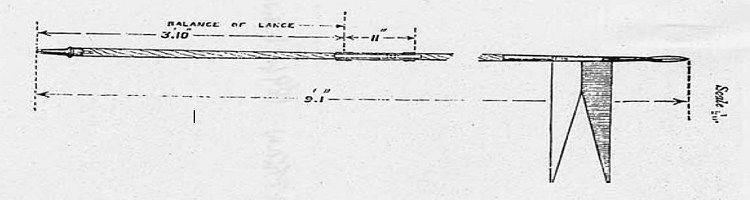
British cavalry in the Great War carried the Pattern 1894 Lance. This had an overall length of 9'1" and consisted of a steel head mounted on an ash stave. The butt ended in a pointed iron shoe.
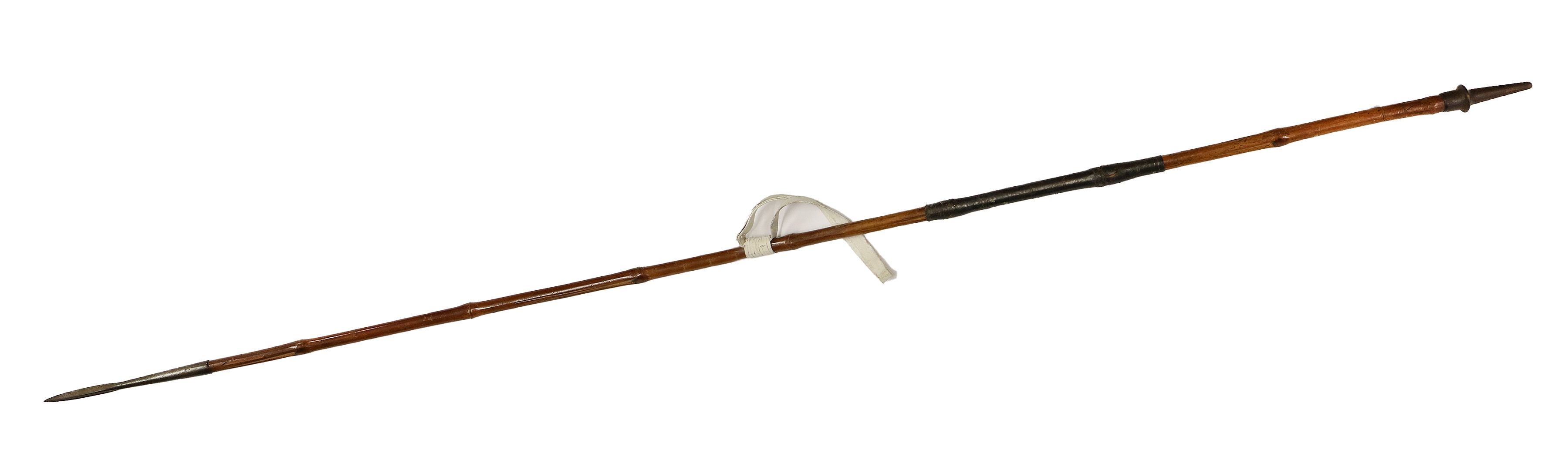
The head was slim and triangular, brazed onto a socket which went over the stave and was secured with screws. At the point of balance, 3'10" from the show, a grip was formed by lapping a white leather thong around the stave. A 13" leather sling was fitted behind the grip.
When carried, the lance shoe went into a leather socket on the offside or right stirrup which enabled the lance to be kept upright.
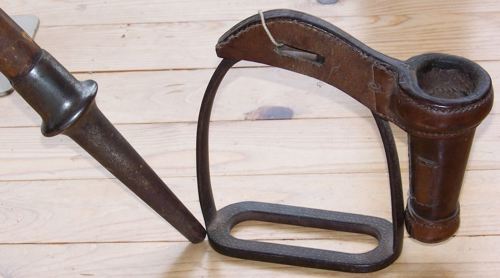
There was also a 'D' shaped brass ring between the sling and the shoe which could be slipped over a hook on the saddle. This enabled the lance to remain attached to the saddle when the trooper dismounted. Finally, all lances carried a red and white flag, 9.25" wide and 2'5" long.
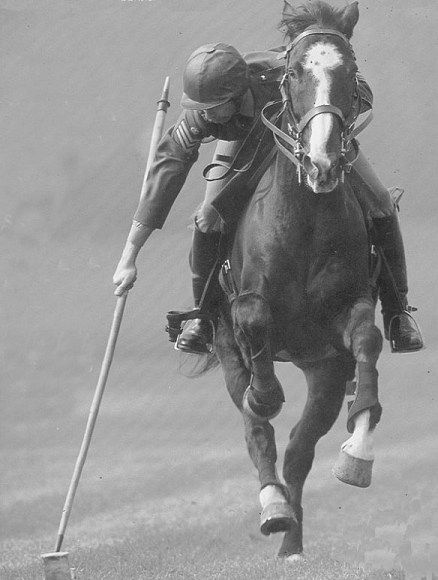
Lancers were proud of their proficiency with their weapon and used a bamboo practice lance to develop the necessary skills by charging dummy targets and by tent pegging. In this, a 3" wide wooden peg had to be struck our of the ground from a galloping horse and it was considered to be the acme of th cavalryman's art. Apparently the real skill is to avoid tangling the lance in the horse's legs.
Lances were used in the War on both the Western Front and in the Middle East. Richard Holmes in 'Riding the Retreat', describes the 9th Lancers' charge against German guns on 24th August 1914 at Elouges, south-west of Mons. It seems to have started as ' a very disordered mess' and was halted by wire fences. We are all aware that conditions on the Western front were not suited to horsed warfare and cavalry units generally fought as infantry.
Though the Great War marked the end of the lance as a combat weapon, the skill and determination of the men who carried out cavalry charges has to be admired. It must have taken a very special sort of courage to ride in a pack of excited horses under fire towards an enemy position.
Becoming a member of The Western Front Association (WFA) offers a wealth of resources and opportunities for those passionate about the history of the First World War. Here's just three of the benefits we offer:

With around 50 branches, there may be one near you. The branch meetings are open to all.

Utilise this tool to overlay historical trench maps with modern maps, enhancing battlefield research and exploration.

Receive four issues annually of this prestigious journal, featuring deeply researched articles, book reviews and historical analysis.


