
The 10th West Yorks at Wareham, 1914-1915
In a letter to the Morley Observer in August 1917, Lance-Corporal David Sharp wrote the following: ‘Sir - Allow me to utilise the columns of your paper to praise a regiment which very much seems in the dark, but whose deeds of valour have never been excelled.'(1) Sharp was speaking here of the 10th West Yorkshire Regiment, and writing from the Priory Hospital in Cheltenham after being wounded for the fourth time in just over two years. He had been injured shortly after the 10th West Yorks had attacked Bellewarde Ridge during the Battle of Ypres in July 1917. The remainder of Sharp's letter is worth reprinting:
The sector laid out for us to attack was to the left of the famous Menin Road, and directly opposite a large sheet of shallow water known as the Bellewarde Lake. We were not only fighting against a powerful enemy, but we had also the disadvantages of flood and mud to contend with, and it seemed that these would rob us of victory...The front line was not a serious obstacle, but beyond here, past the lake and wood and over Bellewarde Ridge, there was continual machine-gun fire, and stout resistance in innumerable trenches and strongholds. All our men acted admirably; they made a true soldiers battle and the testimony of all concerned is that the self-reliance, resource and individual gallantry could not be surpassed. Whenever an officer or non-commissioned officer fell a private took command, and everybody seems to have done his job.(2)
His was not a frustration borne of anger, but rather a need to draw attention to a battalion whose part in the Great War had been often overlooked in favour of the more glamorous units. One can almost sense Sharp's frustration when looking through the newspapers of the period, rarely coming across the name of the 10th West Yorkshire Regiment, but seeing column upon column, dedicated to the actions of the locally-raised or mayoral battalions, such as the ‘Leeds Pals,' amongst other ‘Pals Battalions.' Nevertheless, there is much to be gained from the newspapers, especially in the absence of a nominal roll with which to work from, or where the battalion diaries are seriously lacking, as is the case when the 10th West Yorks were in training at Wareham Camp between 1914 and 1915.
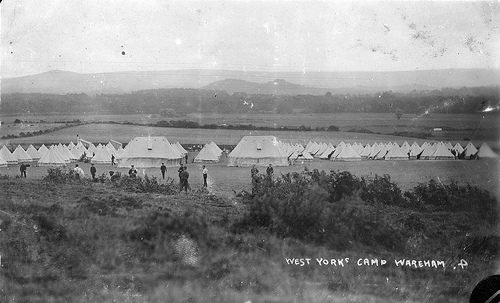
Formed at York: Moved to Wareham
The 10th (Service) Battalion, The Prince of Wales's Own, (West Yorkshire Regiment), was formed at York in September 1914, and attached to 50 Brigade, of the 17th (Northern) Division.(3) Its formation was a response, at least in part, to Lord Kitchener's appeal for a new army of volunteers. Many of those who had rushed to join the Colours in late August and early September mainly hailed from the Leeds and York areas - but by no means exclusively. The North East and East Coast are also represented, and men from the Midlands and the South of England are to be found amongst the (officers and) ranks. Most came from a manual or industrial background, with the engineering, coal, and other sweated industries featuring heavily in the occupations of those who had volunteered. Corporal Fred Dean was a miner at the Topcliffe Colliery in West Ardsley; and Private Thomas Almond, who at sixteen was clearly under age when he joined, worked in the cloth finishing department at Crank Mills. Both served in ‘D' Company, along with David Sharp and many of the other ‘Morley Boys,' the market town from which they had enlisted.(4)
!['The Morley Boys' [1914]](/media/tqilgpiy/the-morley-boys-1914.jpg)
Meantime, their training had yet to begin, and given the chaos at York, with the problems of overcrowding, a group of officers was sent to Dorsetshire on 5 September to look at alternative arrangements.(5) The first choice of call was Wareham or, to be more precise, Worgret, which lay on the outskirts of town. After a brief inspection of what the area had to offer it was decided that Wareham and its environs met the demands required to house upwards of a possible 7000 troops.(6) The first of the men were due to arrive in a matter of days. There was no water or facilities. Provisions needed to be made. A party of 200 Royal Engineers of the 1st Wessex Field Company were despatched from Fareham on the Monday morning to complete the necessary arrangements.(7)
Preparations were also taking place at York, and in less than 24 hours the 10th West Yorks were on their way to Wareham, finally reaching their destination on the Tuesday evening after a gruelling twelve hour journey by train.(8) Due to an oversight the battalion was taken to Wool by mistake and, to compound matters, they were not only forced to march the extra six miles to Worgret, but there was little in the way of victuals or accommodation when they arrived.(9) In short, the thousand-strong battalion, along with the men of the 7th East Yorkshire Regiment who had travelled with them, had been left stranded without food or shelter. The men were also cold, drenched, and tired. It had been raining.(10)
‘Left out to dry'
The weather, both good and bad, features in many of the narratives throughout the battalion's stay, but the most pressing problem was how to accommodate almost two thousand men who had been literally ‘left out to dry.' The people of Wareham dealt with it remarkably well, not only providing drinks and food, but an endless supply of cigarettes. Some even offered the men a bed in their homes for the night. The different religious and denominational groups all rallied round too; with the Council School, Wesleyan School, and the Unitarian Schoolroom all providing temporary relief and shelter. The Congregational Church ‘threw open their doors...where fires were lighted for drying their clothes, together with a liberal supply of newspapers.' The Drill Hall, Town Hall, and Corn Exchange soon followed suit.(11) It seems that most of the men had spent a reasonably comfortable first night under cover. It was not to last and, as the rain persisted over the next few days, the mood of the men began to change. They were not alone in their grievance. The men of the 7th York and Lancaster Regiment had arrived on the Tuesday morning, shortly followed by the 7th Green Howards (Yorkshire Regiment). The Southern Times takes up the mood:
As described last week they arrived here on Tuesday full of buoyancy and enthusiasm, singing "It's a long, long way to Tipperary" through the streets to their camping ground at Worgret. They got over Tuesday night fairly well, sleeping on straw in tents; but on Wednesday morning orders were given to take some of the tents down and put them up again in a different manner. In the meantime rain came down heavily, saturating their "beds" and exposing the poor fellows to a thorough soaking. As the day advanced things began to look bad, and the men all came into town soaked through and availing themselves of every bit of covering possible. It was still raining when about five o'clock a large crowd of the men assembled in the Market-place in a dejected and rather defiant mood, and at one time things looked very ugly and serious.(12)
The first night may well have passed without incident, but the drunkenness and brawling which followed created its own problems. This was almost certainly evident on a Friday and Saturday evenings when the men had been paid, and there was ‘paper money flying around ad libitum,' according to one account.(13) Petty crime and pilfering also kept the courtrooms and magistrates busy, along with Superintendent Toop and the town's constabulary. One soldier of the 10th West Yorks was fined £5 for stealing a pint glass beer mug, valued at 7d (3.5p); another was remanded in custody for walking away with a decanter of wine from the Antelope Inn.(14) Such was the disorder in the early weeks that pickets were formed to ensure that any drunks were taken off the streets and basically frog-marched back to camp. Their role, and that of the local police force, was later strengthened by the use of the military police, and a group of mounted police were sent from Aldershot to ensure that stricter discipline was maintained.(15)
The local and military authorities had decided to act: powers were invoked under the Defence of the Realm Act. Public houses were ordered to close at nine instead of ten o'clock. A further order was issued in early November stating that no recruit was to be served before 4.00 pm or allowed out of camp without a pass.(16) This would have been simply unenforceable only a month earlier, with many of the men still wearing civilian clothing, and waiting for some semblance of a uniform to arrive. Hence, ‘The Chauffeurs', the nick-name given to the 10th West Yorks, due to the long, large-buttoned overcoats, and the high-peaked caps that were first issued to the men in mid-October.(17)
YMCA and entertainment
It would be wrong to assume, however, that drink was the only available culture. Other options were open to the troops. The Wareham Picture Company proved particularly popular with the men on Friday and Saturday nights.(18) The French classes which were held at the Congregational Schoolroom on a Monday and Saturday evenings proved equally popular. These were taught by Mrs Donnington and Mrs Dugdale, and the attendance was such that the dates and times needed to be changed and extended to accommodate the extra numbers.(19) The Drill Hall was also put to other uses and played home to the Church of England Soldiers' Institute. The Institute boasted a tea and coffee bar, a well-stocked library, a piano and games. Access to newspapers and writing materials was provided free of charge. It was estimated that between 350 men at any one time, and over a thousand in the course of the evening, actually made use of the facilities; although the issue of free stamps and paper no doubt provided its own attraction. This may well account for the increase in numbers.(20) The local societies, along with the various groups and organisations, surely fulfilled an important role, and provided a welcome distraction for some when it was perhaps most needed. The Young Men's Christian Association performed a similar function. What follows is an extract covering the opening of the YMCA hut in December 1914. The official ceremony was carried out by Cornelia, Lady Wimborne, with other dignitaries in attendance:
Similar to the building opened the day before at Bovington Camp, and another at Swanage, the hut is of light timber framing with a main hall 100ft by 30 ft., and accommodating a stage and two dressing rooms, providing sleeping berths for four of the staff while at the further end is a lean-to containing the offices and stores; and separate from the building itself, a kitchen and cook's room. The walls are lined with matchboard and face outside with asbestos cement slabs. The roof is of matchboard and felt. The building at present is lit by paraffin gas lamps, although later it is proposed to substitute electricity; while the heating is by four slow-combustion stoves. The hut was erected by Mr Randolph Meech, of Hamworthy Junction, from the designs of Mr. Philip Sturdy, of the Wick, Branksome Park, the Treasurer of the Wareham Camp. Canon FE Toyne, of Bournemouth, presided at the opening ceremony, and there was a large attendance of officers and men. The hut took six weeks to complete from suggestion. (21)
![West Yorks Church Parade [Romsey 1915]](/media/ojfjqaeh/west-yorks-church-parade-romsey-1915.jpg)
The role of the Church is one worth briefly pursuing, if only to highlight the influence of those who ministered to the needs of the men - amongst other duties besides. One of the more charismatic figures was the Rev William Cramb Charteris, a veteran of the Boer War, and Baptist minister from Ayr.(22) Charteris was posted in December 1914, and was to spend the next two years as Chaplain to the 17th (Northern) Division. It is likely he was present at Fricourt in July 1916 in which the 10th Battalion was all but annihilated during the opening phase of the Somme Offensive. What is of interest, though, was the enthusiasm which Charteris brought to his work, and in less than a week at Wareham he had secured the names of no less than ‘100 men committing themselves to Christ' during a voluntary and evangelist-led service at the YMCA.(23) It would be easy to be cynical, and religion does not always sit comfortably with some nowadays, but faith did play an important part in the lives of many, and there is little doubt that Charteris was a very popular and persuasive man. His letters and correspondence to the Scottish Baptist Magazine are testament to his character.(24)
Material comforts and physical improvement
The material comforts, on the other hand, were a little slower in coming, and with many of the men awaiting the completion of their huts, the hardships and privation of army life continued. It was much the same across the area, and with more units arriving daily, the demand for more rigid accommodation was becoming increasingly apparent as the winter months were beginning to set in. Again, the rain was proving a major problem: saturating the men's blankets and clothing, the timber ‘flooring' on which they slept, and often turning the outside of the tents into a quagmire.(25) It was not uncommon to find groups of soldiers gathering bundles of furze or gorse which they then strew around their tents in an effort to prevent their ‘homes' being enveloped by the swamps.(26) The weekly discharge of men from the nearby hospital who had succumbed to the chills and other forms of ill-health was also becoming something of a regular feature. Nor did it go unnoticed. As the Southern Times commented: ‘One cannot but help thinking that the original hospital at the Wesleyan Schoolroom would have been far preferable for the treatment of patients to the hospital on the bleak Worgret-road.'(27)
This is not to suggest that improvements had not been made, and one of the more visible changes had been that of the marked difference in the physical state and appearance of the men. There are any number of factors to consider here: not least, the combination of good food and diet, and fresh air and exercise. Corporal David Sharp offers a brief overview of each: ‘Our diet consists of butter, bacon, cheese, salmon, sardines, etc...and we get 6.5 hours a day parade, chiefly consisting of rifle drills and route marches.'(28) Strictly speaking, Sharp was responding here to concerns at home and elsewhere about camp life and conditions, and the ‘cheese, salmon, and sardines, etc.,' were likely the exception rather than the rule: a supplement to the ‘three loaves, jam, and boiled brawn' normally issued to each twelve-man tent in the morning, or the ‘Irish stew, and four ounces of bread,' regularly dished up and served for dinner around mid-day. ‘Dinner,' according to Private Herbert Parkin, of the 7th Green Howards, who were in training with the 10th West Yorks, ‘is a good meal, though we don't get a change.'(29)
With the day starting at 6.00 a.m., or a half-hour later when the days were shorter, there was much to occupy the men before allowed off duty at 5.00 p.m.(30) The march to ‘Woodbury Hill' is just one example: ‘They left about half-past eight and returned to camp about two ... through Poole-road to Lychett Minster, turning to the left at Baker's Arms to Woodbury Hill, and thence from Bere Regis back to Wareham.'(31) The location was also ideal for ‘skirmishing,' and in what was a break from the daily routine of rifle practice, bayonet practice, parade, and physical drill, the battalion was taken out to the moors three nights a week for mock attacks on the ‘enemy,' or the defence works which the Royal Engineers had recently built on the Carey-road, just north of the town.(32) The advantages of this, at least, for some, was that the men were excused afternoon parade and a further two hours of drill. It was also preparation for what lay ahead in the next couple of months. In short, the battalion was beginning to take shape, and with the men growing in confidence it was probably of little surprise to anyone to hear that some were ‘ready for anything.'(33)
Military Band: ‘The Drums of the Terrible Tenth'
The unrelenting sound of studded boots crashing down on the cobbled streets of Wareham must have proved as tiresome to the locals as it did the soldiers in training. It was no doubt a relief when the 6th Dorsets were handed new musical instruments in early December and formed the first military band. (34) Up until then the only accompaniment had been that of the sound of a couple of ‘mouth organs,' a collection of tin whistles, and the occasional set of bagpipes; with each played at varying levels of success, according to one account.(35)
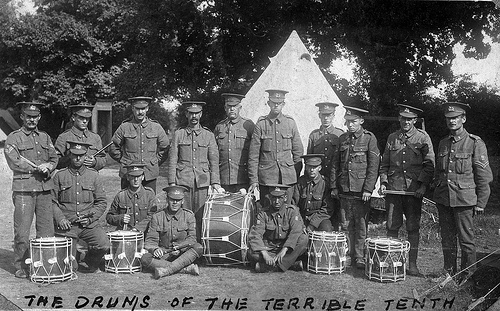
Not to be outdone the 10th West Yorks were not far behind. It was as the Southern Times had predicted: ‘Now that the butter county of the South has made a start it will not be surprising if before long the rich magnates of Yorkshire will see to it that their sons are not without a band.'(36) The band performed many functions, as may be found in the report covering the funeral of Sergeant Charles Ernest Stevens in March 1915. Stevens was an experienced soldier, and a veteran of two previous campaigns. He had died as a result of chest and respiratory complications, and was buried in St. Mary's Churchyard (Wareham) with full military honours. He was 47 years of age.(37)
The funeral of Provost-Sergeant Charles Ernest Stevens, of the 10th West Yorkshire Regiment, whose death was reported in our last issue, took place on Wednesday afternoon at the cemetery. The funeral procession left the mortuary at the workhouse, whence a company of the deceased's regiment followed the body to the grave. The band of the 6th Dorsets played the "Dead March" coming down West-street, as did also the drum and fife band of the 10th West Yorks. The Rev. WL Sorsbie, CE Chaplain, conducted the Burial Service, which was impressive. The coffin, of polished elm with gilt fittings, was covered with the Union Jack, while six fellow sergeants acted as bearers; other sergeants of the 10th West Yorks carried wreaths, and sergeants representing other regiments at the camp also attended. A firing party discharged three volleys over the grave, and the bugles sounded the "Last Post." Mr. Albert Marsh was the undertaker, and carried out the arrangements in his usual manner. (38)
![Headstone Of Sgt. Charles Ernest Stevens [Courtesy Of David Seymour]](/media/20aloal0/headstone-of-sgt-charles-ernest-stevens-courtesy-of-david-seymour.jpg)
The attendance at Stevens' funeral is perhaps illustrative of the relations between the men of the 10th West Yorkshire Regiment and the people of Wareham - but this was not without the problems which a large army presence brings. Some were less than enthralled at the thought of having a permanent army encamped on their doorstep. Not least was the concern over costs, with some critical of ‘the lavish spending of Wareham money,' and questioning whether the expenses should have come out of national funds and not the local purse.(39) It was not an altogether unreasonable objection, but any arrangement does appear to have been mutual and there is nothing to suggest that the rate payers of Wareham suffered financially. Quite the contrary, any expenses that were not attributed to local money or fundraising were met and offset by the War Office. The work connected to the army camps is a good example of how the town benefited. There were other benefits to be found, such as the billeting and feeding of troops, the issue of government contracts, and the purchasing of land and derelict buildings for the purpose of military use.(40)
Mobilisation
Events, however, were beginning to take a turn, and the town began take on a less animated and crowded appearance towards the end of May 1915 when the 10th West Yorkshire Regiment was ordered to Romsey. (41) The battalion arrived at their new billets on Tuesday, 1 June after a 50 mile, three-day route march. They had spent the Monday evening at the New Forest before moving on to Lyndhurst; previously bivouacking at Cranford Park near Wimborne, and Somerley Park, on the River Avon. The battalion remained in the area for a month, and after spending some time on the rifle ranges at Fovant, orders were given that the men be moved from Romsey to Winchester in readiness for overseas service.(42) All that was needed was confirmation, and with the prospect of leave, the feeling was one of excitement and anticipation. The initial decision to hold the 10th West Yorks behind for ‘home defence' must have proved disappointing. This decision was later revoked, and on 12 July the first of the movements began, with the infantry leaving by train to Folkestone, and the ‘guns, transport, and mounted troops, by way of Southampton to Havre.'(43)
The 10th (Service) Battalion, The Prince of Wales's Own, (West Yorkshire Regiment), arrived at Boulogne on the morning of 14 July 1915, after ten months of basic and intensive training.(44) The final few words perhaps belong to David Sharp: ‘Camp life around here is as good as the rest, and better than most.'(45) He was, of course, speaking of the eight months the 10th West Yorkshire Regiment had spent at Wareham.
To The Memory of Geoff Stowe, 1934-2009
References
1) The Morley Observer, Friday 24 August 1917 P 5
2) Op Cit p 5
3) James, E.A. British Regiments, 1914-1918 [London: Samson Books, 1978], p 58
4) The Morley Observer , Friday 14 July 1916. P. 5 [Clifford Hirst, George William Fisher, Bernard Crowther, Eddie Kirk, John Sheldrake, and Cornelius Kidger were also amongst those who had joined in 1914. Kidger was to lose his life at Fricourt on 1 July 1916. He is buried in Fricourt New Military Cemetery. John Sheldrake died of his wounds on 3 July and was laid to rest in Heilly Station Cemetery] See also Morley Observer, 25-9-1914. p 5
5) The Southern Times, Saturday 12 September 1914. P 4
6) Op Cit p 4
7) Op Cit. p 4
8) The Southern Times, Saturday 19 September 1914. P 7
9) Op Cit p 7
10) Op Cit p 7
11) Op Cit p 7
12) Op Cit p 7
13) The Southern Times, Saturday 21 November 1914 P 6
14) The Southern Times, Saturday 10 October 1914 P 6; The Southern Times, Saturday, 7 November, 1914 P 7
15)The Southern Times, Saturday 14 November 1914. P 7; The Southern Times, Saturday, 21 November, 1914 P 6
16) Op Cit p 6
17) The Southern Times, Saturday 10 October 1914. P. 6; Atteridge, A. Hilliard A History of the 17th (Northern) Division (Glasgow: Robert Maclehose and Co. Ltd. 1929) (Reprint: The Naval and Military Press], p. 15
18) The Southern Times, Saturday 7 November 1914. P. 6
19) Op Cit. p. 6
20) Op Cit. p. 6
21) The Southern Times, Saturday 5 December 1914. P. 6
22) Allison, N.E. Baptist Military Chaplaincy during the Great War, 1914-1918 [The University of Wales][Spurgeon's College. London] Unpublished MPhil [January 2006]; Talbot, B.R. Standing on the Rock: A History of Stirling Baptist Church, 1805-2005. [Stirling Baptist Church, 2005] pp. 90-110. See Also: Allison, N.E. "Baptist Chaplains' Revivalism at the Front" [1914-1918]" In: Baptist Quarterly, Volume 42, October, 2007. pp. 303-313.
23) Charteris, WC. ‘Correspondence' In: The Scottish Baptist Magazine, January 1915, No. LXVIII. P. 12
24) For instance: Charteris, W. C. ‘The Army Chaplain on Active Service' In: The Scottish Baptist Magazine, October 1914, No. LXX. P. 158
25) The Southern Times, Saturday 7 November 1914. P. 6
26) The Southern Times, Saturday 7 November 1914. P. 6
27) The Southern Times, Saturday 21 November 1914. P. 6
28) The Morley Observer, Friday 16 October 1914. P. 5
29) The Rothwell Courier and Times, 28 November 1914. P. 5
30) Op Cit p. 5
31) The Southern Times, Saturday 10 October 1914. P. 6
32) Op Cit p. 6
33) The Morley Observer, Friday 30 October 1914. P. 5
34) The Southern Times, Saturday 13 December 1914. P. 2
35) Op Cit p. 2
36) Op Cit p. 2
37) The Southern Times, Saturday 13 March 1915. P. 7.
38) The Southern Times, Saturday 20 March 1915. P. 6
39) The Southern Times, Saturday 10 October 1914. P. 6
40) The Southern Times, Saturday November 1914. P. 6
41) The Southern Times, Saturday 31 July 1915. P. 3
42) Atteridge, A. Hilliard, A History of the 17th (Northern) Division, p. 19. I have taken the liberty here of correcting part of the text. The date of arrival was ‘Tuesday 1 June (1915),' and not ‘Sunday 1 June (1915)', as found in Atteridge.
43) Op Cit pp. 29-34
44) Op Cit p. 34
45) The Morley Observer. Friday 16 October 1914. P. 5
Bibliography
Allison, N.E. "Baptist Chaplains' Revivalism at the Front" (1914-1918) In: The Baptist Quarterly (Ed. J.H.Y Briggs), Volume 42, October 2007 (Didcot: Baptist Historical Society)
Allison, N.E. Baptist Military Chaplaincy during the Great War, 1914-1918 (The University of Wales)(Spurgeon's College, London) Unpub. Mphil, January 2006.
Allison, N.E. "Shakespeare's Man at the Front: The ministry of the Revd William Cramb Charteris OBE MC during the Great War" In: The Baptist Quarterly (Ed. J.H.Y. Briggs), Volume 41, October 2005 (Didcot: Baptist Historical Society)
Atteridge, A. Hilliard The History of the 17th (Northern) Division (Glasgow: Robert Maclehose, 1929) (Reprint: Naval and Military Press)
Charteris, W.C. ‘Correspondence' In: The Scottish Baptist Magazine, January 1915, No. LXVIII
James, E.A. British Regiments, 1914-1918 [London: Samson Books, 1976]
Talbot, B.R. Standing on the Rock: A History of Stirling Baptist Church, 1805-2005 (Stirling Baptist Church, 2005)
Wyrall, E The West Yorkshire Regiment in the Great War, 1914-1918 Vols. I and II (Naval and Military Press, 1929; 2002)
The Baptist Quarterly
The Scottish Baptist Magazine
The Morley Observer
The Rothwell Courier and Times
The Southern Times [Weymouth]
The Yorkshire Gazette
Commonwealth War Graves Commission Database (CWGC)
Officers Died in the Great War (ODGW)
Soldiers Died in the Great War (SDGW)
The Baptist Union of Scotland Archives [Glasgow]
The Prince of Wales's Own Regiment of Yorkshire Museum and Archives [York]
Images:
1) West Yorks Camp-Wareham
2) 'The Morley Boys' [1914]
3) West Yorks Church Parade [Romsey 1915]
4) The Drums of the Terrible Tenth
5) Headstone of Sgt. Charles Ernest Stevens [Courtesy of David Seymour]
I am indebted to the following people for their help: Ruth Allison, Kevin Galloway, Russell Gore, Chris Noble, and David Seymour.
Photographic Sources:
Courtesy of The Prince of Wales's Own Regiment of Yorkshire Museum and Archives [York]. My thanks to Mr. Graham Dyson and Major M.L. Sullivan.
Becoming a member of The Western Front Association (WFA) offers a wealth of resources and opportunities for those passionate about the history of the First World War. Here's just three of the benefits we offer:

With around 50 branches, there may be one near you. The branch meetings are open to all.

Utilise this tool to overlay historical trench maps with modern maps, enhancing battlefield research and exploration.

Receive four issues annually of this prestigious journal, featuring deeply researched articles, book reviews and historical analysis.


