
The Mgeta River, German East Africa 19-24 September 1916
On 1 September 1916 General Smuts' British forces were south of the Central Railway that ran from Dar Es Salaam to Lake Tanganyika. By now the South African mounted troops and infantry were becoming worn out by the terrain, climate, disease, wet weather and the failure of the supply chain which General Smuts took little interest in. 3KAR, in the 2nd East African Brigade of General Hoskins' 1st East Africa Division, was coming into its own and tackling the conditions well, as was the Gold Coast Regiment which was also in that Division.
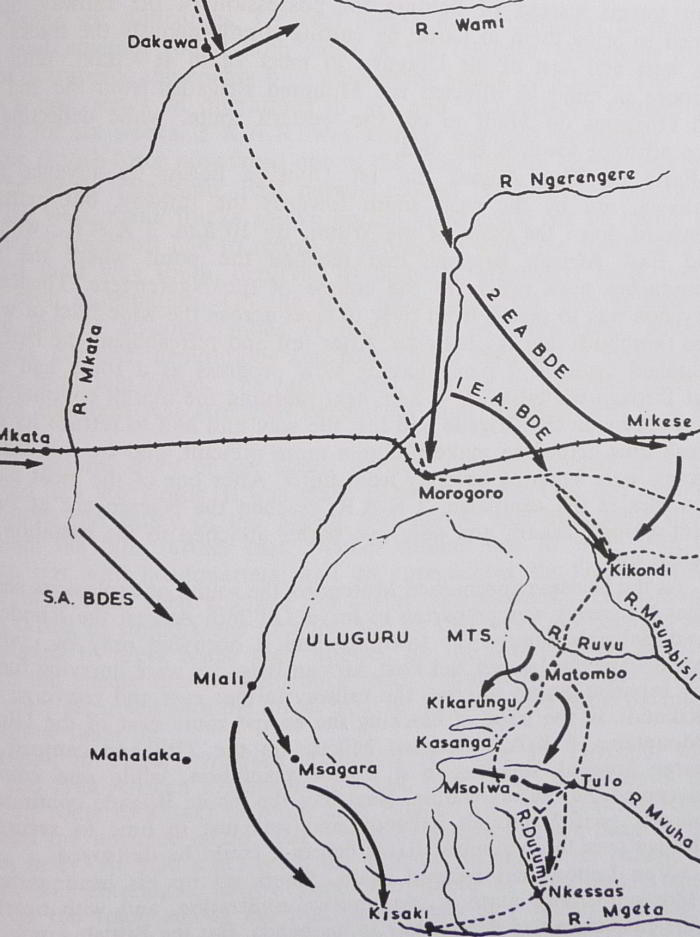
The Germans decided to make a stand on the Mgeta River that runs eastwards from Kisaki, south of the Uluguru Mountains. On 18 September 1916 Lt Col TO Fitzgerald, CO of 3KAR, received orders to move from Nkessa's Village on the Duthumi River and cross the Mgeta about 13 miles east of Kisaki, and then work west along the south bank of that river to make contact with the enemy. The Gold Coast Regiment was to follow in support a few hours later but was to stay on the north bank of the Mgeta. This operation was scheduled as a "demonstration" to assist the operations of Major-General Brits' 2nd South African Mounted Brigade that had established a bridgehead across the Mgeta five miles east of Kisaki.
3KAR departed at 0030 hours 19 September but because of heavy mist that disorientated the guides it did not reach the Mgeta, which was four miles away, until 0630 hours. The river was in flood but luckily a waist-deep ford was found and the battalion was across the river by 0800 hours. An advance westwards was made and at 0900 hours a Schutztruppe picquet was located and driven in. Two and a half hours later the main enemy position was approached and incoming fire received. The bush was dense and the Germans were using scouts in trees to direct fire. 3KAR advanced a few hundred yards and reached a clearing that was impossible to cross due to intense enemy fire.
Lt Col Fitzgerald ordered his company commanders to dig-in where they were, and at around 1400 hours Captain RMT Rose was hit in the stomach whilst supervising the entrenching of his company. He died about 15 minutes later. A lull now occurred, allowing KAR scouts to go out a few yards where they discovered the German positions 200 yards away in a deep donga running down to the Mgeta. At 1700 hours a determined Schutztruppe attack was made that lasted an hour before it was finally beaten back. Lt Col Fitzgerald now used the hours of darkness to re-deploy his battalion into a perimeter bridgehead position with both flanks on the river. During the day he had lost one officer killed and 20 Askari killed or wounded.
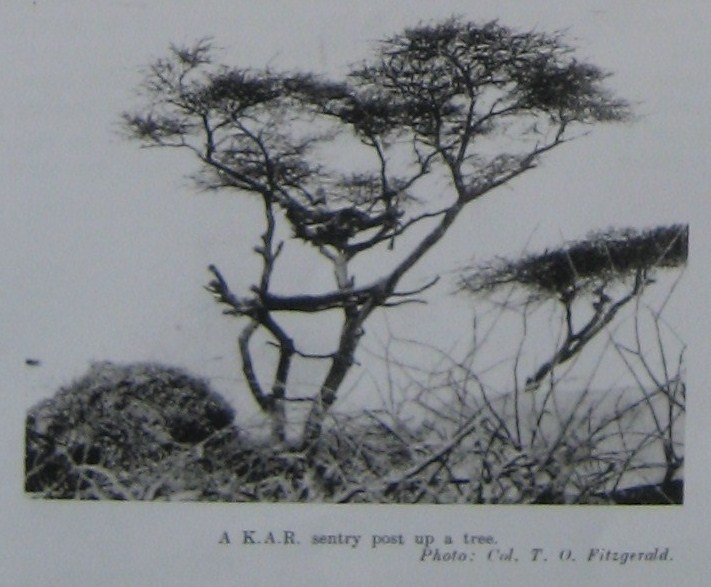
Despite having constant land-line communications with Brigade Headquarters the battalion was not offered any artillery support from the many guns north of the Mgeta. It also became apparent that the South Africans, who should have made aggressive moves from their bridgehead, were not taking part in the battle. The three rifle companies of 3KAR were on their own. (The Official History states that a company of the Gold Coast Regiment crossed the Mgeta into the 3KAR bridgehead on 20 September, but neither the Gold Coast History nor the 3KAR War History make mention of such an event.)
On 20 September KAR patrols constantly searched for the enemy's flanks and for his snipers who were as usual very active. 3KAR held its positions as did the Schutztruppe. On 22 September a German gun fired a few shells into the perimeter but without causing damage. However that day a sniper killed native officer Adam Effendi. This was a heavy blow to the battalion as Adam Adetai Effendi had served for about 24 years in the unit and its predecessors, and he exercised a tremendous influence over the Askari. The following day Lieutenant HB Tupper-Carey was seriously wounded and five Askari were killed or wounded.
The Germans mounted an attack on the 3KAR perimeter on 23 September but without conviction. This was perhaps a cover for the breaking of contact and a Schutztruppe re-location. On the following day the Gold Coast Regiment relieved 3KAR. The South Africans still had not joined the fight. Heavy rains now closed down the battlefield and 3KAR marched north to Tulo to rest and reorganize.
Captain Rose was first buried at the Brigade Camp at Nkessa's Village with the KAR Mounted Infantry Company acting as the Firing Party, and later re-buried in Morogoro CWGC Cemetery. A promotion must have been approved before his death as the rank on his headstone reads Major. He was posthumously Mentioned in Despatches.
References:
The King's African Rifles by Lt Col H. Moyse-Bartlett
The Record of the 3rd Bn King's African Rifles during the Great Campaign in East Africa 1914-1918.
The Gold Coast Regiment in the East African Campaign by Sir Hugh Clifford.
Official History, Operations in East Africa, August 1914 - September 1916.
The King's African Rifles Mounted Infantry Company War Diary, September to October 1916.
Becoming a member of The Western Front Association (WFA) offers a wealth of resources and opportunities for those passionate about the history of the First World War. Here's just three of the benefits we offer:

The WFA regularly makes available webinars which can be viewed 'live' from home. These feature expert speakers talking about a particular aspect of the Great War.

Featured on The WFA's YouTube channel are modern day re-interpretations of the inter-war magazine 'I Was There!' which recount the memories of soldiers who 'were there'.

Explore over 8 million digitized pension records, Medal Index Cards and Ministry of Pension Documents, preserved by the WFA.


