
Kisangire and Kisiju: operations north of the Rufiji River Delta, German East Africa, October and November 1916
By the end of September 1916, the British advance south of the Central Railway had stalled. The Allied theatre commander in East Africa, General J C Smuts, had failed to organize effective logistic support for his troops. General Northey's Rhodesia-Nyasaland Field Force was engaging the Germans in the south-west of German East Africa, and to the east the Royal Navy had seized all the German coastal ports on the Indian Ocean. But the German Schutztruppe, ably commanded by Colonel Paul von Lettow-Vorbeck, had no intention of surrendering and was determined to fight on. One of von Lettow's priorities was the harvesting of crops in the territory still under his control, and the area north of the Rufiji River Delta contained some rich farm land.
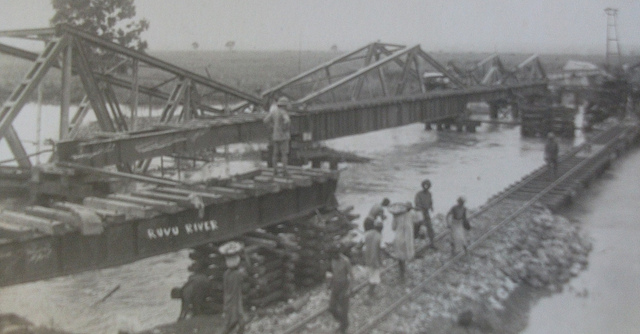
On 1 September 1916, the 40th Pathans, marching swiftly from Bagamoyo, had surprised a German detachment five kilometers east of Ruvu Station and routed it. This action secured the Central Railway for the Allies. The German detachment was from the 3rd Schutzen Kompagnie and consisted of about 50 Europeans and 100 Askari; the detachment commander was Lieutenant Baldamus. However the Germans had completely destroyed the main three-span railway bridge at Ruvu and had also destroyed 21 flood openings in a stretch of railway embankment. This damage compounded Smuts' problems as he was now depending on the railway line from Dar Es Salaam to bring supplies from the coast. Two weeks later the Indian Army 26th and 27th (Railway) Companies, Sappers & Miners, were working to restore the line at Ruvu. Meanwhile Baldamus had marched his men 70 kilometres due south to Kisangire, which he garrisoned so that the agricultural land to the south could be protected.
The attack on Kisangire
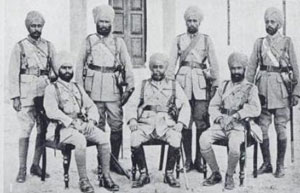
Fearing that Baldamus might be tasked with operating against the Central Railway, the British decided to attack Kisangire. Major General Natha Singh, the commander of the 240-man strong Jind Infantry, was ordered to march from Dar Es Salaam with his sepoys and his two machine guns. The Ruler of the Sikh Princely State of Jind had supplied the Jind Infantry to the war effort as part of the Indian Imperial Service Scheme. Major G C Denton, 12th Indian Pioneers (Kelat-i-Ghilzie Regiment), and two other British officers were attached to the unit. The Jind Infantry had been fighting in East Africa since 1914 and had gained a reputation for professionalism and bravery in action.
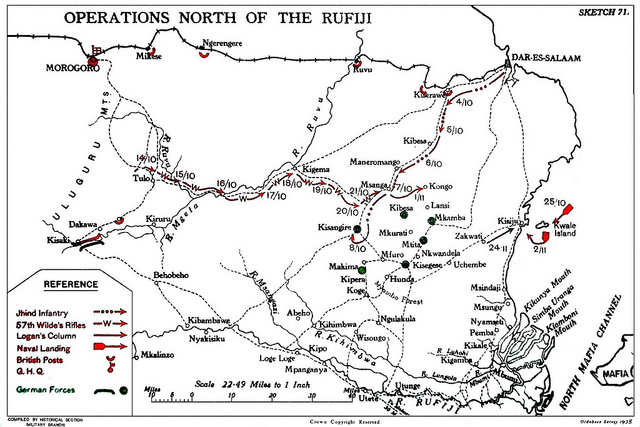
Already operating around Kisangire and observing Baldamus' movements were 40 Intelligence Scouts under the command of Lieutenant G D Howarth of the Intelligence Department. Howarth reported that the German post was in a building on top of a steep conical hill around which two lines of trenches had been dug. The easiest line of approach was from the west and south-west. Moving off before dawn on 9 October 1916, the Sikhs marched around the rear of the conical hill, and at 0930 hours they were ready to attack.
Nathan Singh placed three of his companies and the machine guns in the first line and kept his fourth company as a reserve in a second line. He had 183 sepoys deployed. The Sikhs worked through the bush towards the hill until enemy outposts engaged them and then they rushed forward and captured the first trench line. From there a bayonet attack was mounted that captured the inner trench line. But now problems arose because of the lack of artillery with the Jind troops. The building was engaged with machine gun and rifle fire but these rounds had no effect on the strong stone walls of the post. In retaliation the enemy shot down both Sikh machine gun crews.
Major Denton was mortally wounded and Captain P N Gurdon, 14th King George's Own Ferozepore Sikhs, was killed. 2238 Sepoy Sadha Singh displayed conspicuous gallantry for which he was awarded a posthumous Indian Order of Merit 2nd Class:
'He proceeded forward under a hot fire along a communication trench and removed a number of dead bodies which were impeding the advance. He has since died of wounds.'
After losing a total of 13 men dead or mortally wounded, 27 others wounded, and 8 wounded and missing, Nathan Singh broke off the action. Now the intelligence officer Lieutenant George Dall Howarth took command of the situation for which he later received a Military Cross:
'For conspicuous gallantry and devotion to duty. He assumed command and successfully withdrew an infantry regiment from a very difficult situation.'
The Jind Infantry withdrew to Maneromango and re-grouped. The German losses had been slight, except that Lieutenant Baldamus had been killed by one of the last shots fired during the action.
The British reinforce the area
General Smuts was concerned and ordered units into the area from two directions. From Dar Es Salaam a column of 300 recently-landed white South African reinforcement troops were marched to Maneromango under the command of Major R H Logan of the 2nd Bn The Loyal North Lancashire Regiment.
On 14 October, the 1st Division on the River Mgeta despatched the 57th Wilde's Rifles (Frontier Force), a section of two 10-pounder mountain guns from the 27th (Bengal) Mountain Battery and a section from an Indian Field Ambulance. The commanding officer of the 57th Wilde's Rifles, Lieutenant Colonel T J Willans, commanded this column which marched over 130 kilometres across densely-bushed, un-mapped territory. Two sections of the King's African Rifles Mounted Infantry with Captain G H R Hurst, a professional game hunter, were attached to the column to assist with navigation. Willans had to leave 50 of his sepoys behind as their boots had dropped to pieces and the supply system, heavily dependent on the labour of malnourished, under-strength and over-worked African porters, was incapable of bringing new boots forward.
Willans' column made two difficult crossings of the swift Ruvu River, the gunners and the column's porters having a particularly tough time as often deep potholes were encountered in the river bed whilst the men struggled across. Villagers approached the column on 19 October to report that a German patrol was in the bush nearby. The King's African Rifles Mounted Infantry deployed into the area and captured the small patrol, which had become hopelessly lost. The two British columns met up at Msanga on 21 October and Colonel Willans took over command of all the troops. For his work with this column and for other unspecified duties, doubtless including intelligence activities, Captain George Henry Russell Hurst, East African Mounted Rifles, was later awarded a Military Cross.
Meanwhile von Lettow had ordered Abteilung Stemmerman to march north from Utete to hold the Kisangire area whilst the crops to the south were harvested. Stemmerman arrived at Kisangire the day after the Jind Infantry had withdrawn, and his 4 field companies and 10 machine guns were now too strong a force for Willans to successfully attack. Both sides patrolled aggressively against each other.
On 1 November Willans sent a column under Major Logan to occupy Kongo, east of Msanga. Logan took with him 170 sepoys (two companies) of the 57th Wilde's Rifles with two machine guns, and 130 South African infantrymen. Stemmerman responded by occupying Lansi and raiding the British lines of communication back to Dar Es Salaam. But the Germans were not itching for a big fight, as their main task was to protect the harvesting to the south of Kisangire.
The Royal Navy intervenes on the coast
On 25 October, the Royal Navy seized Kwale Island and landed a garrison of 20 Intelligence Scouts and 50 Askari of the Zanzibar African Rifles. The latter unit was recruited from the islands of Zanzibar and Mafia and it worked closely with the Navy, providing landing parties and coastal garrisons. In early November, the scouts and Askari were transported to the mainland to seize and garrison Kisiju, and from there an intelligence operation was extended westwards through Kongo to Msanga. However this was too much of an intrusion for the Germans and, on 24 November, a detachment under Captain Liebermann re-captured Kisiju. The British garrison fled by boat back to Kwale Island under the covering fire of the British monitors HMS Severn and HMS Mersey. Meanwhile the headman of Kisiju was executed by hanging, the standard German punishment for African leaders who collaborated with the British, and Kisiju was burned down. After firing a few field gun shells at the monitors Liebermann withdrew.
Patrolling contacts
Further inland Willans' sepoys were protecting their new line of communication overland to Dar Es Salaam. During one small action on 28 October, Lieutenant R L Piper, out on patrol with 50 men, confronted a German patrol about 40 strong near Mkwata and dispersed it, inflicting several casualties and capturing several rifles. On the following day the body of the German commander was discovered in the bush where he had crawled to die of his wounds. Lieutenant Ronald Leslie Piper, 57th Wilde's Rifles, was later awarded a Military Cross.
In a similar incident on 30 October, Captain E K Fowler MC with 2 Indian officers and 70 sepoys attacked an enemy position at Makuka. When it was realised that the enemy were in superior force with machine guns, a skilful withdrawal action was fought with the loss of only one Sepoy killed. Four enemy Askari were killed during this action. Captain Fowler, 57th Wilde's Rifles, had gained his Military Cross in France and now he was awarded a Brevet Majority.
The Germans replied on 20 November, when one of their patrols under Lieutenant Schreiner ambushed a 50-man South African detachment south of Kongo. 14 men of the South African party were killed or mortally wounded and 5 others were wounded. Ten days later a convoy party of 43 sepoys and 109 African porters marched from Msanga to Kongo. The convoy walked into a German ambush 3 kilometres before Kongo, and the porters dropped their loads and bolted. The convoy commander, Subadar Major Arsla Khan MC, rallied the sepoys to successfully protect the loads until support arrived from Kongo. All the loads were delivered. Subadar Major Arsla Khan, 57th Wilde's Rifles, who also had gained his Military Cross in France, was later appointed to be a member of the Order of British India 1st Class in recognition of his military performance in East Africa.
Conclusion
At the end of November 1916, the British forces under General Smuts, a former guerrilla leader turned professional politician, were still struggling to regain momentum in their advance. But rainfall, logistical inadequacy and, above all else, ruthless German military professionalism had thwarted the British plans. Smuts was so desperate to end the campaign in German East Africa that he had asked the War Office in London if using gas against the Schutztruppe was feasible. London's reply was that it was feasible on a frontage of 1,280 metres, but thankfully for East Africa and its inhabitants this idea was not pursued.
On the German side Colonel von Lettow-Vorbeck, a professional soldier with much operational experience, had made logistics his priority, and he had ensured that his Schutztruppe now stocked sufficient food supplies for the next few months. The unfortunate African villagers who were required to tend, harvest and then carry these supplies were, as usual in this campaign, the real losers.
The focus of military attention for both sides now moved south across the Rufiji River to Kibata north of Kilwa Kivinje.
References:
- Official History. Volume I. Military Operations East Africa August 1914 to September 1916 compiled by Lieutenant Colonel Charles Hordern.
- Draft Chapter XIII of the Official History Volume II. (CAB 44/5 in the UK National Archives.)
- High Noon of Empire edited by B.A. ‘Jimmy' James.
- Regimental History of the 4th Battalion 13th Frontier Force Rifles (Wilde's). Anonymous author, printed privately by Butler & Tanner Ltd around 1930.
- Tip & Run. The untold tragedy of the Great War in Africa by Edward Paice.
- The Indian State Forces. Their Lineage and Insignia by His Highness the Maharaja of Jaipur.
- Honours and Awards, Indian Army, 1914-1921 published by J.B. Hayward & Son.
- Reward of Valour. The Indian Order of Merit, 1914-1918 by Peter Duckers.
Becoming a member of The Western Front Association (WFA) offers a wealth of resources and opportunities for those passionate about the history of the First World War. Here's just three of the benefits we offer:

Identify key words or phrases within back issues of our magazines, including Stand To!, Bulletin, Gun Fire, Fire Step and lots of others.

The WFA's YouTube channel features hundreds of videos of lectures given by experts on particular aspects of WW1.

Read post-WW1 era magazines, such as 'Twenty Years After', 'WW1 A Pictured History' and 'I Was There!' plus others.


