
The Fight At Rumbo, German East Africa, 18 April 1917
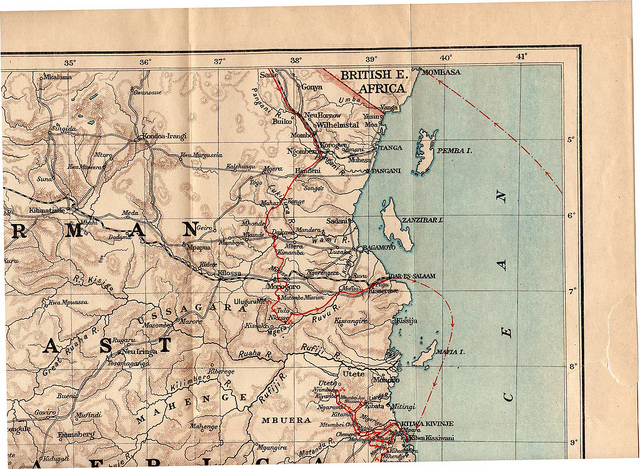
In September 1916 Colonel Paul von Lettow-Vorbeck's Schutztruppe was fighting aggressively against British forces both in the Rufiji River area and in the south-west of German East Africa (GEA). The Royal Navy under Admiral Ned Charlton was tasked with seizing the German ports along the southern GEA coastline, just as it had done along the northern coastline from Tanga to Dar Es Salaam. Charlton, the commander-in-chief of the Cape Station, achieved his task by 18 September and small groups of British soldiers garrisoned the Kilwa Kivinje and Lindi areas.
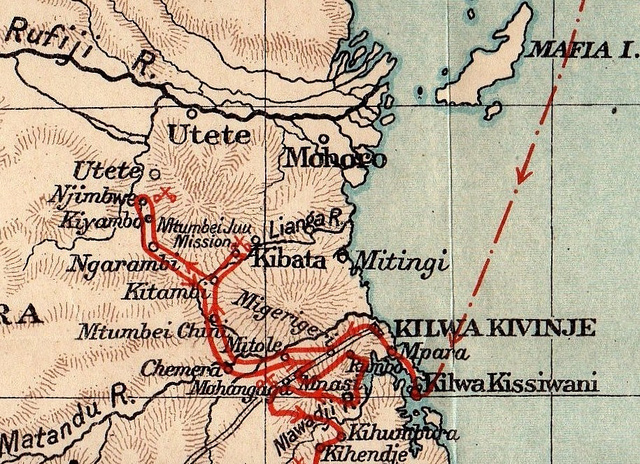
But one month later von Lettow had successfully withdrawn half of his troops south of the Rufiji and a chance to trap him was seized. General Smuts, the Allied theatre commander, sent two brigades from the British 1st Division under General Reginald Hoskins to Kilwa whilst the third brigade continued to face the German rearguard north of the Rufiji. For several weeks heavy military confrontations took place north of Kilwa in the Kibata area until von Lettow moved away, side-stepping westwards around Kilwa.
Rumbo
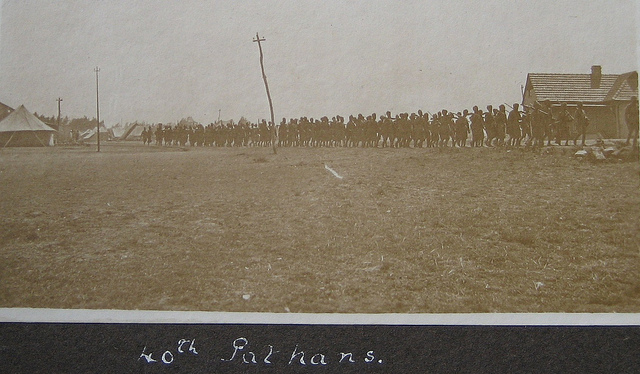
By April 1917 German detachments were threatening Kilwa from the south-west and a British entrenched camp was established at Rumbo with a forward post on the Ngaura River. The Indian Army regiment, the 40th Pathans under Lieutenant Colonel Henry Tyndall, garrisoned Rumbo. Before the war the 40th Pathans was composed of a company of Orakzais, a mixed company of Afridis and Yusufzais, a company of Punjabi Musulmans and a company of Dogras. However, by April 1917, the regiment had been serving in East Africa for 14 months and sickness and disease had reduced the unit strength to 300 men. Also replacement drafts of sepoys from other areas of India had altered the pre-war identity of the unit. Nevertheless the 40th Pathans was a sound regiment that had so far coped very well with both German opposition and the harsh physical and climatic conditions of East Africa.
Tyndall was ordered to take out a force to attack and halt the German move towards Kilwa. His available troops were:
- the 40th Pathans with 3 machine guns, less 100 men left to hold Rumbo camp;
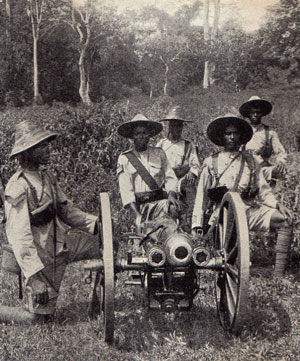
- 2 mountain guns of the Gold Coast Regiment (GCR) Artillery Battery, with an escort of 30 men from ‘A' Company GCR;
- 140 Askari of Nos 1 and 3 Companies of 2/2 King's African Rifles (KAR) with 2 machine guns;
- a Royal Navy Lewis Gun detachment; and
- the 22nd (Derajat) Mountain Battery, Indian Army, which remained at Rumbo camp.
The Royal Navy detachment had previously manned a 12-pounder gun during the Kibata fighting, but the gun produced so much smoke after firing that German gunners had been able to easily identify its location and return fire. The gun was withdrawn to the coast but the detachment was issued with Lewis Guns and tasked with supporting infantry operations.
Tyndall only had two other British officers in the 40th Pathans at that time, and he appointed one of them, 2nd Lieutenant Humphreys, to be his staff officer in a Column Headquarters that he decided to form. Humphreys had recently joined the regiment and had not yet learned to speak to the sepoys in an Indian dialect. Unfortunately, but perhaps understandably, Tyndall did not appoint an officer to command his porters who carried reserve ammunition and supplies for the column.
Facing the British were over 300 German Askari and 4 machine guns of the 11th and 17th Field Companies under Captain von Lieberman and Lieutenant Bueschel. The Germans occupied high ground that rose away from the southern bank of the Ngaura River.
The action across the river
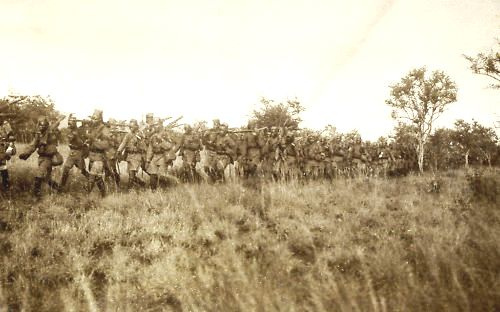
Tyndall's force left Rumbo at 0700 hours on 18 April and waded across the Ngaura which at that time was knee-deep. However rain began to fall and the river began to rise. The single-file track being followed passed through high elephant grass for over a kilometre and a half, and the ground on either side was covered in dense bush. No 3 Company (Dogras) was the Pathan advance guard and at 0945 hours it drove back an enemy piquet on the track, and from then on the Germans laid increasingly heavy fire down on the British troops. The GCR 2.95-inch guns came into action. The Pathans advanced Nos 2 and 4 companies on either side of No 3 Company but forward movement became impossible as enemy machine guns dominated the ground ahead.
The 2/2 KAR detachment under Major W T Gregg was detailed to outflank the 17th Field Company position on a spur on the left of the track whilst the 40th Pathans confronted the enemy on and near the track. However von Lieberman held his ground against the KAR whilst Bueschel mounted fierce flank attacks against the Pathans' advance. The Pathan veterans remaining in the unit held their positions but lost two machine guns, both of the weapons having their crews shot down. The Havildars commanding the gun teams, 3214 Bachitru (Dogras) and 3570 Haider Ali (Pathans) were both killed. The advance guard commander, Subedar Mainu, was also killed and confusion reigned amongst the sepoys due to lack of sufficient leaders in the platoons and companies. The forward companies were severely shaken. Tyndall and his staff officer issued and despatched orders to companies but they were not heeded. Tyndall himself moved around the battlefield but found that the sepoys did not know what to do because of the absence of known leaders giving them orders that they could obey.
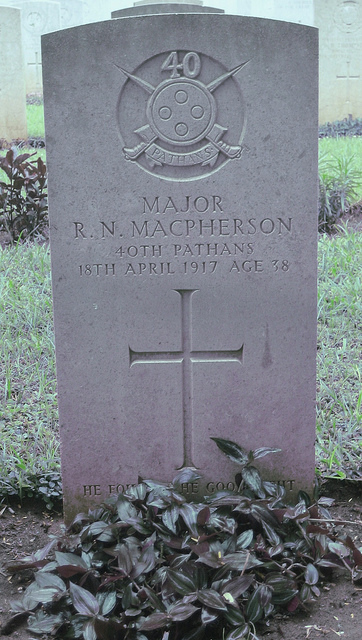
One order sent to the KAR detachment was to re-capture the two lost Pathan machine guns. Gregg crossed the track to try to find out what was going on and saw that Major Robert Naismyth MacPherson, the only British officer with the Pathan companies, had been shot dead with a bullet through his heart. He had been killed whilst trying to rally his men. Gregg was unable to recapture the lost machine guns as his Askari were heavily involved with fighting the 17th Field Company.
Action on the Gold Coast Regiment gun line
Meanwhile the GCR gunners were firing at likely enemy locations ahead of the advance, but their shells were bursting short of the intended targets as they impacted on tree branches that were in the way. The Battery Commander, Captain J G Foley, believed that only the Pathans were to his front. Then the Battery Trumpeter Nuaga Kusasi approached to inform him that the men seen ahead in the bush were in fact German Askari who had infiltrated forward. Foley did not believe this until Kusasi fired at one of the men and the bush came alive with enemy returning fire. This resulted in the GCR gun porters drawing their machetes and offering to fight the enemy. The porters were recruited from the same tribes as the GCR soldiers.
Foley was fluent in the Hausa language and he quickly issued orders to Battery Sergeant Major Bukari Moshi to take the guns out of action and transport them back across the river. Foley then quickly organised two teams of riflemen under the ‘A' Company Sergeant Major with the escort and Battery Sergeant Mahmadu Moshi. These teams alternately charged the enemy, now only 20 metres away, and then leap-frogged back to the river. This tactic kept the enemy from over-running the guns. Sergeant Mamadu Moshi won an African Distinguished Conduct Medal:
'For most conspicuous gallantry and devotion to duty in the field. He greatly assisted in covering the retirement of the guns with 12 gunners and an escort of 10 rifles, checking a strong enemy counter attack by throwing bombs collected from dead and wounded Pathans at the crossing of the Ngaura River. He was in deep water under heavy fire assisting in the withdrawal of the guns, and was one of the last to cross.'
The river was now running chest-deep and the steep 3-metre high banks were slippery, but the GCR guns got across safely. Battery Sergeant Major Bukari Moshi, Headman Kwesi John, Sergeant Member and Gun Carrier Lawani Ibadan, all of the GCR, received Military Medals for gallantry displayed in the river crossing. Captain James Gerald Foley saw his men and guns across the river before he crossed himself, and he was awarded a Military Cross:
'For conspicuous gallantry and devotion to duty. He handled his guns with great skill and succeeded in getting them safely across a river. He displayed great courage and initiative throughout the operations.'
Although the GCR account of the action does not mention it, the withdrawal of the guns was assisted by 50 KAR Askari and by 70 sepoys under Subedar Sher Akhmad (26th Punjabis attached to 40th Pathans).
The Subedar was awarded an Indian Order of Merit:
'During the action at Rumbo on 18 April 1917, when the regiment finally had to retire and was closely pressed, Sher Akhmad commanding the escort of the guns, though wounded, refused to leave the near bank of the Ngaura and stood by Captain Foley until the last porter had crossed.'
The naval Lewis Gun detachment under Lieutenant Murray, Royal Navy, fought bravely during this withdrawal, but Able Seaman (Number: Clyde 52347) James Walker was killed and the others in the detachment were wounded. The Germans captured the Lewis gun. Murray then assisted Foley until the GCR was across the river.
The withdrawal of the 40th Pathans
Tyndall rallied the men that he could locate in the dense bush and fought a defensive action to protect the withdrawal of the guns. Fortunately most of the German Askari were firing high due to the higher ground that they were occupying. For his leadership during this time Subadar Jan Gul (26th Punjabis attached to 40th Pathans) was awarded an Indian Order of Merit:
'For conspicuous gallantry and courageous example in leading his men across the open up to 300 yards from the enemy's position and maintaining them there for three hours under very heavy fire.'
When the guns were across the river the Punjabi Musulman company of the 40th Pathans was ordered to be rearguard. The company commander, Subedar Ghulam Ali, fought a hectic but sound withdrawal action for which he later received a Military Cross with the citation:
'For conspicuous gallantry and devotion to duty. He conducted the withdrawal of a rearguard with exceptional gallantry and skill. He set a magnificent example to his men.'
Fortunately for the Pathans a tree had fallen across the river and by clinging on to it a hazardous crossing could be made, but the remaining Pathan machine gun was lost in the turbulent water. Many loads of ammunition and stores were also lost in the river as panic set in amongst the locally enlisted porters. Casualty evacuation across the river became extremely difficult and hazardous.
The King's African Rifles withdraw
Tyndall, who by now had bullet holes through equipment carried on both sides of his body, ordered the KAR to pull back to the river. On his side of the track Gregg fought a withdrawal action that was made difficult by the 17th Field Company attacking down a spur on his left flank and by the long grass that drastically reduced visibility. During this fighting Major Denys Walter Reynolds (York & Lancaster Regiment and 2/2 KAR) was severely wounded. By now the river had to be swum across and Gregg was one of the last men to do so. Major William Thornton Huband Gregg (Royal Irish Rangers and 2/2 KAR) was later awarded a French Croix de Guerre with Palms. Unfortunately during the fighting on the river bank 23 Lance Corporal Lufani of 2/2 KAR was wounded and left on the enemy side of the river.
1609 Sergeant Ishmael, 2/2 KAR, was later awarded an African Distinguished Conduct Medal:
'For conspicuous gallantry in action and devotion to duty on all occasions. He has always shown the utmost disregard of personal danger under heavy fire, and by his example has done much to stimulate the morale of his platoon.'
2101 Private Waziri Simba was awarded a Military Medal.
As the retreating British troops neared Rumbo Camp they heard the 2.75-inch guns of the 22nd (Derajat) Mountain Battery firing over their heads to deter the German pursuit. The mountain gunners had established an Observation Post in a tall tree, but the observers up aloft had to endure the ferocious stings of a colony of red ants that had been disturbed.
The casualty list
40th Pathans: 1 British officer, 1 Indian officer and 25 sepoys killed. 1 Indian officer and 34 other ranks wounded, 35 other ranks missing. (Most of the missing men were wounded and captured, and were later recovered by British forces as the Germans withdrew southwards.) 3 locally enlisted machine gun porters were killed and 6 wounded.
2/2 KAR: 4 Askari killed, 1 officer and 12 Askari wounded and one Askari missing.
Gold Coast Regiment: 4 soldiers wounded; 5 Carriers killed, 12 wounded and 7 missing.
Royal Navy Lewis Gun Detachment: 1 man killed, 1 wounded and 1 missing.
During the following afternoon the Germans handed over several badly wounded British prisoners under a flag of truce. The Germans intimated that they had taken around 30 casualties during the previous day's fighting.
Conclusion
The enemy continued to patrol against the defenders in Rumbo Camp but an attack was not mounted. However pressure was maintained against Kilwa harbour when on 5 May German gunners shelled British ships at anchor, hitting one ship three times. The gun used was a 7.6-centimetre mountain gun that had been captured from the Portuguese at Newala in southern GEA and carried through the bush to Kilwa.
This incident severely disturbed the British command and troops were hastily deployed into the Kilwa region, but having demonstrated Kilwa's vulnerability the German gunners quietly withdrew.
References
Draft Chapter XVII of the unpublished Part II of the Official History, Military Operations East Africa (CAB 44/9).
High Noon of Empire - the diary of Lieutenant Colonel Henry Tyndall edited by B.A. ‘Jimmy' James.
History of the 5th Battalion (Pathans) 14th Punjab Regiment, formerly 40th Pathans by Major R.S. Waters OBE.
My Reminiscences of East Africa by General Paul von Lettow-Vorbeck.
The Gold Coast Regiment by Sir Hugh Clifford KCMG.
The History of the Indian Mountain Artillery by Brigadier-General C.A.L. Graham DSO OBE DL psc.
Unit War Diary 2nd Bn 2nd Regiment King's African Rifles. (WO 95/5322).
Letters from Lieutenant Colonels H.S Tyndall DSO (40 Pathans), W.T.H. Gregg DSO (2/2 KAR), F.M.G. Griffin MC (129th Baluchis), and Major J.H.M. Stevenson MC (22nd Mountain Battery) (CAB 45/66).
Tip & Run. The Untold Tragedy of the Great War in Africa by Edward Paice.
The African DCM compiled by John Arnold.
Reward of Valor. The Indian Order of Merit by Peter Duckers.
The Award of the Military Medal to African Soldiers of the West African Frontier Force & The King's African Rifles from 1916 to 1919 by John Arnold with William Spencer MA and Keith Steward FRGS.
Commonwealth War Graves Commission records.
Becoming a member of The Western Front Association (WFA) offers a wealth of resources and opportunities for those passionate about the history of the First World War. Here's just three of the benefits we offer:

This magazine provides updates on WW1 related news, WFA activities and events.

Access online tours of significant WWI sites, providing immense learning experience.

Listen to over 300 episodes of the "Mentioned in Dispatches" podcast.


