
1st/2nd King’s African Rifles at Yangwani and Schaeffer’s Farm: German East Africa, April and May 1917
The 1st Battalion of the 2nd Regiment of the King's African Rifles (1/2KAR) was re-formed from Nyasaland soldiers on 1 April 1915 in Nairobi, British East Africa (the original 2KAR had been disbanded as an economy measure in 1911). The experienced 335 Askari from the old "A", "B", "C" and "E" Companies of 1KAR were the hard core of the unit and they were joined by a draft of 1,115 Non-Commissioned Officers (NCOs) and basically-trained Askari sent up from Nyasaland. About 50% of this draft were Ayao tribesmen, 25% were Anyanja and the remaining 25% were either Awemba, Anguru, Achewa, Mpotola, Akokola, Asisya, Atonga, Alunga and Angoni. Major L H Soames (The Buffs) was appointed Commanding Officer (CO), Captain G J Giffard (Queen's Regiment) became the Second in Command (2IC) and Captain L G Murray (Gordon Highlanders) became the Adjutant.
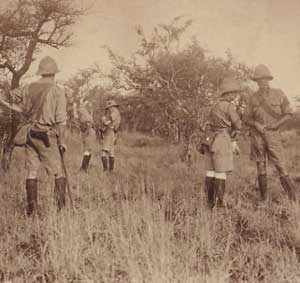
During May it was decided to form a 2nd Battalion of 2KAR to be commanded by Lieutenant Colonel H S Filsell (Royal Warwickshire Regiment), and so 1/2KAR was divided and 2/2KAR formed primarily from the non-Ayao tribesmen. On 4 August 1916 1/2KAR left Nairobi with a strength of 21 British officers, 2 British Warrant Officers, 511 African ranks, 4 machine guns and 8 horses. Transport porters had been recruited from the sturdy Kavirondo tribe that lived along the shores of Lake Victoria. Major Giffard remained in Nairobi training 200 or so of the newly-joined Askari. 1/2KAR reached General Smuts' advanced headquarters at Morogoro, German East Africa (GEA) on 28 August but was soon withdrawn and sent to the northern GEA port of Tanga, meeting up with Major Giffard and his draft on the way. The Battalion sailed from Tanga on 5 October 1916 and disembarked at Kilwa Kiswani, a harbour south of Dar Es Salaam, forty eight hours later.
Kibata
On 10 October 1/2KAR along with 250 sepoys from 129 Baluchis marched towards Kibata, a hilly region northwest of Kilwa, to seize the area from the German Schutztruppe who violently contested it. The fighting centred on Kibata Fort and the hills around it and most actions were fought from entrenched positions where artillery and machine guns dominated the battlefield. The young Askari of 1/2KAR were often shaken by the ferocity of the fighting and enemy shelling but they took part in many of the operations and performed well under the direct leadership of their officers. The Kibata campaign ended in mid-January 1917 and 1/2KAR's casualty figures were 3 officers killed or died of wounds, 2 officers wounded, 17 Askari killed, 46 wounded and 1 missing. Also 1 porter was killed and 16 were wounded. This new unit had come through its first serious trial by enemy fire but ominously the officer casualty figures had been high, and as yet the Askari had not encountered the savage and swift attacks that well-led German troops could mount through thick bush.
After minor operations inland the battalion was withdrawn to Kilwa during the last week of February 1917 and there re-equipped, with the old leather belt and pouches being replaced by webbing items. Four new machines guns were issued. Lieutenant Colonel Soames had returned to Nyasaland to command the Depot and recruiting activities of 2KAR as a third battalion, 3/2KAR was to be formed, and Lieutenant Colonel Giffard became the new CO.
Lindi
1/2KAR were now deployed by sea further south to Lindi, a major German trading harbour where a long tidal creek ran 15 miles inland. Large agricultural estates and areas of bush surrounded Lindi town and the ground rose into ridgelines further inland. The Germans had 600 men in the area and they intended to resist any British attempts to advance from the coast. A 4.1-inch gun salvaged from the destroyed German cruiser Konigsberg was being fired at British ships in Lindi harbour with some success.
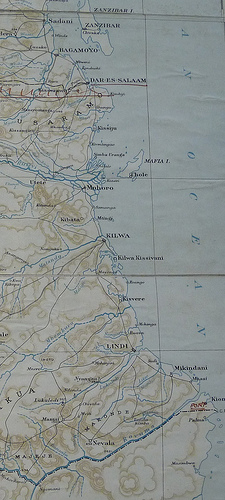
Lindi Force, the British garrison at Lindi that 1/2KAR joined on 5 March 1917, consisted of troops from the 2nd West India Regiment (2WIR), Indian sepoys from the 5th Light Infantry (5LI), the Arab Rifles - a unit recruited from Yemenis working on estates in British East Africa, and the Indian 27th Mountain Battery. More Schutztruppe units moved towards Lindi and they contained, as was the German practice, a high proportion of European officers and NCOs. By comparison 1/2KAR was suffering from wastage of its few European personnel and its present ratio was one European for every 70 Askari. At this time the battalion received a draft of 180 young Askari.
Yangwani and Lutende
The British commander in Lindi, Brigadier General H de C O'Grady, heard of new German arrivals nearby at Yangwani and Lutende and, on 22 April, he dispatched Lieutenant Giffard with 4 machine guns of 5LI, 2 machine guns and 50 rifles of 2WIR, 2 Stokes Mortars and a section of 27th Mountain Battery to attack the enemy positions that were manned by Abteilung Rothe. Lieutenant Colonel Giffard made a successful night march and drove the enemy troops off Yangwani on 23 April after an action lasting 30 minutes. Patrols then went out to locate the German base camp at Lutende. This was found after 24 hours of reconnaissance patrolling and Giffard again made a night march in heavy rain, attacking at 0630 hours on 25 April. The Germans (4 Schutzen Kompagnie, a predominantly white unit) were prepared and after conceding some ground they vigorously counter-attacked with 400 men and 6 machine guns. 1/2KAR lost sight of Lieutenant C V Gray commanding "A" Company, and this left that company without an officer. Two other officers, Captain A R Gill and Lieutenant W J Woods were wounded and evacuated, the latter dying at Lindi the next day.
The remaining handful of officers could not now control the young Askari, confusion reigned due to lack of leaders, and the ability to manoeuvre was lost. Most men wanted to fight but did not know what to do. The battalion swiftly retreated 1,000 yards. Out of contact with the enemy Giffard got a grip over his men and marched them back to Lindi having lost 8 Askari killed, 45 wounded and 6 missing. The transport detachment sustained 8 casualties. The enemy did take casualties, 1 German and 3 enemy Askari were seen bayoneted to death. Two bombers from 1/2KAR repeatedly crawled through the long grass to bomb enemy positions, and they also brought in the badly wounded Sergeant Njasa under heavy fire. These two Askari, 2864 Private Mataka and 2620 Private Makama, were awarded Military Medals for their gallant conduct. Lieutenant Gray was taken prisoner and not released until 18 November 1918.
Schaeffer's Farm
In early May a draft of 53 Askari arrived, 29 of them being Awemba, the first men of that tribe to join 1/2KAR. Also 11 European officers and senior ranks joined the battalion or returned after convalescence. However the vast majority of these Europeans, although keen and battle-experienced from the Western Front, had yet to learn a vernacular language and direct communication with the Askari was not possible.
On 18 May Lindi Force deployed to attack Schaeffer's Farm, the German local headquarters. Three columns moved out: 5LI plus mountain guns to advance via Mtenda, the Arab Rifles plus some 2WIR machine guns to move by boat up the creek and then join 5LI, and 1/2KAR (475 rifles and 6 machine guns plus a total of 100 rifles from 5LI and 2WIR and one mountain gun) to move independently with the aim of surprising the enemy by attacking simultaneously with the other columns. All moved out by night but, as was often the case on operations in Africa, the ground conditions thwarted the planned timings. 1/2KAR's progress during the night was delayed by broken ground, thick bush and high grass and the vicinity of Schaeffer's Farm was not reached until noon the next day, well after the other two columns had engaged the enemy.
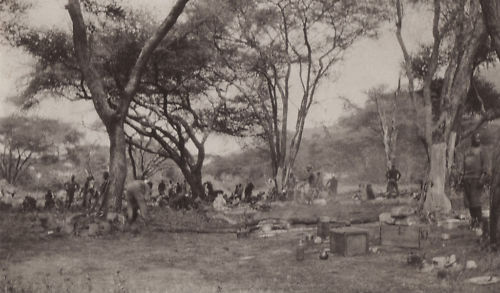
"B" Company (Captain Brodie) plus 2 machine guns led 1/2KAR on a compass bearing (Lieutenant Colonel Giffard had previously overflown the area in a seaplane and taken bearings) and met the enemy on a ridge. "B" Company was ordered to push on and "A" Company (Captain C T Soames) plus 2 machine guns came up to assist. The Germans had their own plan of action and they repulsed British flanking attempts and counter-attacked vigorously. Firing was very heavy for two hours and the enemy machine gun fire dominated the battlefield. Then the Germans mounted an attack on the British right flank, cheering loudly as they ran forward. This noisy attack totally disconcerted most of the 1/2KAR Askari behind the firing line resulting in them bolting 400 yards to the rear, despite the orders and entreaties of their British officers and senior ranks. The firing line also broke and ran. Most of the battalion was on the point of being routed.
Salvation came in the form of Captain R G H Wilson and his Reserve Company which had not seen the rapid retirement and so had not been affected by the panic. Wilson successfully counter-attacked the enemy advance, halting it and allowing the safe withdrawal of the battalion's reserve ammunition and bombs. Now Captain Evans and Lieutenant Blain with a group of about 60 old soldiers and two machine guns fought a successful rearguard action over difficult ground for 90 minutes to cover the battalion's retreat. The Germans then abandoned their pursuit. The operation against Schaeffer's Farm ended and Giffard marched his men back to Lindi, arriving around midnight on 19 May. He had lost Lieutenant C L Barclay wounded and missing, 12 Askari dead, 36 wounded and 9 missing. Four porters had been wounded. In this action some 50% of the 1/2KAR Askari had been serving for less than seven months, and nearly all the casualties had occurred during the retreat. 5LI had lost 3 killed, 7 wounded and 2 missing. The total German official casualty figures were 11 killed and 6 wounded, including one officer and one white NCO.
Aftermath
On 20 May, a German flag-of-truce party handed over the severely wounded Lieutenant Barclay to Lindi Force. Barclay, shot in both thighs and the left arm, had been about to be bayoneted to death when a German intervened and took him to a Doctor.
Captain Wilson was later awarded a Military Cross, the citation reading:
For conspicuous gallantry in action. He made a counter-attack against the enemy, and was largely responsible for saving a critical situation. Later, he assisted in rescuing a wounded N.C.O. under very heavy fire. He set a splendid example to his men.
161 Company Sergeant Major Kanjoti received a bar to his existing Distinguished Conduct Medal, the citation reading:
LINDI AREA
At Yangwani, on 24th April 1917, when a man of his company was being carried away by the enemy as a prisoner after a charge he ran forward and bayoneted the captor and released his comrade.
At Schaeffer's Farm on May 19th (1917) when the remainder of his company had broken, he kept his platoon together and retired in an orderly manner, firing regularly and escorting a machine gun.
170 Company Sergeant Major Chibwana received a Distinguished Conduct Medal for:
At the action near Yangwani on 24th April 1917, when both his officers had become casualties, he led his company with skill and courage. While walking down the firing line, he saw an enemy machine gun about to come into action at close range. He threw a bomb at it, and the crew ran away. He then went forward by himself and started to drag in the gun, but was wounded in the attempt, and the enemy recovered the gun. He has done excellent work at all times and is an excellent example to his men.
After Schaeffer's Farm 1/2KAR settled down, the battle inoculation period was over. The old soldiers had demonstrated how to fight in the bush and more importantly had shown the young Askari how real men behave on the battlefield. The young soldiers responded well. The battalion received more European officers and senior ranks and new weapons - Lewis Guns, rifle grenades and Stokes Mortars. 1/2KAR soon became one of the best British units in East Africa.
Lieutenant W J Woods was first buried in Lindi Cemetery and later his remains were moved to Dar Es Salaam War Cemetery.
References:
The King's African Rifles by H Moyse-Bartlett.
The War History of the 1st/2nd King's African Rifles.
Public Records Office CAB 44/9. Draft chapter on operations in 1917.
Public Records Office. CAB 45/66. Letter from G J Giffard.
The African Distinguished Conduct Medal by John Arnold.
The Cross of Sacrifice Volume 1.
List of British Officers Officers taken prisoner 1914-1918 re-published by The Naval and Military Press.
(This article also appeared in an issue of The Society of Malawi Journal)
Becoming a member of The Western Front Association (WFA) offers a wealth of resources and opportunities for those passionate about the history of the First World War. Here's just three of the benefits we offer:

With around 50 branches, there may be one near you. The branch meetings are open to all.

Utilise this tool to overlay historical trench maps with modern maps, enhancing battlefield research and exploration.

Receive four issues annually of this prestigious journal, featuring deeply researched articles, book reviews and historical analysis.


