
Shrapnel and Whizzbangs - a postscript
One of the unexpected bonuses of writing a book about the Great War is the enthralling new information that comes out into the open as a result of publication. This has been especially true of readers' reactions to my book Shrapnel and Whizzbangs - A Tommy in the Trenches 1914-18. It describes the experiences of my father, George Oswald Mitchell (G.O.M.), who joined up as a private at the beginning of the war, and served through to - and beyond - the Armistice, being demobilised as a second-lieutenant in 1919. The book is based on the trench diary and notes that he kept at the time and which, after his death, I deposited in the Imperial War Museum.
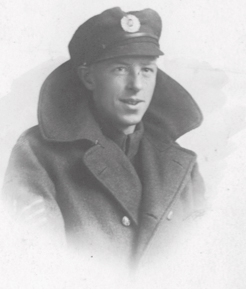
My father was a pre-war ‘Saturday night soldier'. His territorial battalion, 1/6th West Yorkshires, was mobilised at Belle Vue Barracks, Bradford, on the day war broke out, 5th August 1914. After training in Yorkshire and Lincolnshire, G.O.M. and his Bradford comrades sailed for France eight months later and were soon involved in intensive front line action in the Neuve Chapelle sector and the Ypres salient in the spring and early summer of 1915.
G.O.M.'s diary covers this period at the front in detail but, since the publication of Shrapnel and Whizzbangs, his words have been give a visual dimension by the unearthing of a remarkable sequence of over 100 photographs taken at the time by one of his mates, Frank Brocklehurst. These show ‘C' Company, 1/6th West Yorkshires in training and at the front and were sent to me by Bob Richardson, whose brother John discovered the album in a flea market at Skipton Town Hall. They are a remarkable (and still unpublished) depiction of the daily lives of an infantry company, both in training and on the Western Front. The photographs are given added poignancy by having the names of many of those who appear written on the print by Frank Brocklehurst, sometimes with their subsequent fate - ‘killed', ‘wounded' and so on. The picture of the wooden battlefield crosses, captioned ‘Some of our lads', is particularly moving - so different from the neat rows of memorial slabs in the beautifully tended Commonwealth War Graves Commission cemeteries.
G.O.M. was transferred out of the West Yorkshires in July 1915. Following the successful German gas attack at Langemark on 22nd April that year, Sir John French appointed Major C H Foulkes to plan and prepare the use of gas as an offensive weapon by British forces. To staff the gas ‘Special Companies' (later, Special Brigade) within the Royal Engineers, chemistry teachers and students were recruited from universities and colleges. The numbers were bolstered by a draft of infantrymen trained in chemistry, among them G.O.M. I remember him telling me that at morning parade on 16th July 1915 his West Yorkshires Company Sergeant Major had barked out ‘Anybody who knows anything about chemistry, two paces step forward...MARCH!!'
Having studied dyestuffs technology at Bradford Technical College, he dutifully stepped forward. Within hours, he found himself with the first draft of the RE Special Companies at the newly established gas base at Helfaut, near St Omer.
There followed intensive training and preparation for the massive launch of gas that preceded the infantry attack on the first day of the Battle of Loos, 25th September 1915. G.O.M. was in the front line for this, as vividly described in Shrapnel and Whizzbangs, and for many other gas attacks during the remainder of the war, at Cambrin, Neuve Chapelle, Hill 70, Plug Street and other battle fronts.
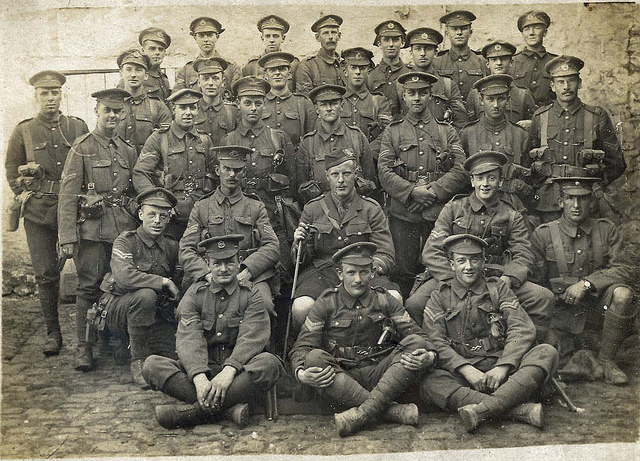
Two significant finds have emerged as a result of the book's publication. Andrew Heaton wrote to me, saying that his grandfather, John S Heaton, had been a colleague of G.O.M.'s in the RE Specials, attaching a cache of group photographs (without names attached) taken at their gas base at Helfaut. In one of them, Andrew has identified his grandfather standing in the very back row on the right. These images also remain unpublished but are a resource for anyone interested in delving into this highly specialised branch of gas warfare.
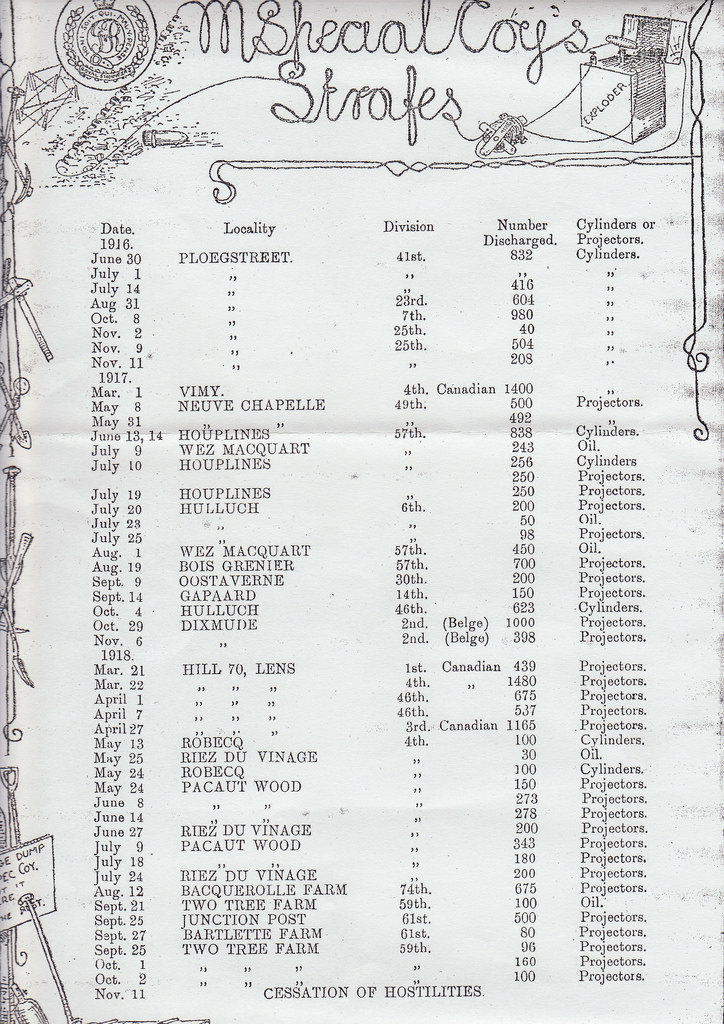
Secondly, Graham Thompson got in touch with me saying he had a document which listed all the gas ‘strafes' carried out by G.O.M.'s ‘M' Company, RE Special Brigade. This is extraordinarily detailed, showing not only the place, but the quantities and types of gas used - another valuable resource.
A final discovery was made in my own home. When G.O.M. died in 1969, he left a box of medals. The full size originals of ‘Pip, Squeak and Wilfred' (1914-15 Star, War Medal and Victory Medal) and the Territorial Efficiency Medal were accompanied by their half size replicas and a matching ribbon. There was also a separate ribbon showing the colours of two other medals, though without any corresponding originals. One was purple, the other red with five apple green vertical stripes, grouped 1-3-1. I gave these little thought at the time, assuming they were something to do with G.O.M.'s service in the Home Guard in the Second World War.
Last year, following the publication Shrapnel and Whizzbangs, I got a query from a reader asking what medals my father had been awarded. This aroused my curiosity about the two unidentified ribbon colours. I posted a message on a great war website and within hours they had been identified as the Belgian Croix de Guerre and Order of Leopold, Knight Rank.
How did they come to be among G.O.M.'s medals? Then I remembered a cryptic entry in his notebook listing of places and dates: ‘9.10.17- attached 2nd Belgian Division'. Could this be a clue? I turned to Major Foulkes' Gas! The Story of the Special Brigade (1934). In October 1917, G.O.M.'s ‘M' Company had been temporarily attached to the 2nd Belgian Division, which was holding part of the line in one of those ‘live and let live' sectors near Dixmude, where there was a tacit understanding between the two sides that no serious offensive action would be undertaken. The Allied High Command had decided to bring this to an end with a surprise gas attack. To conceal the presence of British soldiers, G.O.M. and his ‘M' Company comrades wore Belgian helmets and greatcoats while they brought up all equipment needed for launching gas. When the gas was launched, followed by an assault by Belgian infantry, the Germans were taken completely by surprise. A modest tactical victory was achieved - with a considerable boost to the morale of the Belgian army. In Foulkes' words the ‘...operations were carried out without a hitch and with practically no loss to the Belgians or ourselves'.
Now comes Foulkes' telling phrase ‘I might add that the Belgian authorities were extremely generous in their awards of decorations to our officers and men'. Was my father, at the time a sergeant in ‘M' Company, a recipient of the Belgian Croix de Guerre and Order of Leopold, Knight Rank? Here the trail comes to a halt. There does not seem to be any central register of medals awarded by the Belgian authorities. Perhaps the medals were handed over ‘in bulk' to the British to be allocated by unit commanders, again without any record. I doubt if we shall ever know. Meanwhile, the ribbons lie, as they have lain for nine decades now, in G.O.M.'s medal box.
Becoming a member of The Western Front Association (WFA) offers a wealth of resources and opportunities for those passionate about the history of the First World War. Here's just three of the benefits we offer:

With around 50 branches, there may be one near you. The branch meetings are open to all.

Utilise this tool to overlay historical trench maps with modern maps, enhancing battlefield research and exploration.

Receive four issues annually of this prestigious journal, featuring deeply researched articles, book reviews and historical analysis.


