
Lt Cdr E G Robinson VC
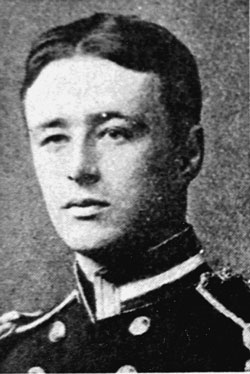
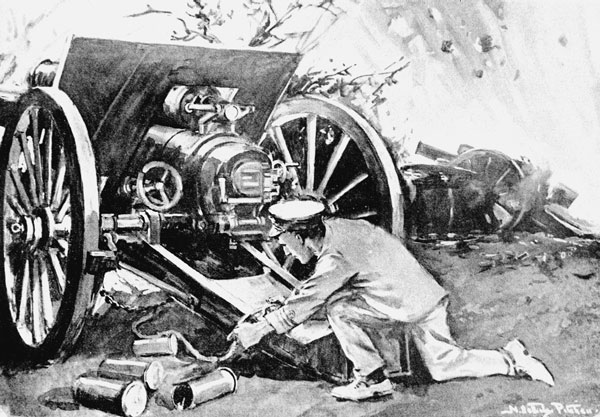
On 26 February 1915 a naval landing party under the command of Lt Cdr Eric Gascoigne Robinson (torpedo officer and explosives expert on the battleship HMS Vengeance) was sent ashore to destroy gun emplacements near Kum Kale and Orkanieh on the Gallipoli Peninsular.
The old ruined forts with their gun positions had been bombarded earlier by British battleships but not all the guns had been silenced so it was decided by Rear-Admiral Sir John de Robeck to complete the destruction by a demolition party. The party consisted of 50 seamen - the majority of whom were needed for carrying the gun-cotton charges - and a party of 50 Royal Marines for protection. The landing went ahead unopposed and, as could easily be observed from HMS Vengeance, by 2.30 pm the party were moving from Kum Kale following the line of the Mendere River past a cemetery and south-west towards Achilles Mound (where two Turkish anti-aircraft guns were located) and beyond to the Orkanieh battery and Yeni Shehr. After passing the cemetery enemy fire was opened from the cemetery, Yeni Shehr and positions near Mendere. A salvo from HMS Dublin silenced some of the firing from Yeni Shehr but the seaman were still under rifle fire and, in the words of an eyewitness from Vengeance:
'When halfway up the slope Robinson's party took cover, with the exception of one who went up to Achilles Mound, got inside the sort of crater at the top, walked calmly down again and, when he was just clear, we saw an explosion, and up went both anti-aircraft guns.'
Robinson had left his party and proceeded alone as he had decided to put only his own life at risk. He was unable to complete his next task unaided due to the weight of explosives charges needed to disable the 9.4-in gun remaining in the Orkanieh battery and he led a small group of men into the battery where they were able to destroy the gun. On both occasions the gun positions had, fortunately, been unoccupied.
For the above exploits Robinson was awarded the Victoria Cross.
It was not long before Robinson displayed his coolness under fire yet again when, in command of a converted trawler minesweeper on the night of 13/14 March, his vessel was hit over 84 times by Turkish shore batteries.
Little over a month later he distinguished himself in an action which many rate as one of the Royal Navy's most gallant enterprises of the War.
The British submarine E15 had run aground very close to the Turkish guns at Fort Dardanus and, disabled by shore batteries, was regarded as a great propaganda prize by the Turks. Attempts by battleships, destroyers and submarines had been made to destroy the submarine without success so an attack by two steam picket boats, manned by volunteer crews was sanctioned.
On the night of 18/19 April Robinson led the torpedo attack in Triumph's boat and, under very heavy fire and illuminated by searchlights, fired one torpedo at E15. Almost immediately the other picket boat from Majestic fired both torpedoes and at least one hit the crippled submarine. The Turkish batteries bracketed this boat and scored direct hits. Despite the heavy fire Robinson brought his boat alongside in the full light of the searchlights and rescued all survivors. The torpedoes had done their work and the E15 was destroyed. Robinson was promoted to Commander for this action although all other members of the picket boats' crews were decorated.
Eric Robinson was born in 1882 and went to sea in 1898. After his service at the Dardanelles he served in the Mediterranean and also in the Caspian Sea in 1919. He retired in 1933 with the rank of rear-admiral and served in World War Two from 1939 until 1941. Admiral Eric Gascoigne Robinson died in 1965.
Becoming a member of The Western Front Association (WFA) offers a wealth of resources and opportunities for those passionate about the history of the First World War. Here's just three of the benefits we offer:

Identify key words or phrases within back issues of our magazines, including Stand To!, Bulletin, Gun Fire, Fire Step and lots of others.

The WFA's YouTube channel features hundreds of videos of lectures given by experts on particular aspects of WW1.

Read post-WW1 era magazines, such as 'Twenty Years After', 'WW1 A Pictured History' and 'I Was There!' plus others.


