
Allons! Sgt Clarence W. Warren of the U.S. 15th Field Artillery
The Doughboys of World War I have not gained the place in the popular imagination reserved for soldiers of the U.S. Civil War and those of World War II. Their travails in the service of their country, the nature of the conflict and the stupendous effort exerted by the United States from 1917 to 1918 are perhaps overshadowed by these other two great conflicts. Whatever the flaws of the powers associated with the United States in the war, they were engaged in a struggle with enemies bent on the destruction of the French Republic and wide ranging territorial aggrandizement in Europe.
The American Expeditionary Force (AEF) helped to save Europe from hegemonic domination and helped put paid to three empires. Yet the doughboys are all but forgotten by their grandchildren and great-grandchildren, perhaps because the war was not "the war to end all wars." However, records and memorabilia that have escaped the ravages of time appear from time to time and reveal some aspects of the lives and heroism of U.S. service members from so long ago.
Sgt. Clarence W. Warren's records are such a case.
From his trove, hidden in a box for years, we can draw some conclusions. Warren lived in Bradford, Pennsylvania and was probably a draftee. Warren's records, at the National Personnel Records Center, were destroyed by fire on July 12, 1973. However, he received a letter in 1955 addressed to him in Bradford, Pennsylvania. A search of the county's draft registration records reveals that Clarence W. Warren enrolled for the draft there.
He became an artillerist and was assigned to Battery F, 2nd Battalion, 15th Field Artillery, 2nd Division, organized in Syracuse, New York, June 1, 1917.
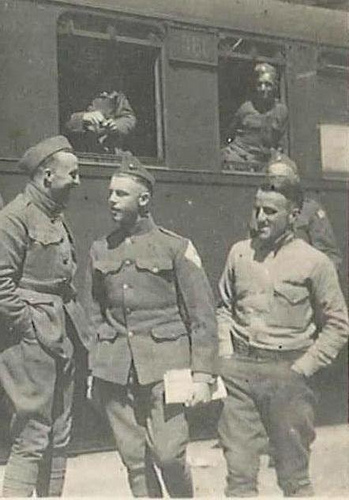
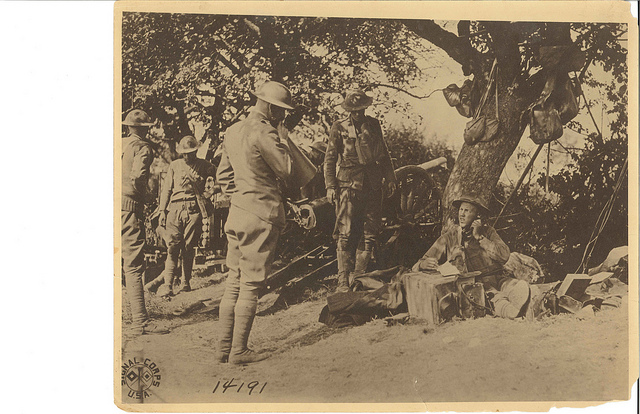
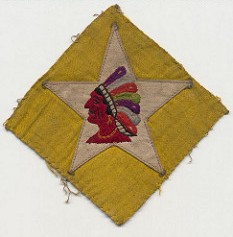
His unofficial memorabilia indicate he was an athlete, wrote home, and while in Paris after the war, picked up and saved some pamphlets commemorating American service in France. He may have owned a camera and left many (regrettably unlabeled) photos of his service that do show some interesting details of the emergence of the shoulder sleeve insignia (SSI) in the U.S. Army. He was sufficiently proud of his service to procure a Signal Corps photo depicting his battery in action at Belleau Wood.
After the Armistice
American soldiers participated in a limited occupation of Germany. While the great mass of the Army was demobilized, this process took some time and Warren did not return home until 1919.
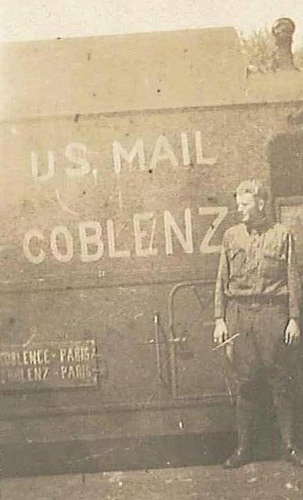
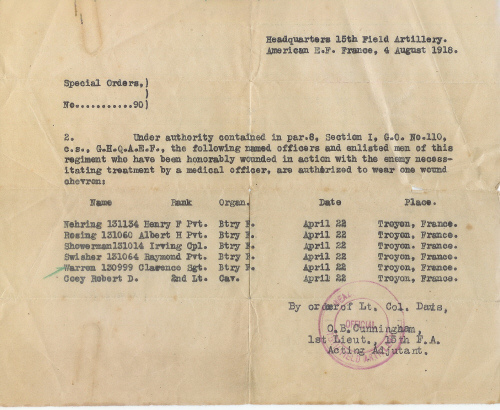
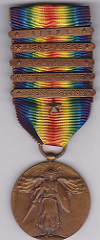
His extant official papers show he was wounded, decorated by the United States and by France, and ended the war as chief of section in his battery.
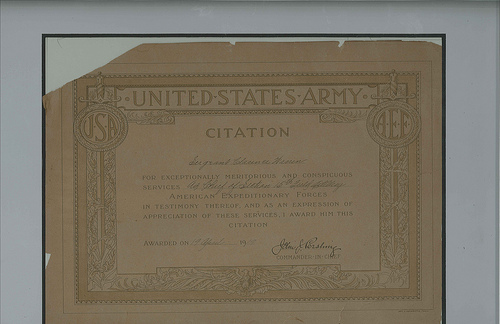
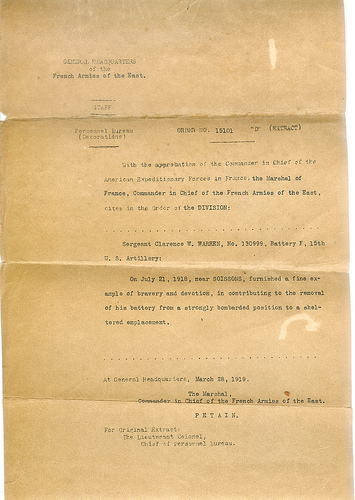
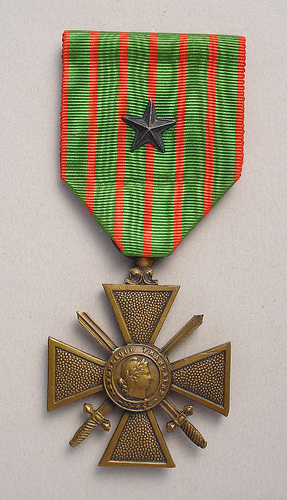
To keep the soldiers' morale up the Associated Powers sponsored a huge athletic completion involving "soldier athletes" from all the victorious armies. Warren's name appears on a broadsheet printed in Paris in 1919 for the games. He was on the U.S. Track and Field Team. Two letters sent home at this time are addressed to his father. Warren also picked up and saved two European printed pamphlets. One commemorated the service of the 2nd Division and the other is collection of doughboy art and poetry.
Other Articles


