
WDYTYA? Hugh Dennis in search of Godfrey Hinnels
In January 2012, Military Historian, Author and WFA member Jeremy Banning spent three days with a film crew for a BBC "Who Do You Think You Are" episode featuring actor and comedian Hugh Dennis. The following has been extracted, with Jeremy's permission, from his blog.

Jeremy was asked to give advice regarding Hugh Dennis's maternal grandfather, Godfrey Hinnels who served with the 1/4th Battalion Suffolk Regiment from Spring 1917 until his transfer to the 1st Battalion Lincolnshire Regiment in March 1918.
The 1/4th Suffolks were part of the BEF's 33rd Division and did not take part in the first attack at the Battle of Arras on 9 April 1917, but was moved close to the front line three days later between Henin-sur-Cojuel and Neuville Vitasse. Jeremy writes,
Godfrey's initiation into active service can hardly have been harsher; searching through the blanket of snow carpeting the battlefield for men killed a few days earlier.
At 4.45am on 23 April 1917 a huge British artillery onslaught fell on to the German trenches signalling the start of the Second Battle of the Scarpe. Godfrey's battalion was tasked with bombing their way down 2,300 yards of both front and support trenches of the Hindenburg Line to the Sensée River. Despite the support of tanks and artillery this was still a highly ambitious task, being prosecuted down a strong system of trenches, specially designed for defence. A deep tunnel ran under the support trench offering accommodation, headquarters and stores. The initial advance was spectacular with the Suffolks reaching a sunken road between Croisilles and Fontaine-les-Croisilles within two hours. Just 200 yards short of their objective they then came under sustained German fire. Later that day a strong German counter-attack pushed them back in both trenches - they ended the day close to the morning's starting position. Despite taking a remarkable 650 German prisoners in the initial advance the battalion suffered over 300 casualties (about 50% of the battalion strength).
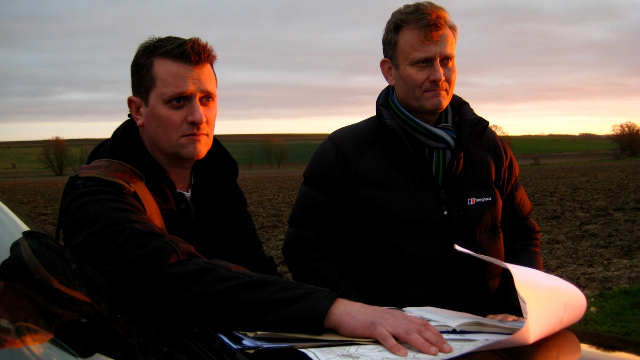
The WDYTYA episode then moved on to the Spring Offensive on 1918, leaving many viewers (who knew a bit about the Great War) to wonder what happened in the intervening months. This section was filmed, but did not make it into the broadcast version.
By March 1918, Godfrey Hinnels had joined the 1st Lincolns, part of the 21st Division, which was holding trenches near Épehy. Godfrey was involved in the defence of the village when the Germans launched their Spring Offensive on 21 March.
Jeremy describes,
Deluged with gas shells the Lincolns were attacked under cover of ‘a heavy white mist'. A day of desperate fighting followed with positions held around Chapel Hill before relief and retirement across the 1916 Somme battlefield. On 1 April the Lincolns entrained north to Flanders but hopes for a rest were short lived.
In early April the battalion was transferred to a ‘quiet' sector on the Franco/Belgian border. Godfrey's battalion was about to take part in one of the most crucial battles of the war, which commenced on 9 April, a year to the day after the Battle of Arras. On 12 April the battalion was holding the line near the village of Wytschaete.
Again, quoting Jeremy's blog:
Messines, directly to the south, had fallen two days previously and with Wytschaete the next village along the ridge an attack was almost inevitable. At 4.30 am on the morning of 16 April a heavy artillery bombardment pounded the British front line, the village and all approaches, lasting for 70 minutes. The official account of the operation details the subsequent events:
"Under cover of a dense fog the enemy attacked on the flanks of the battalion, and succeeded in breaking our line just North of the STANYZER CABARET Cross Roads, and at PECKHAM. Strong parties of the enemy then wheeled inwards and attacked both flanks of the battalion...Owing to the dense fog and bombardment it was impossible to get a clear idea of the situation and the Companies did not know they were attacked until the enemy appeared at close quarters. Fighting under every disadvantage, as the fog denied them the full use of Lewis Guns and rifles and made it impossible to locate the enemy, the battalion stood firm, and fought it out to the last. No officer, platoon post or individual surrendered and the fighting was prolonged until 6.30 am. Ample evidence of this is provided by the Commanding officer [Major Gush MC] and Battalion H.Q. who made a last stand at the Cross Roads, and did not leave there until 7 am. They, a mere handful of men, withdrew slowly, fighting all the way through WYTSCHAETE WOOD." [National Archives Ref: WO95/2154]
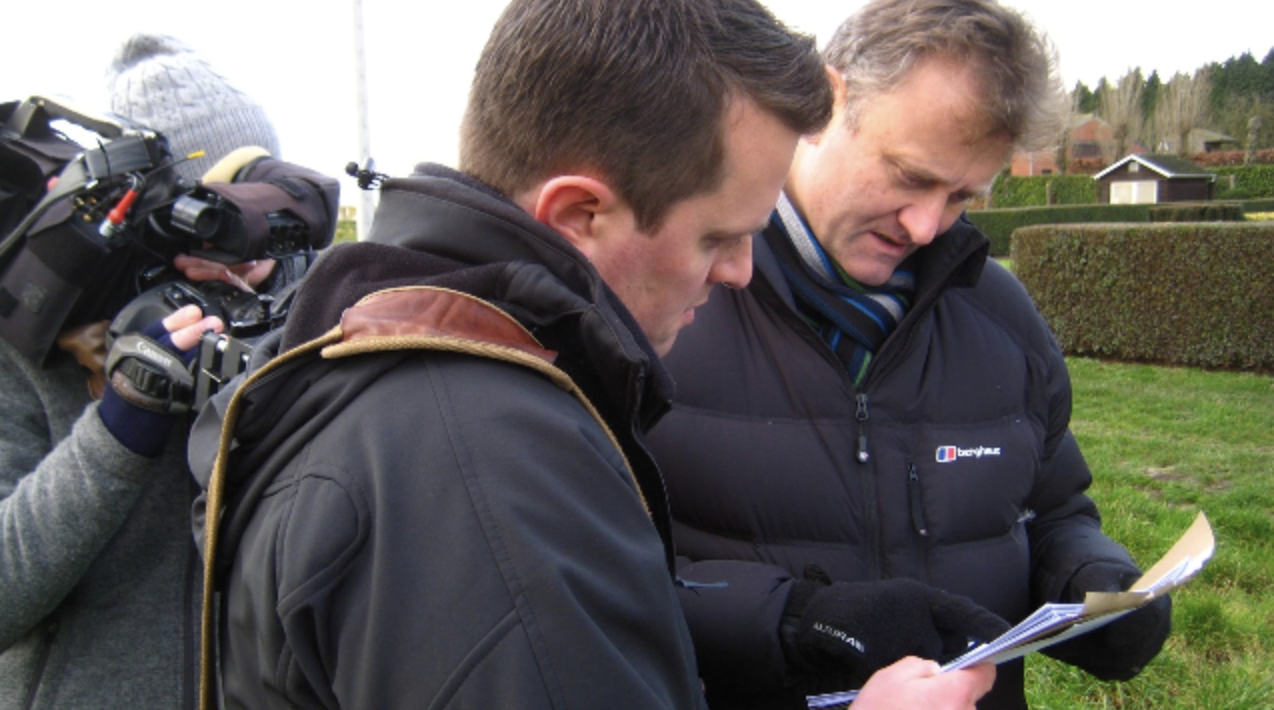
The Western Front Association is always keen to see well made and historically accurate documentaries about the Great War, and to have someone as expert as Jeremy Banning advising the production company was important to ensure accuracy. Both Jeremy and the producers of this episode are to be congratulated on the end result which will introduce many people to this fascinating period of history. This will have the result of introducing even more people to our organisation.
Many thanks to Jeremy Banning for allowing us to use his research.
Becoming a member of The Western Front Association (WFA) offers a wealth of resources and opportunities for those passionate about the history of the First World War. Here's just three of the benefits we offer:

This magazine provides updates on WW1 related news, WFA activities and events.

Access online tours of significant WWI sites, providing immense learning experience.

Listen to over 300 episodes of the "Mentioned in Dispatches" podcast.


