
President's Address to the AGM
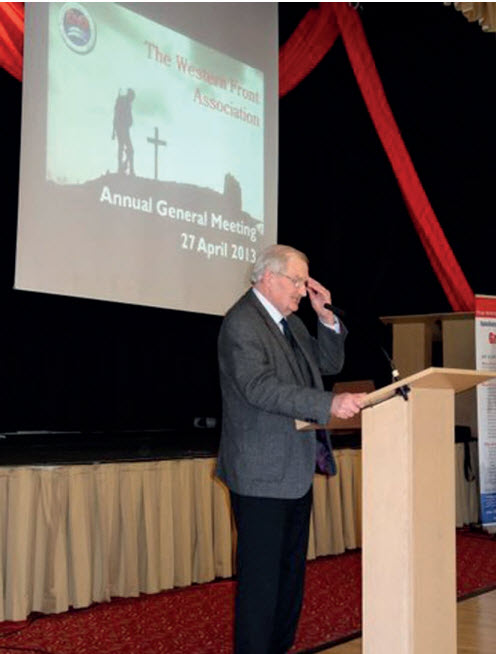
I have often said that the history of the First World War is multi-faceted, not a matter of black-and-white but rather of a million shades of grey. Indeed, for me, it is the many nuances of the subject that fascinate me most. As the Centenary of the Great War rapidly approaches, we who are serious students of the subject will no doubt be bombarded with suggestions as to those aspects of the conflict that should be commemorated and remembered. I also confidently expect that we in the WFA will be criticised or even chastised – both privately and publicly – for taking a too narrow, and too British, view of the war. We will certainly receive plenty of advice as to the form our ‘remembrance’ of the war should take.
‘Remembrance’ may take many forms – attending a ceremony, leaving a poppy cross or wreath on the grave of a relative in a war cemetery, writing or lecturing about a unit or individual, and so on. Remembrance can be a deeply private thing or assume a highly public form, such as Remembrance Sunday at the Cenotaph in Whitehall. It can also be a creative and positive act rather than a passive or contemplative one. As a professional historian, I have long thought that a well-researched book or article about a nation, unit or individual at war does more to create a lasting and widely-available ‘memory’ than does a transient and solitary moment of reflection. This, I firmly believe, is why the WFA plays such a vital role in remembrance of the First World War - i.e. by facilitating different but shared processes of remembrance when the need is felt.
‘Empathy’ is also a key factor in true remembrance. It is a gut feeling whereby one understands and grasps the very essence of the First World War experience rather than merely having the knowledge as to the brigade or division in which Great Uncle Albert’s battalion served. It cannot really be taught. In my other life as a jazz musician, it is reflected in an instinctive sense of time, style and mutual inter-dependency, which can only be developed by listening to, and absorbing, the music. It was, I think, the great Fats Waller who, when asked what was meant by the term ‘swing’, replied : ‘Lady, if you’ve got to ask, you’ll never know’. What you require above all is an unquenchable and genuine passion for the music, or, in our collective case, the subject. That is why some 6,000 of us give up our spare time to attend meetings all over the country with such dedication and interest.
As Professor Hew Strachan has wisely asked, what is it that we are going to remember, given that no veterans are alive today. Hew warns against the Centenary becoming simply Remembrance Sunday writ large. If it simply reworks the familiar themes, it will, in Strachan’s view, be ‘repetitive, sterile and possibly even boring’. In his judgement, we need to emerge in 2018 with fresh perspectives or we shall have failed. I am personally not fully convinced by the latter plea. If sound scholarship over the next five years merely serves to reinforce existing perspectives, then why should this necessarily be a bad thing ? We should not seek fresh perspectives for their own sake, particularly if such a process is motivated merely by a desire for novelty. Good scholarship should be left to produce whatever results may emerge – not used to create new perspectives for their own sake. Such results would be, in my opinion, artificial. Scholarship cannot be predetermined if it is to retain its integrity.
Hew Strachan is right, however, in observing that our predecessors elected to interpret the conclusion of the Great War both as a victory (by means of Armistice Day) and also in terms of mourning (as marked by Remembrance Sunday). According to Hew, we shall confront the same problems in 2018. In the latter case, who are we mourning or remembering ? It has been pointed out that over 6 million served in Britain’s armed forces in the Great War and roughly 12 per cent died. We must therefore be careful when talking about a ‘lost generation’. It is right and proper to reflect upon the terrible losses of the war when we stand in a war cemetery on the Somme or attend a service at a village war memorial. But neither should we forget the men and women who fought and survived or contributed mightily to the war effort through service in munitions work, agriculture or charitable activities.
Professor Strachan and others have observed that the Imperial War Museum and the Commonwealth War Graves Commission represent not only a lasting legacy of the Great War but also a reminder that Britain fought the war as part of a global empire. It will be important for the WFA, in particular, to co-ordinate its activities during the Centenary with those in Commonwealth nations – not least Australia, Canada, New Zealand, India, Pakistan, Bangladesh and South Africa. Indian troops, for example – of whom more than a million were recruited for military service – saw action in a global war in France and Flanders as well as Gallipoli, Mesopotamia, Palestine and East Africa. In this wider connection, it seems highly appropriate to me that the WFA is today giving consideration to inviting a distinguished Commonwealth historian, Chris Pugsley, to be a Vice President of the Association.
Is there a danger, perhaps, that, during the Centenary, we shall become too fixated by the Western Front or too Anglocentric in our approach. David Stevenson has declared in his recent book With Our Backs to the Wall : Victory and Defeat in 1918 that the record of the actual fighting can only tell us so much – or, as my own former tutor, Professor Sir Michael Howard, says in his review of that book : ‘The history of the war is too important to be left to the military historians’. Stevenson also stresses the influence of technical developments (eg: tanks and aircraft) within the armed forces; the importance of movement and supply behind the battlefield; the continued dependence of all armies on the horse and horse-drawn transport, and the growing shortage of fodder; the morale of the belligerents, both civil and military; the maintenance of food supplies; the conduct of the naval war; the prosecution of trade and the distribution of food; and political control of the respective home fronts. He demonstrates how all these factors interacted to produce the situation whereby there was an overwhelming balance of strength on the Allied side, facilitating the eventual victory, though he observes that such a favourable balance could not have been achieved without the vast resources of the United States. Hew Strachan too has emphasised that, as a consequence of the Great War, we are still living with globalisation, including the effects of the emergence of America as a global power and its contribution to the long-term relative decline of Europe.
As students and historians of the First World War we will undoubtedly be encouraged to take such a wider view of the conflict. In addition, within the Centenary period, there will be many competing anniversaries to commemorate and celebrate. Without even thinking too hard, one can name several which are likely to loom large over the next five years and which do not focus directly or primarily on the Western Front. Naval historians, for example, will be re-examining the strategy, tactics and human experience of the Battle of Jutland, the titanic clash between the British Grand Fleet and the German High Seas Fleet in 1916. A related topic will be the scale of the contribution of the Allied naval blockade to the eventual defeat of Imperial Germany. The anniversary of the famous Zeebrugge Raid will almost certainly be commemorated on or around St George’s Day in April 2018. Organisations such as the Cross and Cockade Society will be looking afresh at the war in the air, including the development of air fighting, the origins of strategic bombing and the 100th anniversary of the creation of the Royal Air Force as an independent service – not to mention the birth of maritime air power and the aircraft carrier. The Dardanelles campaign and the fighting on the Gallipoli peninsula will exert a strong pull on our collective imagination in 2015, particularly in Australia and New Zealand. One anticipates that Anzac Day in 2015 will be marked on a huge scale ‘Down Under’ as well as in the UK. We will be called upon to consider other aspects of the global conflict, such as the campaigns in Mesopotamia, Salonika, Egypt, Palestine, East Africa and Italy, as well as the fighting on the Eastern Front – let alone the Russian Revolution.
We already know of proposals to hold a conference on the theme of the Indian Army, and this will possibly reflect, or act as a spur to, more studies of the forces of the Empire in general and of individual Dominions in their own right. And I have barely touched yet on the Home Front and the enormous contribution of women in a multitude of roles – including munitions work, transport and nursing, to name but three of many.
All these themes and topics illustrate the multi-faceted nature of the 1914-1918 conflict and its inter-connectivity. But, for the British and Commonwealth peoples, the core of the subject must remain the Western Front. It was the Western Front which, above all, touched the lives of almost every family in Britain in some way. For us in the UK it was the central and dominant experience of the Great War. We should not, therefore, be in any way apologetic about concentrating our attention upon it. There is still so much about the Western Front that we do not know.
Even within the story of the Western Front there are considerable differences in interpretation. Another highly distinguished academic historian, Professor William Philpott, has argued persuasively that it is Haig’s view of the relative importance of the British and French efforts in the final defeat of the German army which has persisted ever since in British eyes and that, consequently, our understanding of the Western Front is mistakenly skewed towards an Anglocentric bias, seriously underplaying the importance of the French role and contribution. I have to say that, in many respects, I fully endorse the sterling efforts of Bill Philpott , Michael Neiberg and others to remind us of, or bring our attention to, the massive contribution of the French nation and army to the ultimate defeat of Imperial Germany. Under Bill’s scholarly supervision at King’s College London, some important new research, at doctoral level, is being carried out on the French Army – a development which, I think, should be warmly applauded. What I do find difficult to swallow, however, is the criticism – either by direct statement or by implication – that the work of several ‘revisionist’ historians, including myself, has been too Anglocentric in scope, content and tone. Speaking personally, I make no apologies for having spent the best part of thirty years working on the history of the BEF on the Western Front. When we set out on the ‘revisionist’ path, British First World War studies were still mired in the ‘butchers and bunglers’ and ‘lions led by donkeys’ school of Great War history. Now, thirty years later - and thanks to the work of the late Paddy Griffith, Andy Simpson, Gary Sheffield. John Lee, John Bourne, Peter Hart, Rob Thompson, Brian Bond, Bryn Hammond, and several others – we know a great deal more about the organisation, infrastructure, tactical development, command and control, logistics, artillery and engineering effort, brigade and divisional commanders, and the operations of the BEF. As a result of all this effort, we have moved a long way from the ‘lions led by donkeys’ perception. But, as I said earlier, there is still a great deal of work to be done on the role of the British and Dominion forces on the Western Front, particularly on manpower issues, training, the reserve and drafting system, the social and geographical composition of units, casualties, morale and discipline, etc., etc. So long as these gaps in our present knowledge exist, there remains an important role for the WFA and for British First World War studies in general. Again, we have no need to offer excuses for our studies being inevitably Anglocentric. Moreover, I am not aware of many national organisations, or academic institutions, in France, Belgium or Germany which are making a significant contribution to the study of the British and Dominion forces on the Western Front. The truth is that, in the final analysis, it is down to us, and our colleagues in the Commonwealth, to further the proper remembrance of the officers, men and women of the BEF and of their experiences and achievements in France and Flanders.
In short, some of Bill Philpott’s criticisms are undoubtedly justified. We simply do not know enough about the contribution of the French – or the Germans, Belgians and Americans come to that – on the Western Front. However, there is another side to this particular coin. It is only as a result of a determined collective desire and effort to improve and deepen our understanding of the British and Dominion forces on the Western Front that we have obtained a more balanced, detailed and objective picture of Haig himself, and of his armies. This task itself has involved a colossal effort, has taken over twenty years to date, and is by no means finished. How can we truly place the achievements of our allies in a proper perspective and really understand our relationship with those allies unless we genuinely understand the nature and experience of the BEF and its component parts ? It’s a question of balance.
What of the focus of much of our attention – the battlefields themselves. Much of the old front line in France and Belgium that I saw with the late and legendary Rose Coombs in the late 1960s has now changed forever, having disappeared beneath industrial estates and suburbs, ribbon development, motorways and hypermarkets. I have recently been informed, for example, of the threat of a wind farm being installed on the Loos battlefield of 1915. This is the inevitable result of so-called ‘progress’ and, of course, we have no real power or right to interfere in the internal affairs of the communes, towns and villages affected – though we do have an opinion and a voice which we can do our best to make sure is heard. Another potentially dangerous development, in my humble view, is the increase in commercialised battlefield features, such as unregulated private museums, memorials and monuments, reconstructed or replica trenches, and so on. I fully support the need for visitor centres at the major sites such as Tyne Cot or Thiepval, if they do not intrude upon the battlefield landscape, but there is a real risk that, if this process continues unchecked, the sites will take on the feel of a kind of Disneyland rather than the Western Front. I am all for responsible, respectful and properly-controlled battlefield research and archaeology – such as that carried out by Peter Barton, Peter Doyle and the Durand Group – but, above ground, I cannot help feeling that much is best left to the imagination rather than having a sanitised impression imposed on one by a visitor centre with a particular national agenda to propagate. Personally, I feel more in touch with the real Western Front at sites and places like Gillemont Farm, Frankfurt Trench, Hangard Wood and Montbréhain than I do at Thiepval on 1 July.
Arguably, the most important task and the most important opportunity we face in the Centenary is that of education. This is our unique, and perhaps our best, chance of exploding the ‘butchers and bunglers’ myth that is still all too prevalent. Our impact in this regard can, I suggest, be made in two main directions. The first is through the media who, because of lazy research or an all-too-familiar tendency to resort to clichés and stock interpretations, are often mainly responsible for perpetuating the myths. We will undoubtedly be consulted, collectively and individually, by the local and national press and broadcasting organisations between 2104 and 2018 and it is our duty, in essence, to ensure that we deliver the right message to correct the long-established myths and half-truths that dominate the existing perception of the Western Front and which still shape our national ‘remembrance’ of the Great War.
The second, and possibly even more vital, channel for our educational activities is through the schools system. We can achieve much more, in my opinion, by ensuring even closer regular liaison with schools at a local branch level, perhaps by organising seminars for history teachers on relevant topics and themes; by advising schools on potential itineraries and themes for battlefield tours; by essay competitions; and by involving schools in local research and restoration projects (for example, in connection with local war memorials). This, moreover, is not just a task for the Centenary. We need the input of younger people at schools and universities to ensure the long-term welfare and health of our own Association. In this particular connection, we must also avoid simply waiting for things or events to happen. We must be proactive and creative, not reactive and passive.
I am satisfied that we will not be too insular in our approach to the Centenary and that we have heeded the warnings of Professors Strachan, Howard and Philpott. So far as I am aware, we are already involved in discussions to participate and co-operate in conferences which are planned to commemorate Gallipoli and, as I have already indicated, the role of the Indian Army in the war. But, in so doing, we must not lose our own identity as the Western Front Association. Even within our own particular field of interest, there are still battles to be fought in connection with the Centenary. What I know of the Government’s commemoration plans indicates that, as things stand at present, it is intended to mark the anniversaries of the outbreak of the First World War; the Gallipoli landings; the first day of the Somme; the opening of the Third Battle of Ypres (Passchendaele); and the Armistice. Note that at least three of these have negative connotations – i.e. Gallipoli, 1 July 1916 and Passchendaele. As yet, however, we still have a battle on our hands to get the Government to recognise the significance of the Battle of Amiens or the breaking of the Hindenburg Line in the summer and autumn of 1918 – which is when we helped to defeat the main enemy in the main theatre of war as part of the greatest succession of victories in the British Army’s history, thereby ensuring the end of the annexationist and militaristic regime of Imperial Germany. Gary Sheffield, John Bourne and I have, indeed, written to the press to point out the absurdity of this situation – not in a spirit of ‘triumphalism’ but in the interests of historical balance. So far as the Government is concerned, it is almost as if twenty or so years of archivally-based ‘revisionist’ studies of the BEF on the Western Front has not existed or is of no importance. Thus the Government’s present intentions are akin to commemorating the Second World War by marking the anniversaries of Dunkirk and the fall of Singapore but not remembering D-Day ! As members of the WFA, this is no time to shelter in our ‘funk holes’ or the reserve trenches as the Centenary nears. There are still a number of objectives which must be secured before we can rest on our laurels. We are a strong, experienced and knowledgeable organisation, so let’s act like one and make our voice heard. In the words of a Second World War minister – ‘Go To It’!
This article first appeared in Bulletin 96, in July 2013. Bulletin is one of several magazines available for free to members of The WFA. If you want to see more articles like this one, you may wish to become a member of The Western Front Association.
Becoming a member of The Western Front Association (WFA) offers a wealth of resources and opportunities for those passionate about the history of the First World War. Here's just three of the benefits we offer:

This magazine provides updates on WW1 related news, WFA activities and events.

Access online tours of significant WWI sites, providing immense learning experience.

Listen to over 300 episodes of the "Mentioned in Dispatches" podcast.


