
President’s Address - Living and Learning
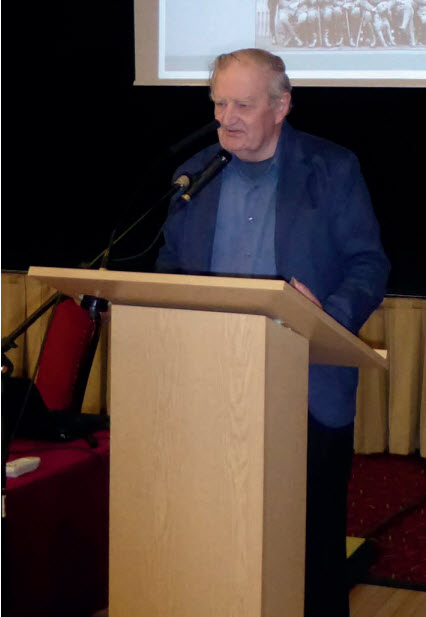
As a working historian, one is constantly reminded that one is never too old too learn. Speaking personally, at the tender age of seventy-five, I am still excited by the fact that in our specialist field of study – the First World War – new scholarly works are being published, and research undertaken, on what appears to be an ever-increasing scale. During my own fifty years as a professional military historian, and thanks to such dedicated research, our understanding of the First World War has been greatly enhanced and transformed. New studies, often largely based on previously unpublished or unexplored archival evidence, are changing our perceptions of the conflict almost daily. Indeed, as the Centenary is reached, it is becoming more and more difficult – both intellectually and financially - to keep pace with the flow of new books and to remain conversant with the latest debates, theories, arguments and interpretations.
As I have already implied, these factors are what currently make our field so vibrant. However, to gain the maximum benefit from such recent scholarship, one must, of course, be open-minded, and receptive to new revelations. This can often be a painful process, as younger generations of historians, be they professional or amateur, will almost inevitably present fresh evidence and convincing arguments which challenge one’s own views or, even worse, render one’s own research, one’s long-established beliefs and one’s own writings out-of-date at a stroke. Apart from an open mind, a working historian – particularly a veteran like myself – also needs a very thick skin.
All this similarly has implications for one of the WFA’s watchwords and guiding principles – ‘Remembering’. Re-stating a question that I have posed in previous addresses to the Association, what, precisely, is it that we are ‘remembering’ ? In my own case, most of what I thought I knew about the Western Front when I was working under Basil Liddell Hart in my early twenties, and what I then regarded as unassailable truth, has since been shown by other historians – and, I hope, by my own objective research as a more mature historian – to be, at best, based on shaky foundations or, at worst, to be entirely wrong. What I thought I was ‘remembering’ in 1970 is decidedly not what I believe I’m remembering today.
To illustrate what I mean, we might briefly consider a few facts or interpretations relating to the events of 1914, the Centenary of which we are now commemorating. Professor William Philpott, for instance, has suggested that Anglocentric historians all too often underplay the massive part played by the French Army in the First World War and that, by taking a cue from Haig’s own writings, have relegated French generals to ‘walk on’ parts in the drama. Certainly, in concentrating our attention – perhaps not unreasonably – on the BEF’s early battles at Mons and Le Cateau, we may easily overlook the scale of the French Army’s sacrifice in August 1914 alone, as a result of the so-called ‘Battle of the Frontiers’. C.R.M.F. Cruttwell places French losses in this period as high as 300,000, representing, in his words, ‘nearly 25 per cent of the combatants – a rate of wastage never equalled in all the rest of the war’. John Terraine estimated that 10 per cent of the French officer corps became casualties in the opening month of the conflict. It should be borne in mind that a large proportion of these losses were sustained before the BEF was involved in a major action. The BEF’s losses of 1,600 at Mons and 7,182 at Le Cateau - though not insignificant to a small volunteer army – seem tiny in comparison.
Similarly, as Jack Sheldon points out, First Ypres is frequently regarded as a wholly British effort rather than what it really was, an Allied defensive effort. The attempt by the German Fourth Army in October 1914 to break through the Nieuport-Dixmude line along the Yser, and thereby threaten Dunkirk and Calais, was stubbornly resisted by Belgian and French formations before the opening of the lock gates at Nieuport caused the low ground east of the Nieuport- Dixmude railway embankment to be flooded, effectively halting German offensive operations in this sector and obliging the Germans to turn their attention inland and to launch their next major attacks in the Ypres sector. Jack Sheldon claims that, at the height of the First Battle of Ypres, the BEF was holding half the length of front line than that for which the French army was responsible, and that ‘every time there was a crisis on the British sector, it was the French army which rushed to buttress the places where it sagged’. A glance at those sketch maps in Volume II of the British official history of 1914 which cover the critical period of 26 October – 11 November will show that French units indeed held, to an increasing extent, the line north of Zonnebeke and south of Zillebeke.
It had long been accepted by many – including me – and almost without question that, at Mons and Le Cateau, the small but highly-professional BEF survived its first encounters with the enemy because its incomparable musketry training enabled its soldiers to inflict terrible casualties on the Germans by rapid rifle fire of fifteen aimed rounds a minute. In this interpretation, so fast and accurate was the British rifle fire that the Germans – relying on weight of numbers to prevail and attacking in a tactically unsophisticated manner in dense formations – apparently believed that they were opposed by more machine-guns than the British battalions actually possessed. This well-established interpretation has been challenged in recent years by Terence Zuber and others. According to Zuber, the BEF’s rapid rifle fire was not the ‘battle-winning wonder weapon’ that British historians have suggested. In fact, Zuber argues, the Germans profited from superior tactical doctrine and training. He states that they did not attack ‘bolt upright in solid blocks, but by bounds in fire and movement‘, as part of a combined arms team and supported by artillery and machine-gun fire which repeatedly enabled them to close with the British defenders. Moreover, he writes, the idea that British musketry was so effective that the Germans took it for machine-gun fire ‘finds no support in German sources’. The British, in short, escaped destruction at Mons and Le Cateau, solely due to errors by the German First Army commander, von Kluck, and his chief of staff, von Kuhl.
In addition, Jack Sheldon has remarked that changes in agricultural practice have altered the landscape of Flanders since 1914. Hundreds of kilometres of hedges, once enclosing small fields, have been uprooted and scrubby wooded areas are no longer coppiced for firewood. In 1914, Jack contends, the Allied defenders exploited these hedges and wooded areas and rather than blast off in the ‘mad minute’ of rifle fire at long range, let the attackers close to short range and then – because of shortages of ammunition – poured ‘lacerating fire into them at short range for as brief a time as possible’.
This latter point seems to me to have more substance than some other attempts to challenge what Zuber calls the ‘Mons Myth’. There is a distinct tendency, especially among some American historians, to subscribe to what our own Vice-President, Chris Pugsley, has described as ‘the Germans did it first and did it best’ view of the Great War on the Western Front. As John Sneddon comments in a recent essay, though acknowledging the thought-provoking aspects of their studies, it should be noted that ‘the praise heaped upon the German army’ by Martin Samuels and Terence Zuber is contradicted by the works of Eric Dorn Brose and Stephen Jackman. Certainly, Spencer Jones and his fellow contributors (including John Sneddon) to the excellent volume Stemming the Tide: Officers and Leadership in the British Expeditionary Force, 1914 (Helion, 2013), have generally taken a more balanced and objective view of the BEF’s performance in 1914, highlighting both its shortcomings and achievements.
In the final analysis one is tempted to raise a couple of issues. If the German army in 1914 was as superior to the BEF in doctrine, tactical training and combat effectiveness as Zuber repeatedly claims, then why did the Germans fail to destroy the British II Corps at Le Cateau or to break through the British positions along the Menin Road in late October and early November 1914? It is true that the French and Belgians played an important, and often unrecognised, part in the defence of Ypres, but the fact remains that the BEF held the crucial Menin Road sector, the principal axis of the German advance towards the town from the east. Given the BEF’s limited supplies of artillery ammunition, what else but tactical knowhow and skill in musketry could have stopped the determined German attacks, not least on 31 October and 11 November 1914. Furthermore, although there were obvious command weaknesses at GHQ level, there can be little doubt that the BEF was decidedly not without leadership of high quality at divisional and brigade level or below. The grip and initiative displayed by Brigadier-General Edward Bulfin of the 2nd Brigade (later 1st Division) and Brigadier-General Charles FitzClarence VC of the 1st Guards Brigade in the defence of Gheluvelt are just two examples of such leadership that spring readily to mind, while the role of officers like Sydney Lawford of 22nd Brigade in helping to ‘putty up’ the line at critical moments, or in leading counter-attacks, should also be re-emphasised. Thus, to return to one of my first points, we must remain receptive to new evidence, fresh interpretations and challenges to long-established views but, at the same time, we must avoid being seduced into seeing only the ‘emperor’s new clothes’.
At Ypres in 1914, the BEF genuinely punched above its weight. One should not ignore the fact that a German breakthrough along the Menin Road – regardless of the obstinate Franco-Belgian defence on the Yser – would not only have been a profound and demoralising psychological shock to the Allied cause but would have seriously threatened to outflank the Anglo-French positions to the south of Ypres. As the British official historian puts it : ‘The whole of Belgium must have been lost, and the Germans would have reached Dunkirk and Calais – which were indeed their objectives. If these ports had fallen to the enemy the effect on our sea communications and on operations generally might well have proved fatal not only to the British Empire but to the whole of the civilised world’. Without these and other Channel ports, the BEF would have been unable to sustain itself on the continent, let alone expand to a strength of over two million, and German domination of Europe would have been assured. This, in my judgement, is the single most important fact underlying the BEF’s achievement at Ypres in October-November 1914 and is perhaps the most truly significant measure of its combat effectiveness.
One national achievement in 1914 that we can surely commemorate without serious question is the vast expansion of the British army under Field-Marshal Lord Kitchener as Secretary of State for War from August that year. Despite all previous deficiencies in experience and preparation, it was an effort of epic proportions to recruit around one million volunteers for the Army by the end of December 1914, so laying the foundations for Britain’s first-ever mass army capable of fighting a modern industrial war on a continental scale. As I have written elsewhere, in the sense that, in 1914-1915, it was raised for the most part by civilian committees and ad hoc voluntary organisations all over the country, this was perhaps the ‘closest thing to a true citizen army that Britain has ever produced’. For good or ill – depending on your standpoint in the debate – it determined the nature and scope of Britain’s subsequent commitment to, and participation in, the war for the next four years, an involvement which ultimately touched every household in the land in some way. In my own opinion, it was an achievement of which we can be justly proud.
This article first appeared in Bulletin 99, in August 2014. Bulletin is one of several magazines available for free to members of The WFA. If you want to see more articles like this one, you may wish to become a member of The Western Front Association.
Becoming a member of The Western Front Association (WFA) offers a wealth of resources and opportunities for those passionate about the history of the First World War. Here's just three of the benefits we offer:

This magazine provides updates on WW1 related news, WFA activities and events.

Access online tours of significant WWI sites, providing immense learning experience.

Listen to over 300 episodes of the "Mentioned in Dispatches" podcast.


