
Hubert Dunsterville 'Bay' Harvey-Kelly DSO: the first RFC pilot to land in France in 1914
As the youngest son of a retired Indian Army officer and born into a military family, Harvey-Kelly's career was predestined to be in the service of His Majesty. Known in the family as 'Bay', a name probably added by his grandparents when registering the birth, he was described by his contemporaries as a "brawny, free spirited, fearless, irreverent, fair skinned and baby faced". So the question was, in what capacity would he serve?
Artillery was too methodical and the engineers too serious for someone with a quick mind, high spirits and the charisma, wit and charm to captivate anyone who came within his orbit. Once his colleagues got to know him better they also noted in him "a highly competitive nature", so perhaps he was well suited to the life of action and adventure offered by military life and aviation.
Although his family hailed from Roscommon, Co Meath, Ireland, where his mother's family, the Dunstervilles, were prominent local landowners, Bay was born at Berry Pomeroy, Devon on 9 February 1891. His schooling appears to have been fairly conventional and, on leaving Sandhurst, he applied to the Royal Irish Regiment, joining them on 5 October 1910 and being commissioned on 23 October 1910. Although a competent soldier, it seems that the routine of military life didn't altogether suit his temperament or lust for life, and his gaze gradually moved to other horizons. Family legend records him winning a bet by dressing in tails and playing a piano strapped to the top of a vehicle as it drove down Piccadilly, an act perhaps symptomatic both of his exuberance and frustration with routine.
By early in 1913 Bay had decided that the new science of aviation offered more and he applied for a transfer to the RFC. At his own expense he 'took his ticket', RAes number 501, on 30 May 1913, with the CFS Upavon. He was commissioned into the RFC Reserve on 14 August 2013 before joining No II Squadron [Roman numerals were still in use - it is referred to as No 2 from now on] with the cutting-edge aeroplane, the BE2a. The squadron operated from the first of the 12 proposed air stations at Montrose, tasked with protecting the new battlecruiser fleet at Rosyth and its destroyer escorts at Cromarty against attack.
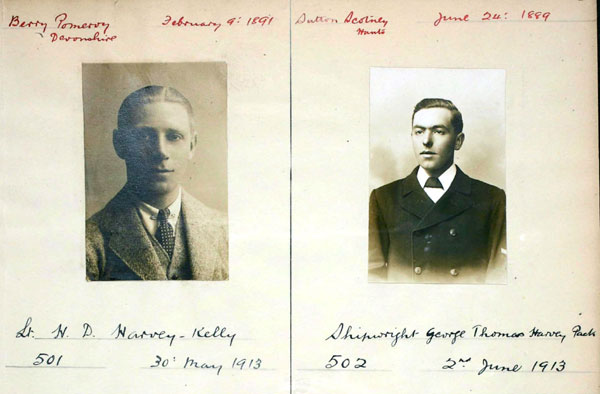


No 2 was led by the redoubtable Major C J Burke, a pioneer of military aviation, noted for his courage in still flying when numerous crashes clearly indicated that he give consideration to something safer. Burke had also transferred from the Royal Irish Regiment and it might have been that he kept an indulgent eye on his ebullient and slightly reckless fellow officer. An Army man to his fingertips Burke demanded, and got, very high standards from the squadron. In September 1913 they had successfully completed the RFC's first overseas deployment to Ireland and, in June 1914, the squadron travelled 570 miles south to Netheravon for the RFC Concentration Camp with only one unfortunate and fatal accident after a forced landing. 3 weeks later it returned north without incident, only to repeat the move south on 3 August 1914, firstly to Farnborough then to Swingate Down, Dover (without serious incident) to prepare for deployment to France.

From 7 August, Bay was one of several pilots who carried out anti-submarine patrols while the RFC gathered for the channel crossing. At Burke's insistence, No 2 were to lead the 4 squadrons deploying: he planned to be the first pilot to land at Amiens. Bay had other ideas and most of the RFC seemed to have been aware of them as the informal sweepstake made him the firm favourite to arrive first, with backers including Jack Salmond (O/C 3 Sqdn - later MRAF) and Josh Higgins (O/C 5 Sqdn).
The route was simple, reflecting the dubious reliability of aero engines at that time: Swingate Down, Boulogne, south hugging the coast, then east along the Somme valley to Amiens. At 06.25 on 13 August, No 2 took off led by Major Burke flying Dover - Boulogne. From Boulogne they followed the coast as planned - except for Bay, who continued inland, apparently following a pre-planned cross country route. He landed, together with Air Mechanic Harris, in Amiens at 08.20, Major Burke arrived 2 minutes later. Although understandably miffed at the flagrant disregard for his orders Burke took it as yet another example of Bay's playfully competitive nature and nothing further was said. A fellow pilot, Archibald James, described Bay as " .... the funniest man I have ever met. He kept me in roars of laughter the whole time". It's very likely that Bay's impact on Squadron morale also came into Burke's thinking.
The RFC moved en masse to Maubeuge on 17 August 1914 and began recce patrols on the 19 August. On 25 August Bay believed he and his observer had forced down a German Etrich Taube. They landed next to it, chased away the pilot and took a plaque from the Taube. However, they had not realised that it had already been fatally disabled by the sharp shooting of Euan Rabagliatti, piloted by C W 'Daddy' Wilson. As Wilson recorded in his diary "stopped him in full career and claimed the first for 398 (their Avro). H-K handed the plaque over gracefully to me "your bird I think".
On 18 February 1915 Bay's DSO was gazetted for "services in connection with operations in the field". Many citations for this decoration were worded similarly at that time, possibly for security purposes.
Promoted Captain on 23 May 1915, in June, Bay was appointed a Flight Commander in 3 Sqdn flying Morane Parasols, an ugly, hypersensitive machine requiring constant attention. James McCudden flew with him as did Charles ('Peter') Portal (later MRAF Lord Portal) and together they tackled Max Immelmann's machine gun-equipped Fokker Eindekker.
By this time many of Bay's contemporaries were squadron commanders and, in the opinion of noted historian Ralph Barker, his slow promotion may have reflected his perceived unpredictability. "His exploits, and his manner of relating them had become legendary", and many of his stories were at his own expense.
In January 1916 Bay was promoted to (temporary) Major commanding 3 Sqdn. It still had Moranes and there was no sign of better machines on the horizon but Bay remained as funny and aggressive as ever. A South African, who later became MRAF, Jack Slessor, described him as "mad as a hawk" but, along with Hawker, Rees, Bron James and D S Lewis, Bay exerted a profound influence on younger RFC pilots expounding the aggressive philosophy summed up in Hawker's maxim: "attack everything".
In January 1917 Bay was appointed CO of 56 Sqdn, who were to be the first recipients of the new SE5, but his tenure was brief due to the arrival of French SPAD machines and in February, he was appointed CO of the SPAD-equipped 19 Sqdn and moved it to a forward base at Vert Galant in March.
The obsolescence of existing aircraft became painfully obvious in 'Bloody April'; pressure on the few well-equipped units stretched resources to breaking point and, on 29 April 1917, against orders, Bay led an offensive patrol (with Richard Applin and W N Hamilton). Ignoring the odds they attacked six of the Red Baron's circus. Disadvantaged in height and dependent on "getting his blow in first" the trio attacked. Applin fell to the Baron himself, while brother Lothar brought Hamilton down, to survive the war as a PoW.
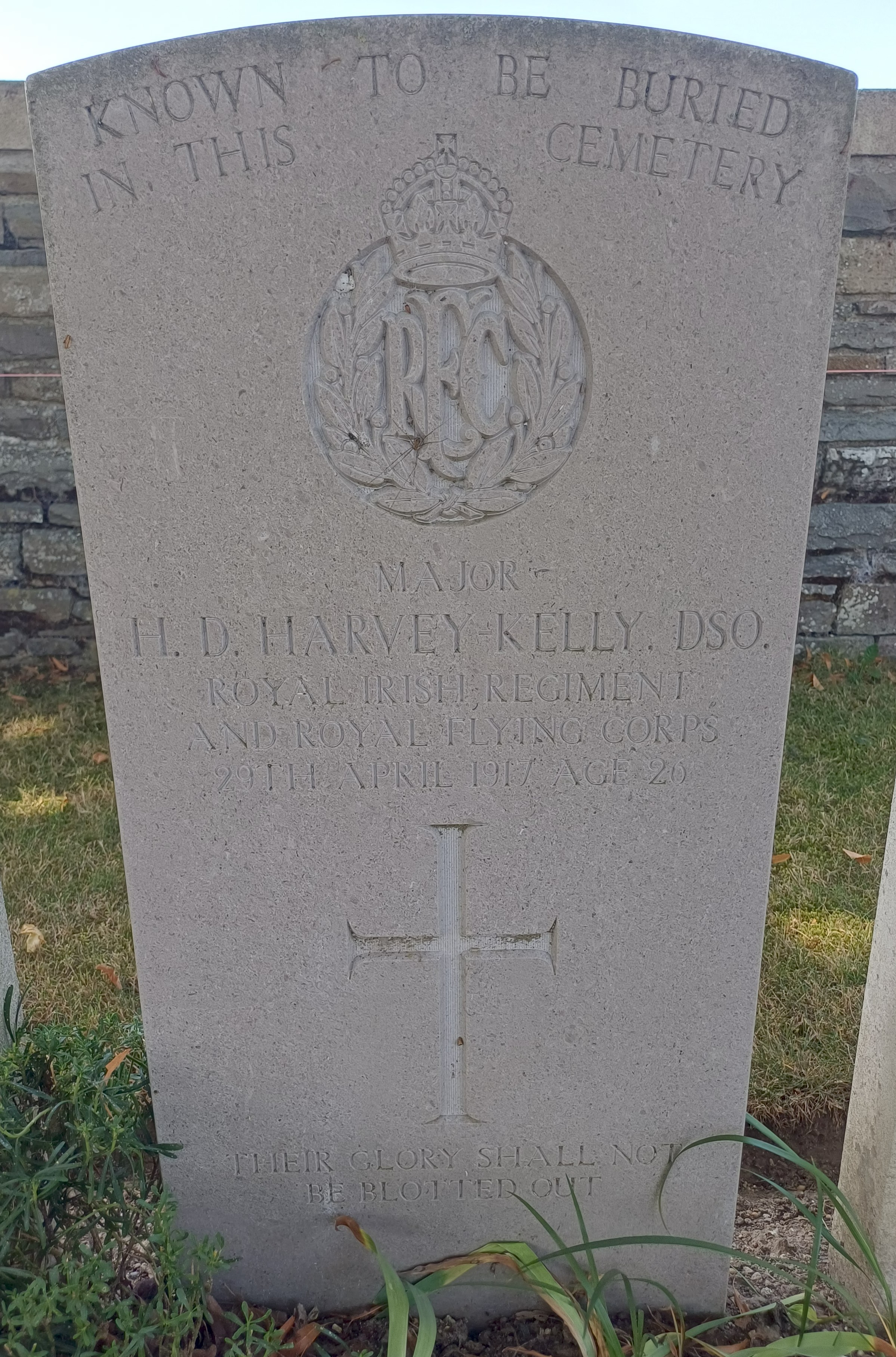
Fighting furiously, Bay was shot down by Kurt Wolff, the highest scoring German pilot during Bloody April. Three days after crash landing he succumbed to his injuries, aged 26, and he was eventually laid to rest in Browns Copse Cemetery, Roeux. The perceptive and adept Maurice Baring, Trenchard's ADC, described him (in the language of the time): "He was the gayest of gay pilots"
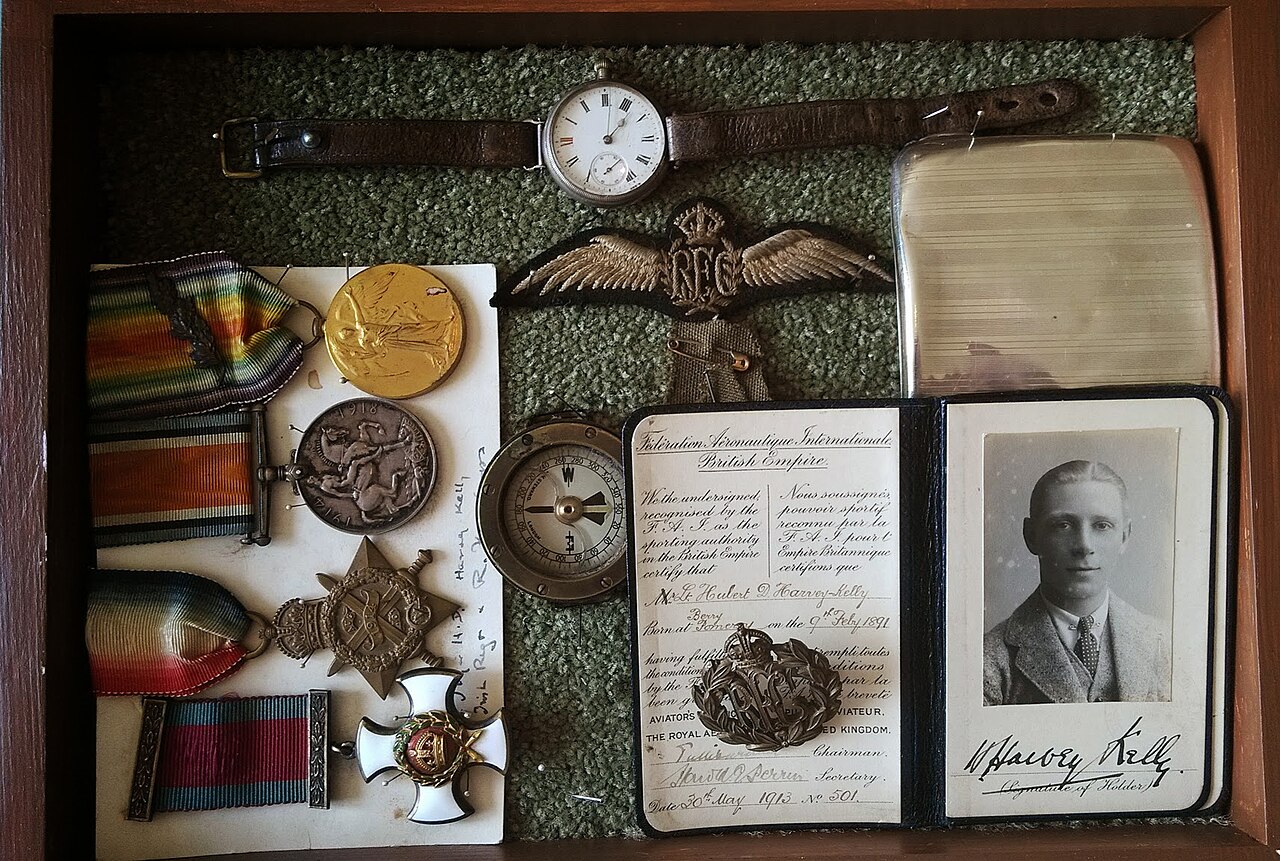
After the war the Harvey-Kelly family received a Red Cross package containing Bay's watch, knee compass, and cigarette case recovered from the crash. They remain in the family.
Becoming a member of The Western Front Association (WFA) offers a wealth of resources and opportunities for those passionate about the history of the First World War. Here's just three of the benefits we offer:

With around 50 branches, there may be one near you. The branch meetings are open to all.

Utilise this tool to overlay historical trench maps with modern maps, enhancing battlefield research and exploration.

Receive four issues annually of this prestigious journal, featuring deeply researched articles, book reviews and historical analysis.


