
Cavalry Memorial, Stanhope Gate, Hyde Park Corner
In 1919, by the time the First World War was over, the future of the Cavalry looked bleak as during the conflict they had been sidelined and only allowed to play a relatively minor role in the fighting. Their traditional military role had been undermined by the use of new methods of warfare including the invention of the machine gun and other new destructive forms of weaponry as well as the use of gas. In addition, by 1916, the introduction of armoured tanks which carried a small crew were destined to take the place of man and horse in warfare. This is not to belittle in any way the sacrifice made in the war by the British Empire's cavalry which had lost a lot of men and horses and, according to figures quoted by the Marquis of Anglesey in Volume 8 of his History of the British Cavalry 1816-1919, the total number of casualties suffered by the cavalry arm of the BEF during the Great War was 19,051 of whom 4,421 were killed or died. In addition, the ratio of officer deaths was greater than in the Infantry.[1]
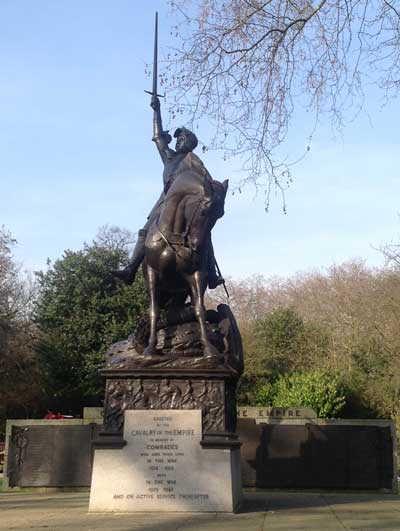
It was these casualties which were to lead to the idea of a suitable memorial being erected on a suitable site in central London and much of the story of the gestation of this commemoration is to be found in the National Archives (Work 20/147) [2] beginning with a letter dated 8 January 1920 from the Cavalry Club to The First Commissioner of Works, Sir Alfred Mond. The letter reported that, after a meeting of cavalry officers under the chairmanship of Field Marshal Sir Douglas Haig, a committee was formed which was to report on arrangements for a suitable memorial in memory of cavalry members who had fallen in the Great War. It was intended that any such memorial should commemorate the memory of regulars and yeomanry from Great Britain as well as the dominions. A prominent position would be sought which would be 'seen by the public and on a route traversed by soldiers proceeding on duty and followed by military processions on ceremonial occasions.' This letter was signed by Lord Valentia and Brigadier-General Lumley. The Cavalry had its eyes on a site in The Mall, or perhaps Hyde Park Corner, and were determined not to accept anything less. [2]
Six weeks later at a meeting on 23 February, the Government Committee on Sites and Memorials [2] suggested a suitable position for such a memorial opposite Marlborough Gate in the Mall but, by January 1922, this idea had been dropped in favour of a position at the Duke of York's Steps. In a letter of 2 May the Cavalry Club suggested to the Earl of Crawford, who by now had succeeded Mond as the new First Commissioner of Works and who was also a member of the Cabinet, that a site on Horse Guards Parade or a position between Stanhope and Grosvenor Gates in Hyde Park might be more suitable. At this point and without being in possession of the full facts, Sir Douglas Haig discussed the situation with the King and, under a misapprehension, the King stated a preference for a position in Horse Guards which in fact had already been reserved for a memorial to Lord Kitchener who had died in 1916.
As so often in these kind of planning cases, discussions dragged on, with the Office of Works expressing a preference for a site just inside the Stanhope Gate which would be between two lodges and in front of Dorchester House.
It was already known that such a position would receive the support of the Metropolitan Police on traffic grounds and that the King would also be happy with this choice of site. The architect, Sir John Burnet (1857 - 1946) was appointed to adapt the original design of the architectural setting, made from Portland stone, for the proposed memorial to this particular site and to also make a few changes suggested by the King to the two entrance gates. At some point it was decided to give the dragon Kaiser Wilhelm ll's upturned moustaches.
By 1 May 1923, The Times [3] was able to report that work on the memorial was now in hand and that the site would be just inside Hyde Park at Stanhope Gate, with its back to Park Lane. The actual design would allegorical in nature and based on the figures of the patron saint of the cavalry, St George, together with a dragon, 'and in the background will be a bronze tablet with a list of all the Cavalry units of the Empire, some 150 in number, which took part in the war .... extra expenditure had to be incurred on alteration of gates and railings and deviation of water mains...' The funds therefore overran by some hundreds of pounds but the memorial committee under Lumley decided to go ahead anyway and to trust that further contributions would be forthcoming.
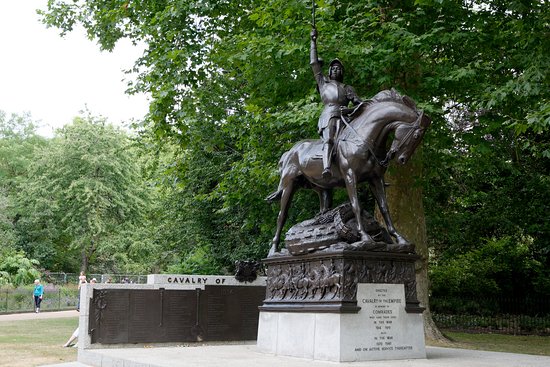
Ten months later The Times [4] reported on 3 March 1924 that the design of the memorial itself would be carried out by Captain Adrian Jones (1845-1938), a very experienced sculptor who had already designed the equestrian figure of the Duke of Cambridge which had been unveiled in front of the War Office in Whitehall in 1907. The Cavalry Memorial would be in the view of those persons who still rode horses in Central London. At this stage the final casts from metal taken from guns used by the cavalry based on the 14th century were in the stage of final completion. The figure of St George was based on a 1454 effigy of the Earl of Warwick who would be portrayed on horseback with the Saint holding an uplifted sword. The horse and its furniture on the other hand was based on a 15th century painting by Albert Durer. A dead dragon would be beneath the horse and show a broken lance driven through it. The slain dragon would signify that 'his season of tyranny is at an end' and the horse was to 'give an impression of rapid action and the thrill of the fight.' The underlying message was to embody a 'composite idea of saint and knight' . In addition, panels forming an artistic frieze were to be used to commemorate soldiers drawn from all Cavalry regiments from the British Empire and the names of these units would be on a background of bronze plate. The design would also include a reference to the four field-marshal's batons to commemorate the four cavalry officers who became field-marshals during the war and who also survived, namely: Haig, French, Allenby and Robertson.
Reading through the archives it is very evident that the familiar arguments of military accuracy as opposed to artistic licence were continuing behind the scenes and some critics would have said that the choice of a design based on historical events of 500 years earlier was hardly bold let alone contemporary. An example of this dispute was aired in a letter to The Times [5] of 8 March in which the correspondent, a Mr A H Henderson-Livesey, commented that the memorial may be alright on artistic grounds but
'will strike every properly trained cavalry officer with dismay. It is supposed to represent a column on the march in the formation known as half-sections, and in this formation it is essential that each pair ride "a half horse's length' behind the pair in front; a squadron proceeding in the manner depicted on the panel would suffer more casualties on the march than at the hands of the enemy. The column is presumably supposed to be moving forwards, but all the horses are reigning back - except the one in the centre, which is being reigned back but is moving forward. Must truth always be sacrificed to art? ... '
Young recruits will be shown the memorial as an example of how not to do it.
Despite much haggling, the memorial was duly unveiled on Wednesday, 21 May 1924 by Field Marshal The Earl of Ypres (formerly Sir John French) and the Prince of Wales accompanied by Prince Arthur of Connaught and the Chaplain-General of the Forces. Many cavalry units from the Empire as well as the Britain were represented at the ceremony and The Times [6] of 22 May 1924 reported that '... during the unveiling ceremony detachments of troops were on parade representing all branches of the mounted services of the British Army at home and abroad... The troops stretched in double file from either side of Stanhope Gate to an enclosure beyond the roadway, where a large company had gathered to take part in the dedicatory service.'
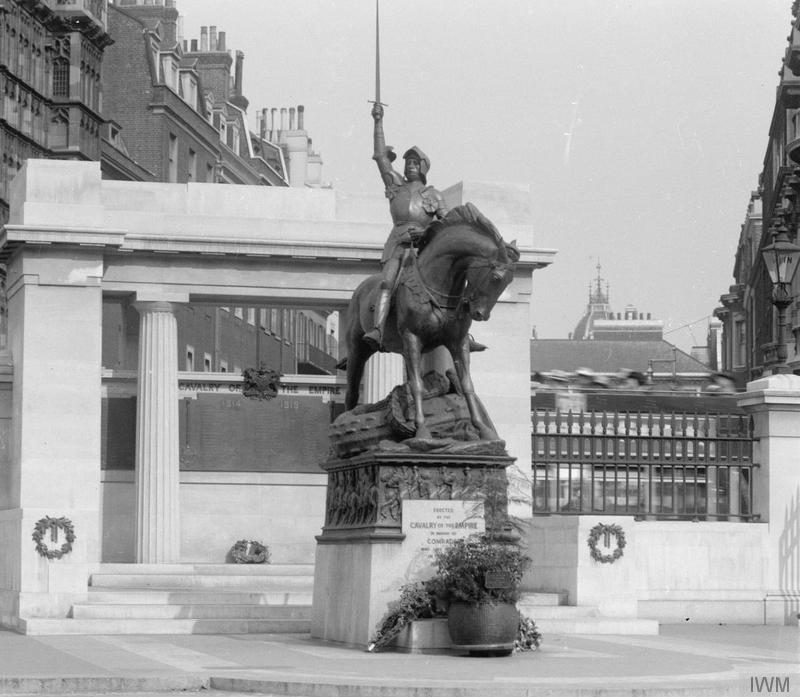
After two verses of the hymn "O God, our Help in ages past" the Earl of Ypres together, with Earl Haig and Sir William Robertson, stepped forward and facing the assembled company gave a short address.
As was customary with many of the war memorials erected between the two world wars, the memorial was to attract its fair share of criticism after its unveiling and, in his book on London's open air statuary, Lord Gleichen wrote in 1928: [7]
It is difficult to avoid, however unwillingly, making invidious comparisons between the Artillery (1925) and the Cavalry Memorials. But even if one deliberately thrusts the former out of one's mind, it must unfortunately be said that the effect of the latter is somewhat insignificant. This is doubtless largely owing to the fact that a Cavalry regiment is a small unit (barely half the size of a battalion).
That there are not many of them in the Regular Army, and that it must have been very difficult to collect adequate subscriptions from the numerous Cavalry corps, largely Indian and Colonial, many of which, though here commemorated, were disbanded immediately after the War, and very few of whose members would be likely ever to see the memorial. As a matter of fact, a considerable portion of the subscriptions had to be spent in rearranging the gates and railings of the Park at this point, so that little enough remained for the memorial itself.
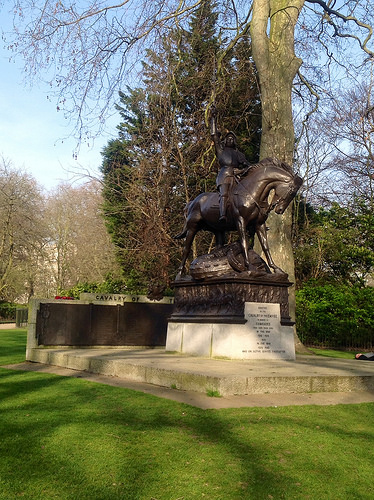
The main group is a good equestrian statue (in bronze) of a youthful St George - only four inches over life-size – standing, sword in hand, over a curled-up dragon on a low and somewhat circumscribed pedestal of Portland stone. The stone screen which forms the background and is inscribed with the names of the four Cavalry Field–Marshals, French, Haig, Allenby, and Robertson - and of the Cavalry regiments engaged in the Great War, has been criticised with some justice as being small in proportion, too straight, and too far away from the group....' The inscription ran: "Erected by the Cavalry of the Empire in memory of comrades who gave their lives in the War, 1914 - 1919".
In 1961 after a second world war and owing to the need of widening Park Lane the Cavalry Memorial had to be moved from its position in front of Stanhope Gate three hundred yards back in the direction of Serpentine Road. However the memorial was then shorn of Burnet's classical setting. In addition it was decided that the memorial needed to have an additional inscription in order to commemorate the casualties from the Second World War, a commission which was ready in time for the annual Cavalry parade on 3 May 1964. The additional wording read: 'Also in the war 1939 -1945' and this cost the Cavalry Club just under £30. The addition of this inscription had first been discussed in 1946. [8]
The Combined Cavalry Old Comrades Association Memorial Parade takes place annually on every second Sunday in May which is named Cavalry Sunday. Normally it consists of a march past and short service.
In recent years the main parade has been followed by tributes being made at the nearby memorial to the four members of the Blues and Royals (Household Cavalry Mounted Regiment) and seven horses killed in an IRA atrocity of 24 July 1982 when a troop was on its way to changing of the guard duties at Buckingham Palace.
In addition twenty-two soldiers and civilians were wounded. A memorial was set up close to where the outrage took place which is set in within a low hedge in the shape of a horseshoe. Each time The Queen's Life Guard or other bodies of Household Cavalry pass the spot, 'they bring their swords down from the slope to the carry, coupled with "eyes left" or "eyes right" as a mark of respect. In addition Bands when passing the scene cease playing as they approach the spot, and only resume once they have passed .
Bringing the story of the memorial up to more recent times, the Prince of Wales took the salute at the Combined Cavalry Old Comrades Association annual parade in Hyde Park on 11 May 2008, the 84th anniversary of the unveiling.
Acknowledgements
With grateful thanks to Dr Graham Keech who carried out much of the initial research on the author's behalf and also with gratitude to Andrew Fisher, Eleanor Fisher and Michael Gliddon.
Acknowledgements
Jones, Adrian - Memoirs of a Soldier Artist (Stanley Paul) 1933
Leetham, Arthur - Particulars Concerning The Cavalry War Memorial At
Stanhope Gate, Hyde Park, W. (R.U.S.I.) May 1924.
References:
1. Anglesey, The Marquess of F.S.A. A History of the British Cavalry 1816-1919 Volume 8: The Western Front, 1915-1918 Epilogue, 1919-1939. (Leo Cooper)
2. National Archives: WORK 20/122147
3. The Times 1 May 1923.
4. The Times 3 March 1924.
5. The Times 8 March 1924.
6. The Times 22 May 1924.
7. Gleichen, E W, London's Open-Air Statues. ( Longmans ) 1928.
8. National Archives: WORK 20/251.
Becoming a member of The Western Front Association (WFA) offers a wealth of resources and opportunities for those passionate about the history of the First World War. Here's just three of the benefits we offer:

Identify key words or phrases within back issues of our magazines, including Stand To!, Bulletin, Gun Fire, Fire Step and lots of others.

The WFA's YouTube channel features hundreds of videos of lectures given by experts on particular aspects of WW1.

Read post-WW1 era magazines, such as 'Twenty Years After', 'WW1 A Pictured History' and 'I Was There!' plus others.


