
Prince of Wales's Own Civil Service Rifles Memorial, Somerset House
At the beginning of August 1914, the 15th (County of London) Battalion, the London Regiment (Prince of Wales's Own Civil Service Rifles), a territorial battalion which had been formed to attract civil servants, left London for Wiltshire and their annual camp on Salisbury Plain. However, within 24 hours, the 800 strong battalion was back at Somerset House, their headquarters in the Strand, on 4 August when they were officially mobilised and the men temporarily accommodated in the corridors of Somerset House.
After training in Somerset House and later in Hertfordshire the 1st Battalion began its active service with the 47th ( London) Territorial Division in March 1915 and was to serve in most of the main Western Front battles including Loos; Somme, Passchendaele and 1918. In 1915 they became the 1/15th (County of London) Battalion, The London Regiment (Prince of Wales's Own, Civil Service Rifles)* as the number of volunteers from the civil service had led to the raising of a 2nd Battalion. The second battalion arrived in France in June 1916 before being transferred to Salonika in January 1917, followed by service in Palestine. So, all told, during the period of the war, the three battalions (two active, one reserve) of Riflemen served on the Western Front; Ireland, Salonika, Egypt, Palestine and Italy. During these campaigns they lost 1,240 officers and men. At the end of the war, the battalions were disbanded.

After the war the idea for a war memorial was first mooted in 1919 by Colonel Parish DSO MC, a late adjutant and commanding officer of the 1st Battalion, but initially it was found that the necessary funding of £750 could not be easily raised. It was partly because of this delay that it was not until July 1923 that permission was given by the Office of Works for a suitable commemorative memorial to be erected in the quadrangle of Somerset House where the battalion trained both prior to, and during, the Great War. The quadrangle had been used as a parade and drill square for 50 years prior to the Great War. Initially the 'Committee on Sites for Monuments' suggested the memorial should be in the 'doorway facing the courtyard, at the back of the Neptune Monument' but, after seeing the site, Parish's chosen architect, Sir Edwin Lutyens, considered the centre of the quadrangle in Somerset House to be a much more suitable position. Today, this site can be said to have been behind the statue to King George III. There had been concern that beneath the centre of the Quadrangle were tombs of attendants of the Roman Catholic Queen Henrietta Maria which might be damaged but Lutyens said these would be protected.
The design of the memorial was to take the form of a rectangular stone column made from Portland stone. The cost for the memorial would be paid for from donations, regimental funds and from the sales of the recently published regimental history. Lutyens visited the site again in May 1923 and the Nine Elms Stone masonry works, a much favoured builder used by Lutyens, was selected to carry out the work under his supervision. The memorial was to be set on a low pedestal with a base of three shallow steps. The top of the column would be ornamented by bronze laurel wreaths with an urn on top. On the east and west sides would be painted and varnished flags, suspended from a flag staff. These would represent the regimental colours and the Union flag. The names of the fallen would be recorded on a scroll which would be placed within the column and the Civil Service Cadet Battalion would be also commemorated. At the base of the structure would be a list of the main military engagements in which the regiment had taken part during the war. The appropriate wording on the north side was to include the following inscription:
This column was erected by the 15th County of London Battalion, the London Regiment, Prince of Wales's Own Civil Service Rifles.
On the south side would be the inscription:
In memory of the 1, 240 men who fell with the Regiment in the Great War. Their names are recorded on a scroll placed within this column.
On the remaining east and west sides would be the regimental colours and around the base were to be listed the engagements in which the regiment took part.
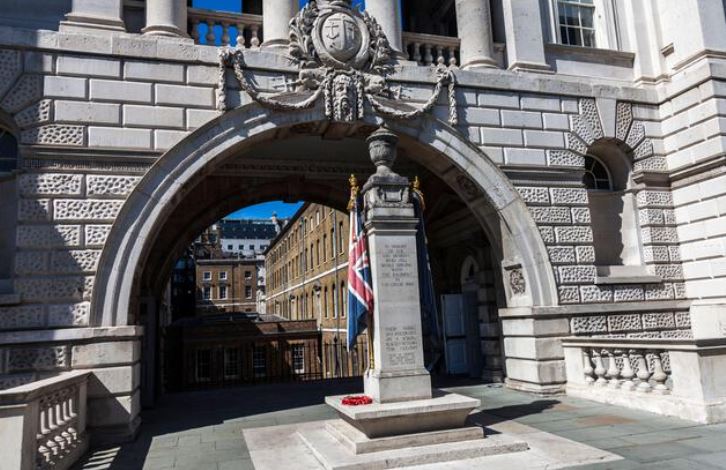
Once approval of the design had been given, work on the memorial proceeded quickly and it was unveiled by the Prince of Wales, the regiment's Honorary Colonel, on Sunday, 27 January 1924. He was dressed in the service dress of a colonel of the Welsh Guards and was received at the Strand entrance; a guard of honour was drawn up on the square. After the unveiling and dedication by the Rev E H Beattie, chaplain to the 1st Battalion in France and Flanders, buglers sounded the 'Last Post' and 'Reveille' and the brief ceremony closed with the singing of the National Anthem. Before leaving the service, the Prince was presented to senior officers of the battalion and, after his departure, wreath laying took place. A roll of honour was included with the programme of the unveiling.
Very soon the memorial's stonework began to show signs of wear which, it appeared, had been caused by it being treated by Messrs Raines & Porter who had used a strong preservative material which led to the stone becoming disfigured; in some places it decayed much sooner than was normal. Lutyens paid Nine Elms to carry out work which, in the end, led to a complete cleaning. Also the flags which, unusually, were made of metal, were repainted in 1927 and again in 1948 (and possibly at other times as well).
In 1928 Lutyens designed a unique receptacle to contain flowers and pots of the base of the memorial. This addition took the form of a shallow stone pit just over 2ft long and nearly 2ft wide with a bronze grill over. This, too, was put in place by Nine Elms and was paid for by a Mrs Middleton.
Annual services of commemoration took place up to the end of the 1980s and in the same decade the Government decided to allow parts of Somerset House to be leased off and, in time, an ice rink and the erection of 50 or so fountains was set up in the quadrangle and other arts events staged. By 2002 the memorial column had been restored and the flags redecorated and relocated to the River Terrace in front of the Navy Treasurer's door on the Embankment side of Somerset House. The memorial was rededicated on 25 July and it can best be reached either via The Strand or from Waterloo Bridge.
Acknowledgements
I would like to thank Dr Graham Keech who carried out much of the original research at the National Archives which included consulting the following files: TNA: WO32/14806 which includes a roll of honour; T 161/212, NSC 25/30, IR 81/216 and Work 20/137.
The Times of 17 and 28 January 1924 was also consulted.
Becoming a member of The Western Front Association (WFA) offers a wealth of resources and opportunities for those passionate about the history of the First World War. Here's just three of the benefits we offer:

The WFA regularly makes available webinars which can be viewed 'live' from home. These feature expert speakers talking about a particular aspect of the Great War.

Featured on The WFA's YouTube channel are modern day re-interpretations of the inter-war magazine 'I Was There!' which recount the memories of soldiers who 'were there'.

Explore over 8 million digitized pension records, Medal Index Cards and Ministry of Pension Documents, preserved by the WFA.


