
The 24th Division Memorial, Battersea Park
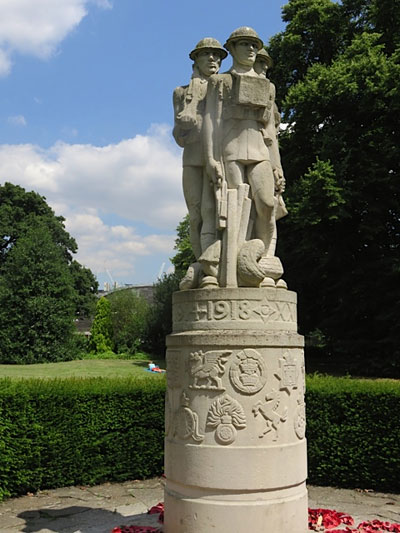
The 24th Division Memorial designed by Eric Kennington was erected in the eastern part of Battersea Park towards Chelsea Bridge and can be found by taking a path to the bandstand. It was unveiled 90 years ago on 4 October 1924 and has been a place of commemorative remembrance on Remembrance Sunday ever since.
This Kitchener Division was formed towards the end of September in 1914 in the area of Shoreham in Sussex. In June 1915 it moved to Aldershot for its final training before leaving for France at the beginning of September. Its blooding was in October when it took part in the Battle of Loos. It later served in the Ypres Salient, the Somme, Vimy Ridge and the German Offensive in March 1918.
The sculptor Eric Kennington's active war service was pretty brief and he was was a member of the 1/22nd (County of London) Battalion, the Artists Rifles, attached to the 2nd London Division before being transferred to the 13th (County of London) Battalion (Kensingtons) of the same division. He served in the trenches in the period between November 1914 and January 1915 and during this time witnessed the Christmas Truce. His active service on the Western Front lasted 78 days when he accidentally shot himself in the foot and the wound later became badly infected; he spent the next 6 months in hospital and convalescent homes before being discharged as physically unfit. In 1917 he was appointed to be one of the official war artists and was sent to France.
It was while Kennington was working as a war artist with the 24th Division that he met with the commander of the 9th Royal Sussex, Lt Col M V D Hill, in November 1917. This battalion, part of the 24th Division serving on the Western Front, had provided hospitality for the artist in November and December. After the Division was disbanded in March 1919 it appears that Hill asked Kennington if he knew the name of a good sculptor who would make a suitable memorial to his Division.
Kennington promptly offered to design a memorial tribute to the 24th Division himself. The site finally agreed upon was to be on the east side of Battersea Park. Former members of the 24th Division had been balloted as to their views for a suitable site and they had chosen Battersea Park. The original idea was to have the memorial at a site in Le Vergurier, France but this had been vetoed. Kennington also carried out work on the Soissons Memorial in Northern France which was later unveiled in July 1928.
Kennington was also a friend of the sculptor Eric Gill and purchased a block of Portland stone from him for £300, which was to be used to for the memorial. This £300 was a sum which kept Gill solvent for some time. At first, professional masons worked on the stone, which allowed the basic shape of the design to emerge before the artist started work on the actual carving process.
Not only did Kennington offer his services but he agreed to provide the funds to cover the cost of the Portland stone as well as for its transportation to his studio. He would also carry out the commission for free. In the end his only payment was an engraved silver cigarette case. According to J Black (1) the sculptor worked in 'a shed-cum-studio' in a Thames side wharf opposite his new home, No 1 Riverside, Chiswick Mall. He also became an official war artist in the Second World War.
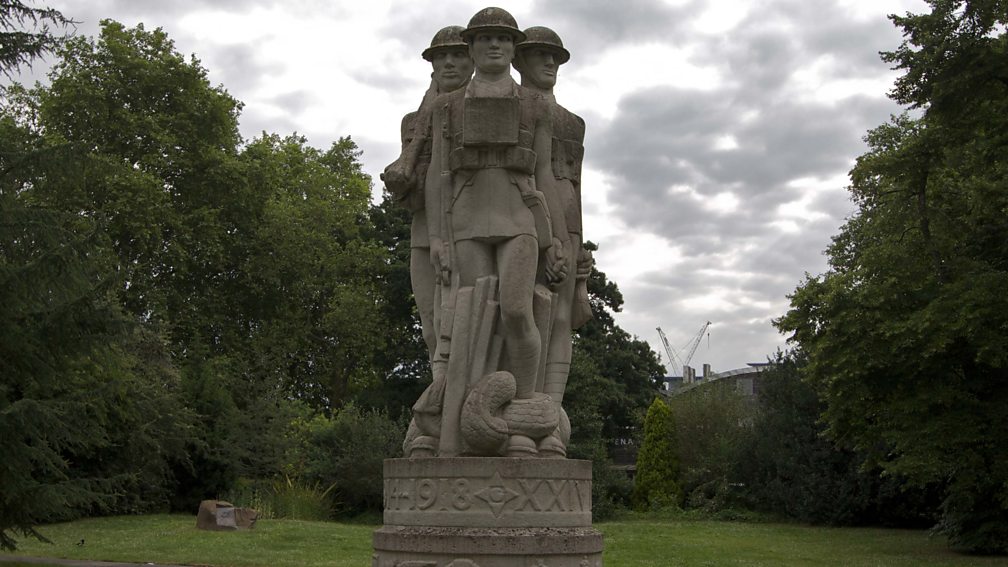
In November 1922, the Illustrated London News published a picture of a 13½ inch-high bronze maquette of the memorial. The six and a half foot figures of the three soldiers were based on men who actually served with the Division: Trooper Morris Clifford Thomas of the Machine Gun Corps; Sergeant J Woods, the central figure, who belonged to the 9th Royal Sussex and was a batman/ bodyguard during the sculptor's stay with the battalion in the last months of 1917; and the poet Robert Graves of the 2nd Royal Welch Fusiliers, the right hand figure. The main inscription was carried out by a Miss Lucy Sampson, a sculpture student, and she also assisted in the carving of the regimental badges at the base.
In 1924 the memorial was unveiled by the former Field Marshal Lord Plumer and dedicated by the Bishop of Southwark. A large crowd attended the ceremony, many of the women wearing black,. There was also a guard of honour and Sir John Capper, former divisional commander, gave a short address in which he revealed that 4,865 men from all ranks of the Division had been killed during the war; 24,000 wounded and 6,000 missing. The inscription reads: '1914-1918 XXIV Division France' . At the end of the service, the memorial was formally accepted by the Chairman of the London County Council.
In his book on London statues, published in 1928, Lord Gleichen (2) wrote rather stuffily of the memorial:
... The limited group of people who admire 'futuristic' art will doubtless highly approve of this monument. It represents in stone three tin-hatted figures; a sergeant, a corporal and lance-corporal - crunched together and looking straight to their front, while a serpent disports itself among their legs - which, by the way, are held together with stone billets. The fore-end of one man's rifle has had to be cut away in order to get it under his hat; and there are no folds to their clothes anyway.
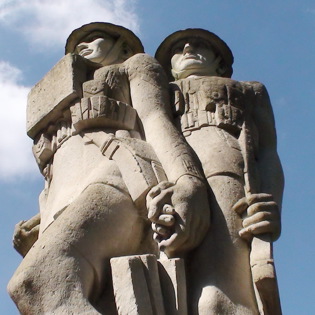
In her book on modern art, Sue Malvern (3) wrote that Eric Kennington carved the monument publicly in the grounds of his studio in Chiswick Wharf and in 1989 John Blackwood wrote (4) of the bunched up figures were meant to:
illustrate the claustrophobia of the trenches. The fact of the figures holding hands symbolises the intense companionship, in the trenches which grew up in the face of hardship and death.
Acknowledgments and thanks are due to the following:
The National Archives, Kew
The Times
References:
(1) Black, Jonathan - The Sculpture of Eric Kennington ( Lund Humphries, 2002)
(2) Gleichen, E W - London's Open Air Statues ( Longmans ,1928)
(3) Malvern, Sue - Modern Art, Britain and the Great War ( Yale University Press, 2004)
(4) Blackwood, J - London's Immortals: the Complete Outdoor Commemorative Statues. (Savoy, 1989)
Michael Gliddon for the picture.
Becoming a member of The Western Front Association (WFA) offers a wealth of resources and opportunities for those passionate about the history of the First World War. Here's just three of the benefits we offer:

This magazine provides updates on WW1 related news, WFA activities and events.

Access online tours of significant WWI sites, providing immense learning experience.

Listen to over 300 episodes of the "Mentioned in Dispatches" podcast.


