
The Battle of Loos – a poet’s view
Robert Graves (1895-1985) was born in Wimbledon, London, son of Alfred Perceval Graves, poet and school inspector and Amalia (née) von Ranke. Both parents came from prosperous (respectively Anglo-Irish and German) families with professional connections. Graves was educated at Charterhouse where he achieved but was unhappy. He was anxious about going to Oxford University straight from school and while on holiday in Harlech when war broke out he decided, outraged by the German violation of Belgian neutrality, but otherwise without much thought, to volunteer.
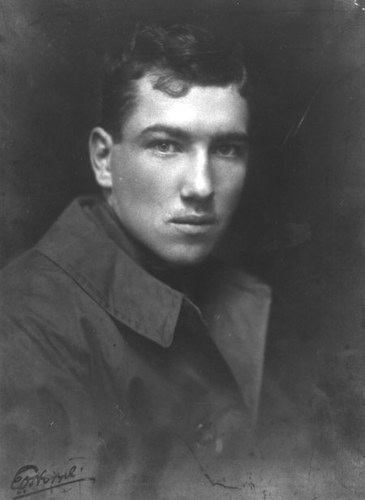
By the time of the Battle of Loos Robert Graves was a lieutenant. His battalion, the 2nd Royal Welch Fusiliers, was in 19th Brigade, 2nd Division, I Corps, First Army in the north of the battlefield below the La Bassée Canal. OC 2nd Division was Major General H Horne.
Extracts below from Robert Graves partial autobiography 'Goodbye to All That' are in italics.
By September 1915 Graves had shed any favourable illusions he may have once had about the war. It would seem that at least some of his brother officers shared his cynicism. Even Captain G O Thomas, his company commander and a regular of 17 years' experience, described as 'skite' the orders for the forthcoming battle he had received. Graves dutifully copied down the 'skite' on the back of the map of the battlefield he had been given.
Captain Thomas: 'There will be no troops in support. We've just got to go over and keep the enemy busy while the folk on our right do the real work. You notice the bombardment is much heavier over there ... Personally, I don't give a damn either way. We'll get killed whatever happens'
We all laughed.
'All right, laugh now, but by God on Saturday we've got to carry out this funny scheme.'
Graves mentions the use of poison gas that so concerned General Haig. His orders referred to it as the 'accessory' so as to keep it secret. As Graves recalls, Captain Thomas had little faith in it: 'It's damnable. It's not soldiering to use stuff like that even though the Germans did start it. It's dirty, and it'll bring us bad luck. We're sure to bungle it. Take those new gas-companies – sorry, excuse me this once, I mean accessory-companies – their very look makes me tremble. Chemistry-dons from London University, a few lads straight from school, one or two N.C.O.s of the old-soldier type, trained together for three weeks, then given a job as responsible as this. Of course they'll bungle it. How could they do anything else?'
Temporarily, and briefly, withdrawn to Bethune before the battle, Graves writes about a dinner he attended: 'It was, as someone pointed out, like a brutal caricature of the Last Supper in duplicate. In the middle of the long table sat the two pseudo-Christs, our colonel and the divisional General.'
Graves reports the comments of a senior staff officer he overheard : ' ... see that silly old woman over there? (What follows doesn't sound like a description of Major General H Horne, OC 2nd Division. But it could possibly apply to Major General Sir John Ramsay, in Sheffield and Bourne's phrase, 'dug out of retirement' in 1914 to raise and train 24th Division. Replaced after the battle.) Calls himself General Commanding! Doesn't know where he is; doesn't know where his division is; can't even read a map properly. He's marched the poor sods off their feet and left his supplies behind. God knows how far back. They've had to use their iron rations and what they could pick up in villages. And tomorrow he's going to fight a battle. Doesn't know anything about battles ... and tomorrow's going to be a glorious balls-up ... no exaggeration. You mark my words!'
Within a few minutes of the start of the battle lightly wounded men of 1st Middlesex, the first in the attack, came stumbling back down a communication trench to the dressing station. To Graves' request for information came the response: 'Bloody balls-up.'
Graves relates the confusion surrounding the release of the 'accessory' in the north of the battlefield. The commander of the gas company in the front line phoned through to divisional headquarters: 'Dead calm. Impossible discharge accessory.' The answer he got was 'Accessory to be discharged at all costs.' Thomas had not overestimated the gas company's efficiency. The spanners for unscrewing the cocks of the cylinders proved, with two or three exceptions, to be misfits. The gas men rushed about shouting for the loan of an adjustable spanner. They managed to discharge one or two cylinders; the gas went whistling out, formed a thick cloud a few yards off in No Man's Land, and then gradually spread back into our trenches.' German artillery opened up accurately and direct hits on the front-line trench broke several of the gas-cylinders and the trench filled with gas.
German shells had already destroyed the Royal Welch's signals dugout and cut communication with divisional HQ. This had resulted in the premature advance of 1st Middlesex who were shot down by accurate German machine gun and rifle fire. 'B' and 'C' Companies of 2nd Royal Welch followed them into the attack and suffered equally heavy casualties. 'D' Company and Graves' 'A' Company reached their front line but their advance was postponed. No advance had been made in this sector. However, Graves mentions that '... things were better on the right, where there had been a slight wind to take the gas over. According to one rumour, the First, Seventh and Forty-seventh Divisions had broken through.'
Graves and the survivors of the Royal Welch '... all went out to get the wounded ...' at dusk. 'The Germans behaved generously. I do not remember hearing a shot being fired that night, though we kept on until it was nearly dawn ...'
That same day Graves saw what happened to the reserve 21st and 24th Divisions as they attempted to follow up the initial attack. 'Pushed blindly into the gap made by the advance .... on the previous afternoon, they did not know where they were or what they were supposed to be doing. Their ration supply broke down, so they flocked back, not in panic, but stupidly, like a crowd returning from a cup final, with shrapnel bursting above them. We could scarcely believe our eyes ....'
2nd Royal Welch prepared for a further attack but it was abandoned. Each night Graves and his men went out to fetch in the dead in the pouring rain – a task which Graves found literally nauseating.
On 3 October, 2nd Royal Welch were relieved by another battalion and left the battlefield.
It shows no disrespect to the memory of Robert Graves to mention that he got into a lot of trouble over alleged inaccuracies in 'Goodbye to All That'. It was written in great haste, through dictation, in only two months and largely for the purpose of raising money which Graves was in great need of. Nevertheless, in Chapter 15 which describes his and the Royal Welch's experiences at the Battle of Loos, he accurately outlines some of the key events and characteristics of that battle, namely:
- hasty and inadequate planning;
- serious problems with the use of poison gas;
- problems with communication;
- intense and accurate German artillery fire;
- problems with the movement and supply of large numbers of troops;
- the dreadful fate of the 21st and 24th reserve divisions.
Of course, Graves benefited from writing 'after the event' and with the 'wisdom of hindsight'. But we should not forget that he actually was at the event and that the passage of 14 years did not diminish the horror he experienced at the event.
'Goodbye to All That' was, and remains, a very appealing book, not just because of its content but also because of the way in which it was written in straightforward and accessible English. Graves' ear for dialogue results in the record of impressively authentic sounding conversations (enhanced, perhaps, because the book was dictated). Graves' style of writing in 'Goodbye to All That' would not seem anachronistic if it were adopted in a contemporary piece. It is sober and vivid at the same time. Its impact is so strong and immediate that one is sometimes startled to remember on reading it today that 'Goodbye to All That' was actually written nearly 86 years ago. It is a golden key which helps unlock some understanding of the Great War in all who read it.
Becoming a member of The Western Front Association (WFA) offers a wealth of resources and opportunities for those passionate about the history of the First World War. Here's just three of the benefits we offer:

Identify key words or phrases within back issues of our magazines, including Stand To!, Bulletin, Gun Fire, Fire Step and lots of others.

The WFA's YouTube channel features hundreds of videos of lectures given by experts on particular aspects of WW1.

Read post-WW1 era magazines, such as 'Twenty Years After', 'WW1 A Pictured History' and 'I Was There!' plus others.


