
The Heilsberg 39: a report on the dedication of the new cemetery
We were blessed with good weather, for once; something not necessarily guaranteed in recent weeks. I attended the ceremony with two British friends. Being ex-army, I decided to wear my old beret and regimental badge (OK, I bought new ones for the occasion). I also had a poppy wreath which The Western Front Association had asked me to lay on their behalf.
We had thought it would just be a small affair, with a few local dignitaries; however, as we reached the town of Lidzbark Warminski, we began to see local scouts, in uniform, with flags and flowers. Then we saw a number of "Kombatants", old army veterans, in uniform and with wreaths. I stopped to buy a small wreath to lay separately on the memorial pyramid built by Russian troops in 1916. I had written a card out in several languages; Latin, Italian, Serbian and French to commemorate the other nationalities buried there, over 2,600 other men who had been POWs of Heilsberg camp.
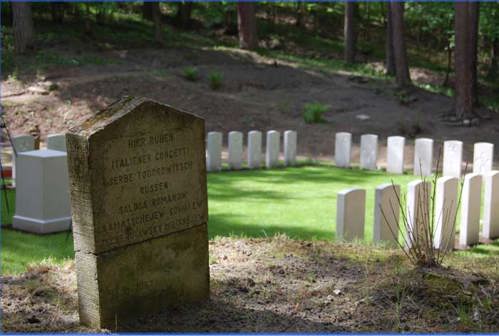
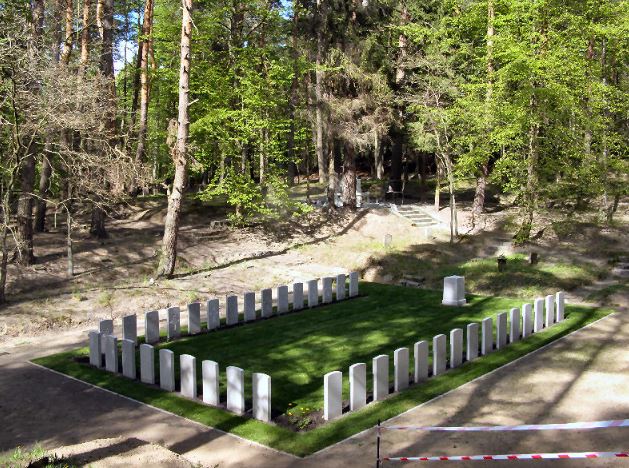
We drove out of town and to the area of Markajmy, just outside Lidzbark Warminski, where the cemetery is situated. We saw more scouts, a new signpost (in English). At the entrance to the cemetery, some children were distributing information leaflets in Polish and English. I laid my wreath at the Russian pyramid and then met some members of RBL and CWGC. Walking up to the British plot, we noticed some scouts and schoolchildren laying out a line of grave candles (in glass jars) which are very common in Poland. The British plot is situated in a dip, with slopes on each side. The schoolchildren lined up along the ridge, facing down onto the British graves.
I was invited into the dignitaries' tent, where I met the Defence Attache and Assistant Attache, as well as the British Ambassador. During the course of the day I also met Mr Xenon Drozd, a local man who was responsible for the restoration of the Cross of Sacrifice and Mr Slawomir Skowronek, a local historian, whose tireless work has yielded much valuable information about the Heilsberg camp and the cemetery, some of which is now presented on a new information plaque by the British plot.
The ceremony started with the sound of a squad of around 20 Polish soldiers from the local battalion marching through the trees and lining up beside the graves. As well as the 100 or so dignitaries (local politicians, representatives of official Polish organizations and veterans) the cemetery was also lined with scouts and veterans, carrying colours. Other people, ordinary members of the public, were also present, many with flowers.
The local mayor, Mr Artur Jankowski, began the service, welcoming the guests, including the British Ambassador, His Excellency Mr Robin Barnett and the CWGC Vice-Chairman, Sir Joe French. Mr Barnett spoke in Polish and English about the sacrifice of the brave men who lay there and across the globe and the continuing importance of remembering the fallen of all wars, especially the Great War. He was followed by Sir Joe French, who spoke of the work of the CWGC and the story of the Heilsberg cemetery, its decline and its restoration, praising all those members of the British, Belgian and Polish teams which had made it possible.
At one point in his speech, Sir Joe introduced two guests, nephews of one of the resting soldiers, Private William Jones of the Durham Light Infantry (although originally from Wales). The gentlemen had travelled over as guests of CWGC from Llanfyllin in Wales (along with Mr Martin Beddoe of their local RBL). Sir Joe told how their poppy wreath contained a picture of a Scots Pine tree. The story was a touching one. In the little village where William Jones had grown up, there was a solitary Scots Pine outside his house. Following the war, new generations of the family would look at this tree as a symbol of his memory, knowing he'd have gazed on it. Sadly, the tree was uprooted in storms in February 2014. However, Sir Joe pointed out, directly behind the headstone of William ... there stood another pine tree, his new headstone giving him a new tree and a memorial for future generations.
I later mentioned to one of the Jones brothers that the word "Spruce" is believed to come from the Polish phrase "Z Prus", "From Prussia", where William now lies.
Following his speech, Sir Joe stood aside for a young Polish girl to read the names of the fallen. He then read the Act of Remembrance.
The shout came from the Polish NCO, and the squad of soldiers raised their rifles and fired three volleys in salute, followed by a Polish bugler sounding the Last Post from beside the original Cross of Sacrifice, erected in 1931.
At this point, I don't mind saying, the tears began to well up. These young men, possibly veterans themselves of Iraq or Afghanistan, the old men and women who fought in the Second World War, these young children, schoolchildren and scouts who have never had to, and hopefully will never, experience war had all come to honour soldiers, men and young lads, of a long gone conflict. And they did it bloody well!

Following the Minute's Silence, the bugler played the Polish lament, "Spij Kolego" (Sleep Comrade). A priest then spoke a prayer and dedication before another little girl read out John McCrea's "In Flanders Field". We then laid the wreaths. As well as the local politicians and representatives of the official organizations, members of the Second World War Polish underground, prisoners from the Soviet camps in Siberia and other veterans also paid homage. The Jones brothers laid their wreath at William's grave, before paying their respects to the central monument. In the midst of it all, I was asked to lay the wreath for the WFA.
The ceremony continued with a girl reading a piece (in Polish) about the price of freedom. Then the children who had stood for almost 80 minutes at the top of the ridge began to walk down towards the headstones in silent procession, each carrying a grave candle. They proceeded along the stones, walking around until each child was facing a stone and then laid the red, white and blue candles before the headstones. The Defence Attaché began the round of applause for the act.
As the squad of soldiers marched away, we began to leave the tent and walk around, mingling, chatting and, in some cases, swapping addresses. Amongst the gathered onlookers who had come to pay their respects was a small group of American pilgrims who had heard about the ceremony. Their presence and the superb organization of the people of Lidzbark Warminski and other parts of Poland brought honour to our boys, and honour to them. In the midst of it all, I recalled that it was the sacrifice of young men such as the Heilsberg 39 and the other 2600 soldiers and civilians lying in the cemetery around us which had led to the reformation of the Republic of Poland in 1918, after over a century of non-existence.
Becoming a member of The Western Front Association (WFA) offers a wealth of resources and opportunities for those passionate about the history of the First World War. Here's just three of the benefits we offer:

This magazine provides updates on WW1 related news, WFA activities and events.

Access online tours of significant WWI sites, providing immense learning experience.

Listen to over 300 episodes of the "Mentioned in Dispatches" podcast.


