
Private Memorials on the Western Front
In 1999, a member of The Western Front Association, Barrie Thorpe, who was the WFA's memorial's officer produced a book entitled 'Private Memorials on the Western Front'. The book is long out of print. As Barrie sadly died in 2013, it is felt that the reproduction of this book with the help of new digital mapping will bring this work to a new audience.
Introduction to the original book
After the Great War of 1914-19 many bereaved families erected private memorials to their loved ones. In the main these were at home, often in church, or school, factory or barracks. But a number were actually on the battlefields of France and Flanders.
Battlefield memorials to individuals are not unique to the Great War, of course, but previously they had tended to be of a temporary nature - as indeed were most war cemeteries. Huge numbers of men fighting so near to home changed all that. The Graves Registration service of 1915 (later the Imperial, and later still the Commonwealth, War Graves Commission) reflected the need - and the will - to mark, record and preserve burial places permanently on an unprecedented scale.
But it took time for this to be understood and it took time for the principle of 'no repatriation of the dead' to be understood. Some of the bereaved wanted the fallen to stay exactly where they were; many wanted to bring them home. Others wanted a commemoration in the nearest church or cemetery. Some wanted to preserve the piece of land on which their missing son was last seen - for all too often he was the only son and the last of his line.
And so, in the years immediately after the War, arrangements were made in a few special cases for graves to remain in the field instead of being 'gathered in' to the permanent war cemeteries. Private memorials of all kinds were erected, some with permission of landowners and some without, some too fragile to survive many winters, others meant to last forever. But permanent arrangements were made for all too few. Local people cared for most of them but as the years went by they grew older, the visits from home became fewer and gradually the memorials in remoter places began to deteriorate and disappear. And the families of the only sons died out.
Over the years, the battlefield war graves which could no longer be maintained privately have been taken to British military cemeteries. And some private memorials have been taken into the care of the Commonwealth War Graves Commission on a contractual basis at the request of the families. It is important to understand, however, that the Commission's Charter provides only for one place of commemoration for each casualty and any additional memorial must be financed by other means.
Looking at some of these private memorials it was clear to me that each represented a unique part of our history which ought to be preserved. Those in churches and cemeteries were well cared for on the whole and not at risk. Generally, those to French soldiers were also well respected. But what of those 'isolated' British memorials miles from anywhere - literally 'in a corner of a foreign field'? These were at risk - even some in the care of the CWGC were vulnerable to damage which might lie undiscovered for months. Some were deteriorating, others were damaged and several marked on maps were no longer there. Further, there seemed to be no record of how many there were, nor indeed where they were.
In 1991 The Western Front Association adopted a policy of helping to restore existing memorials rather than supporting the building of new ones. Under this policy we decided to try to record and preserve the remaining British and Empire isolated private memorials and graves on the Western Front. Nine years later I believe we have located all that now remain. We have restored some at our expense and helped others to do the same, but this would be of only short-term benefit unless each memorial had a permanent 'guardian' for the future. This meant tracing families and interested parties where they existed and finding new sponsors where they did not. In this we have been extremely fortunate and the memorials and graves described here are now in good hands and their future seems assured.
The purpose of this guide is to help visitors find these memorials, and to tell the story of each one.
Barrie Thorpe, March 1999
In order to view an interactive map showing the Private Memorials featured here, click on the icons below.
You can also find the full list by clicking on the 'side bar' icon in the top left of the area below. It is also possible to zoom in and out and expand the map using the icon in the to right corner.
'Other' Private Memorials
The definition of an isolated private memorial is a matter of opinion so some arbitrary decisions had to be taken. Here are some of the others which WFA members kindly reported:
In the early 1990's a wooden cross appeared on a tree in the Bois d'Hollande near Beaucourt-sur-Ancre in memory of 15258 Pte David Amos, 9/N Staffs who was killed on 21 November 1916 and has no known grave. Despite repeated requests in the WFA's 'Bulletin' no one came forward and there is no clue who put it there. Even the landowner, who is happy for it to remain, knows nothing. It has not been listed in this guide because of its temporary nature and there have been many other examples of these over the years.
There is a permanent plaque in a cave on private land near Noyon commemorating the award of the Croix de Guerre to Lt Col H C Simpson CMG, DSO, RFA who survived both the Boer and Great Wars.
It was sad to find so many memorials have disappeared. Below are just four examples:
Until recently there was a memorial to Lt A G Heath of the 6/Royal West Kents, killed in action on his 28th birthday on 8 October 1915 in the 'Quarries' area west of Hulloch. It still appears on IGN maps. Despite a lot of detective work by Paul Reed, the whereabouts of Lt H D Vernon's memorial was never tracked down. It was known to exist in the region of Lesboeufs. He was in the Grenadier Guards when killed on 15 September 1916.
2/Lt W A F Bailey (2/OBLI) was commemorated by a bronze plaque, of which a photograph exists. This was in the region of Villers-au-Flos. He was killed on 24 March 1918.
Extensive searches were made for a memorial to Lt V T T Rea (2/Royal Irish Rifles, killed 25 October 1914 and buried at Guards Cemetery, Windy Corner, Cuinchy). There had been a wooden cross on what is now an empty plot in the Neuve Chapel Cemetery. Perhaps not only isolated memorials are at risk.
Not all were as they seemed. A memorial to Lt EH Montgomery, RFA, reputedly visited by Mr Anthony Eden MC (later 1st Earl Avon) was reported by a number of people who remembered it beside the road from Ligny-Thilloy to Eaucourt l'Abbaye. Although marked on IGN maps, no trace could be found and it was thought yet another had vanished. But it wasn't quite like that. It was believed two graves were preserved a few yards apart in a formal garden, one for Montgomery and the other for Lt J R Tarras, RFA. But in fact both these officers had been lying in Serre Road No 2 all along and many years passed before the mistake was discovered. Once this was established, the site was cleared.
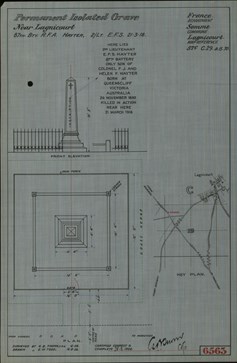
Some graves were gathered because they were at risk. The fathers of 2/Lt E F S Hayter, RFA and Major Wingate (qv) searched together and each bought the piece of ground where he thought his son to be. Mr Hayter subsequently found the remains of his son close by at 57c.C.29.a.3.6 and so his memorial became his grave. By the 1960's the Hayter family had died out and in 1970, concerned for its future, the CWGC moved the grave half a mile to Lagnicourt Hedge Cemetery (see plan of the memorial that marked the isolated grave until it was moved below).
Index
(Click each name below to read about the private memorial)
Ball, Albert VC (Captain, Royal Flying Corps)
Birrell-Anthony, Henry (2/Lt, Monmouthshire Regt)
Blakeley, Thomas (Sapper 61876, Royal Engineers)
Bowlby, Geoffrey (Captain, Royal Horse Guards)
Boyd, Harold (2/Lt, Royal Inniskilling Fus)
Boyle, The Hon James (Captain, Royal Scots Fus)
Braithwaite, Valentine (Lt, Somerset Light Infantry)
Brodie, Ewen (Captain, Cameron Highlanders)
Cecil, George (2/Lt, Grenadier Guards)
Choat, Richard (Sapper 43639, Royal Engineers)
Collingwood-Thompson, Edward (2/Lt, Royal Welch Fus)
Cousins, James (Private 8490, Royal Inniskilling Fus)
Crichton, Cyril (2/Lt, London Regt)
Dickens, Cedric (Major, London Regt)
Dodgson, Francis (Captain, Yorkshire Regt)
Ellison, Charles (Sapper 43609, Royal Engineers)
Fellows, Harry (L/Cpl 13587, Northumberland Fus)
Hartley, Charles (2/Lt, Guards MGC)
Haviland, William (Sapper 59287, Royal Engineers)
Heumann, Richard (Captain, London Regt)
Higgins, John (Sapper 47753, Royal Engineers)
Hill-Trevor, Hillyar (Lt, Scots Guards)
Holland, Charles (Major, Royal Field Artillery)
Isaacs, Henry (2/Lt, Suffolk Regt)
Joiner, James (Sapper 58897, Royal Engineers)
Kennedy, Paul (Captain, Rifle Brigade)
Malcolm, Pulteney (Captain, Grenadier Guards)
Marsden-Smedley, George (2/Lt, Rifle Brigade)
Martyn, Edgar (Lt, Royal Air Force)
Meakin, Herbert (Captain, Coldstream Guards)
Mills, Bertram (Company Sergeant Major 304, London Regt)
Mond, Francis (Captain, Royal Air Force)
Morris, Anthony (Lt, King's Own Royal Lancaster Regt)
'Nine Brave Men' (82 Field Company, Royal Engineers)
Poulter VC, Arthur (Private 24066, Duke of Wellington's West Riding Regt)
Rae, Thomas (2/Lt, Rifle Brigade)
Raper, Robert (Major, South Staffs Regt)
Redmond, William (Major, Royal Irish Regt)
Robotham, Ambrose (Sapper 95180, Royal Engineers)
Skrine, Henry (Captain, Somerset Light Infantry)
Tidswell, Cecil (Captain, Royal Dragoon Guards, RFC)
Torrance, Alfred (Sergeant 2267, London Regt)
Tregidgo, Fred (Pioneer 86972, Royal Engineers)
Vernon, Charles (Sapper 21182, Royal Engineers)
Wallace, Houston (Captain, Worcester Regt)
Wheeler, Albert (Gunner 76586, Royal Field Artillery)
Windeler, Herbert (Lt, Grenadier Guards)
Wingate, Malcolm (Major, Royal Engineers)
Wrenford, Arthur (Lt-Col, East Lancashire Regt)
Becoming a member of The Western Front Association (WFA) offers a wealth of resources and opportunities for those passionate about the history of the First World War. Here's just three of the benefits we offer:

The WFA regularly makes available webinars which can be viewed 'live' from home. These feature expert speakers talking about a particular aspect of the Great War.

Featured on The WFA's YouTube channel are modern day re-interpretations of the inter-war magazine 'I Was There!' which recount the memories of soldiers who 'were there'.

Explore over 8 million digitized pension records, Medal Index Cards and Ministry of Pension Documents, preserved by the WFA.


