
The Landings at Sedd-el-Bahr, Gallipoli
One of the most difficult military operations that can be undertaken is that of an opposed amphibious landing on an enemy shore. When asked to give an example of this kind of operation, many people will automatically think of the famous and successful 'D-Day' landings in Normandy in 1944. However, April 2021 marks the 106th anniversary of an earlier example of this kind of operation when soldiers, sailors and marines from Britain, Australia, New Zealand and France stormed ashore on various parts of the Gallipoli peninsula and Asiatic Turkey. This was an ultimately ill-fated attempt to force the Dardanelles and knock Turkey out of the First World War.
On the 25 April 1915, landings were made at Kum Kale by the French, at the tip of the peninsula (the 'Helles' sector) by the British, and at a beach which was later renamed Anzac Cove by the Australians and New Zealanders
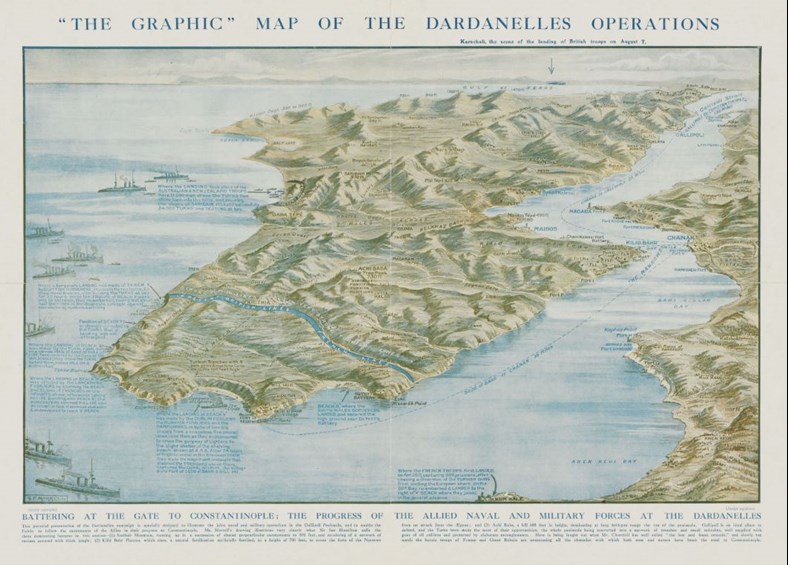
Click here to see a larger version of this map (and click on the image again for a further close-up).
The exploits of the Australians and New Zealanders have, quite rightly, gone down in history as a glorious and extraordinary. The 'six VCs before breakfast' of the Lancashire Fusiliers are also justifiably famous. But the 'Lancashire Landing' operation is only part of the story of the Helles sector.
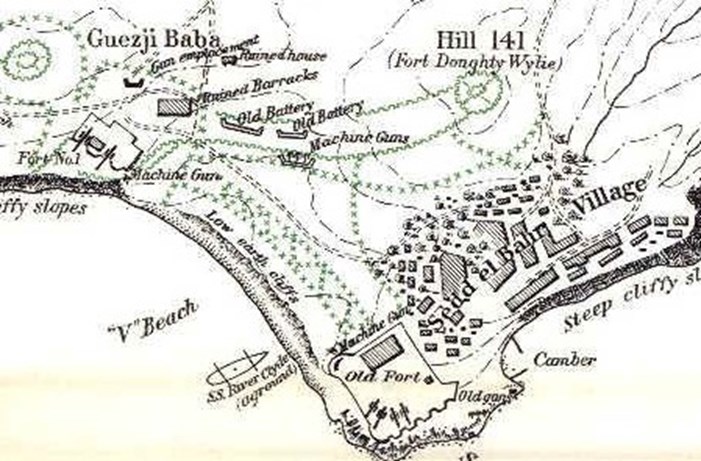
The landings at the very 'toe' of the peninsula were made on a number of beaches code named S, V, W, X and Y. The use of the SS River Clyde at V beach is a very well remembered aspect of the campaign. Actions that came about as a result of the use of this former collier as a 'Trojan Horse' will be described in this article.

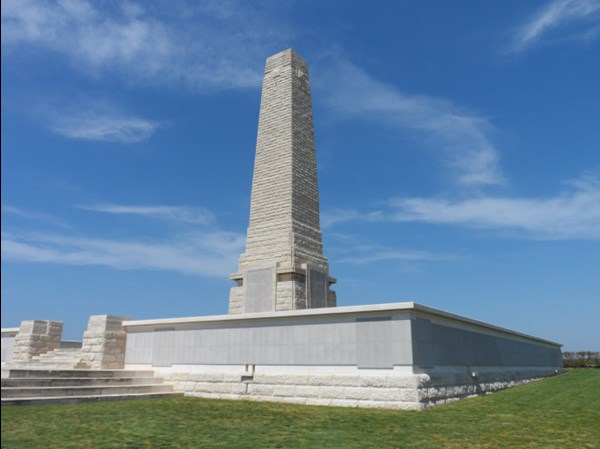
Click here to see an enlarged image. (Author's collection.) Left of centre is the Helles Memorial to the Missing.
Captain Edward Unwin and the River Clyde
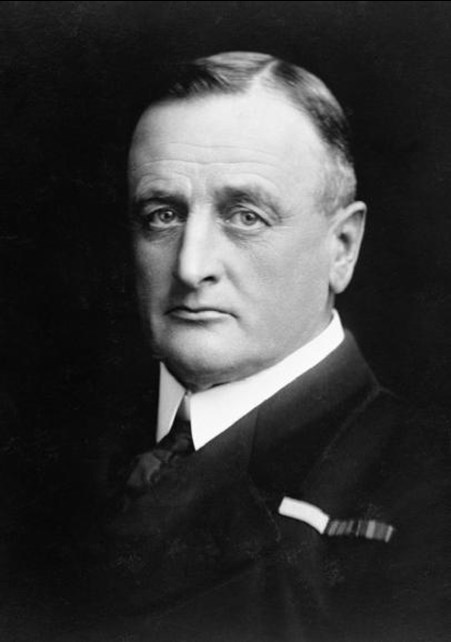
Under the command of Royal Navy Captain Edward Unwin, the River Clyde was to ground itself on the beach adjacent to the ruined fort at Sedd-el-Bahr (now Seddülbahir) and from its holds would emerge, it was planned, some 2,000 men from the 1st Battalion of the Royal Munster Fusiliers, the 2nd Battalion, Hampshire Regiment and the 1st Battalion, Royal Dublin Fusiliers.
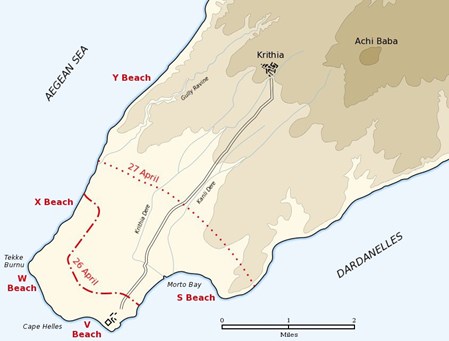
To see a larger version of this map, click here.
The plan went awry and it proved virtually impossible to enable the men to disembark via the sally-ports and gangways provided. The River Clyde had grounded further away from the beach than expected and despite magnificent bravery, a 'bridge of boats' to link the ship to the shoreline failed to enable sufficient men to be disembarked to quickly overwhelm the Turkish defenders.
During this landing at 'V' Beach (as it was known), Victoria Crosses were awarded to individuals from the Royal Navy and Royal Naval Division. Among these were Captain Unwin (who survived), Able Seaman William Charles Williams (who was killed in action), and Midshipman George Drewry (who survived, but died later in the war).
Lt Col Weir de Lancey Williams, an officer from on the staff of General Sir Ian Hamilton (the Commander of the Mediterranean Expeditionary Force), kept a diary and recorded the following from the River Clyde:
"6.22am. Ran smoothly ashore without tremor. No opposition. We shall land unopposed.
6.25am. Tows within a few yards of the shore. Hell burst loose on them. One boat drifting to north all killed. Others almost equally helpless.
6.35am. Connection with shore very bad. Only single file possible and not one man in ten gets across. Lighters blocked with dead and wounded.
9.00am. Fear we'll not land today.
10.00am. Very little directed fire against us on the ship, but fire immediately concentrates on any attempt to land."
Lt Colonel Weir de Lancey Williams, GSO 1 (O), Mediterranean Expeditionary Force.
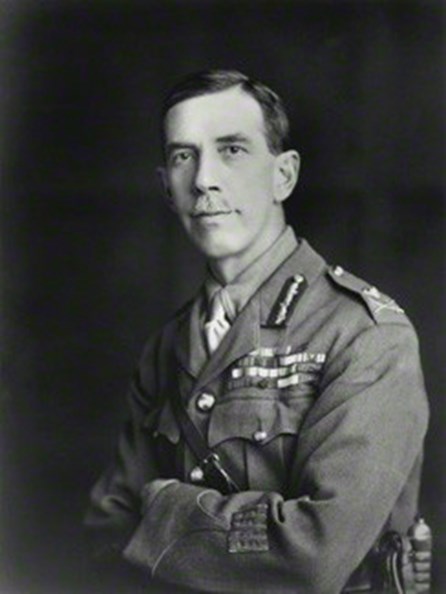
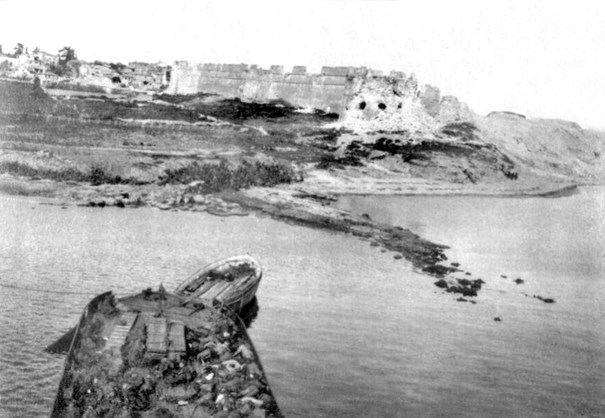
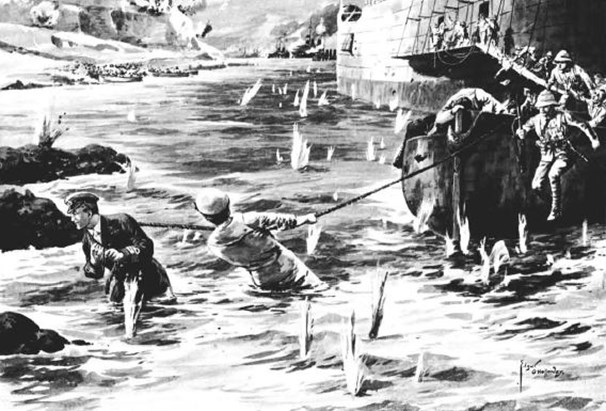
Casualties at V Beach were heavy. The Turks overlooked the beach from the cliff tops and were able to stop any progress from the beach into the village of Sedd-el-Bahr. Fatalities among the British soldiers included 61 incurred by the Royal Dublin Fusiliers (including the battalion's commanding officer Lt Colonel RA Rooth) and 53 among the Munsters.
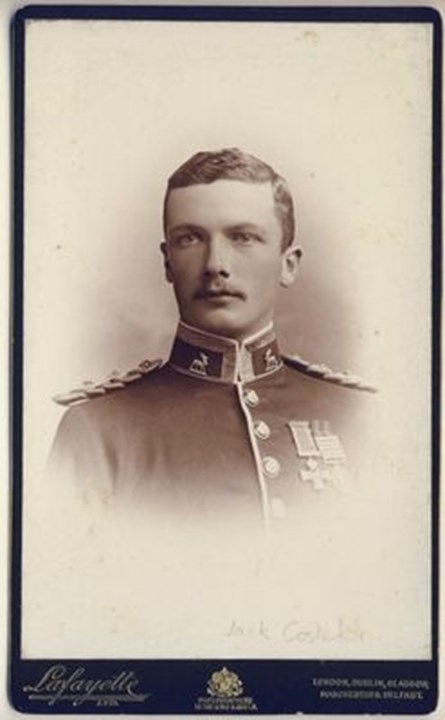
The most senior officer killed in this action was Brigadier-General Henry Napier, who commanded the 88th Brigade. His temporary replacement, Lt Colonel Herbert Smith (who had been commanding the 2nd Hampshire) was also killed on the 25th, as was the brigade's senior staff officer, Major John Costeker.
Nightfall and the next day
Unable to make headway against the Turkish positions, and either pinned down below a short banking on the shore line, or still on board the River Clyde, the landing on V Beach stalled until nightfall. It was only the threat posed by more successful landings on either side of V Beach that forced the Turks to abandon their positions overlooking the beach. Under cover of night, the men pinned on the beach made progress, and those trapped on the River Clyde disembarked.
A party of officers from the HQ of the Mediterranean Expeditionary Force who were on board the River Clyde – must have realised that the casualties to the senior officers during the initial landings may jeopardise further operations, They set about organising a renewed attack. This re-commenced on 26 April. One of these officers has become particularly famous for his un-armed leadership.
Charles Hotham Montagu Doughty-Wylie
A fluent Turkish speaker, 'Dick' (as he was known) Doughty-Wylie had lived in Turkey for a number of years and had even been awarded the Imperial Ottoman Order of Medijedieh, 2nd Class, for his service to Turkish wounded when working with the Red Cross during the Balkan Wars of 1912–1913.
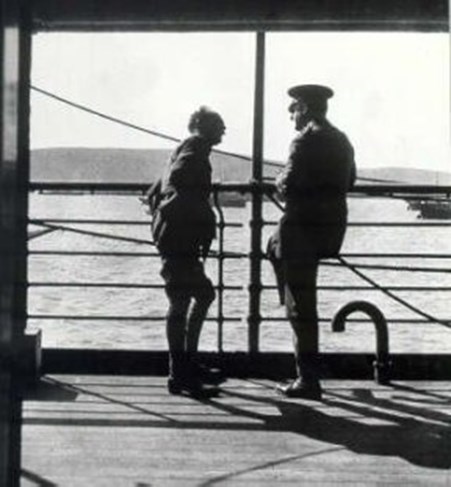
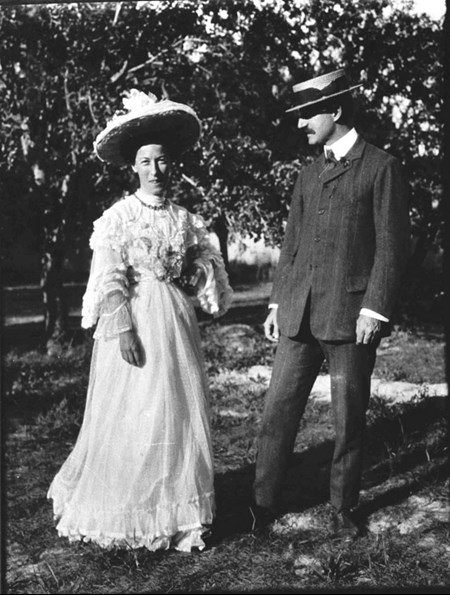
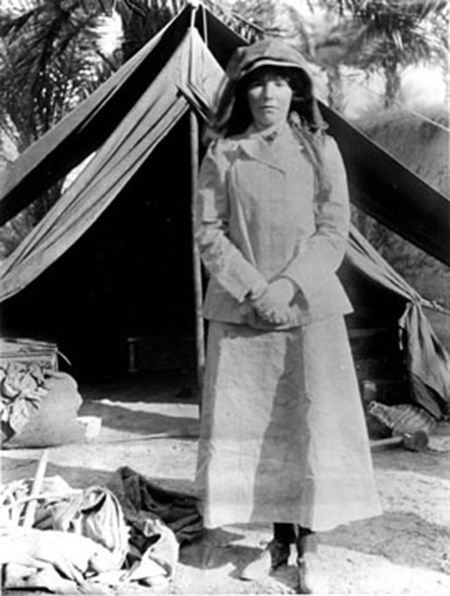
Doughty-Wylie, although married, had an unconsummated affair with Gertrude Bell with whom he exchanged love letters. Gertrude was a writer, traveller, political officer, administrator and archaeologist.
Doughty-Wylie's first target was the castle adjacent to the beach. He led the attack on the castle (or "Old Fort") where a number of Turkish snipers were located and bayoneted. The time was 8am and he realised that more was needed to be done. The Turks were still in possession of the village and the fort which commanded the area from the high point known, to the British, as Hill 141. The problem was that the exits from the Old Fort to the village were covered by Turkish machine guns. Despite this, he led the men onwards, narrowly escaping death when a bullet knocked his cap off.
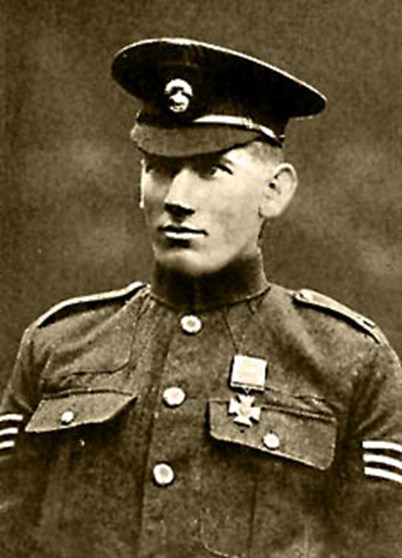
VC for Corporal William Cosgrove
During this phase of operations, outstanding courage was shown by Cpl William Cosgrove, of the Royal Munster Fusiliers. He describes what happened in his own words:
"Our job was to dash ahead, face the trenches, bristling with rifle and machine guns and destroy the wire entanglements. Fifty men were entailed for the work, poor Sergeant-Major Bennett led us, but was killed, a bullet through the brain. I then took charge, shouted to the boys to come on, from the village near at hand came terrible fire to swell the murderous hall of bullets from the trenches. Some of us got close to the wire and we started to cut it with a pliers, you might as well try and snip Cloyne round tower with a scissors.”
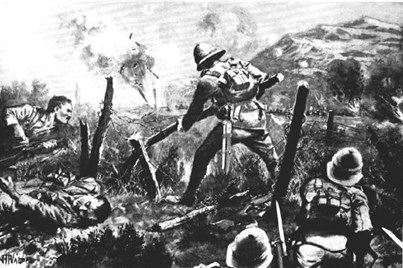
Cosgrove then grabbed hold of the stakes which held the barbed wire:
"I dashed at the first one, heaved and strained and it came into my arms … I believe there was wild cheering when they saw what I was at, but I only heard the screech of bullets and saw dirt rising all round from where they hit. I could not tell you how many I pulled up. I did my best and the boys around me were every bit as good as myself."
It was necessary to take care during the next phase of the house to house fighting in the village of Sedd-el-Bahr. Although the houses were largely ruined, the Turkish snipers were still in evidence. Undaunted, Doughty-Wylie organised a further advance
"...Doughty-Wylie took me up one of the corner turrets of the old Castle, and pointed out to me the way he intended to carry out the assault. There was a strong redoubt on the top, but he decided that the remnants of the three battalions should assault simultaneously.... As the time was getting near for the bombardment to cease, [Doughty-Wylie] gave his final orders to the few remaining officers before the assault.... When the order came to fix bayonets the men scarcely waited for any orders, but all joined up together in one mass, and swept cheering up through an orchard and over a cemetery to the first line of wire entanglement, through which was a way out leading past the deserted Turkish trenches to the summit of the hill. On the top was a flat space surrounded by a moat 20 feet deep with only one entrance leading up over it, through which the assaulting troops were led by Colonel Doughty Wylie and Major Grimshaw."
Captain Guy Nightingale, 1st Royal Munster Fusiliers
Fatalities during the day amounted to 15 men from the Royal Munster Fusiliers, 17 men from the Hampshires and four officers and 23 men from the Royal Dublin Fusiliers. Among those killed during this fighting was Major Cecil Grimshaw, of the Royal Dublin Fusiliers.
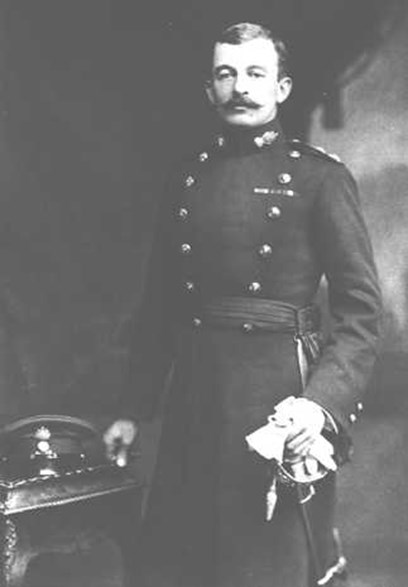
As the attacking troops gained the objective, the unarmed Doughty-Wylie (who had carried a cane rather than arm himself against the Turks, with whom he had lived before the war) was shot in the head. Within a few minutes, Lt-Col Weir de Lancey Williams arrived. He recorded the details in his diary.
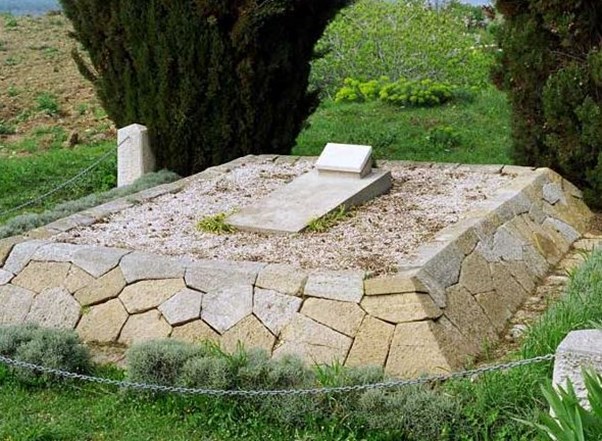
"I found [Doughty-Wylie] lying dead inside the castle on top of the hill. As soon as I realised he was dead I took his watch, money and a few things I could find and had him buried where he fell. I had this done at once, having seen such disgusting sights of unburied dead in the village that I could not bear to leave him lying there. This was all done hurriedly as I had to reorganise the line and think of further advances and digging in; we just buried him as he lay and I said the Lord's Prayer over his grave and bid him goodbye. "
Lt Colonel Weir de Lancey Williams, GSO 1 (O), Mediterranean Expeditionary Force.
Nightingale continued with his description:
"My company led the attack with the Dublins and we had a great time. We saw the enemy, which was the chief thing and all the men shouted and enjoyed it tremendously. It was a relief after all that appalling sniping. We rushed straight to the top and turned 2000 Turks off the redoubt and poured lead into them at about 10 yards range. Nearly all the officers had been killed or wounded by now. Colonel Doughty-Wylie who led the whole attack was killed at my side. I wrote in about him to the staff and he has been recommended for a VC. I buried him that evening and got our Padre to read the service over him".
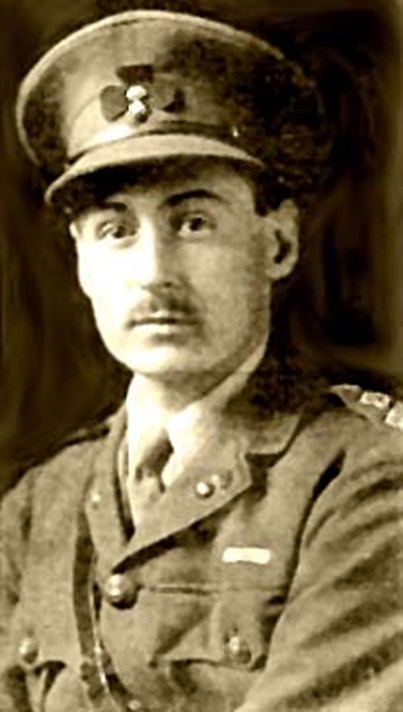
General Sir Ian Hamilton recorded his impressions of the day and reacted to Doughty-Wyile's death in his book, "Gallipoli Diary":
"Hove to off Cape Helles at quarter past five. Joyous confirmation of Sedd-el-Bahr capture and our lines run straight across from "X" to Morto Bay, but a very sad postscript now to that message: Doughty Wylie has been killed leading the sally from the beach.
The death of a hero strips victory of her wings. Alas, for Doughty Wylie! Alas, for that faithful disciple of Charles Gordon; protector of the poor and of the helpless; noblest of those knights ever ready to lay down their lives to uphold the fair fame of England. Braver soldier never drew sword. He had no hatred of the enemy. His spirit did not need that ugly stimulant. Tenderness and pity filled his heart and yet he had the overflowing enthusiasm and contempt of death which alone can give troops the volition to attack when they have been crouching so long under a pitiless fire. Doughty Wylie was no flash-in-the-pan V.C. winner. He was a steadfast hero. Years ago, at Aleppo, the mingled chivalry and daring with which he placed his own body as a shield between the Turkish soldiery and their victims during a time of massacre made him admired even by the Moslems. Now; as he would have wished to die, so has he died.
For myself, in the secret mind that lies beneath the conscious, I think I had given up hope that the covering detachment at "V" would work out their own salvation. My thought was to keep pushing in troops from "W" Beach until the enemy had fallen back to save themselves from being cut off. The Hampshires, Dublins and Munsters have turned their own tight comer, but I hope these fine Regiments will never forget what they owe to one Doughty Wylie, the Mr Great heart of our war."
General Sir Ian Hamilton Gallipoli Diary (Vol I, Page 156-157).
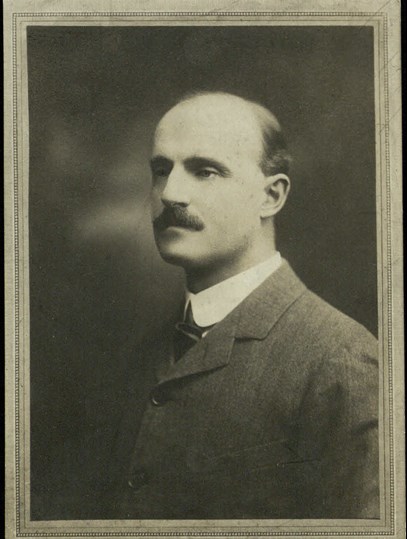
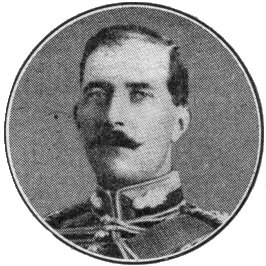
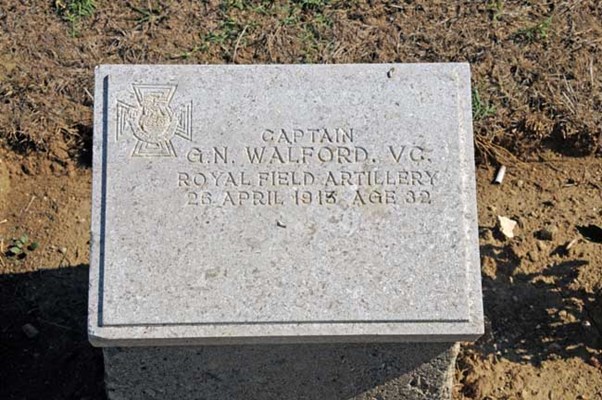
Doughty-Wylie was not the only person to be awarded a VC for his part in this action. The London Gazette records the citation for Captain Walford.
“26th April, 1915, subsequent to a landing having been effected on the beach at a point on the Gallipoli Peninsula, during which both Brigadier-General [Napier] and Brigade Major [Costeker] had been killed, Lieutenant-Colonel Doughty-Wylie and Captain Walford organised and led an attack through and on both sides of the village of Sedd el Bahr on the Old Castle at the top of the hill inland. The enemy’s position was very strongly held and entrenched, and defended with concealed machine-guns and pom-poms. It was mainly due to the initiative, skill and great gallantry of these two Officers that the attack was a complete success. Both were killed in the moment of victory.”
A mystery visit to the Grave
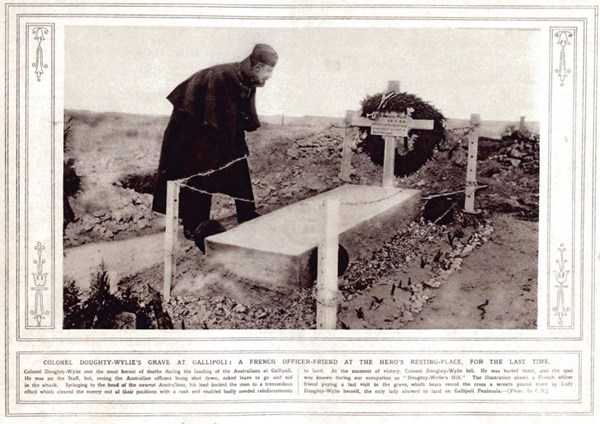
Doughty-Wylie's grave was tended by his comrades and unusually there is photographic evidence of this isolated grave being visited by a French soldier.
The SS River Clyde
One of the iconic images of the campaign was the SS River Clyde grounded on V Beach. For the remainder of the campaign the ship was used as a pier to assist with the re-supply of the Helles sector.
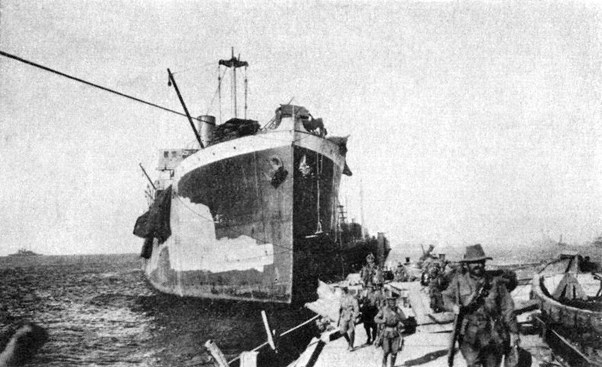
After the war, In 1919, River Clyde was refloated, repaired at Malta and sold to civilian Spanish owners.
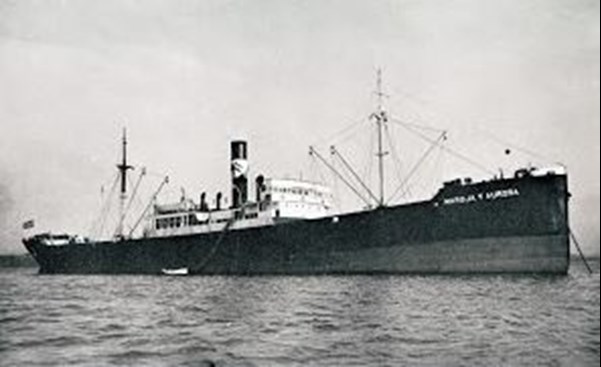
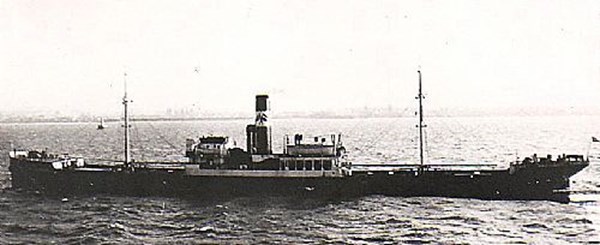
They operated her as a tramp steamer in the Mediterranean, renaming her first Angela and then Maruja y Aurora. In 1965 there was an attempt to buy and preserve River Clyde but in 1966 her owners sold her for scrap and she was broken up at Avilés, Spain.
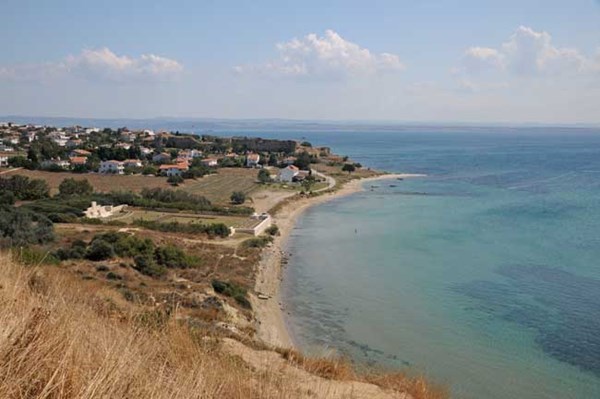
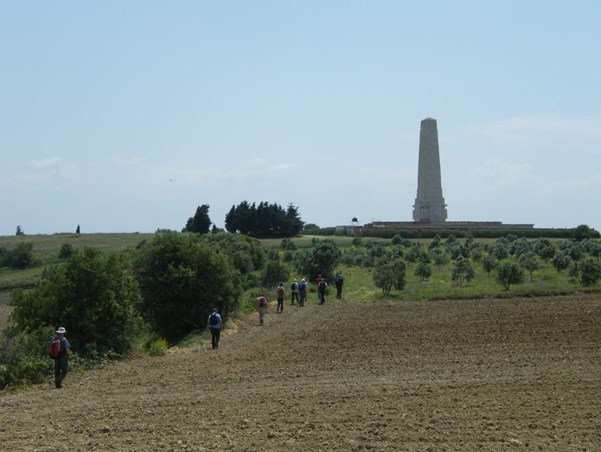
The Area today
The Gallipoli peninsula remains – for the British – an under-visited battlefield compared to the much more accessible Western Front. Nevertheless, a visit can be very rewarding.
Further Resources:
This video (using post war footage) shows 'The Landing at V Beach, 25 April 1915'. From Battlefield Detectives/ITV.
Further reading (on-line):
Papers and Images from the Gertrude Bell Archive is available at the Gertrude Bell Archive (Newcastle University)
Books on Gallipoli are numerous and include:
- LA Carlyon Gallipoli
- Michael Hickey Gallipoli
- Nigel Steel and Peter Hart Defeat at Gallipoli
- Peter Hart Gallipoli
- Peter Burness The Nek - A Gallipoli Tragedy
- John Philip Jones Johnny: the legend and tragedy of Sir Ian Hamilton
Becoming a member of The Western Front Association (WFA) offers a wealth of resources and opportunities for those passionate about the history of the First World War. Here's just three of the benefits we offer:

The WFA regularly makes available webinars which can be viewed 'live' from home. These feature expert speakers talking about a particular aspect of the Great War.

Featured on The WFA's YouTube channel are modern day re-interpretations of the inter-war magazine 'I Was There!' which recount the memories of soldiers who 'were there'.

Explore over 8 million digitized pension records, Medal Index Cards and Ministry of Pension Documents, preserved by the WFA.
Other Articles


