
How to research Australian and New Zealand Soldiers from the First World War
An earlier article has covered the potential sources available to those who are researching Canadian soldiers who served in the Great War. This brief article covers the sources available to research soldiers from Australia and New Zealand.
Australian Service records
Comprehensive service records for Australian soldiers can be found in the National Archives of Australia. Online, it is possible to view service records for the 1st Australian Imperial Force ('AIF'), and also rejected applications to serve in the AIF. Service records can often run to 50 or more pages.
To access the National Archives of Australia website click here: National Archives of Australia
The Australian War Memorial
The AWM also has a range of records which can assist when researching a person, unit or event. Click here to access the site: Australian War Memorial.
The AWM also has records for Red Cross Inquiry reports on wounded and missing soldiers click here to see a summary of what is held: Australian Red Cross records held at the Australian War Memorial (this has useful links at the bottom of the page to other sub-sets of records)
Australian Unit War Diaries
These can be accessed at the AWM here: Australian Imperial Force Unit War Diaries
Other
The UNSW Canberra website Australians at War contains a database on the First AIF and the Great War. Click here to access this: Australians at War
New Zealand Service records
Archives New Zealand has a number of NZEF First World War records that can be accessed via a search engine, Archway. It can be quite complex to access these records but research guides are available. Click here to access this: New Zealand Archives
NZ Unit War Diaries
The process of digitising all Unit War Diaries is ongoing.
Other
The Auckland Museum online cenotaph contains copies of the Memorial Rolls plus links to other useful research sites, including First World War pension rolls. Click here to access this Auckland Museum online cenotaph
Free access to the ‘Australian Anzacs in the Great War 1914-1918’ and ‘New Zealand Anzacs in the Great War 1914-1918’ databases
In 2019, Emeritus Professor Peter Dennis, HASS, UNSW Canberra, announced that these Great War databases were to be made available for public access. These are comprehensive sources for learning about Anzacs, and both are FREE for public access, are regularly expanded and, where errors are pointed out, corrected.
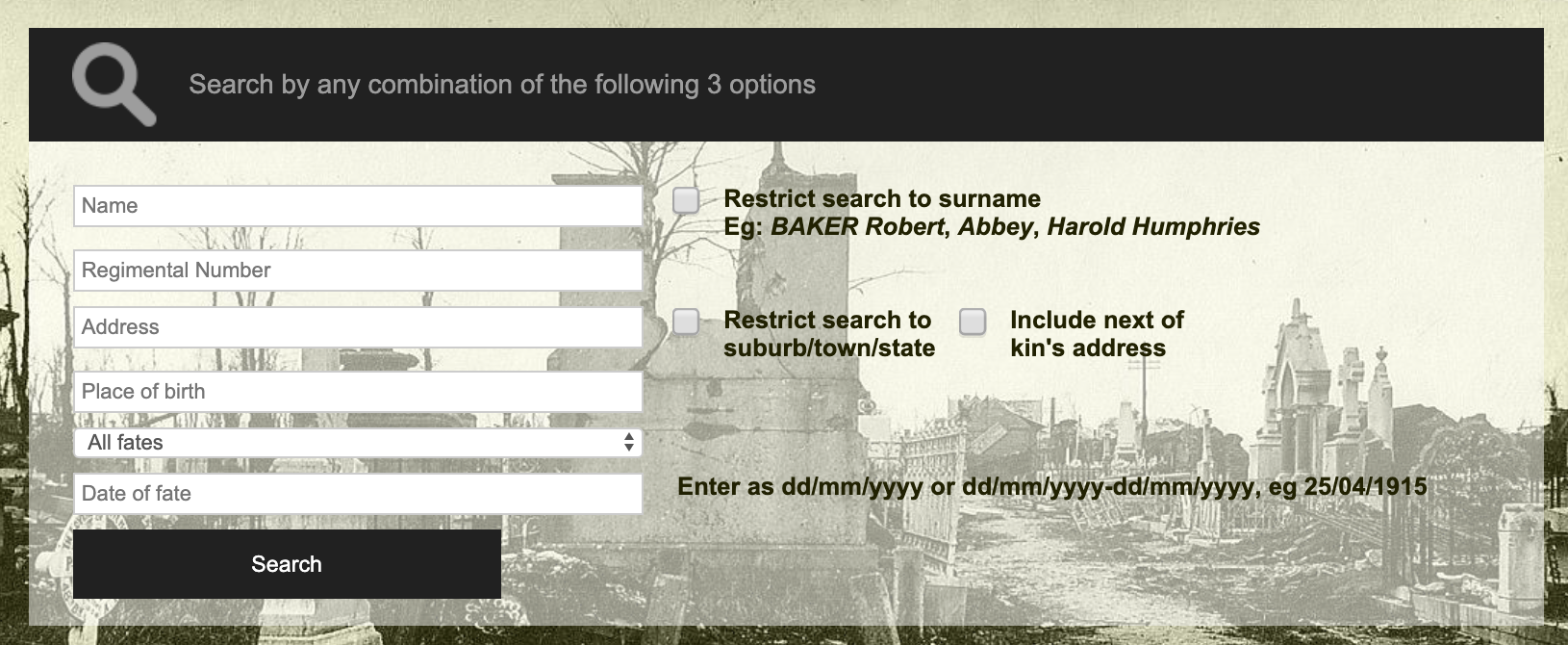
The ‘Australian Anzacs in the Great War 1914-1918’ and ‘New Zealand Anzacs in the Great War 1914-1918’ databases are research and public interest initiatives centred in the School of Humanities & Social Science at the University of New South Wales, Canberra.
Both draw on a wide range of published sources, supplemented by research in cemeteries to identify the dates of death and place of burial. While the structure of both databases is the same, individual entries vary widely. For example, enlistees in Australia were not asked their date of birth (this changed in 1918), whereas in New Zealand they were. Australia produced an end-of-war Nominal Roll, listing service number, final unit, fate and date of fate, but there is no such list in New Zealand. Some Australian enlistees are listed on the Nominal Roll as ‘Effective Abroad’, meaning they were still overseas when the Nominal Roll was compiled in mid-1919. For New Zealand getting the same level of detail entails going to the individual’s digitised Archives file, an ongoing and painfully slow process. Similarly, in Australia the War Memorial sent out a Roll of Honour circular requesting details of each soldier who died in the war – school, age to Australia if born overseas, other relatives who also served, thus enabling us to map family connections. In both databases many thousands of entries have been written up in great detail; on principle there is no censorship of material that some families find disturbing.
Members of the public can submit corrections or ask questions (we will not respond to abusive emails). There are undoubtedly many errors on both databases, inevitably because the printed records were compiled from handwritten forms, the information often dictated to a recruiting officer unfamiliar with place names or personal names, and in the process of going through several iterations, some information inevitably got mangled. We welcome such notifications, and record the nature of the error on the database while correcting the entry. We aim to have the most accurate data sets relating to both the AIF and the NZEF. The work is ongoing, and with only two people responsible for content, there is no end in sight.
We have recently expanded the search engine to make the databases even more useful to those who access them. We welcome new visitors and returning enquirers.
The AIF database can be found at https://aif.adfa.edu.au/aif/index.html, and the NZEF database at http://nzef.adfa.edu.au/index.html. We hope you find them useful. Your comments are always welcome.
Becoming a member of The Western Front Association (WFA) offers a wealth of resources and opportunities for those passionate about the history of the First World War. Here's just three of the benefits we offer:

This magazine provides updates on WW1 related news, WFA activities and events.

Access online tours of significant WWI sites, providing immense learning experience.

Listen to over 300 episodes of the "Mentioned in Dispatches" podcast.


