
Project Big Push
Elsewhere on this website, articles have provided information on the Pension Card projects ‘Alias’ and ‘Hometown’, which dealt with the Soldiers Died set of pension records. Project ‘Big Push’ commenced in February 2021 and is, without a shadow of any doubt, the largest and most ambitious aspect of The Western Front Association’s pension cards work.
The dataset of the Soldiers Survived Pension Cards runs to over 5 million images – all of which have to be ‘eyeballed’ by volunteers on the project. Due to the size of the dataset, Project ‘Big Push’ is twin pronged – volunteers are looking both for any aliases/name errors etc as well as hometowns. To date, the project, with six teams in place, has completed checking of more than half of all the cards. This work has resulted in more than 700,000 hometown addresses to be added to Fold3 tagging, and over 63,000 aliases (or name errors) to be tagged.

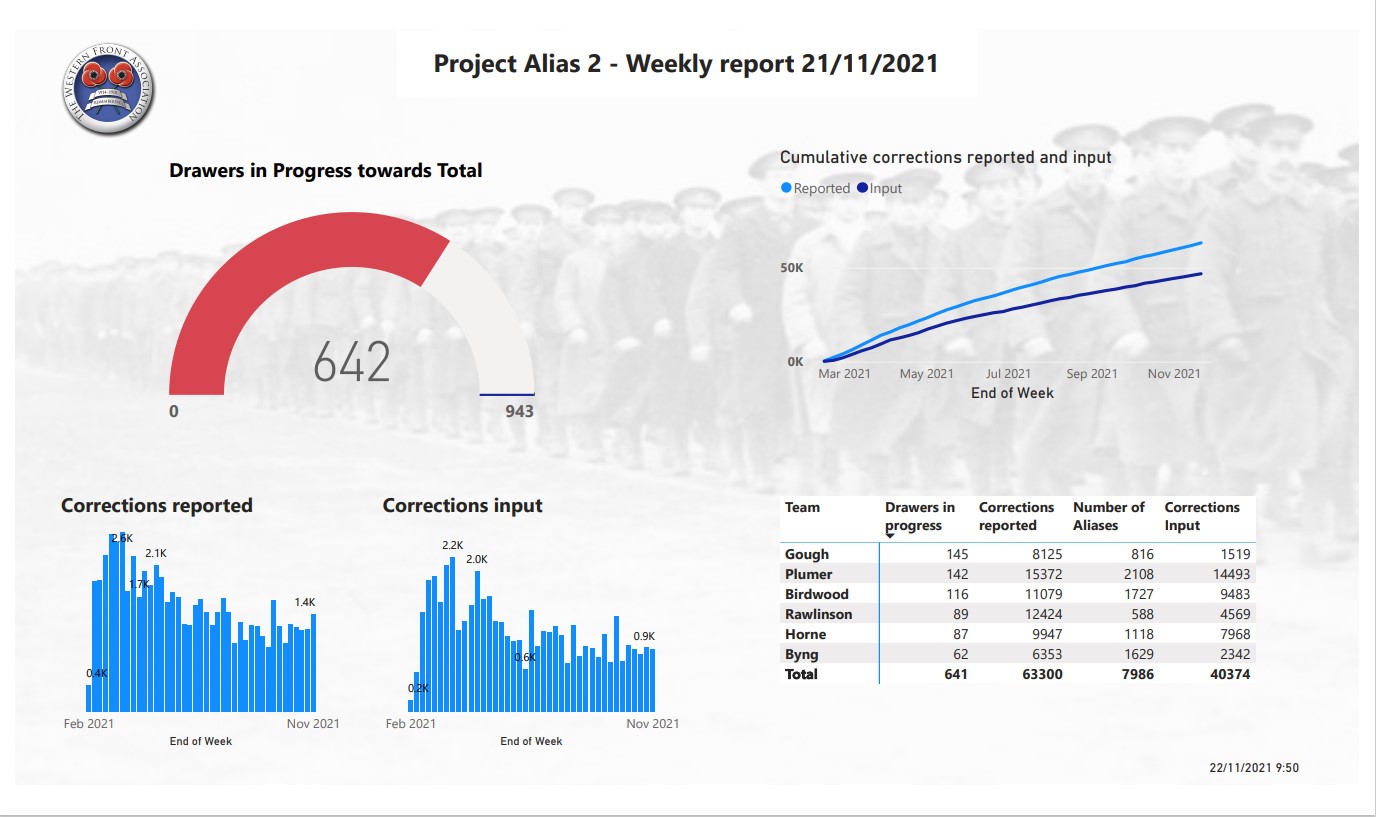
At the outset, it was thought that the Soldiers Survived cards might be of less interest than the Soldiers Died cards – but this has not proved to be the case as several volunteers have identified cards that sparked their interest and carried out further research.
On occasion, these have been amusing, particularly in the case of the cards for brothers Private Fern Leaf of the Durham Light Infantry and Private Vine Leaf of the Royal Engineers. Further research revealed that the Leaf family also comprised Rose, Violet, Lily, Daisy, Adonis, Nolana and Ivy!
In the case of Private Alfred Edwards who had served in the Royal Garrison Artillery, the interest of the volunteer looking at this card was piqued by the annotation on the card.

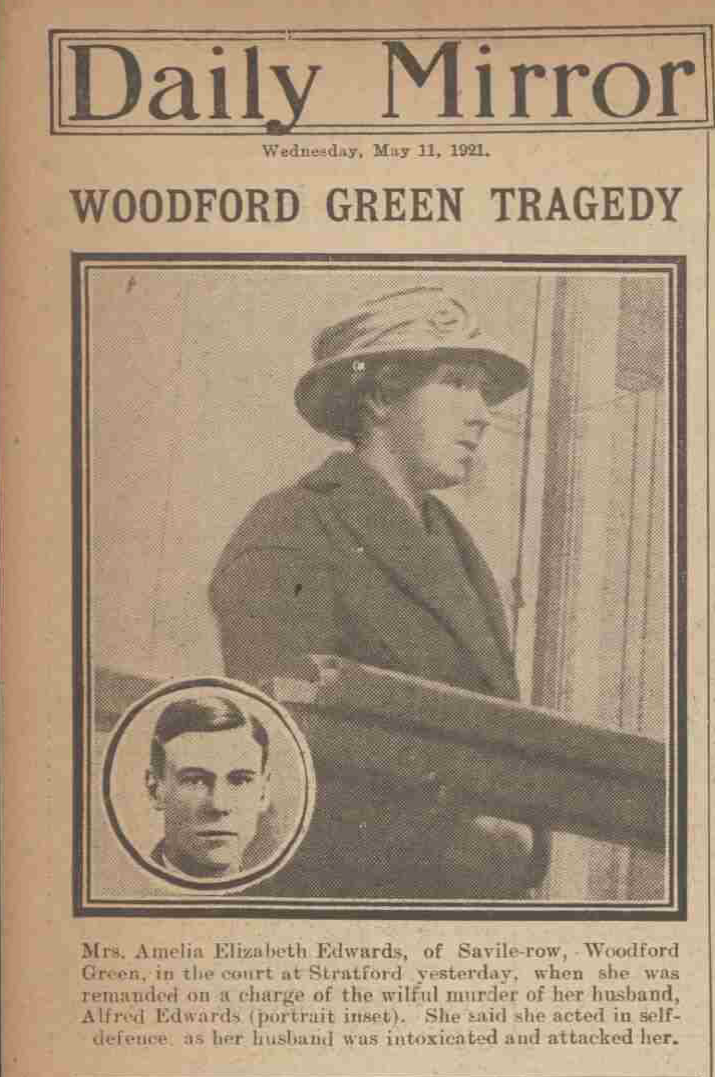
Alfred had been wounded and was in receipt of a pension of £1/18s to support himself, his wife and two children. Press reports on the trial revealed a sad tale of domestic violence.
With further research, a number of the Pension cards yield equally sad stories of those who survived the war – none less so than the case of George Henry Howlett, who had served in the Royal Navy for six months in 1915. By March 1918, George, then described as a ‘pauper lunatic’ would be removed to the London County Lunatic Asylum at Bexley. He would spend the next 30 years there, until his death in 1949.
The pension card for Frederick Day indicates not only that he had been admitted to an asylum but that he was also known as F. Lauraine. Somewhat unusually, Frederick had enlisted at the age of 55 in 1915 and served in the Army Service Corps in France/Flanders until his discharge in June 1916. Unfortunately, no service records for him have survived. Prior to his enlistment, and immediately after his discharge, Frederick would spend spells of time in the workhouse but research identified that in his younger days, he had enjoyed a rather different lifestyle.

Frederick was one of the Lauraine ‘brothers’, described as ‘acrobatic variety eccentrics and comedians’ in 1887. Later they would perform under the name of ‘Hector and Lauraine:The Wonderful Whirligigs’. By 1910, the two were described as ‘the only upside-down boxing comedians in the world’. In all, their theatre career spanned more than 30 years. However, by the outbreak of war, Frederick had fallen on hard times. After spells in the workhouse following his discharge, Frederick was admitted to an asylum, where he died in 1941, aged 82.
The Soldiers Survived pension cards also contain details of grants that were awarded to soldiers after the war to enable them to pursue a career. Some of these are intriguing – for example, Walter George Facey received a grant of £50 ‘towards starting as a bird fancier’. One individual received a grant ‘for shooting and rabbit killing’. This card for Jesse Byford sparked off some research.
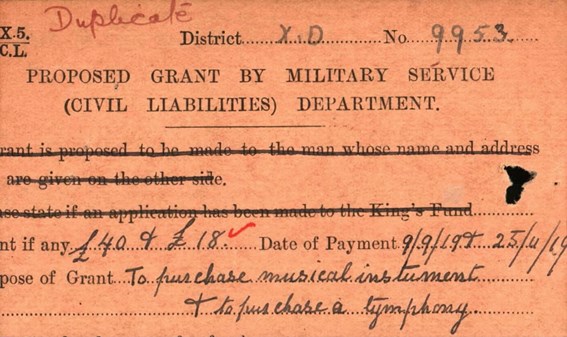
Jesse had joined the 2nd Dragoon Guards when very young (he was born in 1874) and had served in the war in South Africa. Discharged probably in the early 1900’s, Jesse again enlisted in 1917, serving for a year in the Royal Engineers until he was discharged on medical grounds in 1918. Postwar, the two grants made to him were for a set of drums and timpani. By 1922. Jesse appears to have become a successful musician, working at the Empire and Theatre Royal in Leeds and the Hippodrome in Richmond.
In the early hours of Sunday, 10 May 1936, a fierce fire broke out backstage which spread so quickly that within two hours very little of the theatre except the walls remained. Unfortunately, Jesse had left his instruments at the theatre after the Saturday evening performance, and all were lost. In an interview with the local newspaper he said “The instruments were my sole property and consisted of one set of silver-plated tympani, a bass drum, a side-drum, bells, three sets of cymbals, and tambourines; in fact, all necessary instruments required for orchestral use. Unfortunately for me they were not insured.”
It is not known just what employment Jesse had following the fire but on the 1939 Register his occupation is still recorded as “Musician”, although he had moved to Gipping, Suffolk, the county of his birth. He died there in 1945, aged 72.
A number of cards have provided details of unusual regiments in which men served. Some of these – such as Kitchener’s Flying Scouts and the Natal Carbineers - appear to have their origins in the Boer War. One card with ‘Legion of Frontiersmen’ prompted further research.
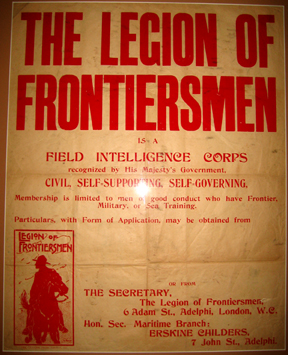
The Legion of Frontiersman was formed by Roger Pocock, a Boer War veteran, to act on behalf of the Crown particularly on the frontiers of the Empire. As the Legion was not officially recognised as part of the Services, it is unclear why there is such an entry in the pension cards.
The Pension card for Private John Benjamin Gidney refers to the Great Indian Peninsula Railway Regiment, a former infantry unit of the Auxiliary Forces under the British Indian Army. It was formed on 29th December 1875. Further research identified that John was born in Bombay, where his father Charles worked for the G.I.P. Railway Company. John married in Bombay in 1919 and later moved to South Australia.
The pension cards, of course, also include records for sailors –the card for Harold Gordon Alexander details his ship as ‘Mystery Ship Q17’. This was the Helgoland, a brigantine sailing ship. At one point, Lieutenant William Sanders served on the Helgoland. He later became Commander and was awarded the Victoria Cross whilst in command of another Q Ship, HMS Prize. Harold was in the Merchant Marine Reserve and served as a cook on the Helgoland. It is quite likely that he would see the action in which the Helgoland engaged three enemy submarines whilst becalmed and without steerage.
Many instances of bravery awards mentioned on pension cards have come to light during the course of the checking work on cards. Driver Daniel Hogwood was awarded the Military Medal during his service in the Royal Field Artillery. His service record was found to have survived in the unburnt series, indicating that he enlisted from an address in Great Maze Court, Maze Pond, Borough, London, a slum area at that time. Further research identified that Daniel had spent a short period of time in the Greenwich Workhouse over the Christmas and New Year period in 1905. Christmas 1919 was an altogether happier period for Daniel when he married on Christmas Day.
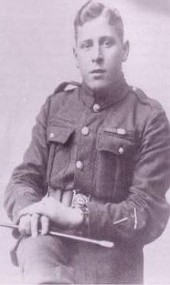
The card for Francis George Miles of the Gloucester Regiment indicates that he was awarded the Victoria Cross and Distinguished Conduct Medal. The citation for his VC reads:
“On 23rd October 1918 at Bois-l'Évêque, Landrecies, France, when his company was held up by a line of enemy machine-guns in a sunken road, Private Miles, alone and on his own initiative went forward under exceptionally heavy fire, located a machine-gun, shot the gunner and put the gun out of action. Then seeing another gun nearby, he again went forward alone, shot the gunner and captured the team of eight. Finally, he stood up and beckoned to his company who, acting on his signals, were able to capture 16 machine-guns, one officer and 50 other ranks”.
Unusually, it is also possible to put a face to the name on the card, thanks to these bravery awards.
Occasionally, the addresses for the soldiers survived are intriguing – as in the case of the Buckingham Palace address for Simon Mclean who had served in the London Scottish Regiment. Simon was born in Inverness-shire. In 1911, he was a valet living on the Sandringham Estate. The address of The Globe and Phoenix, Rhodesia on the card for Gordon Andrew Austen, who had served in the King’s Royal Rifle Corps was found to be a gold mine, established in 1894 and still operational.
Harry Alexander who had served in the Royal Fusiliers was found to have three addresses on his pension card – one, The Highland Hotel, apparently in Port or Fort William (it was difficult to decipher the writing), and the second as The Diamond Works, Brighton. With some further research, it was possible to identify the first address as being in Fort William, as the Oppenheimer family had used the hotel as a training facility for disabled servicemen who would then go on to work in the Diamond Factory. Harry had suffered gunshot wounds to both legs, with the left leg being amputated.

William Joseph Horseman’s post war address was shown on his pension card as being a café in the Rue de Calais. Bois-en-Ardres in France. He had served as driver in the Army Service Corps. The address on the card was close to the battlefields and further research identified that William had joined the Imperial War Graves Commission staff in France in August 1920 as a lorry driver. Although William left the Commission’s employment in March 1921, he stayed on in France.
After the war, Private John Atkinson’s address was noted on his pension card as ‘Westfield War Memorial Village, Lancaster’. In the aftermath of the war, many communities considered the form that memorials to the dead should take with some wishing to have practical expressions of their gratitude for the sacrifices made. In Lancaster, the decision was taken not only to have a monument erected, but also to create a memorial village, to provide housing and employment to men who had returned from the war with serious disabilities. The pension ledger card for John indicates that he had suffered a gunshot wound to the head whilst serving in the West Riding Regiment. In 1924, Earl Haig opened the village which had by then 26 houses.
And finally, a ‘Gordon Bennett’ moment.
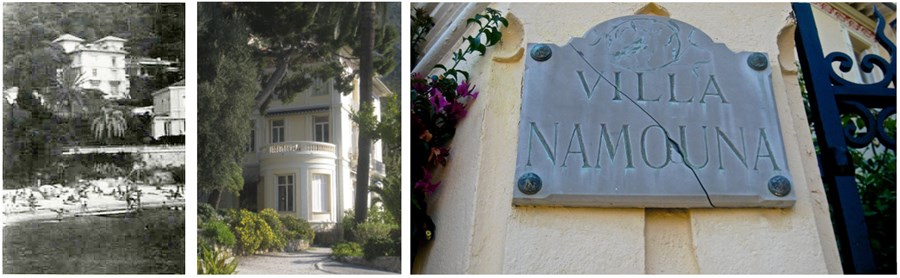
Ernest James Beasey served as Sergeant in the AIF but post war appeared to be living in a villa in France – it was initially difficult to discern exactly where the villa was located but it was perhaps a somewhat unusual address? Much further research produced further information on Ernest and the information that in 1924, he had travelled to America as the butler for Lord Castlerosse, who had served in the Irish Guards during the war. Lord Castlerosse was a close friend of Lord Beaverbrook, who owned a property in Cap d’Ail just outside Monte Carlo. An examination of places nearby produced the potential name for the indecipherable village as Beaulieu-sur-Mer. Even more detailed research identified that the name of the villa was Namouna – which, until 1918 was owned by a James Gordon Bennett, the publisher of the New York Herald and the originator of the well-known exclamation!
This article could not have been written without the contributions of the team leaders in Project Big Push – Tim Walton, Martin Pieroni, Mike Akerman, Pat Miller, Margaret Hawkins and Carolyn Postgate. Dr Alan Hawkins (who is married to one of the Big Push Project team leaders) carries out much research on interesting cards). Other information on the cards featured in this article has also been provided by Project Big Push volunteers Susan Tall, Mike Day, Jeff Ward, Pam Raven and Philip Ward. Not least of all, immense thanks are due to all the volunteers on Project Big Push who identify potentially interesting cards.
We are still seeking volunteers for Project Big Push - If you would like to take part in the biggest collaborative project ever run by the WFA, please contact Jill Stewart via this form.
Becoming a member of The Western Front Association (WFA) offers a wealth of resources and opportunities for those passionate about the history of the First World War. Here's just three of the benefits we offer:

This magazine provides updates on WW1 related news, WFA activities and events.

Access online tours of significant WWI sites, providing immense learning experience.

Listen to over 300 episodes of the "Mentioned in Dispatches" podcast.


