
A Long Distance Raid
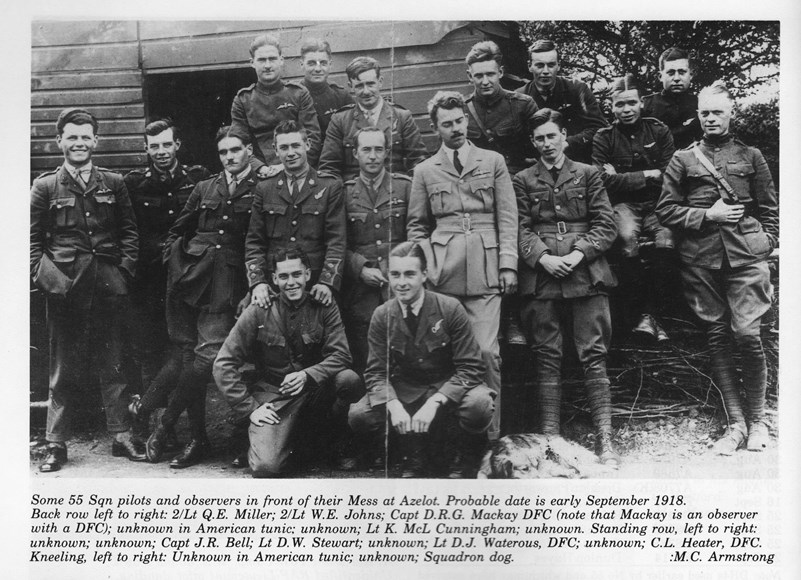
This was written by William Johns (the author of 'Biggles books' ) for the 'Modern Boy’s Book of Aircraft' in 1931. Johns flew combat operations in August and September 1918 with 55 Squadron, Independent Force, RAF.
The first streak of dawn in the eastern sky reveals a dozen pilots standing and chatting and laughing outside the hangars. A cloud of blue cigarette smoke curls mistily about them and rises slowly into the still morning air.
It is our last cigarette for five hours at least, perhaps longer—perhaps much longer.
An air mechanic seated on an upturned chock (wheel block) vacantly contemplates the crows who are persuading themselves they are looking for the early worm on the sun-baked aerodrome. Another mechanic breaks off from an idle survey of the wind-stocking to yawn mightily.
Another, unshaven and with tousled hair, listlessly supports the hangar door as, with sleepy eyes, he gazes moodily at the group of officers responsible for his early rising. No one feels his best at 4.30 a.m.!
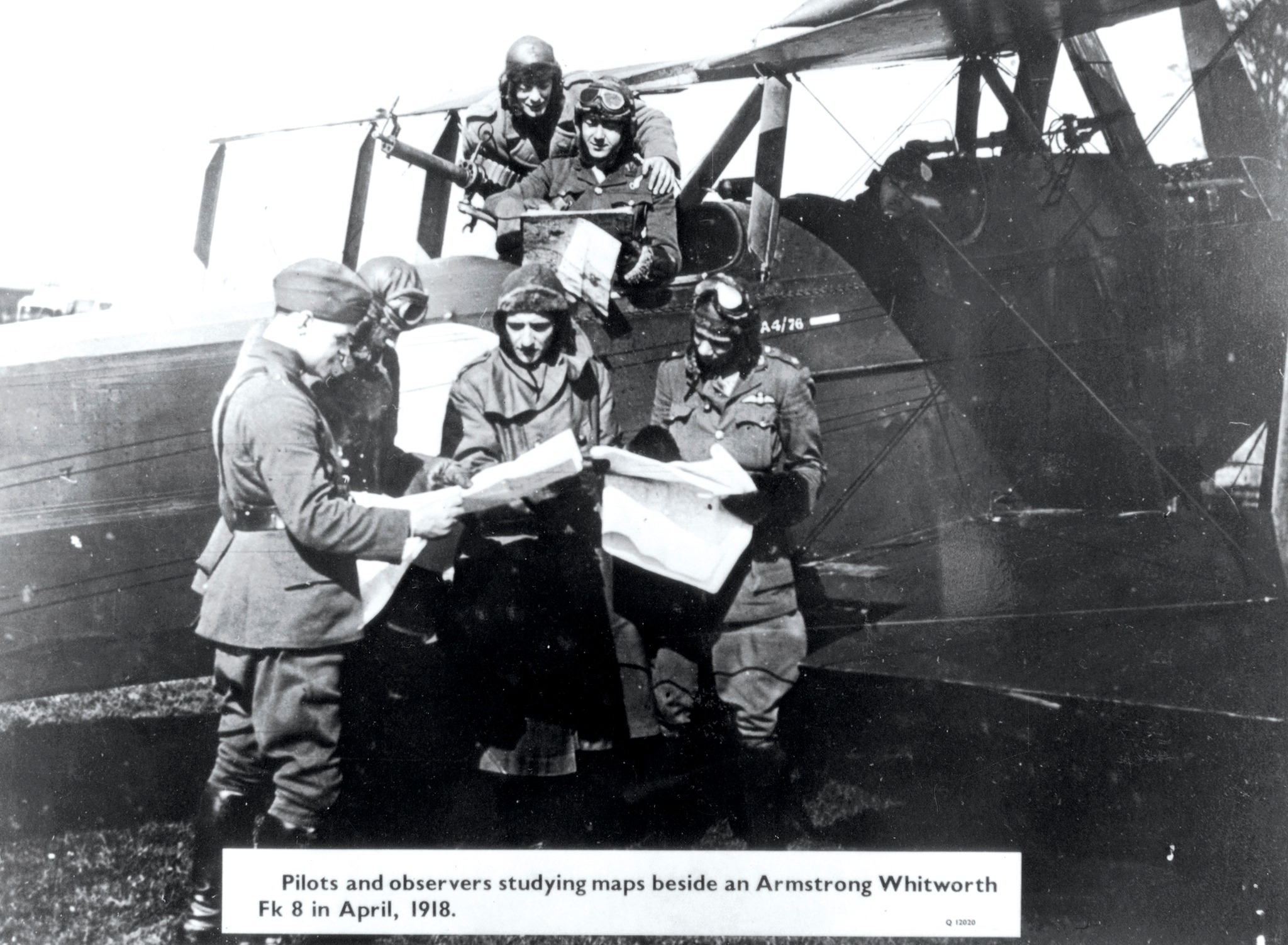
"Start up!" The C.O.'s voice, keen and alert, cuts through the air like a knife as he steps out of the map room followed by the Skipper, who is leading the show.[1]
The dozing air mechanics spring to life and jump to it. Others, hitherto unseen, appear staggering under the weight of 112 lb. high explosive khaki-coloured bombs.
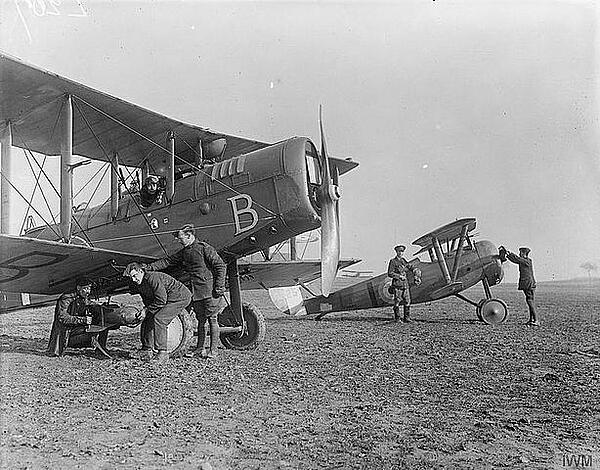
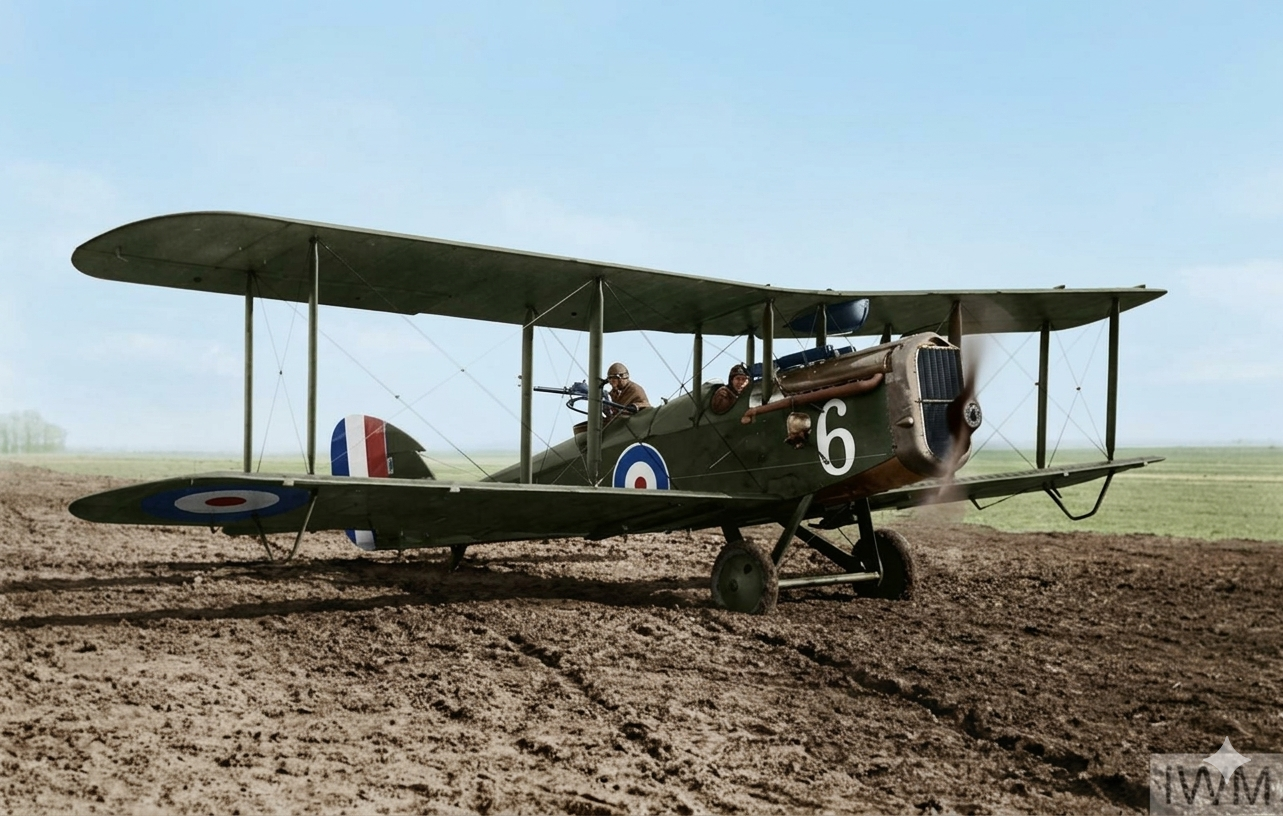
Where a moment before all was still and quiet, swift movement dominates the scene as the D.H.4’s are wheeled out and, one after the other, six Rolls-Royce Eagle engines commence the deep-throated roar which they will, we hope, keep up without a break for the next few hours.
The Skipper waves to the C.O. and walks across to us and names our destination.
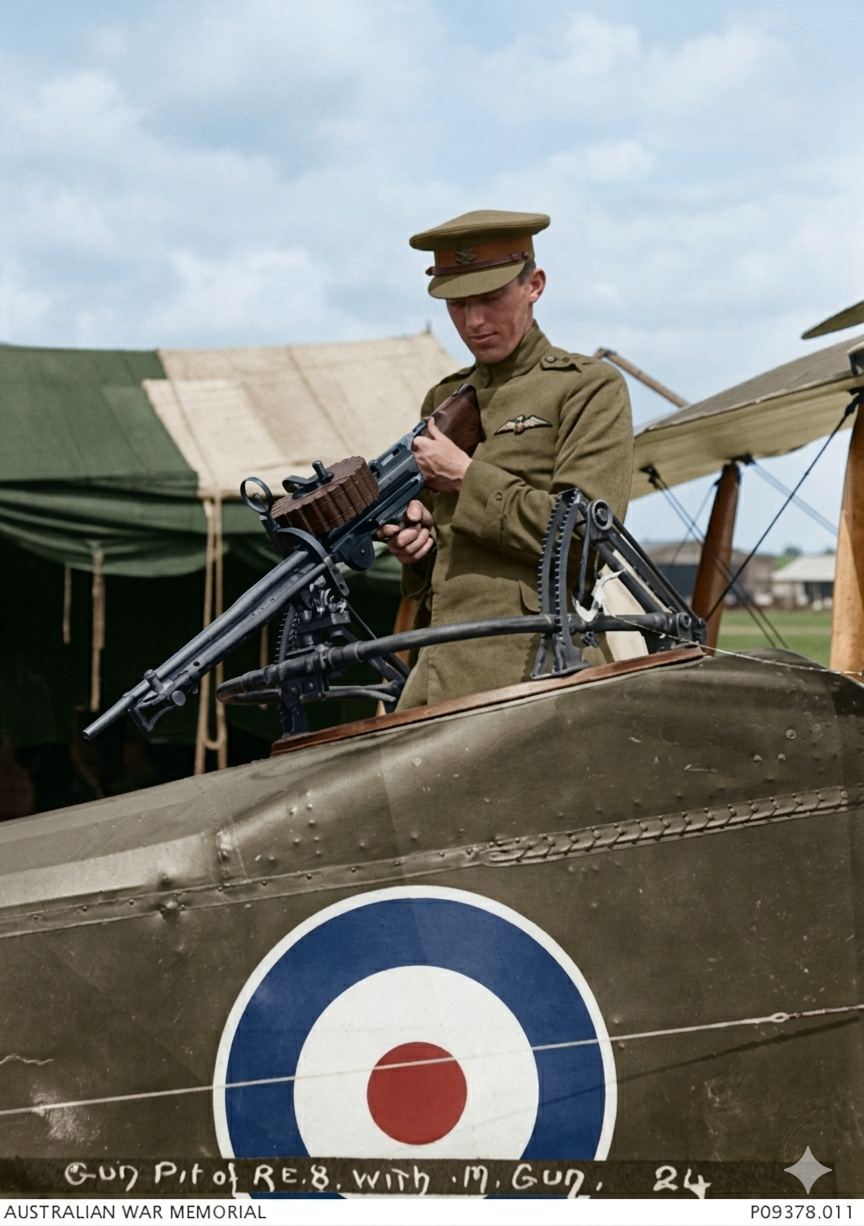
One long, last draw at our cigarettes and we climb into our seats. Rat-at-at-at-ratatat, spit the Lewis guns harmlessly into the ground as our observers, already in their places in the back seats, test the weapons upon which our lives will shortly depend.
I slip a piece of chewing gum into my mouth and turn to have a last word with my observer as the engine warms up.
Whoof! Whoof! Whoof! Three tiny puffs of white smoke appear high in the lightening sky. Bang-whoof! Bang-whoof! joins in our own particular battery.
Dash the enemy! We cannot see him, he is much too high. But we watch the trail of the anti-aircraft guns as the enemy machine swings home. The enemy have shipped someone over to see whether we are turning out to-day.
He has spotted us. Probably got a photograph, and that means that the alarm will go to the enemy that we are on the way, and every machine that can get into the air will be up and waiting for us. They’ve made a habit of doing that lately. Yes, we shall need our guns to-day, without any doubt whatever!
Several pairs of eyes anxiously watch the smoke-bursts speed north-east. A message comes down from the archie (anti-aircraft) battery. They have timed the smoke. Wind thirty to thirty-five miles an hour at over ten thousand feet up, they say. That means an hour and a half on the outward journey, and three hours and a half coming back. We shall most certainly need our guns.
The Skipper taxies out and we follow. Tails lift, and with a roar that awakens the still sleeping village below we are off. We shall stick to the skipper like a long-lost brother to-day. We climb steadily—eight, ten, twelve, fourteen thousand, the altimeter registers, and we head for the enemy. Below us lie St. Nicholas, Nancy, Pont-à-Mousson, and the line, curving in a wide arc to Verdun. We cross at fifteen thousand.
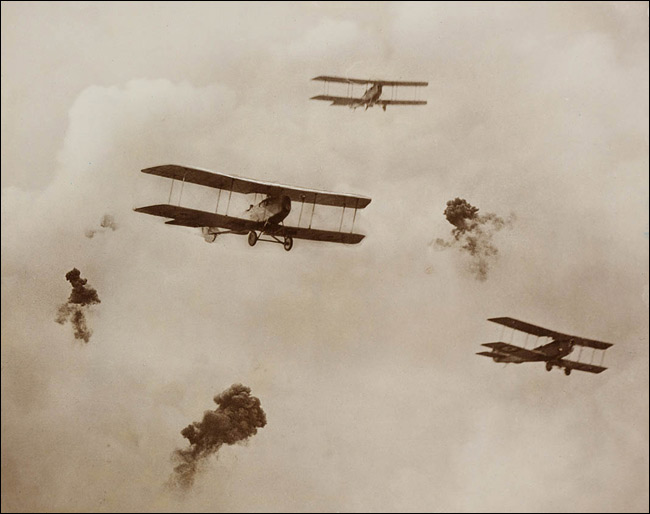
Little jabs of flame and patches of black smoke stain the turquoise blue above and the mauvey-blue beneath. Archie to the right of us, archie to the left of us, and, to depart from the famous poem, it was archie above us and archie underneath us. And now, drat him, archie is in front of us!
The Skipper alters his course half a point. Archie, in front, is bad medicine. If the gunners hold their own we might fly into it.
Bang! A flash of flame and a cloud of putrid black smoke swirls swiftly about us, and is gone. That was closer. They will be hitting someone in a minute if they aren't careful.
I test all controls quickly, glance into the reflector and see my observer swing up his thumbs—the O.K. signal—then grimace at the battery below as a sign of his contempt.
Bang! Dash it! A little jagged hole has appeared near the trailing edge of my lower port plane. Thank goodness it isn't too near the trailing edge. The fabric might "balloon." I chew a little harder on my Spearmint!
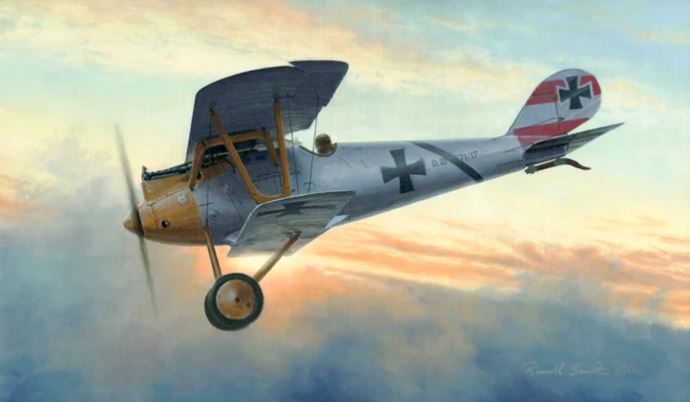
Archie fades away with a suddenness that can only mean one thing, and I scan the sky for the coming menace. My observer crosses his fingers and points. Enemy aircraft. Here they come! What are they? Pfaltz Scouts!
It doesn't worry me, for they'll lose a thousand feet of height at their first dive and never catch us up again.
Rat-tat-tat-tat-tat ! They are shooting at three hundred yards, much too far to do us any harm, or they're nervous. Our observers hold their fire. With only ten drums of ammunition for five hours' work they can't afford to waste a round.
I keep one eye on my position in the formation and the other on the enemy. They are coming in. Rat-tat-tat-tat-tat-tat answer our gunners as they open up. The enemy face it for a moment, then swerve away.
They pull out five hundred feet below, and amuse themselves by standing on their tails and spraying the whole formation with lead.
My stick woggles and I look quickly over my shoulder. With crossed fingers my observer is pointing ahead to a string of dots in the sky. Their straight wings give them away—Fokkers!
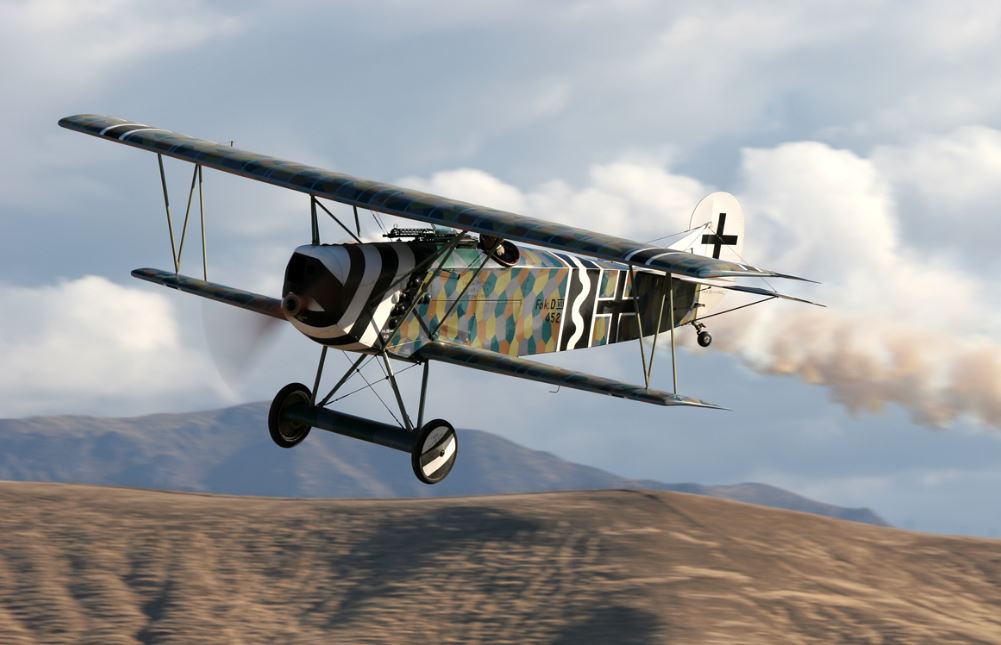
Has the Skipper seen them? Yes, he's looking, and the observers are making signs to each other. The enemy approaches rapidly. The sun flashes on them and I recognise the yellow and blue striped lads from Metz.
I slip another piece of gum in my mouth and chew hard. There will be no swerving away for these boys! There they go, round into the sun—eight of them. They waste no time. Down go their noses towards us, and I crouch a little closer in the "office" watching them over my shoulder.
Three hundred feet, two hundred, a hundred and fifty, a hundred, and still no one fires. I don't like it a bit! Great Scott! They are coming right in. In a second the air is full of the black and white sparks of flying tracer bullets.
I watch the lad who has honoured me with his particular attention. Flames spurt from his guns and his bullets trace a neat pattern in my lower starboard plane, a foot from the fuselage.
I move my stick the fraction of an inch and watch the seeking tracers stream between the planes. There is the sound of a dozen rattles as my observer's gun spits out a series of short, sharp bursts.
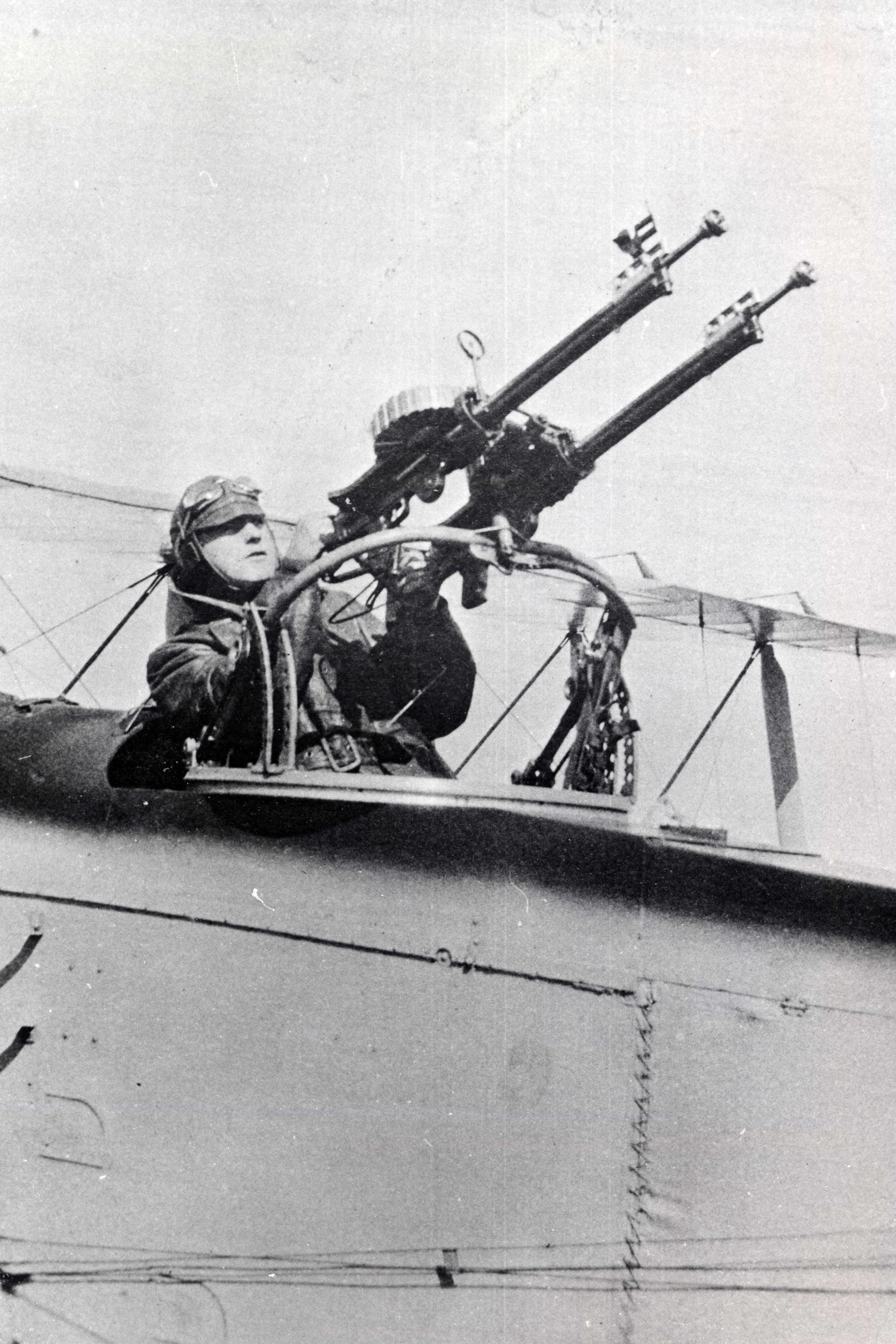
The E.A. (enemy aircraft) holds on to the last second, lurches, swings, and dives past us, gun still going, turning on his back as he goes and missing my tail by ten feet. I see the pilot's face, and touch stick and rudder bar to let my observer rake him with his gun as he goes past. He spins.
I moisten my lips and take a swift look round. Everyone is still in place. There's another E.A. spinning. Gompertz,[2] in the back seat of No. 5, waves to me and points—thumbs up. A quick glance down reveals my E.A. still spinning . . .
There is nothing to grin about yet. The others are climbing back into position, and here come more enemy scouts, from Buhl aerodrome. Warm work ahead. I slip another bit of gum into my mouth. Pity one can't smoke.
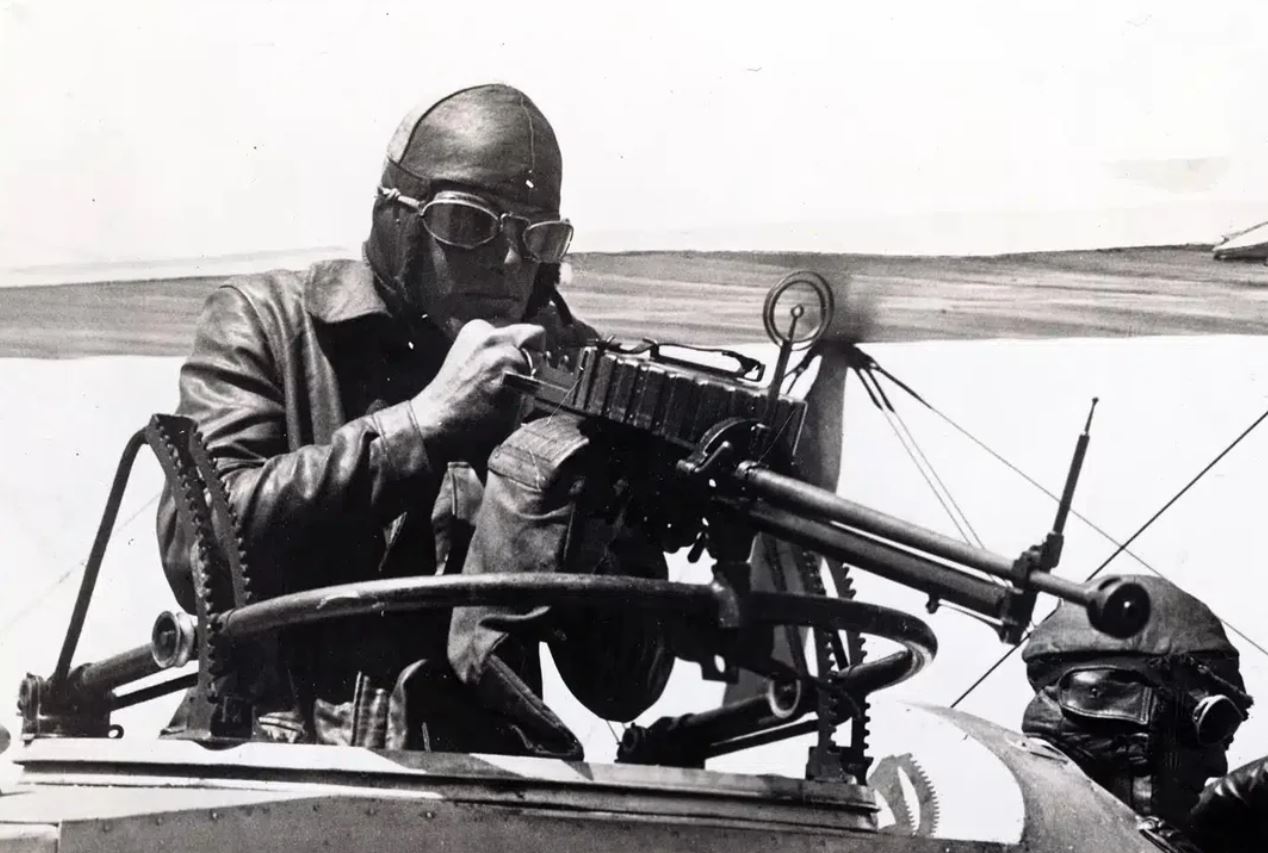
Four gunners have swung their guns round to face the new arrivals; the other two watch the lads in the sun. What a picture our observers make, casually leaning against their scarff rings (the metal gun-mounting round the cockpit), cool and alert, watching.
Here come the enemy—altogether! Rat-atat rat-tatatatatat—and so it goes on.
An hour later Stuttgart lies below us. The Skipper turns slowly, without banking, and fires a green light. All ready! His bombs swing off.
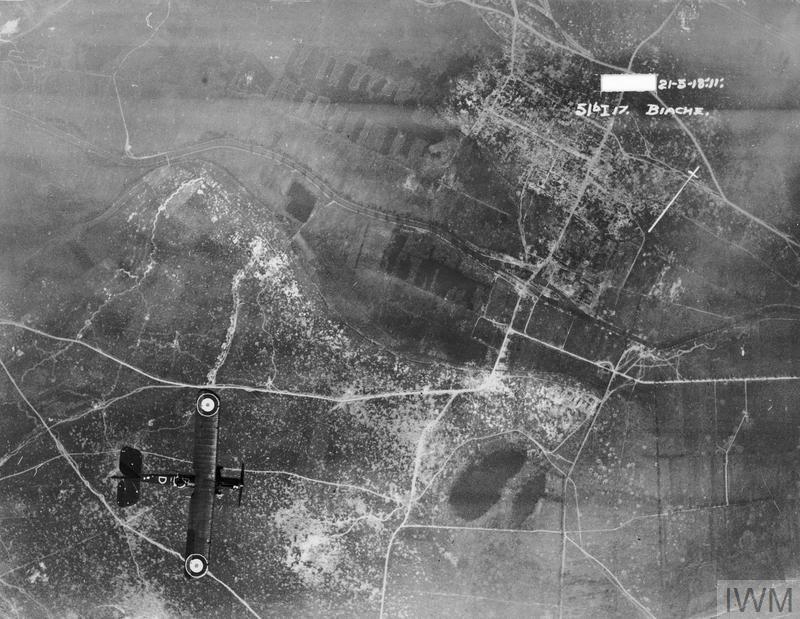
I pull my toggle (bomb-release handle) and glance down to make sure that both my hundred-and-twelve pound bombs have gone, for, should one stick, I should be unable to get to the height of the others on the return journey.
It only happened to me once, on a short show to Buhl, and I never want a repetition of the performance!
The air is full of Archie. Below, I can still see the cluster of bombs—what a time they are going down. They fade out of sight, and just as it seems that they are all duds up go the clouds of smoke. I can't watch them—the photographer will show us later where they fell.
Homeward bound! A glance forward between my centre section struts reveals the air full of aircraft—like gnats on a summer's evening.
I look at my watch as the enemy close in. We've got three and a half hours of it to face before we reach the line!
I chew steadily on my Spearmint and start counting the E.A. ; at forty I give it up. Ratatatatatatat! They mean to get us. Guns are going steadily all the time, and the air is full of flying sparks. Smack—smack—smack smash the Spandau bullets into my machine.
I glance behind and see my gunner still shooting.
A dozen or so enemy machines, oblivious of the flying lead, are right on our tails. I touch the rudder bar very slightly—left and right—to spoil their aim and crouch a little lower still in the cockpit.
Something snatches at my sleeve, my rev. counter flies to fragments, and I nearly swallow my chewing gum!
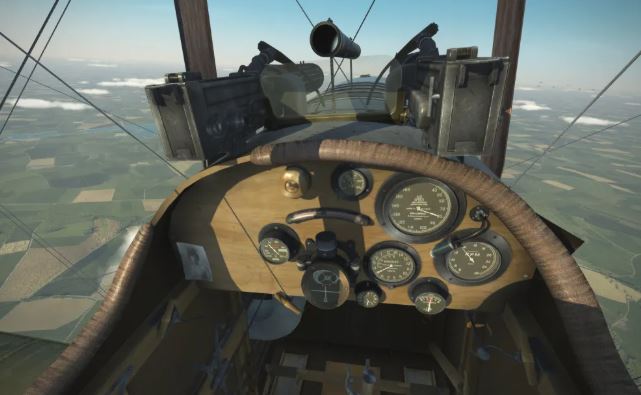
We bunch a little closer together until our wings are nearly touching, to reap the benefit of each gunner's fire. It's hard to sit still and be shot at—particularly when bullets are hitting the machine, but it's our only chance. The gunners must do the shooting. We can't stay and fight—we've a hundred odd miles to go yet.
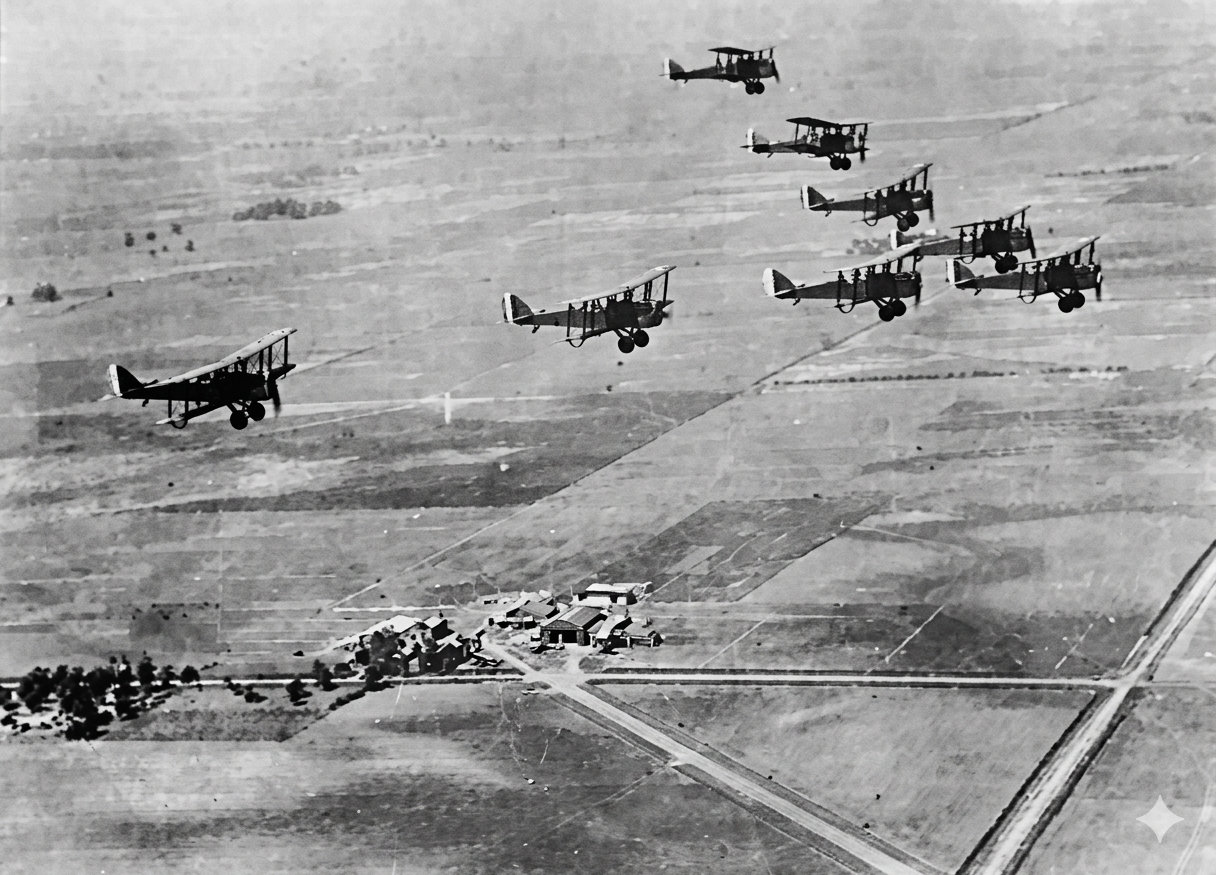
Every pilot knows that once let him lose his nerve for a second and swerve thirty feet out of place, and he would never get back. Every E.A. in the sky would be on him in a flash. Ah! Someone's down!
A "four" slips out of the formation and stalls. I look away, and then back. She dives—glides, dives, and I know the trouble. No pilot flies that machine. The pilot is hit and the observer (who can't fly) is trying to get down.
They'll shoot him to pieces before he is half-way down—it's over four miles to the ground. He'll crash if he does get there, but he still has a hundred to one chance if they don't set him alight. Ah! they've left him—they see he is down. Jolly sporting of them! But they don't all do that.
No. 3 is swinging a bit—he'll kill the lot of us if he starts sliding about. It's only his second show, and so excusable. Thank goodness he's steady again, and we close up—five of us.
Pip Rayment,[3] the observer in the back seat of No. 2, throws me a kiss. Good old Pip! The Skipper is climbing to a little more height, although we are at twenty-one thousand five hundred, and I can't keep up. My observer throws out his empty ammunition drums and crouches lower in the cockpit to reduce the "drag" caused by his body.
A bunch of E.A. come in on me, and every observer gun swings round to drive them off. I get back into place, sweating with fright. Gompertz, another observer, hurls an empty drum, which misses by a yard, at an E.A. Ahead is Strasburg. Thank goodness for that! Only another two hours. Strasburg will still look to be in the same place in half an hour, from this height and against this confounded wind.
Another hour passes slowly and my engine coughs—coughs again. Frantically I switch over to a new tank and breathe again as she picks up. The rattle of guns is incessant. My observer is only using his when the enemy come right in on us, and I know the reason.
He looks at me and holds up a drum—his last, and an hour to go!
I take a fresh bit of Spearmint after that!
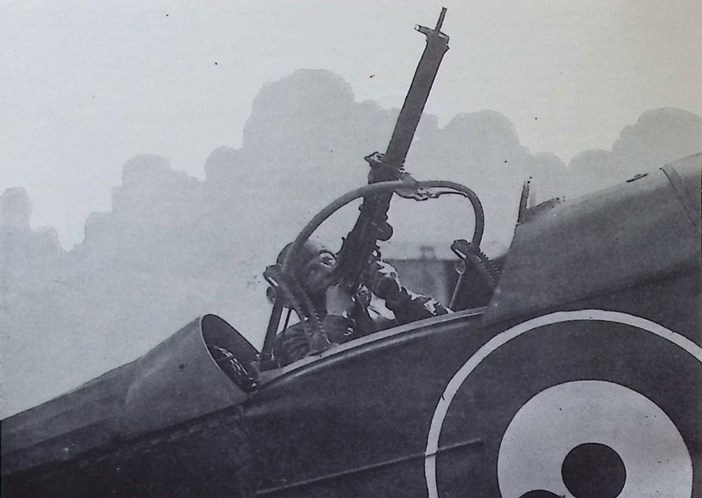
Pip is throwing empty drums overboard at the enemy below, and, between firing, Gompertz applauds him. They laugh at each other and pull long noses. Papworth,[4] another observer, also applauds. Why, heaven only knows!
I look back at my gunner and he grins cheerfully as he wipes blood from his mouth. His lips are skinned raw from standing up in that one-hundred-miles-an-hour blast for nearly four hours, with a temperature below zero.
We've been out four hours, and it seems like four years. I spot the limekilns near the line.
Hallo ! There's Don Waterous going down.[5] Something is wrong, but he is a sound pilot and should just make the line.
Gompertz is out of ammunition and is using his Very pistol. My stick shakes and my observer holds up an empty drum—not a round left!
The last ten minutes is warm work as the enemy make their final effort. A burst of fire rips the side off my instrument board and I look round to see whence it came. A scarlet Fokker is on my tail and I swing violently to spoil his aim.
Pip Rayment sees my plight and puts his last few rounds into him. He jerks up, hard hit, and bursts into flame. The Skipper puts his nose down and dives for home, the rest of us streaking after him. A smother of Archie plasters us as we cross the line.
A green light—that's the washout signal. I sit back, push up my goggles and raise my arms. My observer sees, and takes his spare stick. It's the only chance he gets to practice flying, and he might have to bring me down some day!
I laugh as we stagger about the sky. Ordinary flying seems a puerile business after the last five hours.
I land, taxi in, and switch off, feeling suddenly tired. Jimmy's face is drawn and white, and he bursts into a peal of hysterical laughter which makes us wince. It's time he went home.
We clamber out and stagger to the C.O.'s office to report. Sitting in a cramped seat all that time and at that altitude makes one stiff. A tender takes us to our quarters, and I throw myself on the bed to get the singing out of my ears. . . .
Well, peace-time flying seems a bit slow sometimes, nowadays. Flying meant something in 1918!
Further Reading
The account above was published in May 1935, but three years earlier Johns described how he had been shot down. This is entitled 'My Most Thrilling Flight'
He also wrote 'Memories of 55'
Additionally, Johns described the raid on Stuttgart in an anonymous piece in 'Twenty Years After'. This can be read here: A raid on Stuttgart by 55 Squadron.
The raid on Azelot became the basis of a 'Biggles' short story. This can be seen here: Biggles, the Battle of the Flowers and the RAF in the First World War.
The career of W.E. Johns is summarised in a further article here: Biggles’ Last Flight: the flying career of Captain WE Johns
References
[1] It is not clear who 'the Skipper' is but the squadron CO was Major Alexander Gray
[2] Lt Harry Christopher Travers Gompertz
[3] 2/Lt C L Rayment
[4] 2/Lt A S Papworth (became a Prisoner of War 30 August 1918)
[5] Lt D J Waterous (US airman) flew DH 4s with No 55 Sqn in the Independent Force, RAF. He was involved in many raids, including that on Strasbourg on 14 August 1918 in DH 4 F5703, with 2/Lt C L Rayment as observer, when they were credited with sending down an enemy aeroplane out of control
Becoming a member of The Western Front Association (WFA) offers a wealth of resources and opportunities for those passionate about the history of the First World War. Here's just three of the benefits we offer:

Identify key words or phrases within back issues of our magazines, including Stand To!, Bulletin, Gun Fire, Fire Step and lots of others.

The WFA's YouTube channel features hundreds of videos of lectures given by experts on particular aspects of WW1.

Read post-WW1 era magazines, such as 'Twenty Years After', 'WW1 A Pictured History' and 'I Was There!' plus others.
Other Articles


