
Some Platoon Commanders of the BEF during the Hundred Days
The inspiration for this article was the list of platoon commanders on 29 September 1918 in R.E. Priestley’s account of the 46th (North Midland) Division’s ‘breaking of the Hindenburg Line’.[1] We have wondered for many years who these men were. It is time to find out.
‘A Platoon Commander’s War’
The evolution of the British infantry battalion began before the war. Until 1913 battalions consisted of eight companies, but on 1 October this was changed to four companies. The order applied to all Regular Army infantry battalions. New Army battalions were organised on Regular Army lines from their inception. This was not true of the Territorial Force [TF], however. In some respects, in peacetime at least, an eight-company structure was suited to TF battalions, especially those that were not city-based. So, for example, the 5th Leicesters had companies based at Ashby-de-la Zouch (“A” Coy), Oakham (“B” Coy), Melton Mowbray (“C” Coy), Hinckley (“D” Coy), Market Harborough (“E” Coy), Mountsorrel (“F” Coy), Shepshed (“G” Coy) and Loughborough (“H” Coy). But these arrangements had no utility once TF battalions were deployed on active service and during the course of the first year of the war they converted to the four-company system.[2]
In line battalions, companies were usually designated “A”, “B”, “C” and “D”. Each company was sub-divided into four platoons, numbered sequentially 1-16. Platoons were commanded by junior officers (‘subalterns’) either lieutenants or second lieutenants. In recent years our knowledge of different command levels in the BEF, reinforced by numerous excellent biographies, has expanded enormously,[3] but no one has attempted to do this for platoon commanders. Does this matter? The answer must be ‘yes’ because following the publication of SS 143 Training of Platoons for Offensive Action in February 1917, the platoon commander became the key deliverer of British tactics.[4]
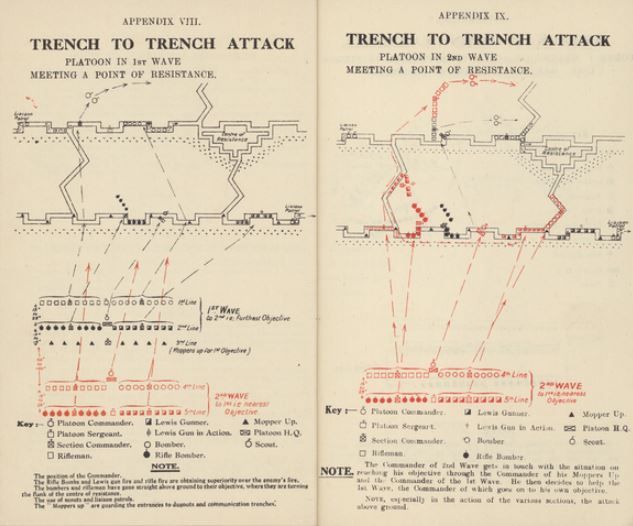
Drilling down to the platoon level poses many problems, not least those of scale. This is a small attempt to discover who were commanding platoons in one Territorial division at a late (mature) stage of the war.
Priestley’s List
In the words of the great French scholar Georges Lefebvre, ‘to be a historian it is necessary to count’. Even at a superficial level Priestley’s list is revealing. The nine infantry battalions of 46th Division on 29 September 1918 should have had 144 platoon commanders, but only the Lincoln and Leicester Brigade had a full complement of 48. The Staffordshire Brigade had 41 and the Sherwood Forester Brigade only 36. The Lincoln and Leicester Brigade only achieved its full complement by utilising seven NCOs as platoon commanders.
Is Priestley’s list an accurate statement of the 46th Division’s platoon commanders on 29 September 1918? Not entirely. He makes several mistakes in the spelling of surnames and in the attribution of initials. These mistakes are identified in APPENDIX 2, below.
More seriously, Priestley fails to take notice of the loss of platoon commanders suffered by the 5th Battalion Leicestershire Regiment in the fighting at Pontruet on 24 September 1918, in which 2nd Lieutenant Albert Asher, Sergeant Percy Bowler, 2nd Lieutenant John Lewin and 2nd Lieutenant Henry Quint[5] were killed and Lieutenant John Barrett, 2nd Lieutenant John Buckley, 2nd Lieutenant Samuel Dennis, 2nd Lieutenant Walter Parsons and Lieutenant Dudley Sloper wounded.[6] Replacements were brought in before 29 September, but this article is concerned only with the men listed by Priestley.
Priestley named 125 platoon commanders, of whom seven were NCOs.[7] We have discovered a considerable amount of information for all but three of these men, all in the 5th Battalion Leicestershire Regiment: 2nd Lieutenant E. Cosgrove; 2nd Lieutenant A. Johnson; and Corporal B. Mead. Ninety-nine have available service files. (Alas, only one service file of the seven NCOs appears to have survived the depredations of the Luftwaffe and the London Fire Brigade.)[8]
Information in these files has been supplemented by that from battalion War Diaries, battalion histories, Medal Roll Index Cards, Medal Rolls, the Register of Soldiers’ Effects, Pension Cards, Silver War Badge records, hospital admission registers, the Commonwealth War Graves Commission Debt of Honour Register, regimental, school, university, town and village Rolls of Honour, censuses (including those of Canada and the United States), Birth, Marriage and Death records, the 1939 Register of England and Wales, Probate Registers, genealogy websites and newspapers.
‘Tactically Naïve Schoolboys’
Vera Brittain’s Testament of Youth recalls the haunting experience of her friend Victor Richardson, a twenty-one year old 2nd Lieutenant in the 9th (Service) Battalion King’s Royal Rifle Corps on the Somme in September 1916. Richardson was acutely aware that his men would look to him for leadership and decision. He was even more acutely aware that he had no idea what he was doing, but hoped that somehow, as if by osmosis, membership of a famous regiment would confer on him the necessary skills.[9] Responsibility without power or knowledge or understanding is the stuff of nightmares.
This image of callow, militarily naïve public schoolboys, barely old enough to grow the moustaches they were expected to sport, has unfortunately persisted. Like many stereotypes, it is not without substance, especially in the early years of the war, when the army expanded exponentially and the urgent need for junior officers undoubtedly led to barely trained young men being thrown into combat in the belief that a public school education, previous membership of the OTC, sporting prowess or professional status would be enough. Like so many aspects of the war, however, this changed over time, as we will see.
The Officer Class
At the outbreak of the Great War there were 24,858 officers on the Active List of the British Army: these included 12,738 Regulars (51.2 per cent), 2,557 members of the Special Reserve [SR] (10.3 per cent), and 9,563 Territorials (38.5 per cent).[10] During the course of the war a further 229,316 commissions were granted:[11] of these only 16,544 were permanent commissions in the Regular Army (7 per cent); 30,376 were in the Special Reserve (13 per cent);[12] 58,674 were in the Territorial Force (25.6 per cent); and 123,722 were ‘temporary commissions’ in the Regular Army (54 per cent).[13] Although the 46th was a Territorial Division its officer platoon commanders on 29 September 1918 included examples of all these types of commission, though Territorial commissions predominated (66 out of 118 or 56 per cent).
The biggest change to how officers were commissioned during the war came with the establishment in February 1916 of Officer Cadet Battalions [OCBs]. Of the 118 platoon commanders who were officers and listed by Priestley, one was commissioned in 1911,[14] one in 1914,[15] three in 1915, seven in 1916, 80 in 1917 and 26 in 1918. All those commissioned in 1917 and 1918 and one of the men commissioned in 1916 went through the OCB system (90.7 per cent). The importance of the OCB system on officer recruitment and training is acknowledged, but has been little studied.[16] A reckoning must await the completion of Charles Fair’s research and the publication of his findings.
There is much contemporary criticism of new junior officers late in the war, similar to those made in 1914-15, that they were very young and untrained. James Jack spoke for many when he commented in his diary while commanding 1st Battalion Cameronians on 7 August 1918: ‘‘[General Maxse] said that every platoon commander should have his men at his disposal for a short period of training every day when out of the Line. This is entirely sensible in theory; but few of the present platoon commanders are professionally fit to instruct their men, and we prefer to educate them first, so that they shall teach correctly and not spread false doctrines among their subordinates.’[17]
It is difficult to pin this criticism on the platoon commanders of 46th Division on 29 September 1918. They were not young men straight out of school. We have the ages of 123 of the 125 platoon commanders listed by Priestley: the youngest were 19 (of whom there were nine) and the oldest 41; 23 were aged 30 or over with a median age of 25 and an average age of 25.54. Eighteen were Lieutenants, which meant that they had spent eighteen months in the rank of 2nd Lieutenant and been considered worthy of promotion. Fourteen (11.2 per cent) were ‘originals’, men who had served with their battalions ever since 46th Division’s deployment in February/March 1915, thirteen of them in the ranks. They were not ‘newbies’ who didn’t know their way round a trench.
Territorial Still?
The 46th (North Midland) Division remained remarkably Territorial given the tremendous changes that the British Army underwent during the war. As we have noted, on 29 September 1918 a majority of the platoon commanders held Territorial commissions. Three of the nine battalion commanders were pre-war Territorials and a fourth held a wartime Territorial commission. Three were natives of the counties of whose regiments they led. But this degree of continuity disguised considerable change. Territorial units were not immune to the social evolution of the army as a whole.
A comparison with the officers who took the 1/5th Battalion North Staffordshire Regiment to war in 1915 is instructive. They were overwhelmingly local men from the heart of the commercial and professional elites of North Staffordshire: architects; brewers; earthenware manufacturers; engineers; factory managers; schoolmasters; solicitors; surveyors. They were the sons of colliery owners, china, earthenware and tile manufacturers, and solicitors with political connections. Some were very wealthy. 2nd Lieutenant Aubrey Bowers, who died of wounds on 2 July 1916 rather unluckily sustained behind the lines at Gommecourt, was one of nine public schoolboys. He inherited Park Hall Colliery on the Cheadle coalfield following the death of his father in 1911. He was a member of Staffordshire County Council and a well-known sportsman, another element in Territorial officers’ local elite status. He left £137,000 at his death, aged twenty-nine. His name is recorded on the Park Hall Colliery war memorial together with three of his miners who died and a further thirty-five who served and survived.
Aubrey Bowers is doubtless an extreme example, but there is more than an element of truth in seeing the social changes within 46th Division as a move from the sons of coal owners to the sons of coal miners. There were platoon commanders in 46th Division on 29 September 1918 who came from ‘privileged’ backgrounds, younger versions of the sort of people who were commissioned in 1914-15 – 2nd Lieutenants Angus, Barrows and Bavin, for example[18] – but the differences are more striking than the similarities. It was a group of officers typified by railway, brewery and insurance clerks, wood carvers, jewellers, carpenters, pottery placers and decorators, miners, quarry labourers and metal workers. They were the sons of commercial travellers, bus drivers, window cleaners, slaters and tilers, boot and shoe makers and farm labourers. Most had only an elementary education, with a leavening of grammar school and public school boys.
It is easy to fall into the trap of thinking that the 46th Division’s remarkable achievement in crossing the St Quentin Canal at Bellenglise, and especially the capture of Riqueval Bridge, terminated its war. This was far from the case. The events of 29 September represented a break-in to the Hindenburg Line, not a break-through. There was much hard fighting to follow. The division lost only two platoon commanders on 29 September, though fifteen were wounded.[19] But thirteen were lost on 3 October at Ramicourt (and eleven wounded).[20] Although, the idea of the ‘six week officer’ is something of a myth, it should not disguise the extent to which the burden of infantry fighting fell on junior officers and at what cost.[21]
Aftermath
The men discussed in this paper were overwhelmingly ‘citizens with no previous military experience’. Many of them were not from the ‘officer class’. Douglas Haig, himself, understood that the war had produced a different kind of army and that appropriate arrangements needed to be made to accommodate officers without private means who had been wounded.[22] This was obvious to many at the time. It gave rise, post-war, to what was known as the ‘officer problem’, how and whether wartime rank could or should be reflected in peacetime status.[23] If any of our cohort thought that unexpected elevation to officer rank would result in itself in a transformation of their social status they would have been sorely disappointed. Most settled back into conventional lives and careers, which developed in ways they would have done had the war never happened – bank clerks who became bank managers, schoolmaster who became headmasters, medical students who became surgeons, police constables who became police superintendents.
There were some changes of direction, however. 2nd Lieutenant Walter Payne gave up a good pre-war job as a designer in the pottery industry to become a police officer on the Wirral. 2nd Lieutenant J.H. Robinson also abandoned the pottery industry during the slump of 1921, becoming a hotel keeper and finally a farmer in Devon. Eight officers emigrated, four to Canada, three to the United States and one to Australia. Perhaps the life that underwent the greatest degree of transformation was that of 2nd Lieutenant Alfred Jepson, who was a farm worker before the war and valet to one of the richest men in the world after it.[24]
Others returned to mundane clerking jobs in their home towns and industries and remained there throughout their working lives. (In the case of the NCO platoon commanders who survived there was no escape from hard, demanding physical jobs. Sergeant Harold Dobson was a fettler in an iron foundry before the war and a furnace labourer after it.) A few officers’ post-war lives were seriously ‘interrupted by history’, however. This was especially true of the division’s ‘warriors’, men who were fulfilled by war and missed its excitement. Chief among these was 2nd Lieutenant J.R. Dench MC**. He found escape from a humdrum existence by joining the Auxiliary Division of the Royal Irish Constabulary [the ‘Black and Tans’],[25] a route also taken by 2nd Lieutenant P.W. Burgess MC MM, but even Dench eventually ended up in his home town doing the sort of clerking job he had before the war.
There was a famous American song, popular in 1918, ‘How Ya Gonna Keep ‘em Down on the Farm (After They’ve Seen Paree)’. The war, in some cases, may have opened new horizons and engendered restlessness, but for many, probably most, the desire was for a return to normality. Lieutenant Maurice Williams MC had what was known as a ‘good war’. He was the son of a grocer and draper from Mildenhall in Suffolk, a quintessentially English place mentioned in the Domesday Book. His war service took him to Gallipoli as well as the Western Front. He returned to his home town after the war and stayed there for the rest of his very long life, becoming ‘a pillar of the community’, a successful green grocer and for fifty years a Scout Master.
The impact of the war on the future health outcomes of those who fought in it has, perhaps, not attracted as much attention as it might.[26] Clearly, the health outcomes for those men who suffered disfiguring or handicapping wounds or psychological trauma were very bad,[27] but what about those who appear to have come out of the war ‘intact’? It is difficult and, indeed, wrong to draw firm conclusions from such a small sample as the platoon commanders of 46th Division on 29 September 1918, but as far as any conclusions can be drawn they do not differentiate the health outcomes of veterans from the health outcomes of the general male population. Ninety-seven men survived the war, seven of whose dates of death we have failed to discover. The following data is therefore based on ninety officers. Their average age at death was 72.32 with a median age of 74.5. Lieutenant Maurice Williams lived to the greatest age (98) and was the last survivor (dying in 1991). The first and youngest of the survivors to die was 2nd Lieutenant Austin Vizor MM MiD (aged 29). The causes of death were also in line with those of the general population, cardio-vascular disease and tuberculosis. The almost universal habit of smoking, strengthened during the war, probably did more to undermine health than the war itself.
Final Thoughts
We began by saying that it was time to discover who the platoon commanders of 46th Division were on 29 September 1918. We have done this. But we have not addressed the question of their competence. An Israeli commander was once asked to explain the success of his country’s arms. He replied, ‘It is simple. My officers do not say “advance”, they say “follow me”’. Between 24 September and the Armistice, 46th Division suffered 27 fatalities among the platoon commanders listed by Priestley; a further 37 were wounded; total casualties of 51.2 per cent. These figures confirm that the division’s platoon commanders led from the front. Courage and competence are not distributed by social class. 2nd Lieutenant Maxwell Barrows MC, the son of a solicitor, educated at Sedbergh School and Pembroke College, Oxford, was an impressive soldier, as was the nineteen years old Sergeant Newman Smith, the son of a roofer. Both were killed. The fighting in the Hundred Days was among the most severe in British military history. The war was not winding down to a conclusion that people could see on the horizon. The platoon commanders of 46th Division possessed the ‘will to combat’, committed to taking the fight to the enemy and committed to winning.
Acknowledgements
The authors are delighted to acknowledge the help of Alan Angell, Richard Bagshaw, Lindsay Baker, Nick Baker, Janice Bovill (MoD), Steve Bramley, Peter Duckers, Jeff Elson, Charles Fair, Tim Halstead, Paul Handford, Hugh Mackrell, Andy Rawson, Audrey Samwells (MoD), Professor Michael Snape, Dr William Spencer, Craig Suddick, Dr Heather Swanson, David Tattersfield, Dr Tom Thorpe, Phil Tomaselli, and Lev and Janice Wood in researching this article.
Appendix 1
Select Biographies of 46th Division’s Platoon Commanders
29 September 1918
2nd Lieutenant William Stephenson Angus (1899-1982), 1/6th Battalion North Staffordshire Regiment
b. 2 March 1899, Bingley, Yorkshire; s. of Henry Angus (1864-1938), General Practitioner and Medical Officer of Health for Bingley, and Elizabeth Heuston Angus (née Stephenson) (1867-1947); educ. Bradford Grammar School, where he joined the school’s fledgling OTC in November 1914; in September 1917, aged 18, he was sent for officer training at No. 12 Officer Cadet Battalion (Newmarket), from which he was discharged to a commission in the North Staffordshire Regiment on 18 December 1917. He served with the 5th (Reserve) Battalion on the east coast at Mablethorpe for three months before deploying to France to join the 2/5th Battalion in April 1918. He transferred to the 1/6th Battalion in May after the 2/5th was reduced to a training cadre; he was aged 19 on 29 September 1918.
Angus was wounded at Ramicourt on 3 October 1918, evacuated to the UK and attached to the 3rd (Reserve) Battalion North Staffordshire Regiment at Wallsend after his recovery. He was ‘disembodied’ in April 1919, but retained his Territorial commission until he resigned it in February 1921. In 1919 he had won a Scholarship to Pembroke College, Oxford, where he read Modern History; after graduating he embarked upon a career in educational administration, which put him back in uniform. He was recommissioned as a Lieutenant in June 1924 for service with the Liverpool University OTC, with which he served (ultimately as a Captain) until May 1929. He then joined the Territorial Army Reserve of Officers until resigning his commission for the second time in February 1939. From 1930 he held various offices in the Federal University of Durham and was eventually its Registrar (1935-52). He seems to have been a formidable operator with high standards who left an enduring mark upon the Universities of Durham and Newcastle.[28] In 1952 he became Registrar of Aberdeen University, which was just embarking on a period of unprecedented expansion.
Angus married Rosamund Vera Willis (1903-79), a well-known interior designer, somewhat late in life (1945). He died in York on 21 October 1982, aged 83.
- Honours and Awards: BWM; VM
- Service File: Not found
- Probate: £106,524 0s 0d
Lieutenant Edwin Francis Ann (1893-1941), 1/5th Battalion Sherwood Foresters
b. Derby, 5 August 1893; s. of Sir Edwin Thomas Ann (1852-1913), twice Mayor of Derby, and Sophia Ann (née Eastland) (1851-1934); his father was a draper who founded Midland Drapery, the ‘first purpose-built independent department store’ in Derby;[29] his maternal grandfather was for 37 years Professor of Midwifery at the University of Aberdeen; educ. Malvern College, where he joined the OTC; Ann worked for the family firm as a salesman before the war; he received a direct commission into the Sherwood Foresters from the ranks of the 21st (Service) Battalion Royal Fusiliers (4th Public Schools) on 5 December 1914; he deployed to France with his battalion in March 1915, making him a 46th Division ‘original’; he was injured by a shell blast at Gommecourt on 1 July 1916 and evacuated to No. 3 Southern Hospital, Bristol; during a long period of convalescence he was attached to 681 Agricultural Company, Labour Corps; he attended a School of Instruction for Infantry Officers between 15 June and 10 August 1918, where he was reported as a ‘persevering officer of a quiet and retiring disposition’; with ‘fair military knowledge’, though ‘weak in knowledge of the Lewis gun and topography’; he was considered ‘not yet’ fit to command a company in the field; he was aged 25 on 29 September 1918, when he again suffered a shell wound to the head and was evacuated to No. 2 Western General Hospital, Manchester.
He married, firstly, (Dorothy) Renée Johnson (1890-1920) on 18 July 1917; secondly, Sarah Doreen Light Gifford (1902-35) on 20 September 1922; and, lastly, in 1938 Mary Vaughan Parry (1905-64). Edwin Ann was described as a ‘company director’ in the 1939 Register of England and Wales, which implies a continued connection with the family firm, but perhaps retailing was not something he relished. The 1921 Census lists him as a ‘farm pupil’ with George Gifford at Colerne in Gloucestershire. This was after the death of his first wife from influenza, leaving him with a four-month old daughter. (Ann’s second marriage was to Gifford’s youngest daughter.) He died from self-administered gunshot wounds to the head at his farm in Holford, Somerset, on 11 June 1941, aged 47.
- Honours and Awards: 14-15 Star; BWM; VM
- Service File: TNA WO 374/1882
- Probate: £45,279 15s 9d
Lieutenant Henry (‘Harry’) Bamber (1887-1962), 1/5th Battalion Lincolnshire Regiment
b. 11 September 1887, Spilsby, Lincolnshire; s. of Andrew Bamber (1840-1923), a baker, and Emma Bamber (née Hales) (1842-1905); educ. King Edward VII Grammar School, Spilsby; a school teacher at a Lincolnshire council school before the war. Bamber was a pre-war Territorial, who joined the TF on the day it was formed, 1 April 1908. By 1914 he was Company Sergeant Major (WO2) of the 5th Lincolns and deployed with them to France on 1 March 1915, making him a 46th Division ‘original’. He served with the BEF until 23 September 1915, when he was evacuated to England via 1st North Midland Division Field Ambulance, No. 15 CCS, No 2 Canadian Stationary Hospital and HMHS Anglia. This meant that he missed the 46th Division’s disastrous attack against the Hohenzollern Redoubt on 13 October in which 170 men of the 1/5th Lincolns were killed. He was not to return to France until April 1918.
On 13 October 1915 he was transferred to the 3/5th Lincolns as CSM. On 15 December 1915 he was discharged to a commission in the 3/4th Lincolns, where he seems to have been used on training duties. On 1 July 1917 he was promoted to Lieutenant. The following month his request for transfer to the Signal Service was rejected. In April 1918 he joined the 2/5th Lincolns in 177 Brigade, 59th (2nd North Midland) Division TF, then engaged in the Battles of the Lys. 2/5th Lincolns were reduced to cadre in May 1918. Bamber was one of ten officers to remain with the battalion until it was disbanded on 31 July 1918. He was eventually posted to 1/5th Lincolns, which he joined on 5 August 1918, almost three years after he left it as CSM. He was aged 31 on 29 September 1918.
Harry Bamber was released from military service on 13 January 1919. He returned to the teaching profession and was a headmaster in Skegness by 1939. He also served with the Observer Corps during the Second World War. He married Gwendoline Hill (1893-1965) in 1927 at the age of 40. Harry Bamber died in St George’s Hospital, Lincoln, on 2 June 1962, aged 74.
- Honours and awards: 14-15 Star; BWM; VM
- Service file: TNA WO 374/3625
- Probate: £2,732 16s 7d
2nd Lieutenant (Richard) Neville Barker (1892-1980), 1/8th Battalion Sherwood Foresters
b. 18 November 1892, Sherwood, Nottinghamshire; s. of William Sissons Barker (1859-1920), a maltster, and Bertha Maria Barker (née Kirkham) (1858-1933); educ. Nottingham High School. Barker was a pre-war Territorial who served for eighteen months in the 7th (Robin Hood) Battalion Sherwood Foresters until discharged on 8 January 1912. This was almost certainly because he left the United Kingdom to work in Argentina, where he was an inspector of cold storage.
He arrived back in Britain on SS Highland Rover on 23 February 1916 and enlisted in the Royal Engineers on 3 March. After proceeding to the Signal Depot in France he was posted the 5th Divisional Signal Company, where he was a despatch rider. He remained with this unit, reaching the rank of Corporal, until returning home for officer training on 14 February 1917. This was intended to be with the Machine Gun Corps,[30] but he was found to be ‘unsuitable’ and posted instead to No. 12 Officer Cadet Battalion (Newmarket) on 7 June 1917. He was discharged to a commission in the Sherwood Foresters on 25 September 1917. He was aged 25 on 29 September 1918.
He married Marjorie Frances Gamble (1893-1976) on 11 December 1918. He returned with his wife to Argentina in December 1920, describing himself as a ‘cattle exporter’. It is not known when he finally left Argentina, but in the 1939 Register of England and Wales he was living in Lincolnshire where he was the Assistant County Architect, a remarkable change of career. The name of his house in Queensway, Lincoln, “Belgrano”, was a reminder of his time in Argentina. He retired to Jersey, where he died on 29 November 1980, aged 88.
- Honours and awards: BWM; VM
- Service file: TNA WO 339/81048
- Probate: Not found
2nd Lieutenant Roderick Barron (1877-1954), 1/6th Battalion North Staffordshire Regiment
b. 17 April 1877, Laggan, Inverness-shire; s. of Hugh Barron, a police constable, and Margaret Barron (née Fraser); educ. Edinburgh University (MA, 1900); an educational administrator, Sub-Inspector of Schools before the war; he enlisted on 23 February 1916 and arrived in France at No. 21 Infantry Base Depot on 29 September. On 12 October he was posted to 15th (Service) Battalion Highland Light Infantry (1st Glasgow) (Glasgow Tramways Battalion), aged 38. He was transferred to the UK on 22 January 1917 for officer training at an Officer Cadet Battalion and was discharged to a commission in the 1/6th North Staffordshire Regiment on 31 July 1917. He was aged 41 on 29 September 1918, the oldest platoon commander in 46th Division, and very much an exotic among the serried ranks of midland Englishmen. He had reached the rank of A/Captain by the time he was demobilised in January 1919.
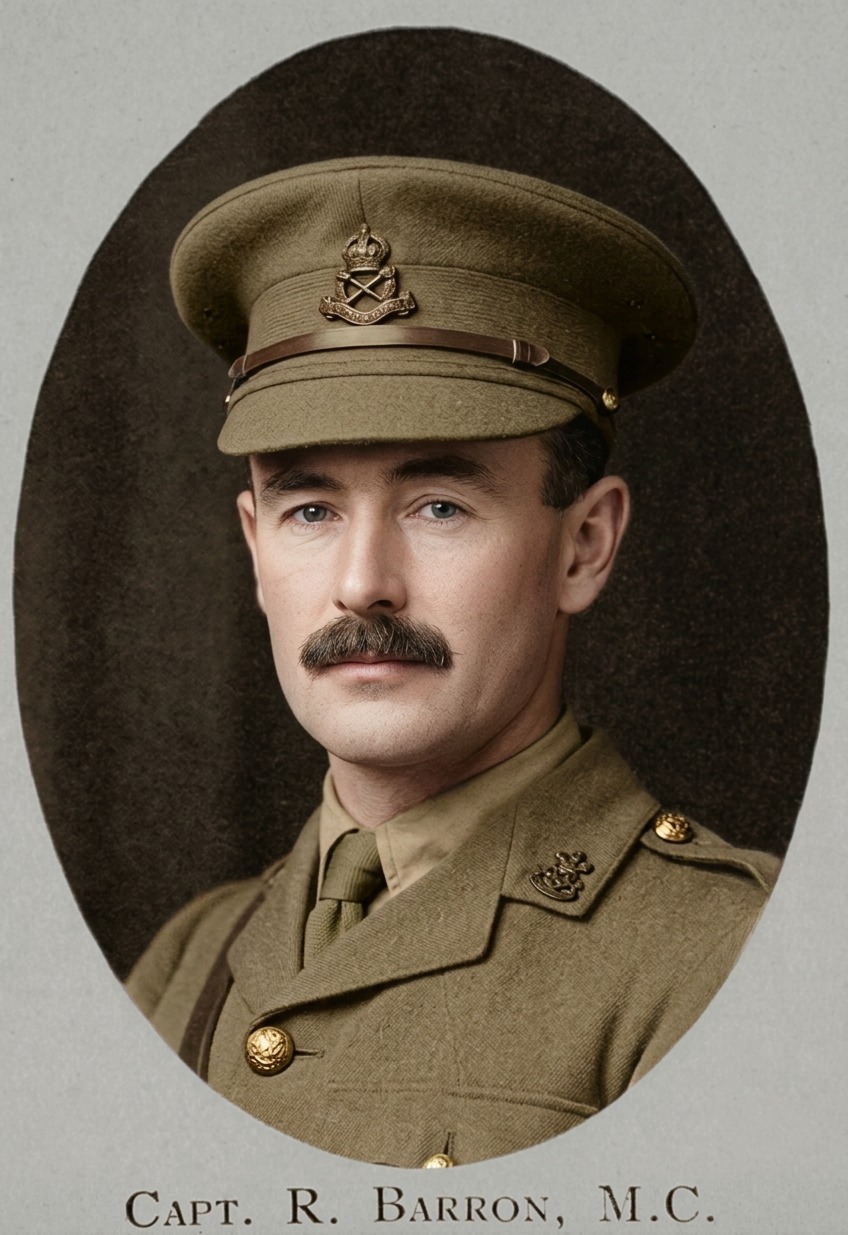
Barron resumed his educational career and became His Majesty’s Inspector of Schools in Scotland. He was a Gaelic speaker, a member of the Gaelic Society of Inverness and its Honorary Chieftain in 1952. He wrote many papers on the Gaelic language and on the history of Inverness-shire. He married Helen Margaret Cook (1888-1979) on 9 September 1924. He died in Raigmore Hospital, Inverness, from a heart attack, on 8 July 1954, aged 77.
- Honours and awards: MC; BWM; VM
- Service file: TNA WO 339/81048
- Probate: Not found
2nd Lieutenant Maxwell Dalston Barrows (1898-1918), 1/5th Battalion Sherwood Foresters
b. 5 August 1898, Nottingham; s. of George William Barrows (1860-1940), solicitor, and Jane Marguerite Barrows (née Dalston) (1873-1945); educ. Nottingham High School, Sedbergh School and Pembroke College, Oxford; a schoolboy and then a university student before the war. He attested on 9 August 1916 and was posted to the Army Reserve. He served with the Sedbergh School (1912-Oct 1916) and Oxford University (October 1916-) OTCs. ‘Keen and intelligent. Should make a sound officer.’ He was mobilized on 9 April 1917 and posted to No. 8 Officer Cadet Battalion (Lichfield) on 12 April. He was discharged to a commission on 31 July 1917, deploying to France on 11 September in the 2/5th Sherwood Foresters TF, 178 Brigade, 59th (2nd North Midland) Division TF. He was appointed A/Captain and Adjutant of the battalion (5 April-5 August 1918), the last man to hold the position. After the 2/5th Sherwoods were disbanded on 3 August 1918, Barrows transferred to the 1/5th.
He was aged 20 on 29 September 1918. He had already distinguished himself at Berthaucourt on 24 September. ‘During a successful attack when platoons of another company had been held up, he led his platoon forward under heavy machine gun fire. It was largely due to his courage, initiative and fine leadership displayed at a very critical moment that a series of very strong machine-guns posts were able to be carried and a large number of prisoners taken.’[31] 2nd Lieutenant Barrows, by then commanding a company, was killed in action on 3 October 1918 at Ramicourt shot through the head at point blank range by a machine-gun. He is buried in Bellicourt British Cemetery, France, and commemorated on the Nottingham High School and Pembroke College, Oxford, Rolls of Honour.
- Honours and awards: MC; BWM; VM
- Service file: TNA WO 374/4363
- Probate: £189 11s 5d
2nd Lieutenant William (‘Billie’) Bavin (1899-1918), 1/6th Battalion Sherwood Foresters
b. 11 April 1899, Nottingham; s. of Richard Bavin (1868-1936), estate agent, and Mary Bavin (née Radage) (1867-1946); educ. Nottingham High School and University College Nottingham. He spent nine months with the Nottingham University OTC and a further five with No. 3 Officer Cadet Battalion (Bristol) before being commissioned in the 3rd (Reserve) Battalion Sherwood Foresters on 25 March 1918. He did not proceed to France until 28 June 1918, joining the 1/6th Sherwoods on 23 July. 2nd Lieutenant Bavin was killed in action on 29 September 1918, aged 19, twenty-four days after recovering from influenza at No. 10 Field Ambulance. He has no known grave but is commemorated on the Vis-en-Artois Memorial, France, and the Nottingham High School and University College Nottingham OTC memorials.
- Honours and awards: BWM; VM
- Service file: TNA WO 339/105959
- Probate: Not found
2nd Lieutenant Joseph Bellingham (1896-1987), 1/6th Battalion North Staffordshire Regiment
b. 29 March 1896, Glasgow; s. of William Bellingham (1864-1902), railway signalman, and Mary Ann Bellingham (née Heeley) (1868-1935); educ. Wolseley Street School, Glasgow; employed as a patternmaker at Alley & McLellan, Glasgow; he was a pre-war Territorial who enlisted in the 7th Battalion Scottish Rifles on 21 May 1913. The 7th Scottish Rifles joined the Mediterranean Expeditionary Force on 23 May 1915. Bellingham remained with his unit on the Gallipoli peninsula until 16 October when he returned to the UK almost certainly suffering from dysentery and malaria.[32]
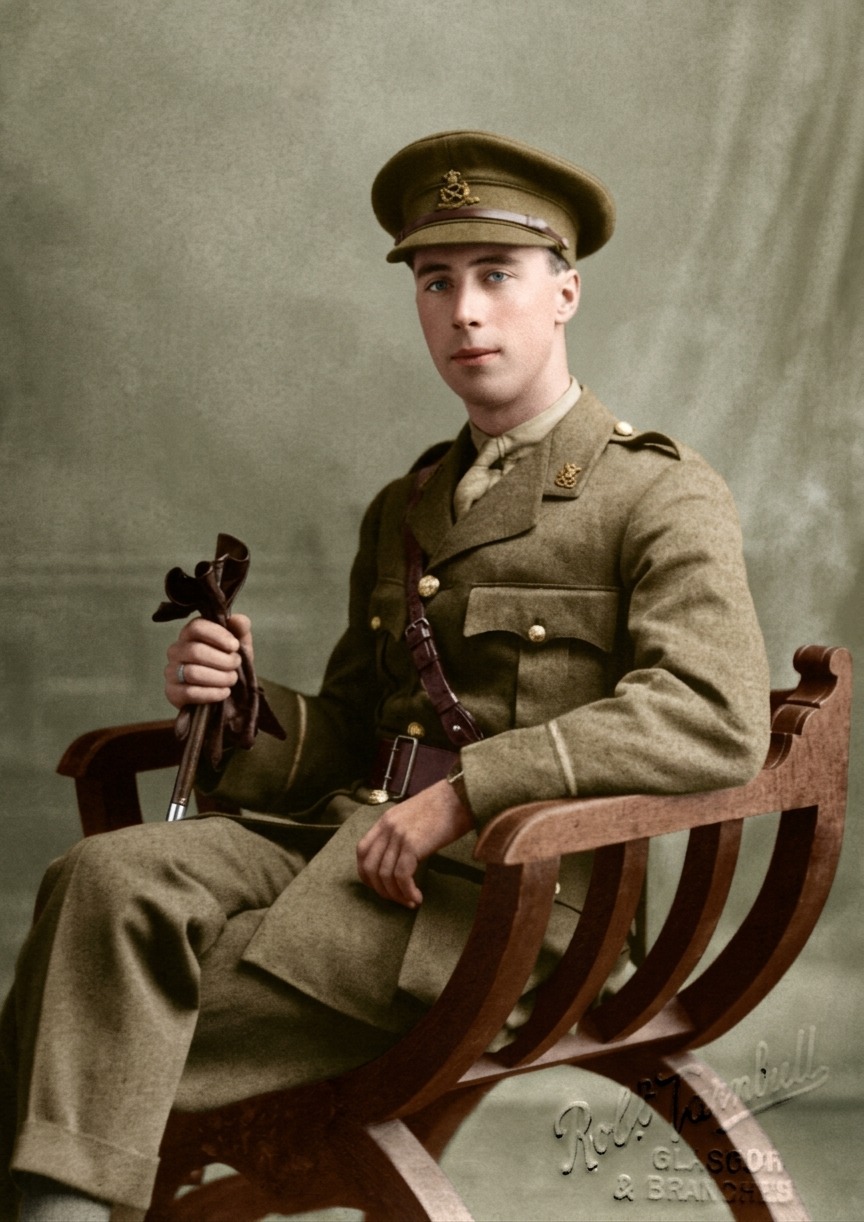
Soldiers who were evacuated to the UK from the Mediterranean theatre rarely went back. This was the case with Joseph Bellingham, who was transferred to 5th Scottish Rifles in France on 29 September 1916. He remained with the 5th until wounded (GSW right thigh) on 15 April 1917. While recuperating in the UK, he was selected for officer training at No. 7 Officer Cadet Battalion (Fermoy) on 9 November 1917. He was discharged to a commission in the North Staffordshire Regiment on 23 March 1918. He was aged 22 on 29 September 1918. The act for which he was awarded the Military Cross occurred the day before. ‘On 28 September 1918 … near Bellenglise, while defending a newly won trench against a determined counter-attack, he commanded his platoon and showed great gallantry and devotion to duty, materially helping the company commander to maintain his ground. On the following day during our advance he again showed fine leadership and initiative.’[33]
He was employed for a while after the end of hostilities with 170 POW Coy until his release from military service on 25 September 1919. In 1921 he emigrated to Canada where he joined his uncle, John Bellingham, a factory labourer in Hamilton, Ontario. He resumed his previous work of pattern making. He married the Scots-born Cecilia Murray Hogg (1897-1990) in Wentworth, Ontario, on 7 October 1921. They had three sons. By 1931 he was a machinist in a vacuum cleaner factory. Joseph Bellingham died in Hamilton on 4 May 1987, aged 91.
- Honours and awards: MC; 14-15 Star; BWM; VM
- Service file: TNA WO 339/115503
- Probate: Not found
2nd Lieutenant John Vickers Blunt (1892-1972), 1/5th Battalion South Staffordshire Regiment
b. 3 November 1892, Scropton, Derbyshire; s. of Henry William Blunt (1867-1923), a farmer and stud owner, and Mary Blunt (née Speirs) (1869-1921); educ. elementary schools at Breedon-on-the-Hill, Derbyshire, and Rostherne, Cheshire; he was a pre-war Territorial, attesting on 7 April 1913 when he described himself as a farm labourer; he had attained the rank of Lance Corporal in the 5th Battalion Leicestershire Regiment by the outbreak of war; he deployed to France with his battalion on 28 February 1915, making him a 46th Division ‘original’. He remained in France until 21 September 1915, eight days after 46th Division’s disastrous attack against the Hohenzollern Redoubt at Loos, when he was posted home to the 5th Leicesters’ second line battalion. He returned to France on 25 February 1917 with the 2/5th Battalion Leicestershire Regiment, part of the 59th (2nd North Midland) Division TF. He was by then a Company Sergeant Major. In June 1917 he was posted back to the UK for officer training, his certificate of recommendation being signed by his battalion commander, Lieutenant-Colonel G.B.G. Wood, and the CRA 59th Division, Brigadier-General J.W. Stirling. He joined No. 15 Officer Cadet Battalion (Romford) on 10 August 1917 and was discharged to a commission in the South Staffordshire Regiment on 26 November 1917. He was aged 25 on 29 September 1918.
Blunt was wounded at Ramicourt on 3 October. He was hit by a shell fragment in the left arm, suffering severe bruising. But the same shell also buried him in his dugout, rendering him unconscious for an hour. This had serious long term consequences. He was evacuated to the UK on 7 October and after initial assessment at 2nd Southern General Hospital, Bristol, he spent two months in the Special Neurological wing of Oulton Hall Officers’ Hospital, Leeds. When he was assessed at a Medical Board in Leicester in January 1919, however, he was still complaining of ‘nervous attacks. These come two or three times a week. He cannot then speak and can’t get up’. He had headaches and noises in his ears and could not sleep at night. He had not regained his ‘self-confidence for social life or any unusual circumstances’. He was declared permanently unfit for further military service and instructed ‘to proceed to his home address’.
He returned to work on the family farm, but following the death of both parents he emigrated to Australia in 1924. John Vickers Blunt died on 6 October 1972 at Hoddles Creek, Victoria, aged 79. He was described as a ‘retired farmer’, but he was recorded in various Australian electoral rolls as a gardener and timber worker. He appears never to have married.
- Honours and awards: 14-15 Star; BWM; VM; SWB
- Service file: TNA WO 374/7282
- Probate: Not found
2nd Lieutenant Stanley Bradwell (1894-1970), 1/8th Battalion Sherwood Foresters
b. 18 December 1894, Bradwell, Derbyshire; youngest of five children of John Bradwell (1857-96), green grocer, who died when Stanley was aged two, and Nancy Stafford Bradwell (née Hall) (1859-1925); educ. Bradwell Council School; the family were strong Wesleyans. Stanley attended evening classes with an eye on self-improvement; he worked initially as a cotton minder in a textile mill, but in 1914 he joined the Derbyshire Constabulary and was stationed at Grindleford and Long Eaton; he attested at Ilkeston on 1 June 1915 and was posted to 16th (Service) Battalion Sherwood Foresters (Chatsworth Rifles); he deployed to France with his battalion, part of 117 Brigade, 39th Division, on 6 March 1916; on 27 July 1916, by then a Sergeant, Bradwell took part in a raid against the German trenches at feature called the ‘Duck’s Bill’, near Givenchy, for which he was later awarded the Distinguished Conduct Medal;[34] this was only a few days after Bradwell had been returned to duty following treatment for a GSW to his leg and knee incurred on 15 July; on 11 August he came down with influenza and was eventually evacuated to England. After recovering, he was posted to No. 12 Training Reserve Battalion and then to 3rd (Reserve) Battalion Sherwood Foresters, where he remained until selected for officer training at No. 20 Officer Cadet Battalion (Crookham) on 4 January 1918. A Confidential Report from his OCB read: ‘Standard of Education: Very fair. Military Knowledge: Good. Power of Command and Leadership: Good. Special Qualifications: Bombing Certificate. Remarks: Better in the field than on paper. Should make a good officer.’ He was discharged to a commission on 25 June 1918. He was aged 23 on 29 September 1918, the day he added the Military Cross to his DCM. ‘At Bellenglise, on September 29th, 1918, during the attack on the Hindenburg Line he showed exceptional powers of leadership and organisation throughout the action. When the advance of his platoon was temporarily checked, he showed absolute disregard for danger, although exposed to machine-gun and snipers’ fire, and his leadership and devotion to duty enabled the advance of his flanks to be continued.’[35]
Bradwell returned to his police career after demobilisation, rising eventually to the rank of Superintendent. He married Lily Dorothy Walker (1890-1969) in 1920 and they had three children, one of whom died young. Stanley Bradwell died in Middleton, first and last a Derbyshire man, on 25 March 1970, aged 75.
- Honours and awards: MC; DCM; BWM; VM
- Service file: WO 339/123109
- Probate: £4,390 0s 0d.
2nd Lieutenant David Joseph Brewin (1895-1952), 1/4th Battalion Leicestershire Regiment
b. 13 January 1895, Melton Mowbray, Leicestershire; s. of David Brewin (1867-1920), manager of a wine and spirits vaults, and Mary Jane Brewin (née Stevens) (1869-1943); educ. British School, Melton Mowbray; worked as an auctioneer’s clerk at Shouler & Sons, estate agents, Melton Mowbray, before the war. He enlisted on 19 November 1915 and was posted to 10th (2nd Reserve) Battalion Leicestershire Regiment, transferring to the Machine Gun Corps on 3 March 1916, appointed A/Corporal in 115 Coy MGC on 15 April 1916 and deployed to France on 16 May 1916. 115 Coy was the Machine Gun Company of 115 Brigade, 38th (Welsh) Division. He reached the rank of Sergeant on 1 January 1917. Brewin remain in France until 13 October 1917, when he returned to the UK. He was recommended for officer training and joined No. 21 Officer Cadet Battalion (Crookham) on 7 December 1917. He was discharged to a commission in the Leicestershire Regiment on 29 May 1918. He was aged 23 on 29 September 1918.
Brewin was released from military service on 30 March 1919. On returning home he went to work for the newly-formed Melton Mowbray Farmers’ Association where he stayed for the next 33 years, ultimately as senior sheep and poultry auctioneer. He married Mabel Pick (1896-1961) in 1918 and they had two children. David Brewin became a well-known figure in Melton Mowbray, as an athlete, footballer, cricketer and bowls player. He was Secretary of the Melton Dairy Farmers and organised the annual farmers’ ball. He died from acute lymphatic leukaemia in Leicester Royal Infirmary on 5 October 1952, aged 57.
- Honours and awards: BWM; VM
- Service file: TNA WO 374/8866
- Probate: £2,545 7s 1d
2nd Lieutenant John George Ernest Buckley (1899-1966), 1/5th Battalion Leicestershire Regiment
b. 13 January 1899, Leicester; s. of William Ernest Buckley (1871-1943), assistant schoolmaster, Leicestershire County Council, and Florence Kate Buckley (née Glover) (1872-1952); educ. Wyggeston Grammar School, Leicester; he was still a student at the time of his attestation on 8 December 1916, when he was released to the Army Reserve. He was mobilised on 11 April 1917 and posted to the Inns of Court OTC, from where he went for officer training to No. 12 Officer Cadet Battalion (Newmarket) on 10 August 1917. He was discharged to a commission in the Leicestershire Regiment on 27 November 1917 and posted to 1/4th Battalion on 8 June 1918, being attached to the 1/5th Battalion two days later, aged 19. He was wounded in the lower lip and right knee by a German hand grenade while bombing a trench at Pontruet on 24 September 1918 and was evacuated to England on 5 October. The wound to his lip left a disfiguring scar. The Ministry of Pensions ruled that he was not entitled to a wound gratuity.
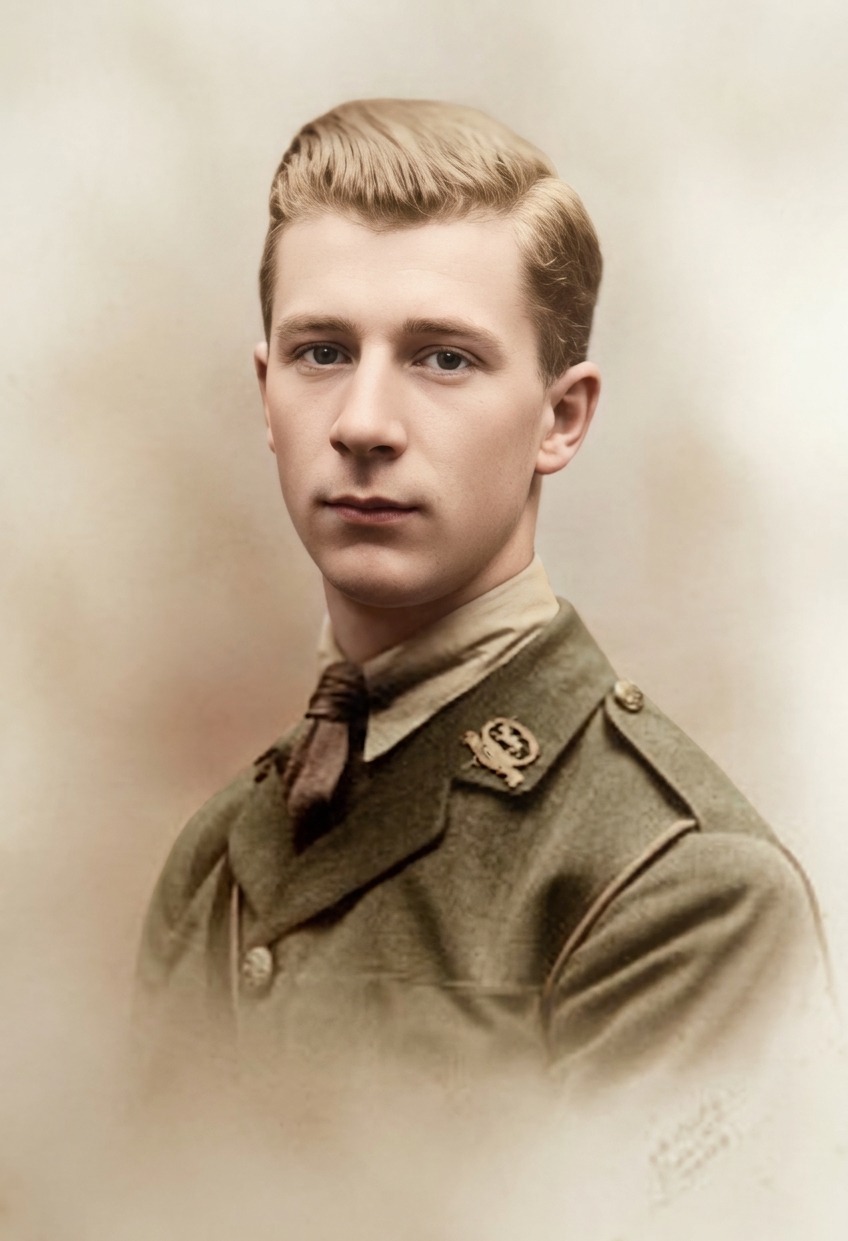
After the war he became a Chartered Surveyor and auctioneer, and a Fellow of the Royal Institute of Chartered Surveyors. He became a well-known figure in Leicester and district. He played in the county symphony orchestra, was sometime Chairman of the Leicester and County Auctioneers’ and Estate Agents’ Association, Master of the Lodge of Flaming Torch of Freemasons, Chairman of the East Langton Conservative Association and of Langton Cricket Club. He married Margaret Lilian Westby (1903-1980) in 1926 and they had two children. John Buckley died at the Cottage Hospital, Market Harborough, Leicestershire, on 8 March 1966, aged 67.
- Honours and awards: BWM; VM; FRICS
- Service file: TNA WO 374/10564
- Probate: £25,553 0s 0d
Sergeant Charles William Bugden (1882-1918), 1/4th Battalion Leicestershire Regiment
b. 15 October 1882, Ulcombe, Kent; s. of William Bugden (1852-1942), a farm labourer, and Mary Ann Bugden (née Price) (1859-1941); educ. Ulcombe National School; he was a veteran of the South African War who bought his discharge from the 3rd Buffs on 28 July 1902; he is shown as a farm labourer in the 1911 Census, but as an engine driver on his 1914 Attestation Papers; he attested in Maidstone, Kent, on 10 August 1914 and was posted as a Special Reservist (one-year engagement) to the 3rd Battalion Royal West Kents on 21 August; on 29 November 1914 he transferred to the Army Cyclist Corps, rising to the rank of Sergeant by 20 October 1915. His service included ten days in hospital with ‘facial abrasions’ in June 1916, possibly indicating a cycling accident. He spent three years cycling round the Garden of England before being transferred to 1/4th Leicesters on 20 December 1917; he was aged 35 on 29 September 1918, his elevation to platoon command being a consequence of the officer casualties suffered by the battalion at Pontruet on 24 September; he was shot in the head at Ramicourt on 3 October 1918 and evacuated to No. 53 Casualty Clearing Station, but died of his wounds at No. 6 General Hospital, Rouen, on 28 October, leaving a wife, Elizabeth ‘Bessie’ Rose (1885-1964), whom he had married on 29 April 1905, and three daughters. His transfer from the Army Cyclist Corps at home to a front line infantry unit at the age of 35 is rather surprising, but he seems to have been a well-regarded NCO. Sergeant Bugden is buried in the St Sever Cemetery Extension, Rouen, France, and remembered on the Ulcombe and Loughborough Rolls of Honour.[36] His brother, James (‘John’) Victor Bugden, who was killed in action on 23 March 1918 while serving with the 11th Hussars, is also remembered on the Ulcombe Memorial.
- Honours and awards: BWM; VM
- Service file: TNA WO 363 ‘The Burnt Records’
- Probate: Not found
2nd Lieutenant Percy William Burgess (1894-1979), 1/6th Battalion South Staffordshire Regiment
b. 22 June 1894, Bilston, Staffordshire; s. of Thomas Burgess (1852-1928), musician and piano teacher, and Amy Burgess (née Colley) (1856-1944); educ. Ettingshall Council School, Staffordshire; worked as a solderer in a tinplate works before the war, but described himself as an ‘engineer’ on his Attestation Form. He volunteered for military service on 22 September 1914 and was posted to the 3rd (Reserve) Battalion South Staffordshire Regiment. He went to war with the 9th (Service) Battalion South Staffordshire Regiment, the Pioneer battalion of 23rd Division on 24 August 1915. He was awarded the Military Medal on 23 August 1916 ‘for bravery in the field’. He remained on the Western Front until 22 January 1917, reaching the rank of Corporal, when he proceeded to No. 14 Officer Cadet Battalion (Berkhamsted) for officer training. He was discharged to a commission in the 3rd (Reserve) Battalion South Staffordshire Regiment on 26 June 1917 before being posted to the 1/6th Battalion. He added the Military Cross to his Military Medal on 18 October 1917 when he led a ‘silent raid’ on a German post, which was captured, three enemy soldiers killed and one made prisoner. The Citation in the London Gazette, 26 November 1917, gives a slightly different account, stating that the award was for ‘For conspicuous gallantry and devotion to duty in an attack on an enemy post. While he was cutting the wire the enemy attempted to escape. He immediately rushed past and turned them back into a sap, where five were killed and one taken prisoner. He himself shot two, and it was entirely due to has splendid dash and careful previous reconnaissance that the encounter terminated successfully.’ The GOC III Corps, Sir Willliam Pulteney, issued a special recommendation for this raid, which was described as a ‘model of its kind’.[37]
Burgess was aged 24 on 29 September 1918. He received a wound to the back of his head from a grenade fragment in the crossing of the St Quentin Canal. Though ‘slight’, the wound required his evacuation to Britain and he did not return to active duty until 3 November. He was released from military service on 26 July 1919 after a brief spell with 173 Chinese Labour Coy. This did not terminate his military career. On 18 October 1920 he joined the Auxiliary Division of the Royal Irish Constabulary (‘The Black and Tans’) and was promoted section leader. He was posted to “J” Coy on 7 March 1921, resigning on 23 April 1921 on completion of six months’ service.[38]
Burgess began a new chapter of his life on 28 July 1921, during a period of high unemployment in Britain, when he emigrated to the United States with his wife Isobel May Spurrier (1897-1995), whom he had married in 1919 . The US Census of 1930 found him living with his wife and two sons in San Francisco and working as a ‘general machinist, engineering’. His marriage broke up at some point after 1930 (his wife remarried in 1945). He died in California on 12 July 1979, aged 85. His brother 53382 Cyril Robert Burgess, 15/17th Battalion West Yorkshire Regiment, died from gas poisoning on 14 August 1918.
- Honours and awards: MC; MM; 14-15 Star; BWM; VM
- Service file: TNA WO 339/93034
- Probate: Not found
Lieutenant John Frissell Crellin (1889-1981), 1/5th Battalion Sherwood Foresters
b. 22 November 1889, Douglas, Isle of Man; s. of John Christian Crellin (1853-1913), a retired engineer who had worked for the Blue Funnel Line, and Sophia Harriett Crellin (née Anderson) (1861-1911); educ. King William’s College, Isle of Man; he served an apprenticeship as an engineer at Coalbrookdale Iron Works in Shropshire before the war. He joined the Middlesex Regiment as a private soldier in 1914, deploying to the Western Front on 17 November 1915. He had risen to the rank of Corporal before he was discharged to a commission in the 4th (Extra Reserve) Battalion Sherwood Foresters on 6 July 1916. He was wounded in the thigh by shrapnel that pierced the flesh but missed the bone on 27 September 1916 while on attachment to the 9th (Service) Battalion Sherwood Foresters during the battle of Thiepval Ridge.
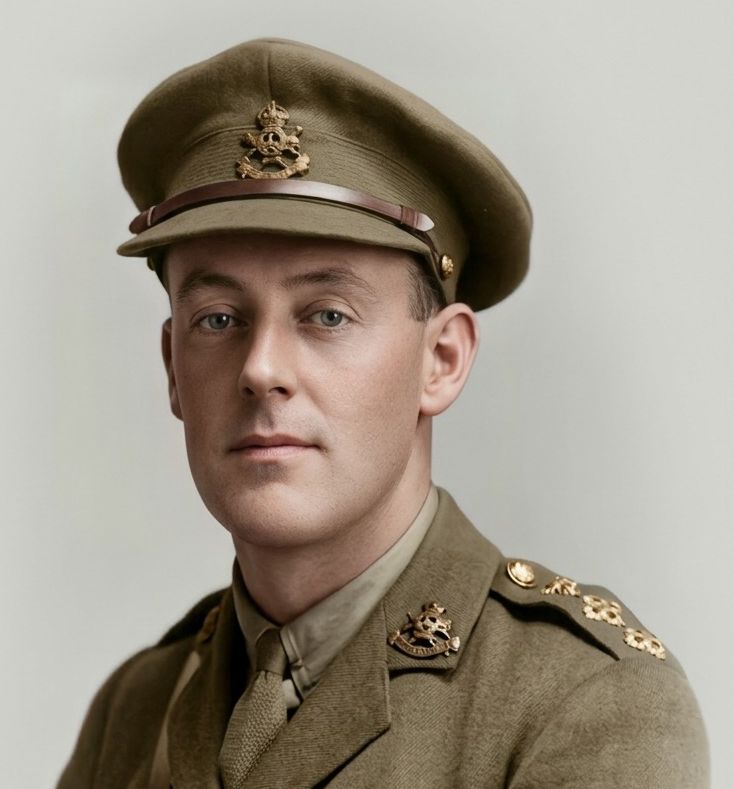
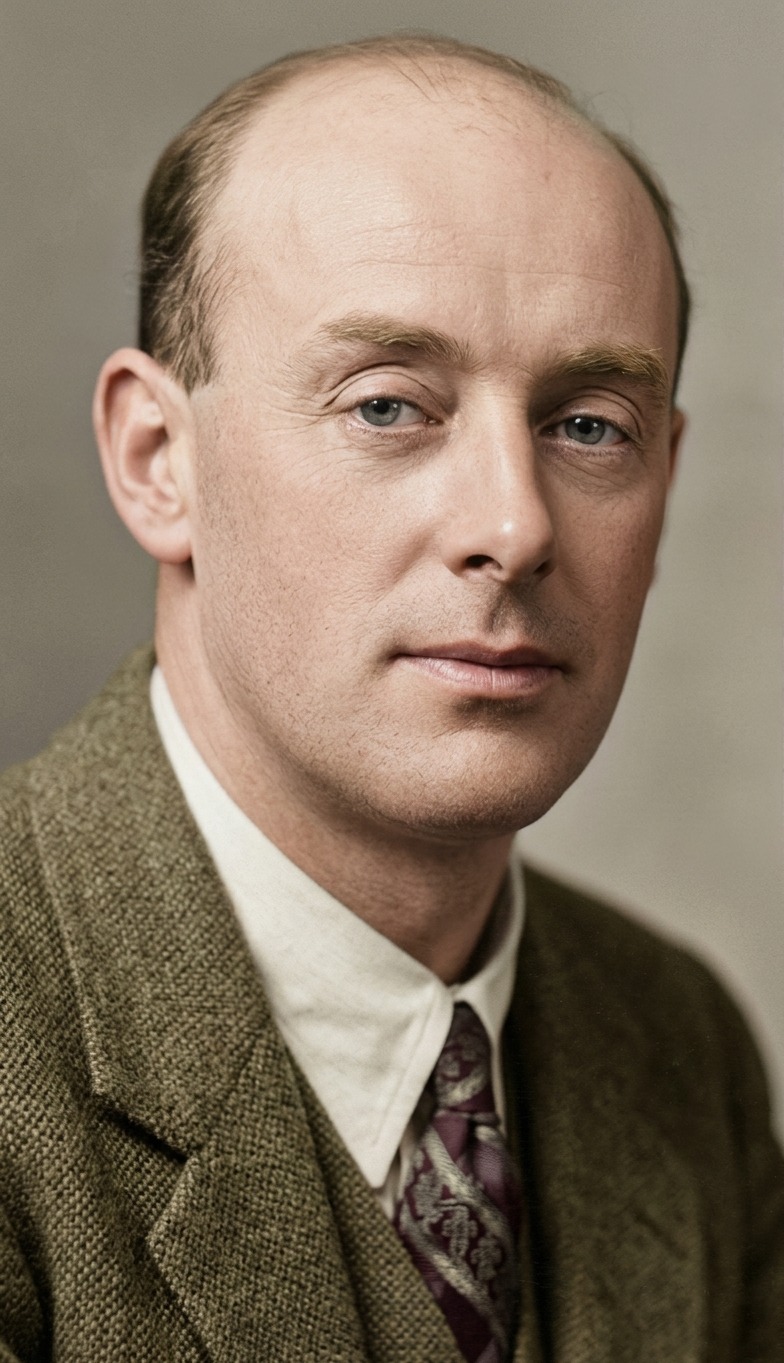
He was aged 28 on 29 September 1918, the occasion of the award of his first Military Cross at Lehaucourt, when he took command of his company after the OC became a casualty, showing ‘conspicuous dash and courage, and able leadership in attaining the objective in face of heavy machine gun and shell fire’.[39] His second Military Cross was awarded for actions five days later at Ramicourt, when he spotted that the attack was being held up by two German field guns firing over open sights, organising and leading an attack that captured the guns and their crews.[40]
Crellin was the second oldest of four brothers, all of whom served in the Great War. Captain (T/Lieutenant-Colonel) William Anderson Watson Crellin DSO* (1882-1918) began the war as a Regular 2nd Lieutenant in the 2nd Battalion Sherwood Foresters, taking command of the 15th (Service) Battalion Sherwood Foresters in 1917 at the age of 24. He died at No. 10 CCS, Poperinghe, on 8 October 1918, following wounds received in action. Arthur Murray Crellin MC (1891-1962) served with the King’s African Rifles, attached from the 4th Battalion Sherwood Foresters. The youngest son, George Parsons Crellin (1895-19??), emigrated to Canada before the war. He joined the Canadian forces in March 1916, serving as a private soldier mainly with the Canadian Army Service Corps (3rd Divisional Supply Column) in France.
After the war, John Frissell Crellin became a leading figure in the political and business life of the Isle of Man. He was elected to the House of Keys in 1922 and was a member of the island’s Legislative Council from 1943 until 1962. As President of the Local Government Board he presided over important infrastructure improvements in water supply and sewerage. During the Second World War he was given command of local troops guarding airfields. In 1936 he became a Director of the Isle of Man Steam Packet Company, succeeding to the Chairmanship in 1947. His contribution to the island was recognised by the award of the OBE in 1954.
Crellin married Eileen Mary Flood Jackson (1891-1967), daughter of a master mariner, in 1922. They had four children. He died on 26 March 1981, aged 91.
- Honours and awards: MC*; 14-15 Star; BWM; VM; OBE
- Service file: Not found
- Probate: Not found
2nd Lieutenant Joseph Richard Dench (1890-1955), 1/5th Battalion Sherwood Foresters
b. 12 September 1890, Winthorpe, Nottinghamshire; s. of Joseph R. Dench (1860-1949), gardener, and Katherine Dench (1858-1936); educ. Mount Schools, Newark; employed by Gilstrap, Earp & Co., Maltsters, of Newark, before the war. Dench was a pre-war Territorial, joining the 8th Battalion Sherwood Foresters on 3 April 1908, two days after the TF’s formation; he rose steadily and was promoted to Company Quarter-Master Sergeant on 31 January 1915. He deployed to France with his battalion on 1 March 1915, making him one of the division’s ‘originals’; on 7 June 1917, by now Regimental Quarter-Master Sergeant, he was posted to No. 12 Officer Cadet Battalion (Newmarket), from which he was commissioned in the 1/5th Sherwoods on 26 September 1917; he was aged 28 on 29 September 1918.
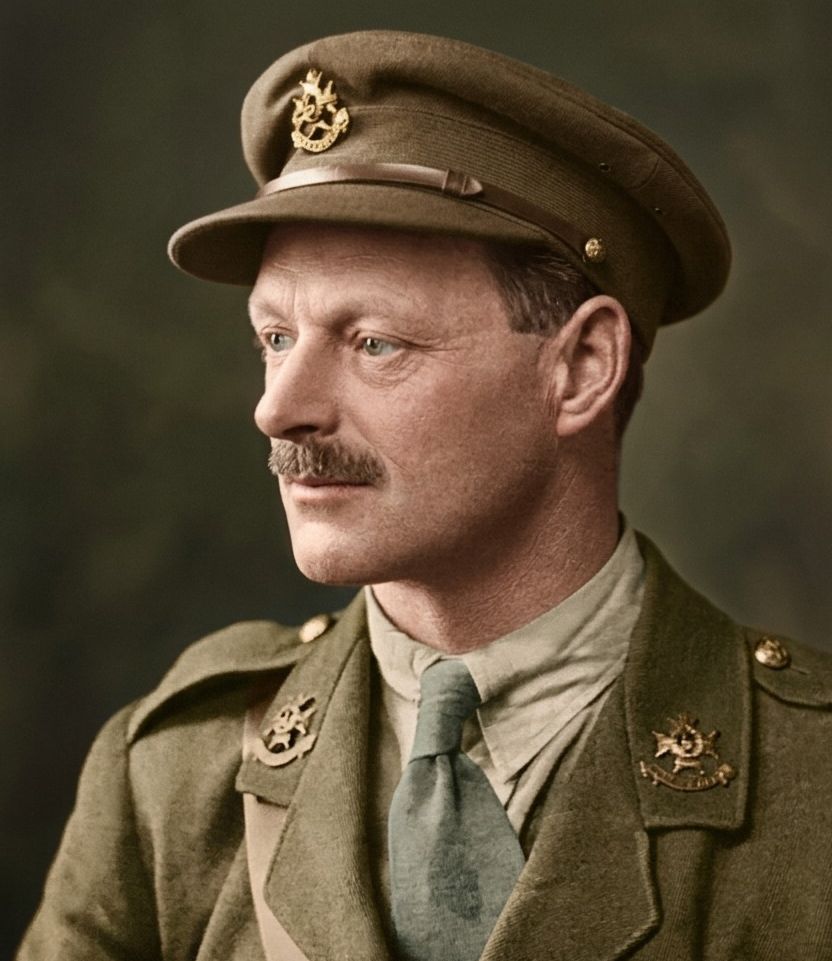
Dench was a warrior. He was one of only 176 men to be awarded a Military Cross and two bars during the war.[41] These were earned in a five week period in the last two months of the war, beginning on 29 September 1918 at Lehaucourt, where he made a flank attack against a German 77m battery, capturing it and two machine-guns, killing or making prisoner their crews.[42] His second award was for actions only four days later, at Montbrehain, when he took command of his company and routed a German counter-attack with Lewis gun fire.[43] His third was for actions on 6 November 1918 when he led ‘his company over very difficult and thickly wooded country, which was continually under hostile machine-gun fire, and, although at one time held up by a broad and deep stream, he skilfully constructed a rough bridge, got his company across, and gained his objective’.[44]
Dench remained in the Territorials after the war and became Adjutant of the 8th Battalion. This was to prove his undoing. He was accused of misappropriating mess funds, failing to return monies to men who had been overcharged, failing to pay his mess bills and failing to repay a loan from an NCO. The authorities deemed these charges to be so ‘serious’ that some of the most important organs of the British state concerned themselves with the case. These included the War Office, the Ministry of Pensions, the Treasury Solicitor, the Director of Public Prosecutions, the GOC Northern Command, the Government of Ireland and the police! They all failed even to find him, much less to subject him to military discipline or civil proceedings. In the end, the London Gazette reported that he had ceased ‘to hold a commission in the Territorial Army for failing to reply to official correspondence’!
Dench’s elusiveness owed much to his having joined the Auxiliary Division of the Royal Irish Constabulary (‘The Black and Tans’) on 8 March 1921. He remained with the ADRIC until its demobilization in January 1922.[45] He then followed a path taken by other Black and Tans. He joined the British Gendarmerie section of the Palestine Police. It is not known how long he served in Palestine, but he was back home in Newark by 1936, when he married Agnes Jane Clark Grant (1902-87). His working life ended as it began, as a clerk in his home town, this time for the Ransome & Marles Bearing Company. He died of laryngeal cancer on 12 April 1955, aged 64.
His brother, Sergeant Alfred Charles Dench, King's Coy, 1st Battalion Grenadier Guards, was killed in action at Loos on 27 September 1915. His other brother, Edward John Dench, served in the Merchant Navy throughout the war.
- Honours and awards: MC**; 1914-15 Star; BWM; VM
- Service file: TNA WO 374/19160
- Probate: £891 5s 1d
2nd Lieutenant Samuel Henry Dennis (1889-1933), 1/5th Battalion Leicestershire Regiment
b. 7 October 1889, Leicester; s. of Samuel Henry Dennis (1855-1914), boot laster, and Elizabeth Ann Dennis (née) Stringer (1863-1913); educ. Wyggeston Grammar School, Leicester; he was employed as an elementary school teacher for Leicestershire County Council before the war. He volunteered on 19 December 1914 for ‘for 4 years’ service in the United Kingdom’ with the Territorial Force Reserve and was posted to the 2/4th Battalion Leicestershire Regiment. He was hospitalised in the Rochester Row Military Hospital SW London, a specialist hospital for venereal diseases, with gonorrhoea from 14 February until 28 March 1916. He remained in the 2/4th Battalion, attaining the rank of Sergeant, and deployed with it to France on 25 February 1917 as part of 177 Brigade, 59th (2nd North Midland) Division TF. He was slightly wounded on 23 April 1917, but remained at duty. In October 1917 he was selected for officer training and returned to the UK. His recommendation was signed by Major-General Cecil Romer, GOC 59th Division. On 9 November he was posted to the 5th (Reserve) Battalion Argyll and Sutherland Highlanders, prior to six months at No. 18 Officer Cadet Battalion (Bath). He was discharged to a commission in the 5th Leicesters on 30 April 1918. His Confidential Report read: ‘Standard of Education: Good; Military Knowledge: Good; Power of Command and Leadership: Good; Special Qualifications: Drill, Musketry, Engineering; Remarks: An excellent cadet who has taken a leading part in all games. Has worked very well and should make an excellent leader.’ He was slightly wounded at Pontruet on 25 September, aged 28.[46]
Dennis was discharged on 23 March 1919 and returned to the teaching profession as an elementary school teacher in Leicester. He had married Helen Gladys Webster (1892-1988) on 7 July 1915. He died on 25 September 1933 in Leicester Royal Infirmary of a cerebral haemorrhage and chronic interstitial nephritis, aged 43.
- Honours and awards: BWM; VM
- Service file: TNA WO 374/19225
- Probate: £1,613 7s 8d
2nd Lieutenant William James Alfred Ensor (1883-1918),[47] 1/6th Battalion North Staffordshire Regiment
b. 4 November 1883, Westminster, London; s. of Alfred Endsor (1837-1891), prison officer (principal warder), and his second wife Eleanor Catherine Endsor (née Rossiter) (1856-1938). He was that rarest of birds among the platoon commanders of 46th Division, a pre-war Regular ranker who was discharged to a Regular commission.[48] He joined the Army Service Corps [ASC] in 1903 and was a career soldier. He served in France from 6 October 1914, variously at HQ 7th Division, the ASC section of the Adjutant-General’s Office, ASC section GHQ, HQ Second Army, ASC Base Depot and HQ I Corps. On 15 October 1917 he was posted to 1st Battalion Honourable Artillery Company on probation for a Regular commission and then to No. 16 Officer Cadet Battalion (Kinmel Park, Rhyl), from which he was discharged to a permanent commission on 27 February 1918. He was aged 34 on 29 September 1918.
2nd Lieutenant Ensor was killed in action at Ramicourt on 3 October 1918 and is buried in Levergies Communal Cemetery, France.
- Honours and awards: 14 Star; BWM; VM
- Service file: TNA WO 374/22873
- Probate: Not found
2nd Lieutenant Arthur Cecil Fisher (1898-1984), 1/5th Battalion Lincolnshire Regiment
b. 8 March 1898, Godmanchester, Huntingdonshire; s. of Arthur Thornton Fisher (1862-1945), a railway clerk and later stationmaster, and Amelia Fisher (née Goodwin) (1866-1946); educ. Ramsey Grammar School, Huntingdonshire; he was a student teacher at the time of his attestation on 2 June 1916. He was transferred to the Army Reserve the following day, mobilised on 10 October 1916 and posted to the 1st (Reserve) Battalion Honourable Artillery Company. He joined No. 15 Officer Cadet Battalion (Romford) for officer training on 5 May 1917 from where he was discharged to a commission in the Lincolnshire Regiment on 29 August. He was aged 20 on 29 September 1918. He remained in France after the end of the war and was attached to the Royal Engineers. On 14 March 1920 he was diagnosed with syphilis in Cambrai and returned home for treatment at the Officers Hospital, Spike Island, Netley, near Southampton. He was released from military service on 3 June 1920.
Fisher does not appear to have continued with his pre-war career of teaching. At the time of the 1921 Census he was an articled clerk to Messrs. Walker, Hunter & Co., Incorporated Accountants, in Newport, Monmouthshire. He married Lillie May Davies (1902-89), the daughter of a locomotive driver, in Newport and was still living there at the time of the 1939 Register, when he stated his occupation as ‘Assistant Secretary and Accountant’ (he was also serving in the Observer Corps). Arthur Fisher died in Paignton on 5 April 1983, aged 85. His wife left more than £100,000 at her death in 1989.
- Honours and awards: BWM; VM
- Service file: TNA WO 374/24372
- Probate: £68,596 0s 0d
2nd Lieutenant Ronald Alfred Frith (1897-1977), 1/6th Battalion Sherwood Foresters
b. 27 November 1897, Sheffield; s. of Samuel Frith (1861-1927), a commercial traveller for the Bessemer Steel Co. and a well-known local organist, and Elizabeth Frith (née Addy) (1862-1933); educ. Shefield Central School and Sheffield Pupil Teachers’ Centre; he was a member of staff of Ellesmere Road Council School, Sheffield. He attested under the Derby Scheme on 8 December 1915, but was not mobilised until 2 October 1916. He remained in the UK until 28 February 1917 when he was posted to No. 9 Infantry Base Depot and thence, on 1 March 1917, to 10th (Service) Battalion Lincolnshire Regiment (‘Grimsby Chums’). He was transferred to the 6th (Service) Battalion Lincolnshire Regiment eighteen days later. His service in the ranks was short-lived, however. On 30 May 1917 he returned to the UK for officer training at No. 8 Officer Cadet Battalion (Lichfield), from where he was discharged to a commission in the 3rd (Reserve) Battalion Sherwood Foresters on 31 October 1917, later being attached to the 1/6th Battalion. He was aged 20 on 29 September 1918 and was in the thick of the fighting. His Military Cross was ‘For great gallantry and determined leadership in the attack on the St Quentin Canal, near Bellenglise, on September 29th, 1918. He used his Lewis gun to subdue the hostile machine-gun fire from south of the canal and under fire by field guns and anti-tank guns at short range led his men right through. When ordered to swing round to charge the battery on the flank, he led his platoon splendidly and the gun team fled, two being taken prisoners’.[49] He was released from military service on 22 July 1919 after a period as an officer with 182 PoW Coy.
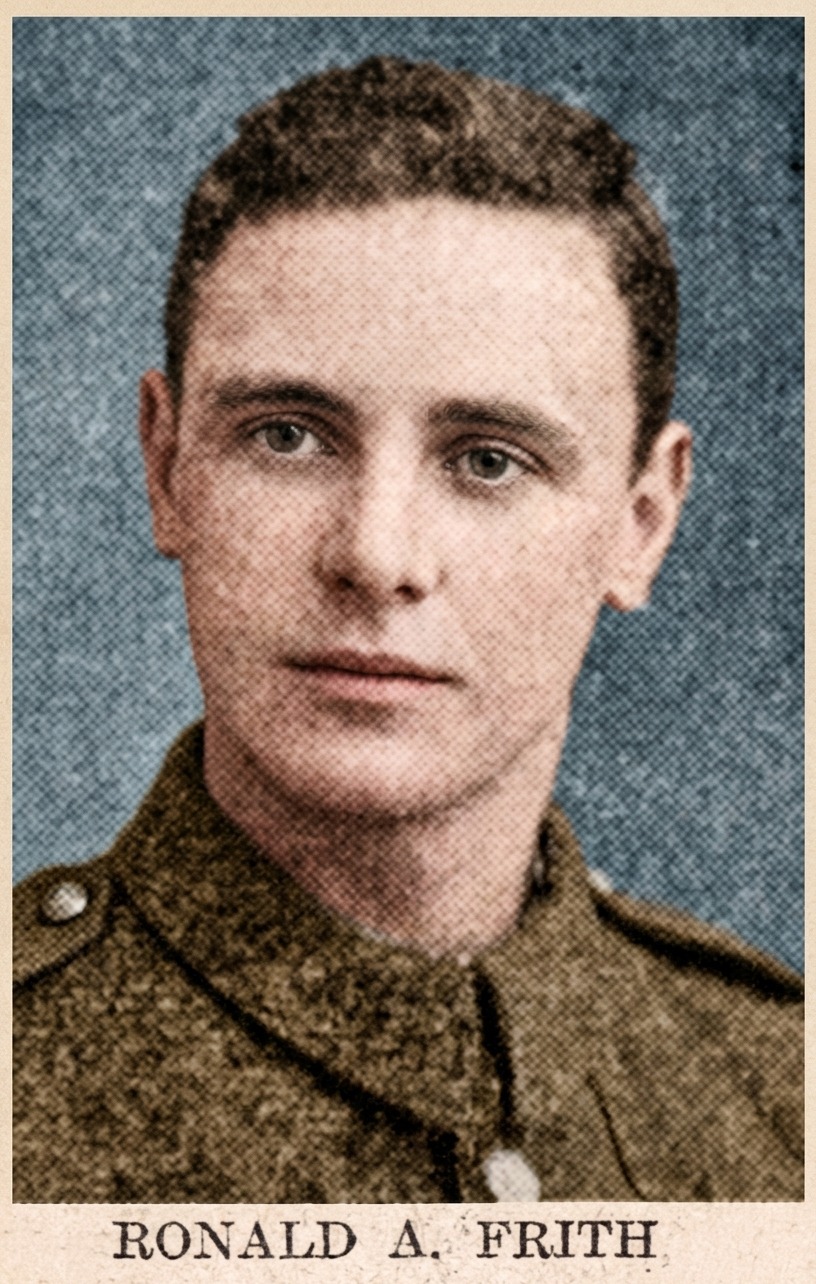
He returned to study after the war at Sheffield University probably with the intention of resuming his teaching career, but after working as a shipper’s clerk, he later became an accountant and financial advisor. He married, firstly, Mabel Winifred Isabel Henderson (1896-1929) on 12 June 1924, who died of heart failure at the age of thirty-two, leaving him with two small children. He did not remarry until after the Second World War. He led a very peripatetic life, his work (presumably) taking him to South America and East Africa, among other places. After spending some years living in the Canary Islands he moved to South Africa, where he married his second wife. He died in Cape Town on 19 May 1977, aged 79.
- Honours and awards: MC; BWM; VM
- Service file: TNA WO 374/25864
- Probate: Not found
Lieutenant Roland George Harris (1895-1973), 1/5th Battalion Lincolnshire Regiment
b. 9 January 1895, Forest Hill, London; s. of Charles Harris (1856-1936), Accountant, Secretary to the Auctioneers Institute of the United Kingdom, and Florence Hester Harris (née Burt) (1859-1934); the twelfth of fifteen children; educ. Emanuel School, Wandsworth (1909-12) and the University of London (1912-13); he was employed as a motor draughtsman before the war. He served in the Emanuel School and University of London OTCs (1912-14), but resigned in January 1914 owing to his ‘civilian occupation interfering with parades’. Nevertheless, he volunteered on 27 August 1914 and enlisted in the 16th (County of London) Battalion London Regiment (Queen’s Westminster Rifles). The battalion was among the early reinforcements for the Regulars and Reservists of the BEF, landing at Le Havre on 3 November 1914. On 15 June 1915 Harris was admitted to No. 18 Field Ambulance suffering from varicose veins and was sent home the following day. He remained at home until 1 June 1917. During this period, there was a battle for Harris’s services between the army and his former employers Parker & Co. (Coachbuilders) of Notting Hill, who wanted him back, an endeavour in which they failed having no one they could release to replace Harris. On 6 February 1917 Harris’s fate was decided when he was admitted to No. 16 Officer Cadet Battalion (Kinmel Park, Rhyl) for officer training. He was discharged to a commission in the 4th (Reserve) Battalion Lincolnshire Regiment on 1 June 1917, but did not go abroad until 1 November. He was aged 23 on 29 September 1918.
Harris was promoted to Lieutenant on 30 November 1918 and briefly attached to the Royal Air Force, but was released from military service on 3 March 1919 and returned to his career as a draughtsman. He married Nesta Evelyn Robinson (1896-1989) on 17 March 1924. In the 1939 Register of England and Wales he was listed as ‘Chief Draughtsman’ to a Public Works Contractor in Dorset. He died at Great Bookham, Surrey, on 16 June 1973, aged 78.
- Honours and awards: 14 Star; BWM; VM
- Service file: TNA WO 374/31292
- Probate: £4,486 0s 0d
2nd Lieutenant Frank Ridgway Hartshorne (1898-1955), 1/5th Battalion Sherwood Foresters
b. 7 December 1898, Worthington, a Leicestershire mining village; youngest of three sons of William Hartshorne (1865-1945), a coal miner (underground) and later a contractor, and Sarah Jane Hartshorne (née) Towers (1862-1938); educ. Ashby-de-la-Zouch Grammar School; he was a bank clerk before the war. He joined Nottingham University OTC on 1 February 1917, was ‘called up for service’ on 7 June 1917 and immediately posted to No. 9 Officer Cadet Battalion (Gailes). His report from the OTC read ‘Brother of an older cadet who is now a Captain. This boy is quite up to his standard. Very keen and thorough. Will make a good infantry officer’.[50] He was discharged to a commission in the Sherwood Foresters on 25 September 1917 and joined the BEF on 8 January 1918. He was aged 19 on 25 September 1918.
Frank Hartshorne returned to banking after the war. He married Florence Durow (1893-1983), a fellow clerk at the London Joint City & Midland Bank Co., on 5 September 1928. He died of pneumonia on 11 May 1955 in Derby Royal Infirmary, aged 56.
- Honours and awards: BWM; VM
- Service file: TNA WO 374/31650
- Probate: £6,204 10s 5d
Sergeant Randolph Balfour Haynes (1895-1958), 1/5th Battalion Leicestershire Regiment
b. 27 May 1895, Harpole, Northamptonshire; s. of John William Haynes (1851-1934), shoemaker, and Thurza Kate Haynes (née Turland) (1856-1925); one of fourteen children; worked at a factory making cycles before the war, alongside two of his brothers; he volunteered for military service in 1914 or 1915 and was posted to the 7th (Service) Battalion Leicestershire Regiment, deploying to France on 29 July 1915, eventually reaching the rank of Sergeant; at some point he transferred to the 1/5th Leicesters; he was aged 23 on 29 September 1918.
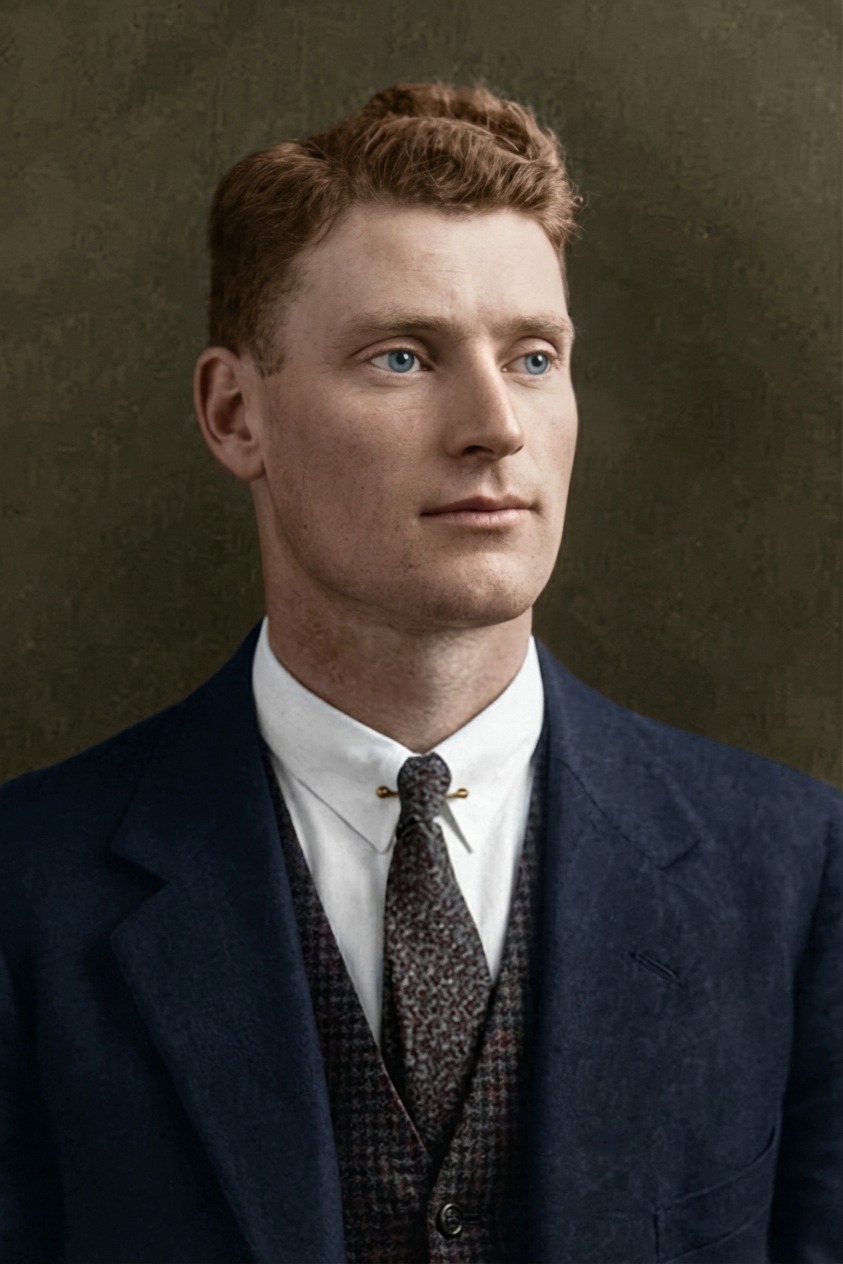
Haynes became a police officer in May 1919 and in 1920 married (Mabel) Miriam Primrose Popham (1899-1989). They had a daughter, Joan Clarice, on 9 May 1921, but his world had fallen apart even before the birth could be registered. On 15 May he broke into the warehouse of George Gibbard in Brackley, Northants, and stole flour, firelighters and soap to the value of 16s 6d. His arrest was not bad luck. Things had gone missing before from Gibbard’s and Haynes was a suspect, his behaviour having been giving concern for some time. Knowing that Haynes was on night duty in the area, Inspector Brumby positioned himself in the premises and arrested Haynes after he left the warehouse with his sack of stolen goods. Brumby did not put Haynes in the cells but allowed him to go home. PC Rainbow went to see Haynes the next morning and found a note that read ‘Dear Miriam and Baby I can’t stand it any longer. I’m got to go. I’m tried my best and can’t get through. Dear Mother and all I’m tried to get along the best I could, but I’m failed, so don’t worry when you hear all about this.’ Rainbow took the note and a knife from near Haynes’s bed to Inspector Brumby. He then went back to Haynes’s bedroom and found him with a large knife wound in his neck. Haynes pleaded not guilty in the Magistrates Court both to the break in and theft and the attempted suicide, but changed his plea to guilty when he came to trial.[51] He was sentenced to six months in prison for theft and three months for attempting suicide, the sentences to run concurrently. Evidence was heard of his gallant war record and that he had received a shrapnel wound to the head and suffered from shell shock.[52] These were considered to be mitigating circumstances and his sentence was to be served in the ‘second division’. Second division prisoners were kept apart from other prisoners as far as possible, were able to receive more frequent letters and visits and did not wear the standard convict clothing. The report of his trial added that arrangements had been made after Haynes’s release to set him up in business and give him a fresh start.[53]
The fresh start was to be in Canada. He sailed from Southampton for St John's, New Brunswick, in March 1923 on SS Montcalm. He declared that he was married, but that his wife was not travelling with him. He was aiming to join up with a cousin in Alberta and take up farming. He had paid his own fare, second class, and was carrying £20 in cash. He never went to Alberta and he did not take up farming. A year after Haynes’s arrival in Canada, Peggie Margaret Stewart (1901-76), a young Scottish woman from the Isle of Barra, also arrived in St John’s. In 1927 she and Haynes had their first child, who was to be one of seven. At the Canada Census of 1931 they were living in London, Ontario, by which time they had five children. Haynes was employed as a hospital orderly. There is no evidence that they were ever married or that his first marriage was ever dissolved. Haynes’s first wife died in 1989, aged 90. She never remarried. At the time of the 1939 Register Miriam Haynes was living with her parents at the pub they kept in Kettering, the ‘Queen’. She is described as ‘married’. The daughter she had with Haynes died on New Year’s Day 1926, aged four.
Haynes lost three brothers to the war. Horace, 6th (Service) Battalion Northamptonshire Regiment, died on 19 November 1915, aged 25. James died on 4 March 1919 in the Military Hospital, Shorncliffe Camp, Kent, while serving with the Labour Corps, aged 29. John died on 5 July 1922 from tuberculosis contracted on active service with the Northamptonshire and Devonshire Regiments, aged 43. Randolph Haynes died on 10 April 1958 in London, Ontario, aged 52.
- Honours and awards: MM*; 14-15 Star; BWM; VM
- Service file: Destroyed
- Probate: Not found
2nd Lieutenant Alfred Jepson(1895-1981), 1/6th Battalion Sherwood Foresters
b. 27 September 1895, Leicester; s. of Richard Jepson (1848-1919), inn keeper and later groom, and Frances Beaton Jepson (née Strickson) (1857-1904); Jepson worked on a farm before the war; he volunteered for military service in the 9th (Service) Battalion Leicestershire Regiment, deploying with them to France on 29 July 1915; he was commissioned in the 1st Battalion Sherwood Foresters from No. 8 Officer Cadet Battalion (Lichfield) on 17 December 1917 and transferred to the 1/6th Sherwood Foresters on 5 September 1918; he was aged 23 on 29 September 1918; he was wounded (GSW right leg) at Ramicourt on 3 October 1918.
It is not known what Jepson did in the immediate aftermath of the war,[54] but in 1928 he sailed for the United States on RMS Berengaria, stating his occupation as ‘domestic’. In 1929 he secured the post of valet to Vincent Astor (1891-1959), who had inherited a vast fortune at the age of 20 following the death of his father John Jacob Astor IV (1864-1912) in the sinking of RMS Titanic. There are numerous references to how indispensable Jepson became to Astor, a man who moved in the highest political and social circles in the United States.[55] He was not only a valet in the accepted sense, but also managed Astor’s hundred-strong personal staff. On his 1942 Draft Registration Card, Jepson actually gave Astor as his next of kin. It is therefore surprising that he was not a beneficiary of Astor’s will, though others of his staff were. This suggests that he was no longer working for Astor by then, a split possibly occasioned by Astor’s marriage to his formidable third wife, Brooke Russell, in 1953. Jepson’s life after Astor’s death is obscure. In 1950 he had emerged to some extent from Astor’s shadow when, at the age of 55, he wrote the words and music of a pop song, ‘Too Sweet to Forget’, which became a hit for Jo Ann Tolley. Alfred Jepson died in New York City in October 1981, aged 86.
- Honours and awards: 14-15 Star; BWM; VM
- Service file: Not found
- Probate: Not found
2nd Lieutenant Clarence Morbey (1892-1963), 1/4th Battalion Leicestershire Regiment
b. 4 November 1892 in Leicester; s. of John Morbey (1853-1932), a railway porter who later became a railway policeman, and Betsy Burton Morbey (née College) (1857-1924); educ. Wyggeston Grammar School, Leicester; he was employed as a clerk before the war. He volunteered for military service on 24 March 1915 and served in the ranks of the Army Service Corps until 31 July 1917 as a Driver with 515 Coy at Moore Park, Co. Cork. A recommendation of selection for officer training was signed by Major-General Arthur Sandbach (GOC 59th (North Midland) Division TF) on 1 January 1917. He was posted to No. 9 Officer Cadet Battalion (Gailes) on 7 April 1917 and discharged to a commission in the Leicestershire Regiment on 1 August. He deployed to the BEF on 26 September, his first posting outside the UK. He was gassed on 18 May 1918 at the same time that he was diagnosed with ‘PUO’ (Pyrexia of Unknown Origin), occasioning a high fever and debility. He was recommended for fourteen days sick leave in the UK. During his convalescence he married Elsie Edith Chawner (1890-1962) in July 1918.
Morbey was 25 years old on 29 September 1918 when he was wounded in the right leg and right wrist at Bellenglise.[56] The wounds were classified as ‘very serious’ and ‘likely to be permanent’. He qualified for a Wound Pension of £50. Once he returned home he was granted leave until 13 June, later extended for another seven months. During this period he qualified for promotion to Lieutenant, which was approved. But he and the army eventually bowed to the inevitable. He relinquished his commission on grounds of ill-health caused by wounds on 12 May 1920 but retained the rank of Lieutenant and was granted the King’s Certificate of [Honourable] Discharge.
Morbey was able to obtain work. The 1921 Census found him employed as an ‘overlooker’ in the mending department of Fielding Johnson, Worsted Spinners, Leicester. On 11 March 1931 he pleaded guilty before Leicester Police Court to a charge of stealing ten bundles of yarn, the property of Sydney John Pick, the owner of a well-known Leicester knitwear company, and was sentenced to three months’ imprisonment in the ‘second division’.[57] The offences had taken place over a period of months between 1 June 1930 and 6 March 1931. Once his civil conviction became known the War Office took the necessary steps to deprive him of the rank of Lieutenant. This was published in the London Gazette on 1 May 1931. In the 1939 Register of England and Wales he was employed as a typewriter fitter and assembler at the Imperial Typewriter Company in Leicester. Clarence Morbey died in his home town in 1963, aged 70.
- Honours and awards: BWM; VM
- Service file: WO 339/84592
- Probate: Not found
2nd Lieutenant Francis Arthur Morgan (1887-1957), 1/6th Battalion South Staffordshire Regiment
b. 28 September 1887, Marylebone, London; s. of Francis Robert Morgan (1861-1925), a heating and ventilation engineer, and Catherine Anne Morgan (née Wood) (1857-1913); educ. University College School and Merton College, Oxford (1909-11), where he was a member of the Officers Training Corps [OTC]; he was commissioned on 30 September 1911 for service with Queen Mary’s Grammar School, Walsall OTC; m. 1914 Dorothy Muriel Barratt (1890-1980); he became OC King’s School, Worcester OTC in April 1916; his wish to transfer to active service was frustrated in September 1916 and April 1917 because of his OTC duties and (probably) because he wore glasses; but he was eventually transferred to 5th (Reserve) Battalion South Staffordshire Regiment in September 1917, deploying to France in January 1918 to join the 5th South Staffords, later attached to the 6th.[58] He was aged 31 on 29 September 1918, the day on which he was awarded the Military Cross for ‘marked gallantry and determined leadership’ at Bellenglise. ‘When all the other officers in his company had been wounded in the first few minutes of the attack, he led his company on and captured his objective after overcoming all resistance in the village.’[59] He suffered a GSW to his right arm in the follow up attack at Ramicourt on 3 October and was invalided home.
He was demobilised on 4 July 1919 and returned to teaching. He was Headmaster of Farnham Grammar School, Surrey, from 1924 until 1953. He died of lung cancer on 8 September 1957 at 14 Greenhill Road, Farnham, aged 69. The name of his house - “Bellenglise” – was a daily reminder of his war and his courage.
- Honours and awards: MC; BWM; VM
- Service file: TNA WO 374/48735
- Probate: £7,870 0s 0d
2nd Lieutenant Thomas Lee Moulton (1896-1969), 1/5th Battalion Sherwood Foresters
b. 28 September 1896, Newton, Derbyshire; s. of Charles William Moulton (1866-1946), draper, and Louisa Jane Moulton (née Lee) (1871-1955); educ. Blackwell Elementary School, Derbyshire and High Grade School, Sutton-in-Ashfield, Nottinghamshire; he followed his father into the drapery business. He attested at Mansfield on 9 November 1914 and was posted to the 13th (Reserve) Battalion Sherwood Foresters, transferring to the 9th (Service ) Battalion Sherwoods on 25 October 1915. This battalion had been on the Gallipoli peninsula since 20 July. Moulton joined them at Suvla Bay on 5 November 1915. After the termination of the Gallipoli campaign 9th Sherwoods were re-deployed to the Western Front, arriving in July 1916. On 20 August 1916 Moulton was posted to the 17th (Service) Battalion Sherwood Foresters (Welbeck Rangers) and promoted to the rank of Sergeant on 8 November. He remained on the Western Front until 28 April 1917 when he was ‘posted home pending commission’. This was despite a Regimental Conduct Sheet that had several examples of insubordination and neglect of duty.
He joined No. 7 Officer Cadet Battalion (Fermoy) on 6 July 1917. While at Fermoy he contracted gonorrhoea and was sent for ‘special treatment’ to the Portobello Military Hospital, Dublin.[60] He was only in hospital for a day, but remained under treatment for a further thirty-five days at Portobello Barracks. He was not discharged to a commission until 26 March 1918. He was aged 22 on 29 September 1918. On 17 October, at Bohain, he suffered a serious wound on the left side of his neck caused by a grenade, leaving him with ‘an aneurism the size of a pigeon’s egg on the left carotid artery’. Medical opinion was divided about how the wound should be treated, surgery initially being thought inadvisable, but he was eventually operated on. The wound resulted in his being permanently unfit for military service. He received a Wound Gratuity of £250, but in May 1919 the Ministry of Pensions considered that he did not meet the criteria for a Wound Pension. This opinion was later changed because at his death on 24 February 1969, following a stroke, he was in receipt of a 70 per cent disability pension (‘gunshot wound to the neck with recurrent laryngeal palsy’).
His health problems had not prevent him from working. After the war, he left retailing and went to work in the mining industry on the Nottinghamshire coalfield, retiring as a Coal Board Ventilation Engineer. Moulton married twice. His first wife, Alice Mary Redmile, whom he married in 1923, died in 1942. His second wife was Mary Agnes Long, whom he married in 1944, died in 2000.
- Honours and awards: 14-15 Star; BWM; VM
- Service file: TNA WO 339/114741
- Probate: Not found
2nd Lieutenant Arthur John Musgrove (1892-1938), 1/5th Battalion South Staffordshire Regiment
b. 6 May 1892, Walsall, Staffordshire; s. of Arthur Musgrove (1867-1938), a foreman whip maker, and Lucy Musgrove (née) Tonkinson (1868-1935); educ. Ablewell Street Wesleyan Schools, Walsall, and Walsall Municipal Institute; he was employed as a manufacturer’s clerk before the war. The family were Wesleyans.
Musgrove attested on 8 November 1915. He served with the 5th (Reserve) Battalion South Staffordshire Regiment at home, reaching the rank of Corporal, until sent for officer training to No. 6 Officer Cadet Battalion (Balliol College, Oxford) on 3 January 1917. He was discharged to a commission in the 5th (Reserve) Battalion South Staffordshire Regiment on 25 April 1917.
He deployed to the Western Front on 1 June 1917, joining the 1/5th Battalion South Staffords. He was wounded on 29 August 1917 when a shrapnel ball lodged itself in his right hand. This required surgery once he had been evacuated to the UK. After a period of convalescence he returned to the front. He was aged 26 on 29 September 1918. By then he had already made his mark. ‘On the early morning of the 28th Sept., 1918, north of Bellenglise, at a critical moment when Capt. Ball [Captain G.H. Ball DSO MC] was short of small arms ammunition and bombs, [2nd Lieutenant Musgrove] took his platoon forward to support “D” Company, and in spite of heavy machine-gun fire and severe casualties he got his men into a position to render support and renew the supply of ammunition. His personal example achieved this.’[61] He suffered a severe gunshot wound to his left shoulder at Ramicourt on 3 October 1918 that left him seriously ill. He was evacuated to the UK on 6 October. This left him unfit for further military service. He relinquished his commission owing to ‘ill health caused by wounds’ on 3 January 1920 and was allowed to retain the rank of Lieutenant.
After the war he joined the civil service, working for Customs and Excise in Walsall, but was compelled to retire early through ill health. Arthur Musgrove died from coronary heart disease at his father’s house in Aldridge on 18 March 1938, aged 45. He never married.
- Honours and awards: MC; BWM; VM
- Service file: TNA WO 374/49885
- Probate: £574 17s 0d
2nd Lieutenant William Walter Parsons (1881-1954), 1/5th Battalion Leicestershire Regiment
b. 6 March 1881, Sutton Coldfield, Warwickshire; s. of William Howkins Wall Parsons (1857-1943), sanitary inspector, and Louisa Hannell Parsons (née Over) (1855-1943); educ. Lower School of Lawrence Sheriff, Rugby, Warwickshire; employed as an accountant with Rugby Urban District Council. His route to a commission and to the war was slow and somewhat surprising. He attested under the Derby Scheme on 10 December 1915 and was posted to the Class B Reserve. He remained there until 2 April 1917, when he was posted to the Inns of Court OTC and then to No. 11 Officer Cadet Battalion (Pirbright). His Confidential Report prior to commissioning read: ‘Standard of Education: average; Military Knowledge: fair; Power of Command and Leadership: very fair; Special Qualifications: nil; Remarks: A nice type, has done well always, works hard and is keen. Should make a very good officer.’ He was discharged to a commission on 26 February 1918, deployed to France on 28 May and posted to 5th Leicesters on 10 June. He was aged 37 on 29 September 1918, making him the second oldest platoon commander in 46th Division and one with the least military experience. But by then he was back in England at the Prince of Wales’s Hospital, Marylebone, having suffered a machine-gun bullet wound to the face at Pontruet on 24 September.
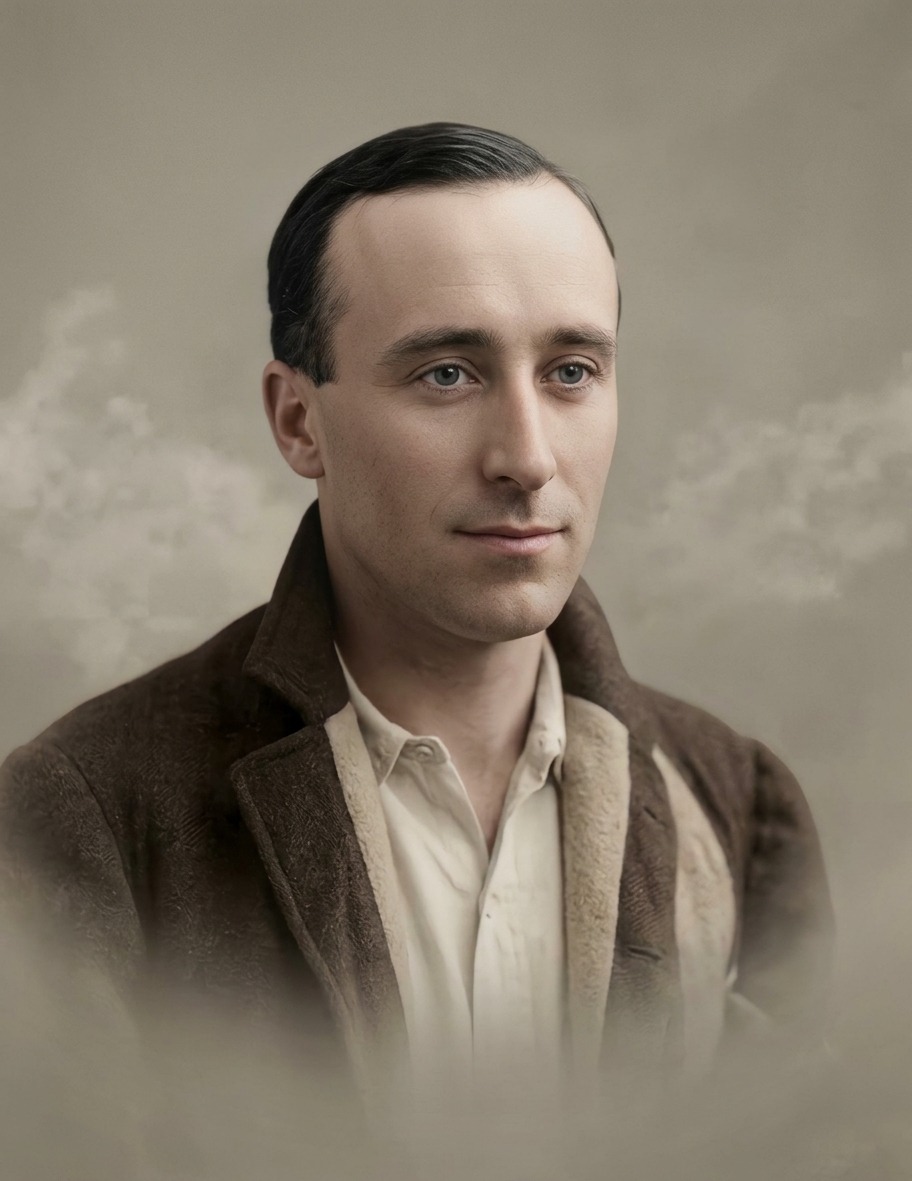
He was released from military service on 28 October 1919 and returned to local government, rising eventually to become the Borough Treasurer of Rugby. He married Joan Avis Loverock (1909-66), the daughter of a Warwickshire farmer, in January 1936. William Parsons died at the Hospital of Holy Cross, Rugby, on 1 November 1954, aged 73.
- Honours and awards: BWM; VM
- Service file: TNA WO 374/52425
- Probate: £446 13s 10d
2nd Lieutenant Walter Payne (1890-1959), 1/5th Battalion South Staffordshire Regiment
b. 28 January 1890, Shelton, Staffordshire; s. of John Payne (1865-1916), potter’s presser, and Jane Elizabeth Payne (née Longmore) (1866-1939); educ. Hanley Secondary School, Staffordshire; he was employed as a pottery designer before the war. He attested on 20 October 1914 and was posted to his local TF battalion, the 5th North Staffords. He deployed to France on 5 March 1915, making him one of the 46th Division’s ‘originals’. He remained in France until 3 July 1916, when he was evacuated to the UK having sustained a GSW to the foot at Gommecourt.
Following his discharge from hospital, he was posted to the 5th (Reserve) Battalion North Staffordshire Regiment, stationed at Mablethorpe in Lincolnshire as part of the Humber Garrison. In June 1917 he was selected for officer training, attending No. 15 Officer Cadet Battalion (Romford). He was discharged to a commission in the 5th Battalion South Staffordshire Regiment on 27 November 1917. He married Ethel May Bennett (1889-1983) on 23 March 1918. He was aged 28 on 29 September 1918, when he was wounded again.
Walter Payne was released from military service 19 February 1919. He did not return to his quite prestigious job in the pottery industry, but joined the police force at Wallasey on the Wirrall. He had risen to Inspector by 1939. He died at Wallasey on 8 March 1959, aged 69.
- Honours and awards: 14-15 Star; BWM; VM
- Service file: TNA WO 374/52868
- Probate: £1,891 2s 8d
2nd Lieutenant Leonard Pearson (1896-1978), 1/5th Battalion South Staffordshire Regiment
b. 31 December 1896, Barwell, Leicestershire; sixth of the seven children of William Nathaniel Pearson (1865-99), shoe rivetter, and Harriett Pearson (née Heywood) (1865-1904), boot machinist; he was orphaned by the age of eight, both parents having died from pulmonary tuberculosis; educ. Barwell Church of England School; he married Lilly Jacques (1892-1978) on 8 April 1916, aged 19;[62] he had attested under the Derby Scheme on 21 December 1915 and was mobilised and posted to the Leicestershire Regiment on 1 May 1916, transferring to the South Staffordshire Regiment two days later. He deployed to France on 25 September 1916, serving with the 1/6th South Staffords. While recovering from a shrapnel wound to his right arm, inflicted in April 1917, he was selected for officer training at No. 5 Officer Cadet Battalion (Trinity College, Cambridge). He was discharged to a commission in the 1/5th South Staffords on 21 January 1918. He was aged 21 on 29 September. He was badly wounded in his right arm at Ramicourt on 3 October 1918, resulting in a compound fracture of the ulna that required extensive treatment.
He relinquished his commission on the grounds of ill health and wounds on 11 April 1920. He was employed as a commercial traveller for Dudley’s, shoe manufacturers in Leicester, in 1921, but his employment seems to have been negatively impacted by his war wounds, for which he received an army pension. On 18 February 1938 he was convicted of theft at Hinckley while working as a temporary postman. He was stripped of his rank (Lieutenant) and sentenced to one month’s imprisonment with hard labour. He was subsequently employed as a boot and shoe repairer. Leonard Pearson died on 8 July 1978, aged 81.
- Honours and awards: BWM; VM
- Service file: TNA WO 374/53084
- Probate: Not found
2nd Lieutenant Rupert Charles Quayle (1898-1918), 1/4th Battalion Leicestershire Regiment
b. 22 September 1898, Khandwa, India; youngest s. of Colonel William Adair Boyd Ardiss Quayle (1855-1938), Indian Medical Service (i/c Lunatic Asylums, Central Provinces of India), and Clara Henrietta Ernestina Henrietta Quayle (née Krause) (1864-1921); educ. Charterhouse School, Queen’s College, Oxford, and Queen’s University, Belfast; he attested in Belfast on 23 January 1917, having served in both the Charterhouse and Queen’s University OTCs, and was immediately transferred to the Army Reserve. He was mobilized on 2 July 1917 and discharged to a commission in the 1st Battalion Leicestershire Regiment on 30 October 1917. He was later attached to the 1/4th Leicesters. He was aged 20 on 29 September 1918. 2nd Lieutenant Quayle was killed in action at Ramicourt on 4 October 1918. He is buried in Calvaire Cemetery, Montbrehain, France, and commemorated on the Queen’s University, Belfast, Roll of Honour.
- Honours and awards: BWM; VM
- Service file: TNA WO 339/105912
- Probate: Not found
2nd Lieutenant Leonard Roberts (1892-1959), 1/6th Battalion North Staffordshire Regiment
b. 26 December 1892, Selly Oak, Warwickshire; s. of Robert Roberts (1853-1912), a warehouse clerk, and Elizabeth Roberts (née Edwards) (1852-1930); educ. George Dixon’s School, Birmingham; he worked as a clerk in the Telephone Branch of the Post Office before the war. He volunteered for military service on 9 September 1914 and was posted to the 12th (Service) Battalion Hampshire Regiment. He deployed briefly to France with his battalion before it transferred to Salonika, where he rose to the rank of CQMS. He was accepted for admission to an Officer Cadet Battalion on 20 July 1917 and embarked for the UK on 5 August 1917, where he joined No. 6 OCB (Oxford). He was discharged to a commission in the 3rd (Reserve) Battalion North Staffordshire Regiment on 28 May 1918. He joined the 1/6th North Staffords on 30 August 1918. He was aged 25 on 29 September. He ended the war at No. 3 Southern General Hospital, Oxford, to which he had been admitted on 24 October 1918. He was discharged from the army on 4 February 1920, returning to his employment with the Post Office. He married Emily Cutler (1893-1975) in 1922 and died at Golders Green, north London, on 23 November 1959, aged 66.
- Honours and awards: 14-15 Star; BWM; VM
- Service file: TNA WO 339/120868
- Probate: £778 12s 10d
2nd Lieutenant John Hollins Robinson (1889-1962), 1/6th Battalion South Staffordshire Regiment
b. Newcastle-under-Lyme, Staffordshire, 20 January 1889; s. of John Hollins Robinson (1862-1940), potter’s fireman, and Mary Ann Robinson (née Bourne) (1865-1957); educ. Orme Boys School, Newcastle-under-Lyme; he was employed as a potter’s placer (a skilled job) with Josiah Wedgwood & Co. prior to his enlistment in the Grenadier Guards on 7 June 1915 (he was six feet four inches tall); he served with 2nd Battalion Grenadier Guards in France from 4 June 1916 until 13 January 1917, when he returned to the UK for officer training at No. 8 Officer Cadet Battalion (Lichfield), beginning on 27 February. He was discharged to a commission in the South Staffordshire Regiment on 26 June 1917. He was aged 29 on 29 September 1918.
He was released from military service on 16 February 1919 and married (Elizabeth) Emily Mear (1884-1955) later the same year. He returned to the pottery industry and became, like his father, a potter’s fireman, an even more skilled job than the one he had before the war, but by 1921 he was unemployed, a victim of the great economic downturn of that year. Either the pottery industry tired of Robinson or he tired of it. By 1939 he was a hotel keeper in Tenby; at the time of his death on 12 October 1962, aged 73, he was a farmer in Devon.
- Honours and awards: BWM; VM
- Service file: TNA WO 339/94104
- Probate: £3,444 0s 0d
2nd Lieutenant Frank Thurlow Walker Saunders (1896-1935), 1/8th Battalion Sherwood Foresters
b. 6 July 1896, Musselburgh, East Lothian; he attested at Coalville, Leicestershire, on 1 November 1915 and joined the 18th (Service) Battalion Sherwood Foresters at Derby on 4 November. The army must have seen possibilities in him. He was sent to the NCOs School of Instruction in York in December. The report on his ‘capabilities’ stated that his Musketry was ‘Good’, his Physical Drill and Bayonet Fighting ‘Very Fair’ and his Squad Drill and Rifle Exercises ‘Good’, and that he had ‘the makings of a good instructor’. He was promoted to Corporal on 3 February 1916 and transferred to the 13th (Service) Battalion Yorkshire Regiment on 1 April. He served with the BEF from 4 June 1916 until 15 July 1917, reaching the rank of Sergeant. He proceeded to England on 17 July 1917, was posted to the Yorkshire Regiment Depot in Richmond on 18 July and attached to 11th Training Reserve Battalion at Brocton Camp, Staffordshire, on 3 September, pending admission to a Cadet Battalion. He was posted to No. 4 Officer Cadet Battalion (Oxford) on 6 October. He was discharged to a commission in the 3rd (Reserve) Battalion Sherwood Foresters on 26 March 1918 and joined the battalion at Roker on 5 April 1918 before being sent back to the Western Front on 1 July to join the 1/8th Sherwoods. His Confidential Report from No. 4 OCB described his Standard of Education as ‘Average’, his Military Knowledge as ‘Good’ and his Power of Leadership and Command as ‘Good’, concluding that he had ‘made good progress’. He was aged 22 on 29 September 1918.
Saunders was wounded at Ramicourt on 3 October 1918. A machine-gun bullet struck him in the left arm, in the lower third of his triceps muscle just above the elbow, resulting in damage to the nerves. There was an almost complete paralysis of his hand. He was evacuated to England where he received ‘Special Orthopaedic’ treatment at the ‘Birmingham Special Military Surgical Hospital’. He did not return to the war. While he was recuperating, he achieved eighteen months continuous service in the rank of 2nd Lieutenant. This entitled him to be considered for promotion, but he was ‘superseded’. When asked by the War Office to explain the supersession, the CO 3rd Sherwood Foresters, Lieutenant-Colonel H.E.D. Disbrowe-Wise, stated bluntly on 29 November 1919 that ‘I have found him lazy & inefficient & in my opinion [he] was not worthy of holding His Majesty’s commission’.
It is difficult to conceive of origins less officerly than those of Frank Saunders. His physique on joining the army was indicative of a life of hardship and poverty. He stood only 5’ 1½” tall, small enough for a Bantam battalion, and weighed only 112 lbs.[63] His Scottish birth certificate shows his parents as Thomas Thurlow Saunders, bootmaker, and Annie Saunders (née Sanders). Both his parents were English. Saunders’ birth certificate gives the date of their marriage as 15 January 1886 in Leicester, though no evidence of such a marriage has been found.[64] His father does not appear with the family on any census. In 1901 Frank was living with an aunt and uncle in Hugglescote, Leicestershire. His mother and Saunders’s sister were living with another aunt in nearby Shepshed. By 1911 Saunders was living with his grandparents, John (a farm labourer) and Rachel. He was employed as a labourer at a Sanitary Pipe Works in Hugglescote. His mother and sister were also present, though described as ‘Visitors’. At the time of his Attestation, Saunders gave his occupation as ‘bread checker’. On his Protection Certificate prior to leaving the army he is described as a ‘confectioner’.
Saunders relinquished his commission on 7 December 1920 and went to live with his mother, beginning full-time study at a secretarial college. In 1924 he emigrated to the United States, giving his occupation as ‘accountant’s clerk’. His sister Alice, a nurse, also emigrated to the United States the following year. She married an American, Arthur Cameron Humphreys (1866-1943), more than thirty years her senior. They settled in Norfolk, Virginia, where they were eventually joined by Frank and her mother.
Nothing is known of Frank Saunders’s life in the USA. He died in Montreal on 13 February 1935, aged 38, and is buried in Forest Lawn Cemetery, Norfolk, Virginia. On his entry to the United States, Saunders was required to ‘renounce forever all allegiance and fidelity to any foreign prince, potentate, state or sovereignty, and particularly to George V, King of Great Britain and Ireland’. The wording on Saunders’s headstone, however, proclaims a deeper, enduring allegiance in which he and his family took pride: ‘Lieut. Frank T.W. Saunders, The Sherwood Foresters, British Army’.
- Honours and awards: BWM; VM
- Service file: TNA WO 339/60462
- Probate: Not found
2nd Lieutenant Edwin (‘Ted’) Scarrott (1886-1959), 1/6th Battalion Sherwood Foresters
b. 26 August 1886, Nottingham; the second oldest of the eight children of Edwin Scarrott (1862-1935), grocer, and Mary Ann Scarrott (née Osinbrook) (1863-1918); educ. Mundella School, Nottingham; he married Mary Evelyn Bishop (1886-1971) in 1910; he was employed as ‘provision dealer’s manager’, probably in the family business, prior to his attestation on 7 September 1914. He enlisted in the 7th (Robin Hood) Battalion Sherwood Foresters TF, deploying with them to France on 28 February 1915, making him a 46th Division ‘original’. He remained with his battalion in France until returning home for officer training at No. 16 Officer Cadet Battalion (Kinmel Park, Rhyl), beginning on 8 July 1917. He was discharged to a commission in the 6th Sherwoods on 29 January 1918. He was aged 32 on 29 September 1918.
He was released from military service on 15 February 1919 and returned to the grocery trade. He died in the City Hospital, Nottingham, on 11 December 1959, aged 73.
- Honours and awards: 14-15 Star; BWM; VM
- Service file: TNA WO 374/60674
- Probate: £2,680 18s 11d
2nd Lieutenant Frank Stanley Skinner (1892-1978), 2nd Lieutenant, 1/5th Battalion Lincolnshire Regiment
b. 18 December 1892, West Norwood, London; s. of Jesse Skinner (1865-1950), a grocery department manager, and Laura Jane Skinner (née) Edward (1866-1947); educ. Dulwich Hamlet [Elementary] School and Battersea Polytechnic; he was employed as a stockbroker’s clerk before the war. He volunteered within days of the outbreak of war on 29 August 1914 and joined the 10th (Service) Battalion Royal Fusiliers (‘Stockbrokers’). He deployed to France with his battalion, part of 111 Brigade, 37th Division, on 31 July 1915. He suffered a shell wound to his left hand and face on 18 November 1916, right at the end of the Somme campaign. He was invalided home in January 1917 and did not return to the Western Front until January 1918. After recuperating, he was posted to No. 17 Officer Cadet Battalion (Kinmel Park, Rhyl) on 7 September 1917 and was discharged to a commission in the Lincolnshire Regiment on 29 January 1918. He was aged 25 on 29 September 1918 when he was wounded for the second time in the attack at Bellenglise. He was evacuated to No. 2 Red Cross Hospital, then to No. 72 General Hospital before being ‘boarded’ B3 at No. 4 Medical Base Hospital. He did not return to active service. He was ‘disembodied’ on 28 March 1919.
Skinner returned to the City after the war and eventually became a Member of the London Stock Exchange. He married Daisy Winifred Edward (1893-1977) on 3 November 1923. He died in Sevenoaks, Kent, on 10 October 1978, aged 85.
- Honours and awards: 14-15 Star; BWM; VM
- Service file: TNA WO 374/62786
- Probate: £73,941 0s 0d
2nd Lieutenant Dudley Thomas Sloper (1882-1951), 2nd Lieutenant 1/5th Battalion Leicestershire Regiment
b. 11 September 1882, Kensington, London; s. of Thomas Sloper (1844-1923), silk mercer, and Eliza (‘Nina’) Sloper (née) Beattie (1855-1906); educ. St Augustine’s School and Brighton Grammar School; he was described as a ‘clerk’ in the 1911 Census, but as an advertising manager on his Protection Certificate in January 1919. He volunteered for military service on 28 September 1914 and was posted to the 2/14th (County of London) Battalion London Regiment (London Scottish); he remained at home until 22 April 1915, when he was posted to 1/4th Londons in France; he was identified as a candidate for officer training in February 1916, after an interview with Brigadier-General A.J. Reddie (GOC 1 Brigade). He was posted to No. 8 Officer Cadet Battalion (Lichfield) on 31 March 1916 and discharged to a commission in the 1/5th Battalion Leicestershire Regiment. He was wounded on 8 June 1917 by shrapnel, which caused ‘an in and out wound of [his] left arm’. He married Edith Dorothy Finke (1892-1972) in June 1917 while on leave. He returned to action with 2/5th Leicesters, 177 Brigade, 59th (2nd North Midland) Division TF and was again wounded on 6 December 1917, at Cambrai, this time by a rifle bullet that ‘entered through [his] right groin, exited outer side of thigh without causing injury to nerves’. He was wounded for a third time, while serving with the 1/5th Leicesters, in the attack at Pontruet on 24 September 1918. He had only been with the battalion since 3 September. He was aged 36. The gunshot wound to his neck was described as ‘slight’, but he was still evacuated to the UK and granted two months’ leave. He did not return to action.
Lieutenant Dudley Sloper retained his Territorial commission until March 1920, when he was given permission to resign. He returned to advertising, working as Advertising Manager for a Burton-on-Trent brewer. Sloper died on 11 February 1951 in Nottingham from ‘toxic myocarditis, bronchopneumonia and emphysema’, aged 68.
- Honours and awards: 14-15 Star; BWM; VM
- Service file: TNA WO 374/62936
- Probate: Not found
2nd Lieutenant James Howard Smith (1893-1956), 1/8th Battalion Sherwood Foresters
b. 18 April 1893, Retford, Nottinghamshire; s. of John Smith (1853-1937), a schoolmaster, and Ann Elizabeth Smith (née Howard) (1853-1924); educ. Wesleyan School, Retford; at the 1911 Census he was employed as a clerk to a coal merchant; by the time of his Attestation on 8 September 1914, he was Clerk to the Bassetlaw Conservative Association. He was posted to the 8th Battalion Sherwood Foresters and deployed with them to France on 1 March 1915, making him a 46th Division ‘original’. He remained in France until 17 May 1917, having reached the rank of Sergeant (A/CQMS), when he returned to England for officer training. He was posted to No. 21 Officer Cadet Battalion (Crookham) on 5 July 1917 and discharged to a commission in the 5th (Reserve) Battalion Sherwood Foresters on 30 October 1917. It is not known when (unusually) he joined his old battalion as an officer. He was aged 25 on 29 September 1918. On this day, ‘at Bellenglise, he proved himself invaluable both as a platoon commander and second in command of a company. During the advance through a dense fog he was largely instrumental in maintaining direction from one position to another. He showed great skill and courage in handling his platoon and did excellent work in mopping-up in Bellenglise and in gaining and consolidating the objective’.[65]
After the war, Smith worked briefly for the Ministry of Pensions before making a career with the Prudential Insurance Company, first at Skegness, then for many years in Gainsborough (1934-41) and, finally, in Lincoln. He married twice, first to Nellie Spurr (1892-1937), and secondly in 1948, to Victoria Huntley. James Smith died suddenly at the County Hospital, Lincoln, on 2 February 1956, aged 63, apparently from undiagnosed cancer.
Smith’s brother, Private George James Smith, 16th (Service) Battalion Sherwood Foresters (Chatsworth Rifles) was killed in action at Thiepval on 10 October 1916. His nephew, Aircraftsman 1st Class Francis John Smith (1925-1942), died in Japanese captivity on 28 December 1942.
- Honours and awards: MC; 14-15 Star; BWM; VM
- Service file: TNA WO 374/63571
- Probate: £1,243 0s 0d
2nd Lieutenant Richard Smith (1890-1970), 1/6th Battalion South Staffordshire Regiment
b. 20 February 1890, Manchester; s. of Thomas Smith, a ‘hooker and stitcher’ in a textile warehouse and sometime pedlar, and Margaret Smith (née Leonard); he was the second oldest (and second son) of nine children at the 1911 Census; he worked as an upholsterer before the war, volunteering for military service on 17 November 1914. He was posted to the 20th (Service) Battalion Manchester Regiment (5th City), deploying with his unit to France on 19 November 1915, eventually rising to Sergeant in “B” Coy. On 31 January 1917 the CO of the 20th Manchesters, Lieutenant-Colonel Edgar Smalley, recommended Smith for officer training. He was posted to No. 17 Office Cadet Battalion (Kinmel Park, Rhyl) on 5 May 1917 despite having begun treatment for syphilis on 4 April.[66] He was discharged to a commission in the South Staffordshire Regiment on 30 October 1917.[67] He was aged 28 on 29 September 1918, when he was wounded and evacuated to the UK.
He was released from military service on 5 April 1919 and emigrated to Canada the following year. He is listed in the Canadian Census of 1931 as a ‘food checker’ at a hotel in East Kildonan, Manitoba. He was married with a daughter. He did not apply for his campaign medals until 18 November 1958, in consequence of his being employed by the Canadian Corps of Commissionaires,[68] when he found it ‘necessary to have them especially when a parade is called’.[69]
Richard Smith died in Winnipeg, Manitoba, on 30 May 1970, aged 80.
- Honours and awards: 14-15 Star; BWM; VM
- Service file: TNA WO 339/107016
- Probate: Not found
Lieutenant Sunley Gordon Hayward Steel (1894-1941), 1/5th Battalion Leicestershire Regiment
b. 8 August 1894, Hascomb, Surrey; s. of Thomas Sunley Steel (1865-1935), stock jobber in the South African market, and Marion Leila Donaldson Steel (née Peters) (1864-1914); educ. St Paul’s School (1908-11); he was a bank clerk before the war; he emigrated to Canada in 1912, aged eighteen, the year after his father went bankrupt;[70] he attested for military service on 7 June 1915 and was posted to the 30th (Reserve) Battalion Canadian Expeditionary Force, from which he was discharged to a commission in the Leicestershire Regiment on 11 January 1916. He suffered deep wounds from shrapnel in both legs and the right buttock on 5 August 1916 near Monchy and was evacuated to the UK a fortnight later. It is not clear when he returned to the front. He was aged 24 on 29 September 1918.
On 14 December 1918 Steel applied for a Permanent Regular Commission in the British Army. This was supported by the GOC 138 (Lincoln and Leicester) Brigade, Brigadier-General F.G.M. Rowley, who recommended that the commission be backdated to 12 October 1916. This may explain why he was transferred to the 11th (Service) Battalion Leicester Regiment (Midland Pioneers). This unit was the Pioneer battalion of 6th Division and went with it to become part of the Army of Occupation in Cologne. His Military Cross for actions at Pontruet on 24 September 1918 was gazetted on 15 February 1919. The citation reads: ‘For conspicuous gallantry and devotion to duty in the attack on Pontruet … He rallied several scattered bodies of men, took up a position on [the] east[ern] edge of the village, and held it throughout the day. It was this post that kept the enemy from obtaining a footing in the east end of Pontruet. During the subsequent evacuation of the village he acted as rearguard and covered the withdrawal of the battalion.’[71]
He was granted the acting rank of Captain on 12 June 1919, backdated to 3 May 1919.[72] He relinquished his commission and was granted the rank of Captain on 5 May 1920, the day of his demobilization. This was also the day he arrived back in Canada with a job apparently waiting for him at the Bank of Montreal. He was finally offered a Permanent Regular commission in the British Army in November 1920, but was unable to accept, writing on 19 March 1921, that ‘I regret not having answered your letter of 12 November 1920 before. I have delayed in the hope of being able to return to England. As it is I regret that I am now in such a position that it is impossible for me to accept an appointment to a permanent regular position’. This inability was almost certainly connected to the arrival in Canada in October 1920 of his father.
Steel evidently became disillusioned with life in a bank. In the 1931 Census of Canada he was a foreman in a hemp factory in Manitoba. He later worked as an accountant at Central Manitoba Mines and as the Bursar of St John’s-Ravenscourt School, Winnipeg, the Canadian equivalent of an English public school. On 11 September 1939 he again volunteered for military service, joining the Queen’s Own Cameron Highlanders of Canada with the rank of Lieutenant. By the time of his death from heart failure at Lewes, Sussex, on 9 July 1941, aged 45, he had risen to the rank of Major. He is buried in Brookwood Military Cemetery, Surrey. He married Alice Adelaide Jones (1888-1974) in August 1935, significantly, perhaps, seven months after the death of his father.
- Honours and awards: MC; BWM; VM
- Service file: TNA WO 374/65027
- Probate: Not found
2nd Lieutenant Austin William Vizor (1891-1921), 1/5th Battalion South Staffordshire Regiment
b. 5 March 1891, Birmingham; s. of William Vizor (1854-1927), a carter, and Laura Agnes Vizor (née Robinson) (1862-1956); educ. St Barnabas [Elementary] School, Birmingham; he was listed as an invoice clerk in the 1911 Census and as a [commercial] traveller on his Protection Certificate when leaving the army. He joined the 3rd (Special Reserve) Battalion South Staffordshire Regiment on 18 September 1909 from the South Midland Field Ambulance TF and was promoted Sergeant on 21 July 1913; he joined the 2nd Battalion South Staffordshire Regiment in France on 26 January 1915 and was twice wounded while in the ranks – a shell wound to his face on 16 May 1915 and a GSW to his arm and left leg on 25 September 1915 (at Cuinchy) – and awarded the Military Medal.
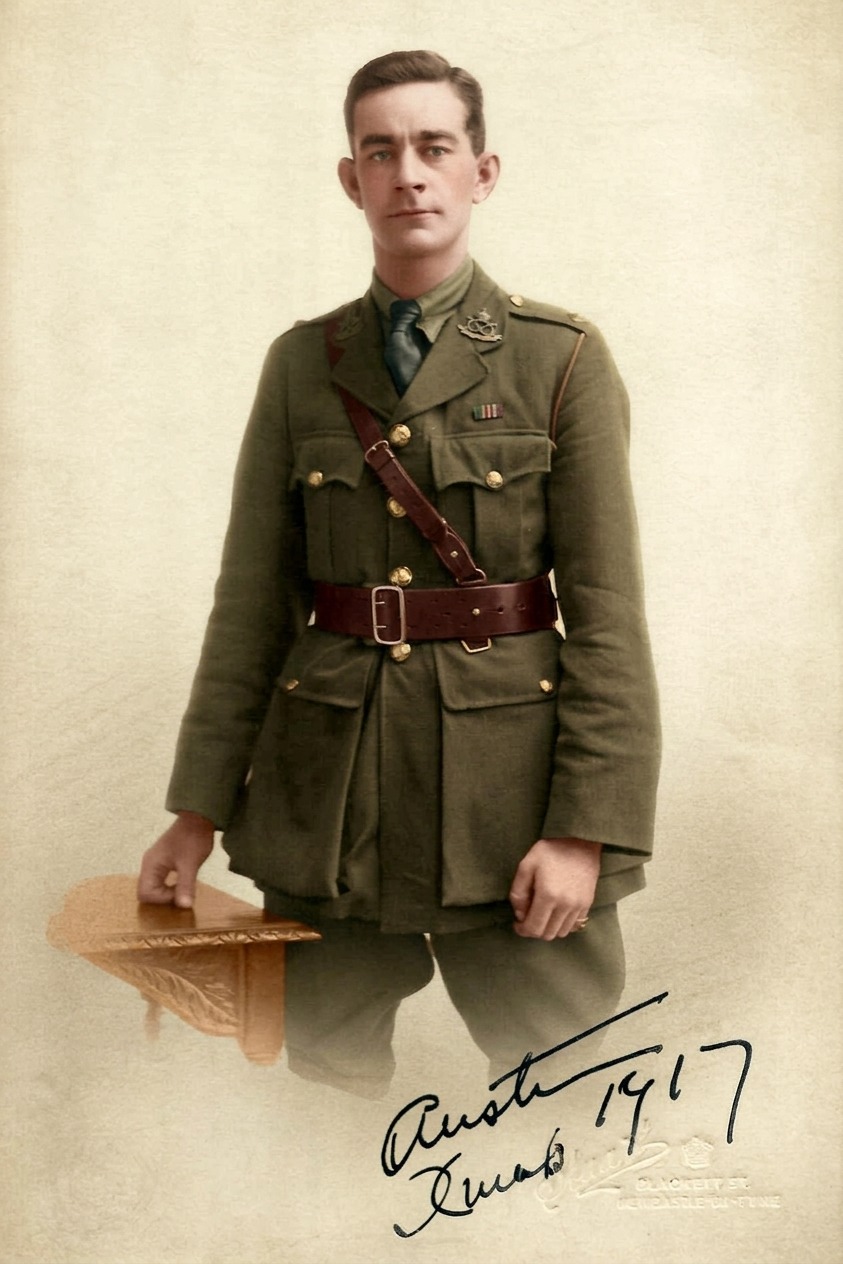
He was commissioned in the 1/5th South Staffords from No. 3 Officer Cadet Battalion (Bristol) on 25 September 1917. He was aged 27 on 29 September 1918. His war was ended by a machine gun bullet at Ramicourt on 3 October 1918. He was admitted to No. 1 Southern General Hospital, Birmingham University, on 6 October 1918 and demobilised on 2 May 1919, transferring to the Special Reserve, from which he relinquished his commission on 4 May 1920, retaining the rank of Lieutenant. He was unable to work, living on an army pension, dying unmarried in Birmingham of tuberculosis of the lungs on 19 February 1921 at his parents’ house, aged 29.
- Honours and awards: MM;[73] MiD;[74] 14-15 Star; BWM; VM
- Service file: TNA WO 374/70706
- Probate: £17 18s 4d
2nd Lieutenant Sidney Walters (1894-1918), 1/6th Battalion South Staffordshire Regiment
b. 27 November 1894, Tipton, Staffordshire; the seventh of the twelve children, eleven of whom survived infancy, of Alfred Walters (1865-1927), a colliery engine driver, and Mary Jane Walters (née Bayley) (1865-1936); Sidney worked as a labourer before the war. He attested on 19 August 1914 at Lichfield and was posted to the 7th (Service) Battalion South Staffordshire Regiment, part of 33 Brigade, 11th (Northern) Division. He deployed with his parent formations to the Mediterranean Expeditionary Force on 1 July 1915 and landed on the Gallipoli peninsula, at Suvla Bay, on 7 August 1915.
After the termination of the Gallipoli campaign, 11th Division was redeployed to France in July 1916. Walters, by then a Corporal in “C” Coy, remained with his battalion until 24 April 1917, when he was posted home. He was accepted for officer training at No. 7 Officer Cadet Battalion (Fermoy) on 5 July 1917 and discharged to a commission in the South Staffordshire Regiment on 30 October 1917. He was aged 23 on 29 September 1918, the day on which he won his Military Cross ‘for conspicuous courage in action … in the operations near Bellenglise. With a few men he attacked an enemy machine-gun which was holding the troops on his flank. He rushed the post and turned the gun on the retreating enemy. Throughout the operations he led his platoon with great dash and coolness’.[75]
On ‘October 2nd-3rd [1918] there was a bitterly contested attack and counter-attack at Ramecourt [sic] [by 1/6th South Staffords]. Only at the point of the bayonet was that position held, and even then at the expense of heavy casualties’.[76] Sidney Walters was one of them. He was severely wounded on 3 October and died at No. 50 Casualty Clearing Station the following day.[77] He is buried in Tincourt New British Cemetery, France.
Walters married Dora Handley (1895-1977), eldest child of a Black Country ironworks labourer, William Handley, on 30 October 1916. She was only 23 and had a ten-month old son, William Sidney Walters (1918-2001), when her husband was killed. She did not remarry until 1926 and had no further children.
- Honours and awards: MC; 14-15 Star; BWM; VM
- Service file: WO 339/ TNA 114761
- Probate: Not found
2nd Lieutenant Cyril Ernest Wardle (1896-1918), 1/6th Battalion Sherwood Foresters
b. 7 November 1896, West Bridgford, Nottinghamshire; s. of John Wardle (1872-1959), a commercial traveller for Boots the Chemist, and Mary Lavinia Wardle (née Oldfield) (1871-1941); educ. Mundella School, Nottingham, and University College Nottingham; he attested on 16 September 1914 and was posted to 7th (Reserve) Battalion Sherwood Foresters TF, aged 17, transferring to the 7th (Robin Hood) Battalion Sherwood Foresters on 16 March 1915, by then aged 18. He served with this unit in the BEF from 25 June 1915 until 24 December 1916, attaining the rank of Corporal. He returned to England for officer training at No. 6 Officer Cadet Battalion (Balliol College, Oxford). He was discharged to a commission in the 3rd (Reserve) Battalion Sherwood Foresters on 29 July 1917 and later attached to the Regular 1st Battalion. He was posted to the 1/6th Sherwoods on 20 August 1918. He was aged 21 on 29 September.
2nd Lieutenant Wardle was killed in action at Ramicourt on 3 October 1918 and is buried in Calvaire Cemetery, Montbrehain, France. His younger brother, Lieutenant John Royston Wardle (1898-1995), later a bank manager, also served in the Sherwood Foresters.
- Honours and awards: 14-15 Star; BWM; VM
- Service file: TNA WO 339/91604
- Probate: £18 14s 6d
2nd Lieutenant Joseph Harold Watson (1891-1918), 1/4th Battalion Leicestershire Regiment
b. 23 March 1890, Duffield, Derbyshire; s. of William Watson (1855-1933), a frame work knitter in the hosiery industry, and Mary Ann Watson (née Davis) (1858-1921); he was one of ten children; educ. Holy Trinity School, Leicester. He began his working life as a coalminer, but was employed as an Audit Clerk with the National Insurance Audit Department in Sheffield before the outbreak of war. He volunteered at Derby on 22 January 1915 and was posted to the 4th (Extra Reserve) Battalion Sherwood Foresters, part of the Tyne Garrison, until he was transferred to the Regular 2nd Battalion in France on 18 August 1915, eventually becoming a Lance Corporal in “A” Coy. He joined No. 13 Officer Cadet Battalion (Newmarket) on 10 March 1917 after a successful interview with the GOC 71 Brigade, Brigadier-General Edward Feetham, and was discharged to a commission in the 1/4th Leicesters on 26 June 1917; he was aged 27 on 29 September 1918.
2nd Lieutenant Watson died at No. 141 Field Ambulance on 3 October 1918 from wounds suffered at Ramicourt. He is buried in Vadencourt British Cemetery, Maissemy, France.
Watson had married Nellie Eglin Jepson Hardstaff on 15 December 1911. The marriage was evidently unhappy. At the time of his death Watson was in the process of divorcing his wife and seeking custody of their daughter, Marjorie Jessie (1913-98). The petition was undefended and Mrs Watson did not object to her husband having custody. Watson’s daughter was recognised by the army as his next of kin. His file contains several letters from Colonel ‘Max’ Graham, Deputy Military Secretary at the War Office, addressed ‘Dear Madam’ to ‘Miss Watson’, who was five years old at the time. She was eventually taken into the guardianship of Watson’s parents.
- Honours and awards: 14-15 Star; BWM; VM
- Service file: TNA WO 339/86467
- Probate: £1 13s 2d
2nd Lieutenant Walter Whapples (1888-1943), 1/5th Battalion Lincolnshire Regiment
b. 8 May 1888, Barton-under-Needwood, Staffordshire; the third of ten children of George Whapples (1861-1941), coal merchant, and Louisa Whapples (née Asbury) (1864-1902). On 9 March 1911 he sailed for Canada on the SS Tunisian, giving his occupation as ‘labourer’; in his service file he described himself as a ‘waiter’ and on his Medical Sheet as a ‘valet’. He married the Northamptonshire-born Emma Elizabeth Jemima Jeffery (1888-1964) in Quebec on 9 April 1913 and they had a son in 1915.
He attested under the Derby Scheme on 10 November 1915 and was immediately posted to the Army Reserve. He was mobilised on 31 May 1916 and joined the Grenadier Guards at Caterham on 3 June 1916. A rather bewildering array of transfers followed: on 8 December 1916 to the Royal Warwickshire Regiment; then, four days later, to the 1st Garrison Battalion Worcestershire Regiment; then, on 8 May 1917, to the 3rd (Reserve) Battalion Royal Warwickshire Regiment; then, on 21 August 1917, to No. 29 Infantry Base Depot; a day later to 14th (Service) Battalion Royal Warwickshire Regiment; another eight days later, on 22 August 1917, to the 1st Battalion Royal Warwickshire Regiment. He did not enter a Theatre of War, the Western Front, until 22 August 1917. Perhaps he was shunted round like this because he had specialist skills in bombing and musketry (he qualified as Instructor at the Bombing School, Lyndhurst, on 30 June 1917.) He returned to England for officer training at No. 11 Officer Cadet Battalion (Pirbright) on 4 November 1917, after only three months of active service. He was discharged to a commission in the 4th Lincolns on 25 May 1918. He was aged 30 on 29 September.
He was evacuated to England with bronchitis on 20 October 1918 and relinquished his commission on the grounds of ill health on 4 February 1919. After the war he was employed as the Steward of Northampton Masonic Club (his wife was Stewardess) and from 1934 to 1939 was landlord of ‘The Cock’ in Northampton before securing the position of Steward of the Rayon Works (Courtauld) Social Club, Coventry (where his wife was again Stewardess). Walter Whapples died on 28 January 1943, aged 54, from cardiac failure brought on by bronchitis.
- Honours and awards: BWM; VM
- Service file: TNA WO 374/73357
- Probate: £262 1s 1d
2nd Lieutenant John Charles Wheatley (1898-1918), 1/5th Battalion Sherwood Foresters
b. 16 December 1898, Loughborough, Leicestershire; s. of Charles Obadiah Wheatley (1870-1932), Board School teacher, and Sarah Anne Wheatley (née Renals) (1869-1914); educ. Loughborough Intermediate School, the Country Grammar School of King Edward VII Melton Mowbray and Nottingham University; he enlisted on 17 December 1916, the day after his eighteenth birthday. He was posted to the 28th Battalion London Regiment (Artists Rifles) on 27 July 1917 and discharged to a commission in the Sherwood Foresters on 26 June 1918. He was aged 19 on 29 September 1918.
2nd Lieutenant Wheatley died at the Advanced Dressing Station, No. 90 Field Ambulance, from wounds suffered on 3 October 1918 at Ramicourt. (Lieutenant Crellin (qv) wrote a letter explaining the circumstances of Wheatley’s death to his father.) John Wheatley has no known grave, but is commemorated on the Vis-en-Artois Memorial, France, the County Grammar School of King Edward VII Melton Mowbray Roll of Honour, and the memorials of All Saints Church, Hoby, Leicestershire, All Saints Church, Loughborough, and the Carillon Tower Memorial, Loughborough.
- Honours and awards: BWM; VM
- Service file: TNA WO 374/73398
- Probate: Not found
Lieutenant Robert George (‘Bertie’) Whittaker (1894-1966), 1/5th Battalion Sherwood Foresters
b. 29 March 1894, Durban, South Africa; one of the five children of Robert (‘Bobbie’) John Whittaker (1868-1940), salesman, and Matilda Annie Whittaker (née Reed) (1869-1943); the Whittakers were a prosperous South African family; educ. Berea Academy, Durban, and Acton Commercial College, Middlesex; he worked for the wholesale firm J.W. Jagger & Co. in Johannesburg as a commercial traveller before the war.
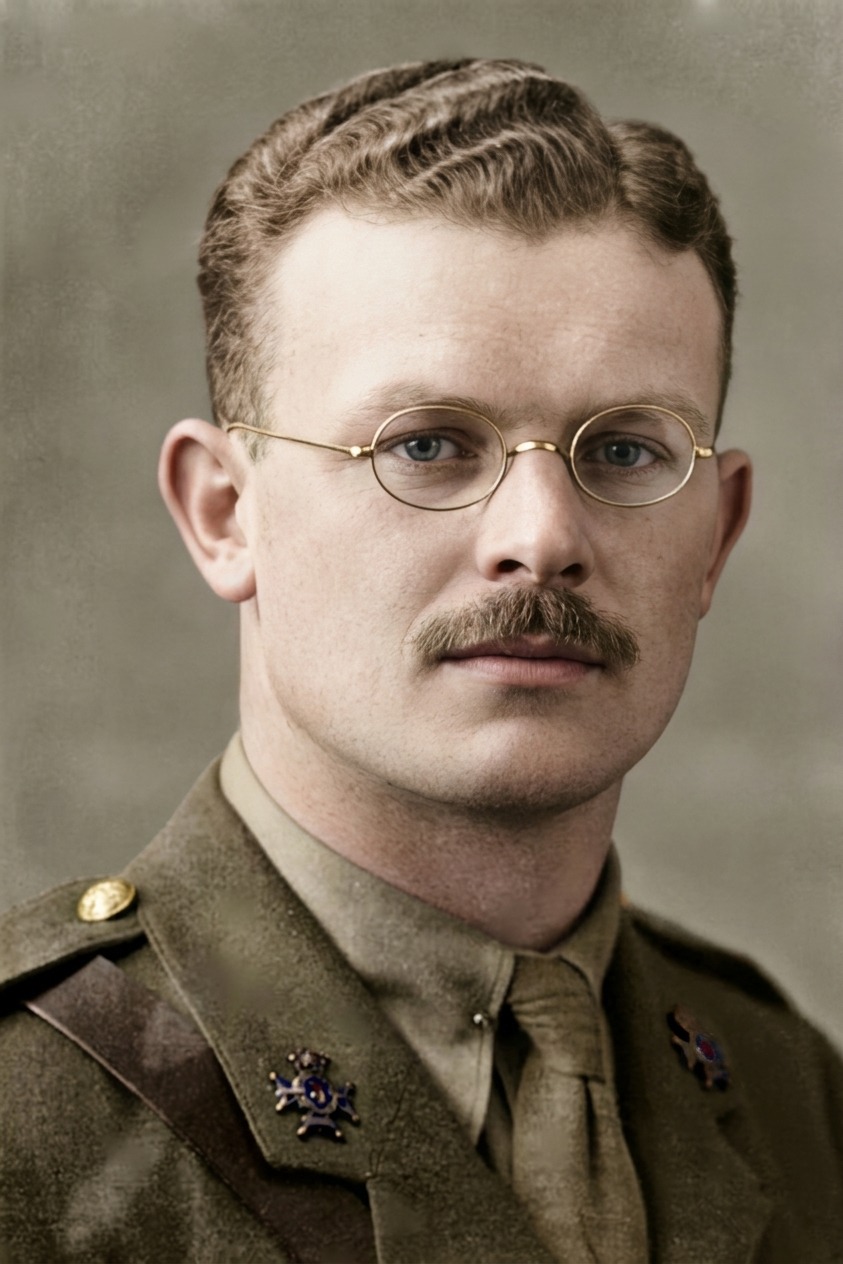
His military service began as a Corporal in the South African Service Corps, taking part in the campaign in German South West Africa (February-August 1915). He came to England in May 1916 and worked for a while in the Trench Warfare Department of the Ministry of Munitions, but eventually enlisted in the Army Service Corps. He had been continually rejected for infantry and artillery service, apparently on the grounds of myopia, but the Report of the 7th OTC Class held at Aldershot on 20 December 1916 pronounced him ‘suitable for Horse Transport Duties on the L. of C. or Supply and Transport Duties with Divisional Train’. He joined 572 Coy ASC on 29 December 1916 and was commissioned on 26 February 1917, serving at Aldershot, the Curragh and Blackheath. After some toing and froing he was eventually posted to an infantry battalion, the 3rd (Reserve) Battalion Sherwood Foresters at Sunderland on 12 November 1917. He was promoted to Lieutenant on 27 August 1918.
He was aged 24 on 29 September 1918. ‘At Ramicourt on 3rd October, 1918, he led his platoon to its final objective through heavy machine-gun fire. When the enemy counter-attacked he collected men from three different battalions, organised them and held off the enemy till darkness. Although suffering severely from shell shock he remained at duty until the battalion came out of action. He showed great courage and determination.’[78]
He married Sylvia Catherine Drennan (1901-66), daughter of a Kent GP and RAMC officer, on 7 April 1920 in Durban. They had two children. The marriage ended in a separation, though they never divorced. Whittaker ran his own men’s outfitting shop in Durban for many years. He died in Durban on 2 August 1966, aged 72.
- Honours and awards: MC; 14-15 Star; BWM; VM
- Service file: TNA WO 339/95326
- Probate: Not found
Lieutenant Maurice Edward Williams (1892-1991), 1/6th Battalion South Staffordshire Regiment
b. 14 August 1892, Mildenhall, Suffolk; s. of William Edward Williams (1849-1911), grocer and draper, and Emily Elizabeth Williams (née Morley) (1850-1933); educ. Mildenhall Church of England School; enlisted 19 August 1914 in the 5th Battalion Suffolk Regiment TF. The battalion sailed from Avonmouth for the Mediterranean Expeditionary Force on HMT Aquitania on 29 July 1915, landing at Suvla Bay on 10 August. Williams was hospitalised in Cairo with enteritis on 29 November 1915 and invalided to England on 12 December where he was treated at the 2nd Western General Hospital, Manchester. He was posted to 3/5th Battalion Suffolk Regiment, promoted to Sergeant on 13 April 1916 and then chosen for officer training at No. 9 Officer Cadet Battalion (Gailes) on 2 December 1916. He was discharged to a commission in the 6th South Staffords on 28 March 1917. He was aged 26 on 29 September 1918. He sustained a bullet wound to his left thigh on 12 October 1918. After recovering he was posted to the 5th (Reserve) Battalion South Staffordshire Regiment at Sutton-on-Sea in Lincolnshire.
He returned to his home town after the war and became a well-known and successful greengrocer. He was a Scout Master in Suffolk for fifty years. He died in Mildenhall on 19 January 1991, aged 98.
- Honours and awards: 14-15 Star; BWM; VM
- Service file: TNA WO 374/74982
- Probate: £115,000 0s 0d
2nd Lieutenant William Woodward (1892-1972), 1/6th Battalion North Staffordshire Regiment
b. 17 December 1892, Bulkington, Warwickshire; third of the four children of Frederick Woodward (1856-1925), farmer and butcher, and Lucy Woodward (née Cotton) (1864-1939); educ. King Edward VI Grammar School, Nuneaton, Warwickshire; he worked as a draughtsman prior to his attestation at Burton-on-Trent on 18 January 1915 and was posted to the 2/6th Battalion North Staffordshire Regiment, achieving the rank of Acting Sergeant on 4 September 1915. On 17 February 1917 he was transferred to the 3/5th (Reserve) Battalion North Staffordshire Regiment. He was selected for officer training and posted to No. 21 Officer Cadet Battalion (Crookham) on 7 September 1917 and discharged to a commission on 18 December 1917. He went to France on 3 April 1918. He was aged 25 on 29 September 1918. He suffered a bullet wound to the little finger of his left hand at Ramicourt on 3 October. The wound proved to be complicated and brought his active military service to an end.
After the war Woodward went to Birmingham University to read Civil Engineering, graduating BSc in 1923. He found employment with the Public Works Department in Hong Kong, where he specialised in water and sewage systems. On 25 January 1925 he married Margaret Mary Wyatt (1898-1991), a schoolteacher, and like him the child of a farmer. After the Japanese capture of Hong Kong in December 1941 Woodward was interned at Stanley Camp, where his expertise with water and sewage supplies prevented even worse conditions from developing. He left an account of his work at Stanley Camp and this is now in the Imperial War Museum.[79] His wife and daughters do not appear to have been interned. The whole family returned to the UK in May 1940. It seems that the women remained in England, while he – fatefully – returned to his duties.
William Woodward died on 26 May 1972, at Olney, Buckinghamshire, aged 79.
- Honours and awards: BWM; VM
- Service file: TNA WO 374/76758
- Probate: £20,624 0s 0d
Appendix 2
Platoon Commanders of the 46th (North Midland) Division TF
29 September 1918[80]
137 (Staffordshire Brigade)
1/5th Battalion South Staffordshire Regiment
2nd Lieutenant C. Jones MC
2nd Lieutenant H. Howell
2nd Lieutenant W.B. Brown
2nd Lieutenant J.B. Bushby
2nd Lieutenant W. Payne
2nd Lieutenant A.C. Moore MM
2nd Lieutenant A.C. Bull
2nd Lieutenant J.V. Blunt
2nd Lieutenant L. Pearson
2nd Lieutenant W. Hooper[81]
2nd Lieutenant A.J. Musgrove
2nd Lieutenant J.N. Whittaker
2nd Lieutenant H.G. Waters
2nd Lieutenant A.W. Vizor MM[82]
[Total: 14]
1/6th Battalion South Staffordshire Regiment
2nd Lieutenant F.C. Beech
2nd Lieutenant G. Evans
2nd Lieutenant C.W. Briand
2nd Lieutenant J. Baker MC
2nd Lieutenant P.W. Burgess MC MM
2nd Lieutenant F.A. Morgan MC
Lieutenant M.E. Williams MC
2nd Lieutenant H. Watts DCM
2nd Lieutenant J. Robinson
2nd Lieutenant S. Walters MC
2nd Lieutenant C.P.H. Sylvester
2nd Lieutenant L.J. Knight
2nd Lieutenant R. Smith
2nd Lieutenant H.W. Wootton[83]
Lieutenant J.A. Armstrong MC
Lieutenant H.C. Marriott MC
[Total: 16]
1/6th Battalion North Staffordshire Regiment
2nd Lieutenant W.S. Angus
2nd Lieutenant F.E. Brindley
2nd Lieutenant E.W. Parkinson
2nd Lieutenant A.E. Chambers
2nd Lieutenant W. Woodward
2nd Lieutenant W.J.A. Ensor
2nd Lieutenant C.B.E. King
2nd Lieutenant L. Roberts
2nd Lieutenant J. Bellingham MC[84]
2nd Lieutenant R.H. Sennett
2nd Lieutenant R. Barron
[Total: 11]
138 (Lincoln and Leicester) Brigade
1/5th Battalion Lincolnshire Regiment
Lieutenant H. Bamber
Lieutenant E.A. Dennis
Lieutenant C.R. Madden MC
Lieutenant H.F. Hawkeswood
Lieutenant R.D. Lepine
2nd Lieutenant A.C. Fisher
2nd Lieutenant R.S. Lord
Lieutenant J.W. Mansfield
2nd Lieutenant W.A. Giles
2nd Lieutenant F.S. Skinner
2nd Lieutenant A.G. Black MC
Lieutenant R.G. Harris[85]
2nd Lieutenant F.W.L. Few
2nd Lieutenant J.H. Hopkins
2nd Lieutenant W. Whapples
41424 Sergeant N. Smith
[Total: 16]
1/4th Battalion Leicestershire Regiment
2nd Lieutenant J.H. Watson
2nd Lieutenant C. Morbey
2nd Lieutenant H.N. Lacey
2nd Lieutenant H.J. Partridge[86]
2nd Lieutenant M. Lamont
2nd Lieutenant J. Turton
2nd Lieutenant F.H. Wills
2nd Lieutenant W.L. Barber
2nd Lieutenant R.C. Quayle
2nd Lieutenant E. Cashmore
2nd Lieutenant C.H. Wood
2nd Lieutenant H.E. Scoffield[87]
2nd Lieutenant D.J. Brewin
Lieutenant T.R. Flynn
36381 Sergeant H. Dobson
11087 Sergeant C.W. Bugden
[Total: 16]
1/5th Battalion Leicestershire Regiment
2nd Lieutenant A. Asher[88]
2nd Lieutenant H.J. Quint[89]
2nd Lieutenant S.H. Dennis[90]
2nd Lieutenant J.W. Lewin[91]
2nd Lieutenant E. Cosgrove
Lieutenant S.G.H. Steel MC
Lieutenant J.C. Barrett VC[92]
2nd Lieutenant A. Johnson
2nd Lieutenant W.W. Parsons[93]
Lieutenant S. Corah
Lieutenant D.T. Sloper[94]
2nd Lieutenant J.G.E. Buckley[95]
240467 Sergeant P. Bowler
240919 Lance Sergeant G. Fowkes
240118 Corporal B. Mead
242599 Sergeant R.B. Haynes
[Total: 16]
139 (Sherwood Forester) Brigade
1/5th Battalion Sherwood Foresters
Lieutenant J.F. Crellin MC
Lieutenant R.G. Whittaker MC
2nd Lieutenant J.C. Wheatley
2nd Lieutenant A.H.T. Gent
2nd Lieutenant M.D. Barrows
2nd Lieutenant R.N. Lakeman
Lieutenant E.F. Ann
2nd Lieutenant F.R. Hartshorne
2nd Lieutenant T. Moulton
2nd Lieutenant C.W. Holmes
2nd Lieutenant J.R. Dench MC
2nd Lieutenant F.T. Metcalfe MC
[Total: 12]
1/6th Battalion Sherwood Foresters
2nd Lieutenant C.B. Newell MC
2nd Lieutenant F. Touch MC DCM
2nd Lieutenant H.A. Paine[96]
2nd Lieutenant R.A. Frith MC
2nd Lieutenant C.E. Wardle
2nd Lieutenant W. Bavin
2nd Lieutenant P.A. Tompkinson
2nd Lieutenant A.J. Tyrrell[97]
2nd Lieutenant A. Jepson[98]
2nd Lieutenant C. Bimrose MC
2nd Lieutenant W. Meakin
2nd Lieutenant E. Scarrott
[Total: 12]
1/8th Battalion Sherwood Foresters
2nd Lieutenant S. Bradwell MC DCM
2nd Lieutenant J.F. Shackleton MC
2nd Lieutenant R.N. Barker[99]
2nd Lieutenant F.T.W. Saunders
2nd Lieutenant P.A. Turner
2nd Lieutenant C.M. Bedford
2nd Lieutenant A.D.H. Dunkin
2nd Lieutenant F.L. Harrop MC
2nd Lieutenant A.N. Davis
2nd Lieutenant James H. Smith MC
2nd Lieutenant T.F. Mitchell MC
2nd Lieutenant John H. Smith
[Total: 12]
6th South Staffordshire Regiment
9 October
2nd Lieutenant Joseph Bryan Bushby 5th South Staffordshire Regiment
17 October
Sergeant Newman Smith 5th Lincolnshire Regiment
28 October
Sergeant Charles William Bugden 4th Leicestershire Regiment
Wounded
24 September
2nd Lieutenant John Cridlan Barrett 5th Leicestershire Regiment
2nd Lieutenant John G.E. Buckley 5th Leicestershire Regiment
Lieutenant Dudley Thomas Sloper 5th Leicestershire Regiment
25 September
2nd Lieutenant Samuel Henry Dennis 5th Leicestershire Regiment
2nd Lieutenant Herbert John Partridge 4th Leicestershire Regiment
26 September
2nd Lieutenant Ernest William Parkinson 6th North Staffordshire Regiment
29 September
Lieutenant Edwin Francis Ann 5th Sherwood Foresters
2nd Lieutenant Charle William Briand 6th South Staffordshire Regiment
2nd Lieutenant Percy William Burgess 6th South Staffordshire Regiment
2nd Lieutenant Francis W.L. Few 5th Lincolnshire Regiment
2nd Lieutenant Charles B.E. King 6th North Staffordshire Regiment
2nd Lieutenant Harold Neal Lacey 4th Leicestershire Regiment
2nd Lieutenant William Meakin 6th Sherwood Foresters
2nd Lieutenant Clarence Morbey 4th Leicestershire Regiment
2nd Lieutenant Walter Payne 5th South Staffordshire Regiment
2nd Lieutenant John Hollins Robinson 6th South Staffordshire Regiment
2nd Lieutenant Frank Stanley Skinner 5th Lincolnshire Regiment
2nd Lieutenant Richard Smith 6th South Staffordshire Regiment
2nd Lieutenant Harold Watts 6th South Staffordshire Regiment
2nd Lieutenant John Norman Whittaker 5th South Staffordshire Regiment
2nd Lieutenant Henry Walter Wootton 6th South Staffordshire Regiment
2 October
2nd Lieutenant Herbert Eric Scoffield 4th Leicestershire Regiment
3 October
2nd Lieutenant Alfred Charles Bull 5th South Staffordshire Regiment
2nd Lieutenant Albert Edward Chambers 6th North Staffordshire Regiment
2nd Lieutenant Francis Thomas Metcalfe 5th Sherwood Foresters
2nd Lieutenant Francis Arthur Morgan 6th South Staffordshire Regiment
2nd Lieutenant Arthur John Musgrove 5th South Staffordshire Regiment
2nd Lieutenant Leonard Pearson 5th South Staffordshire Regiment
2nd Lieutenant Frank T.W. Saunders 8th Sherwood Foresters
2nd Lieutenant Richard Herbert Sennett 6th North Staffordshire Regiment
2nd Lieutenant Austin William Vizor 5th South Staffordshire Regiment
2nd Lieutenant Charles Herbert Wood 4th Leicestershire Regiment
2nd Lieutenant William Woodward 6th North Staffordshire Regiment
10 October
2nd Lieutenant Maurice Edward Williams 6th South Staffordshire Regiment
11 October
2nd Lieutenant Edward Cosgrove 5th Leicestershire Regiment
17 October
2nd Lieutenant Thomas Lee Moulton 5th Sherwood Foresters
2nd Lieutenant John Henry Smith 8th Sherwood Foresters
Appendix 4
Honours Won by 46th Division’s Platoon Commanders
Victoria Cross
Lieutenant John Cridlan Barrett 1/5th Leicestershire Regiment
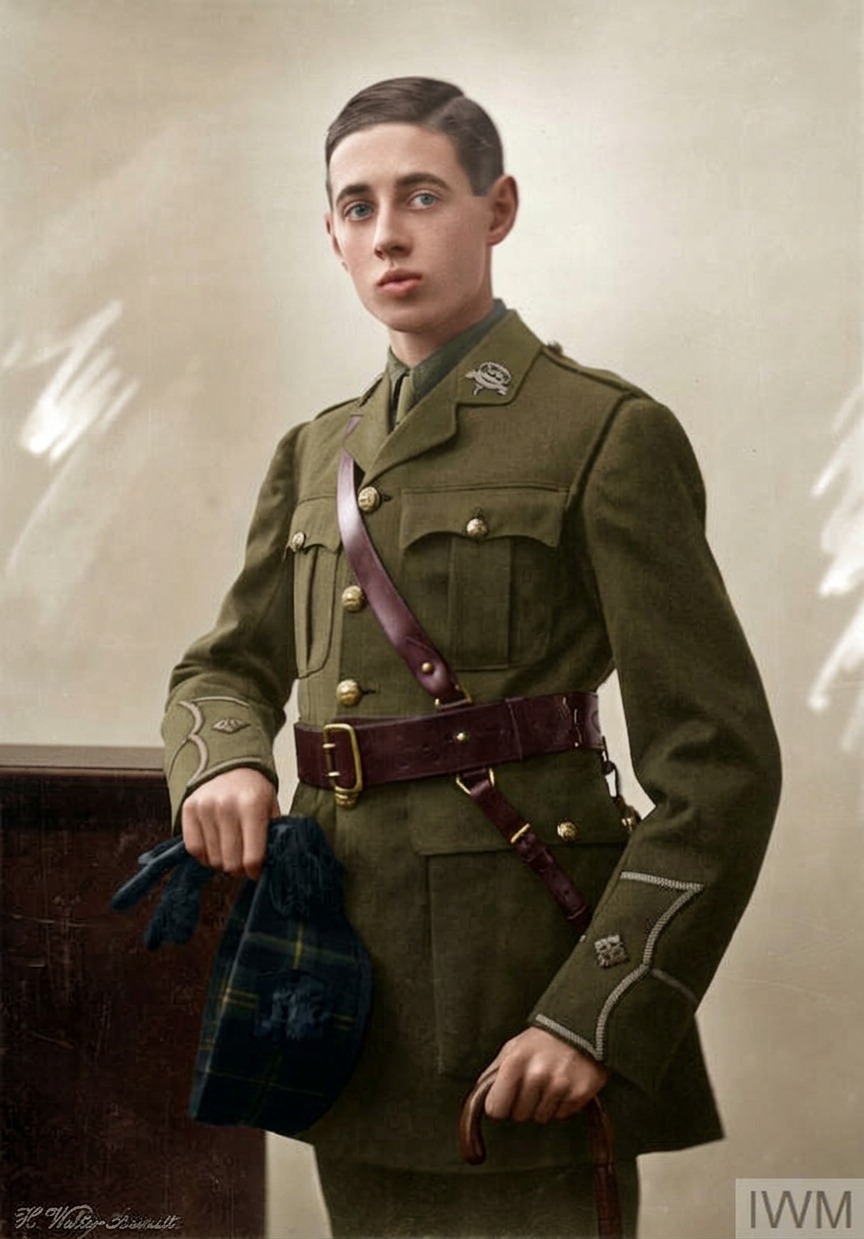
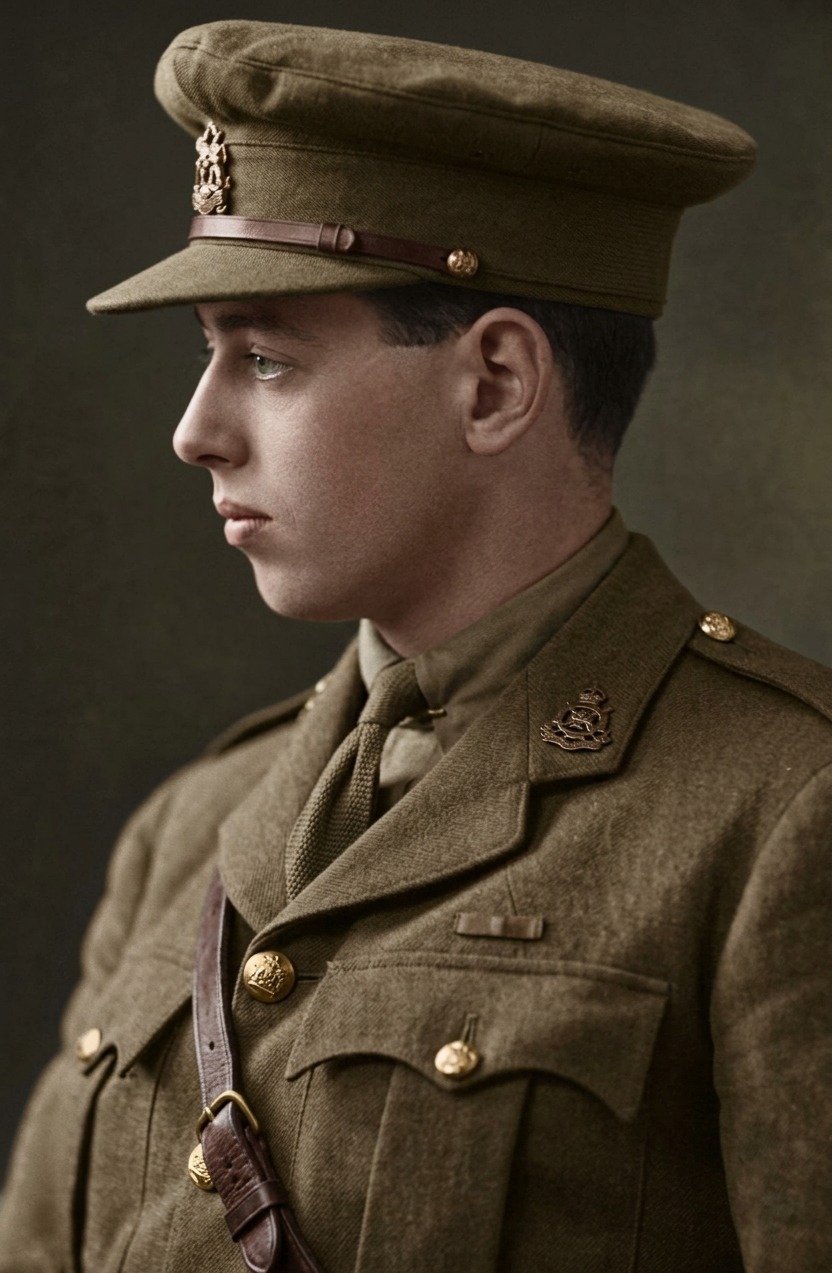
Military Cross + 2 Bars
2nd Lieutenant Joseph Richard Dench 1/5th Sherwood Foresters
Military Cross + Bar
Lieutenant John Frissell Crellin 1/5th Sherwood Foresters
Military Cross
2nd Lieutenant John Baker 1/6th South Staffordshire Regiment
2nd Lieutenant Roderick Barron 1/6th North Staffordshire Regiment
2nd Lieutenant Maxwell Dalston Barrows 1/5th Sherwood Foresters
2nd Lieutenant Joseph Bellingham 1/6th South Staffordshire Regiment
2nd Lieutenant Charles Bimrose 1/6th Sherwood Foresters
2nd Lieutenant Adolphus George Black 1/5th Lincolnshire Regiment
2nd Lieutenant Stanley Bradwell 1/8th Sherwood Foresters
2nd Lieutenant Wilfred Ben Brown 1/5th South Staffordshire Regiment
2nd Lieutenant Percy William Burgess 1/6th South Staffordshire Regiment
Lieutenant Thomas Richard Flynn 1/4th Leicestershire Regiment
2nd Lieutenant Ronald Alfred Frith 1/6th Sherwood Foresters
2nd Lieutenant Alfred Harry Thomas Gent 1/5th Sherwood Foresters
2nd Lieutenant Frank Leslie Harrap 1/8th Sherwood Foresters
2nd Lieutenant Clifford Jones 1/5th South Staffordshire Regiment
2nd Lieutenant Leonard James Knight 1/6th South Staffordshire Regiment
Lieutenant Clarence Rowland Madden 1/5th Lincolnshire Regiment
Lieutenant Harry Conrad Marriott 1/6th South Staffordshire Regiment
2nd Lieutenant Francis Thomas Metcalfe 1/5th Sherwood Foresters
2nd Lieutenant Thomas Frederick Mitchell 1/8th Sherwood Foresters
2nd Lieutenant Francis Arthur Morgan 1/6th South Staffordshire Regiment
2nd Lieutenant Arthur John Musgrove 1/5th South Staffordshire Regiment
2nd Lieutenant Cecil Bertram Newell 1/6th Sherwood Foresters
2nd Lieutenant Herbert John Partridge 1/4th Leicestershire Regiment
2nd Lieutenant John Farrar Shackleton 1/8th Sherwood Foresters
2nd Lieutenant James Howard Smith 1/8th Sherwood Foresters
Lieutenant Sunley Gordon Hayward Steel 1/5th Leicestershire Regiment
2nd Lieutenant Frank Touch 1/6th Sherwood Foresters
2nd Lieutenant Sidney Walters 1/6th South Staffordshire Regiment
Lieutenant Robert George Whittaker 1/5th Sherwood Foresters
Lieutenant Maurice Edward Williams 1/6th South Staffordshire Regiment
2nd Lieutenant Frank Harry Wills 1/4th Leicestershire Regiment
Distinguished Conduct Medal
2nd Lieutenant Stanley Bradwell 1/8th Sherwood Foresters
2nd Lieutenant Frank Touch 1/6th Sherwood Foresters
2nd Lieutenant Harold Watts 1/6th South Staffordshire Regiment
Military Medal + Bar
Sergeant Randolph Balfour Haynes 1/5th Leicestershire Regiment
Military Medal
2nd Lieutenant Percy William Burgess 1/6th South Staffordshire Regiment
2nd Lieutenant Alfred Charles Moore 1/5th South Staffordshire Regiment
2nd Lieutenant Austin William Vizor 1/5th South Staffordshire Regiment
Notes
-
R.E. Priestley, Breaking the Hindenburg Line: The Story of the 46th (North Midland) Division (London: T. Fisher Unwin, 1919), pp. 180-95. Lieutenant (T/Captain, A/Major) (later Sir) Raymond Edward Priestley MC RE (1886-1974) was the signals officer of the 46th (North Midland) Division. After the war, he was seconded to the War Office to write the history of the Signals Service, producing one of the dullest and most impenetrable books ever written (Work of the R.E. in the European War, 1914-19: The Signal Service (France)). He was a geologist by training and had served on pre-war Antarctic expeditions with both Shackleton and Scott. His name has echoed throughout John Bourne’s career. Not only did Priestley write the history of his local TF division, but he was also Vice-Chancellor of Birmingham University (1938-52), where John worked for thirty years, and where Ernest Shackleton’s grandson, Richard, was one of his colleagues. See Mike Bullock, Priestley's Progress: The Life of Sir Raymond Priestley, Antarctic Explorer, Scientist, Soldier, Academician (Jefferson NC: McFarland, 2017). ↩
-
For a useful, if notional, description of infantry battalion organization, strength and responsibilities, see Andrew Rawson, British Army Handbook 1914-1918 (Stroud: Sutton Publishing, 2006), pp. 88-89. ↩
-
For High Command, see Simon Robbins, British Generalship on the Western Front 1914-18: Defeat into Victory (London: Frank Cass, 2005); for the Staff, see Paul Harris, The Men Who Planned the War: A Study of the Staff of the British Army on the Western Front, 1914-1918 (Farnham: Ashgate, 2016), for corps commanders, see Andy Simpson, Directing Operations: British Corps Command on the Western Front 1914-18 (Stroud: Spellmount, 2006); for divisional commanders, see J.M. Bourne, ‘British Divisional Commanders During the Great War: First Thoughts’, Gun Fire. A Journal of First World War History, 29 [1994], pp. 22-31; for brigade commanders see Roger Wood, The Best of All Appointments? The Evolution of Infantry Brigade Command in the British Army on the Western Front, 1915-1918 (Warwick: Helion, 2024) and Trevor Harvey An Army of Brigadiers: British Brigade Commanders at the Battle of Arras 1917 (Warwick: Helion, 2017); for infantry battalion commanders, see Peter E. Hodgkinson, British Infantry Battalion Commanders in the First World War (Farnham: Ashgate, 2015). ↩
-
Fraser Skirrow, ‘Most of the work, most of the blame, none of the credit: Platoon Commanders in the Great War’, Western Front Association Bulletin, 127 (August 2024), pp. 8-9, provides a useful introduction. ↩
-
Asher, Lewin and Quint are buried next to one another in Cerisy-Gailly Military Cemetery, France. ↩
-
Barrett was awarded the Victoria Cross for his role in the fighting at Pontruet. ↩
-
See Appendix 1 for biographies of fifty of these men. ↩
-
That of Sergeant Charles Bugden, for whom see Appendix 1. ↩
-
Victor Richardson MC (1895-1917) died of his wounds in No. 2 London General Hospital on 9 June 1917. The wound would have left him blind had he survived. Richardson had been at Uppingham School with Brittain’s brother Edward and her fiancé, Roland Leighton. ↩
-
There were a further 3,202 on the Reserve of Officers [RoO]. ↩
-
War Office, Statistics of the Military Effort of the British Empire during the Great War 1914-1920 (1922; Uckfield: Naval & Military Press, 1999), pp. 234-235 ↩
-
The Special Reserve had been established on 1 April 1908 as part of the ‘Haldane Reforms’. ↩
-
Statistics of the Military Effort, pp. 234-35 ↩
-
The officer commissioned in 1911 was Francis Arthur Morgan, who was commissioned in order for him to assume command of the Queen Mary’s Grammar School, Walsall OTC. For Morgan, see Appendix 1, Select Biographies. ↩
-
The officer commissioned in 1914 was Edwin Francis Ann (1/5th Sherwood Foresters), who was commissioned from the ranks of the 4th (Public Schools) Battalion Royal Fusiliers. For Ann, see Appendix 1, Select Biographies. ↩
-
See Charles Fair, ‘From OTC to OCB: The Professionalisation of the Selection and Training of Junior Temporary Officers During the Great War,’ in Spencer Jones, ed., The Darkest Year: The British Army on the Western Front 1917 (Warwick: Helion, 2022), pp. 78-109. ↩
-
James Jack, General Jack’s Diary 1914-1918: The Trench Diary of Brigadier-General J.L. Jack DSO ed. John Terraine (London: Eyre & Spottiswoode, 1964), p. 252. Jack was a pre-war Regular who rose from Captain to Brigadier-General. His experience was entirely with Regular units. ↩
-
For these officers, see Appendix 1 ↩
-
For a full listing of casualties, see Appendix 3 ↩
-
The CO of the 1/6th North Staffords, the unit that captured Riqueval Bridge, Lieutenant-Colonel T.R. Evans, was also killed on this day. ↩
-
Tom Thorpe, ‘A “mere six weeks”? A comparative study re-examining the longevity of infantry officers’ frontline service during the Great War,’ War in History, 29 (2) (April 2022), pp. 427-49 ↩
-
See J.M. Bourne, ‘Haig and the Aftermath’, The Douglas Haig Fellowship Records, 23 (December 2020), pp. 1-14 ↩
-
See Martin Petter, ‘“Temporary Gentlemen” in the Aftermath of the Great War; Rank Status and the Ex-Officer Problem’, Historical Journal, 37 (1) (1994), pp. 127-52. Se also, Laura Trott, ‘“Temporary Gentlemen” on the Western Front: Class Consciousness and the British Army Officer, 1914-1918’, The Osprey Journal of Ideas and Enquiry (2006) ↩
-
See Appendix 1. ↩
-
‘Escape’ was literally true in Dench’s case. See Appendix 1. ↩
-
For the New Zealand experience, see Nick Wilson et al, ‘Mortality of first world war military personnel: comparison of two military cohorts’, The BMJ [British Medical Journal], 16 December 2014. ↩
-
Two of our cohort, Lieutenant F.A. Ann and Lieutenant H.J. Armstrong, subsequently committed suicide. ↩
-
Durham University Gazette, XXXVII (ns), pp. 405-6 ↩
-
Sir Edwin Ann left £146,683 18s 1d at his death in 1913 ↩
-
He was recommended for a commission in the MGC by the GOC 5th Division, Major-General R.B. Stephens, after a personal interview. ↩
-
London Gazette, 30 July 1919 ↩
-
Although his name does not appear in any of the surviving hospital lists, he indicated on his application for a commission that he had suffered from dysentery and malaria. ↩
-
London Gazette, 4 October 1919 ↩
-
The raid was led by 2nd Lieutenant R.C. Davies, “D” Coy, who was badly wounded and rescued by Bradwell. There is a short account in Geoffrey Husbands, Joffrey’s War: A Sherwood Forester in the Great War Edited and Introduced by J.M. Bourne and Bob Bushaway (Nottingham: Salient Books, 2011), pp. 266-67. Husbands mistakenly calls Bradwell ‘Sergeant Bradley’. Lieutenant Davies was awarded the Military Cross and Private L. Boaler the Military Medal. These were the first honours won by the 16th Sherwoods. ↩
-
London Gazette, 30 July 1919 ↩
-
Bugden himself had no connection with Loughborough, but his family was living there by the time of the 1921 Census. Nevertheless, the (digital) Loughborough Roll of Honour gives an excellent account of Bugden’s war service: https://www.loughborough-rollofhonour.com/page6.htm He is not commemorated on any of Loughborough’s physical memorials. ↩
-
The War History of the Sixth Battalion The South Staffordshire Regiment (T.F.) by A Committee of Officers Who Served With the Battalion (London: Heinemann, 1924), p. 194 ↩
-
See https://www.theauxiliaries.com/men-alphabetical/men-b/burgess-pw/burgess-pw.html ↩
-
London Gazette, 30 July 1919 ↩
-
London Gazette, 4 October 1919 ↩
-
Authorities differ on the correct figure for the number of two Bar awards. The figure of 176 is based on J.V. Webb, Recipients of Bars to the Military Cross 1916-1920 (London: 1988). It includes two bars awarded for the North Russia expedition. ↩
-
London Gazette, 29 July 1919 ↩
-
London Gazette, 3 October 1919 ↩
-
London Gazette, 9 December 1919. The ‘Hundred Days’ have never had the same impact on British memory as the Somme and ‘Passchendaele’, but Dench’s record is indicative of the intensity and tempo of the fighting. It sometimes appears that after the crossing of the St Quentin Canal on 29 September 1918, the door to the Hindenburg Line had been kicked in and the rest was straightforward. It wasn’t. ↩
-
See https://www.theauxiliaries.com/men-alphabetical/men-d/dench-jr/dench-jr.html ↩
-
An account of this incident may be found in Captain J.D. Hills, The Fifth Leicestershire: A Record of the 1/5th Battalion Leicestershire Regiment TF During the War, 1914-1919 (Loughborough: echo Press, 1919), pp.285-86 ↩
-
He was born William James Alfred Endsor, but changed his name to Ensor by Deed Poll on 11 November 1916, occasioning some confusion in army bureaucracy! ↩
-
The number of commissions granted from the beginning of the war up to 1 December 1918 was approximately 229,316. Only 16,544 of these were permanent commissions in the Regular Army. The number of Territorial Force commissions in the infantry granted between 4 August 1914 and 1 December 1918 was 39,901. See Statistics of the Military Effort of the British Empire during the Great War 1914-1920 (London: War Office, 1920), pp. 234-35. ↩
-
London Gazette, 30 July 1919 ↩
-
His brother was Major Samuel Towers Hartshorne (1894-1961) MC TD MiD. He served in the 1st and 9th Battalions of the Leicestershire Regiment and briefly commanded the 1st Battalion (12-20 May 1918). He served in the RAF in the Second World War. An author, who had several plays broadcast on the radio in the 1950s. ↩
-
Suicide in England was not decriminalised until 1961. ↩
-
The only record of Haynes in Hospital Registers shows him with a GSW to the knee and buttock and being shipped back to England on 1 July 1916. He may have changed unit when he returned to active duty. ↩
-
For an account of Haynes’ arrest, attempted suicide and trial, see the Northampton Mercury, 10 June 1921 and 1 July 1921. ↩
-
In the 1921 Census he is recorded as a Lieutenant in the 1/8th Sherwood Foresters. In November 1922 he was involved as a passenger in a car crash in which his brother Samuel was killed. ↩
-
See Jeffery M. Dorwart, ‘The Roosevelt-Astor Espionage Ring’, New York History, 63 (3) (July 1981), pp. 307-33 ↩
-
For Morbey’s wounding, see John Milne, Footprints of the 1/4th Leicestershire Regiment August 1914 to November 1918 (Leicester: Edgar Backus, 1935), pp. 140-41 ↩
-
See the biography of Randolph Balfour Haynes, above, for an explanation of ;second division’. ↩
-
The date of deployment to France on his MRIC, 27 January 1917, is clearly wrong. ↩
-
London Gazette, 4 October 1919 ↩
-
The Portobello Military Hospital was opened in May 1916 as a specialist venereal disease hospital. This was the result of the British Army’s introduction in 1907 of a ‘VD treatment programme with a requirement to construct purpose-built clinics at major bases with standardized treatments’. The authors are grateful to Nick Baker for this information. ↩
-
London Gazette, 4 October 1919 ↩
-
Lilly Jacques had given birth to a son, Gordon Trevor Jaques, on 25 April 1915. No father is shown on the birth certificate. ↩
-
Like many other soldiers, a regime of exercise, fresh air and regular food saw him put on three inches in height and ten pounds in weight by July 1917. ↩
-
This information was repeated on the Scottish birth certificate of his younger sister, Alice. ↩
-
London Gazette, 30 July 1919 ↩
-
During his treatment Smith was placed under medical surveillance to ensure that the course of treatment was followed. Army Form 1.1239 stated that ‘When any circumstance arise likely to interfere with the regular attendance of men on the continued treatment list, such as transfer to another station, Musketry Courses, Imprisonment, and especially Furlough, their Commanding Officer will apprise the Medical Officer of the fact’. This was indicative of the Army’s practical and pragmatic attitude to Venereal Disease. ↩
-
He was severely reprimanded for drunkenness while attached to 2/6th Battalion South Staffordshire Regiment from the 2nd Battalion on 26 April 1918. ↩
-
The Canadian Corps of Commissionaires was formed in 1925 partly with the intention of providing employment for ex-servicemen. ↩
-
TNA WO 339/107016 ↩
-
See Paddington, Kensington and Bayswater Chronicle, 27 April 1912. Steel Senior had made a considerable amount of money in the South African boom of 1900, but was declared a defaulter on the Stock Exchange on 14 December 1911. ↩
-
London Gazette, 30 July 1919 ↩
-
London Gazette, 12 December 1919 ↩
-
London Gazette, 21 October 1916 ↩
-
London Gazette, 22 June 1915 ↩
-
London Gazette, 4 October 1919 ↩
-
The War History of the Sixth Battalion The South Staffordshire Regiment (T.F.) by a Committee of Officers Who Served with the Battalion (London: William Heinemann, 1924), p. 218. The battalion War Diary records the intensity of enemy shelling and machine-gun fire throughout the day: TNA: PRO WO 95/2687, 3 October 1918. ↩
-
2nd Lieutenant C.P.H. (‘Val’) Sylvester and 2nd Lieutenant George Evans were also killed in the engagement. ↩
-
London Gazette, 4 October 1919 ↩
-
IWM: Private Papers of William Woodward, Documents 228464. ↩
-
Extracted from Appendix V of Priestley, Breaking the Hindenburg Line, pp. 180-95. ↩
-
Shown as ‘H. Hooper’ by Priestley ↩
-
Spelled ‘Vizer’ by Priestley ↩
-
Spelled ‘Wooton’ by Priestley ↩
-
Spelled ‘Beelingham’ by Priestley ↩
-
Shown as ‘R.B. Harris’ by Priestley ↩
-
Wounded at Pike Wood, 25 September 1918 ↩
-
Spelled ‘Schoffield’ by Priestley ↩
-
KiA at Pontruet, 24 September 1918 ↩
-
KiA at Pontruet, 24 September 1918 ↩
-
OC No. 4 Platoon. Slightly wounded at Pontruet, 25 September 1918. ↩
-
KiA at Pontruet, 24 September 1918 ↩
-
Lieutenant (later Colonel) John Cridland Barrett (1897-1977) VC TD DL FRCS was not in post on 29 September 1918. He had been wounded in the attack at Pontruet on 24 September, while actually commanding “A” Company. ↩
-
Wounded at Pontruet, 24 September 1918 ↩
-
Wounded at Pontruet, 24 September 1918 ↩
-
Wounded at Pontruet, 24 September 1918. ↩
-
Spelled ‘Payne’ by Priestley ↩
-
Spelled ‘Tyrell’ by Priestley ↩
-
Spelled ‘Jephson’ by Priestley ↩
-
Shown as ‘R.M. Barker’ in Priestley ↩
Becoming a member of The Western Front Association (WFA) offers a wealth of resources and opportunities for those passionate about the history of the First World War. Here's just three of the benefits we offer:

The WFA regularly makes available webinars which can be viewed 'live' from home. These feature expert speakers talking about a particular aspect of the Great War.

Featured on The WFA's YouTube channel are modern day re-interpretations of the inter-war magazine 'I Was There!' which recount the memories of soldiers who 'were there'.

Explore over 8 million digitized pension records, Medal Index Cards and Ministry of Pension Documents, preserved by the WFA.
Other Articles


