
David Ronald Cross was killed on this day in 1915
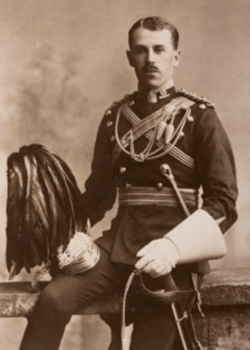
David was born 18 October 1889 at Dalmeny, Linlithgowshire, Midlothian. His parents were Adam Paterson Cross, a chemical manufacturer, and Annie Cross née Guthrie. He had an older sister, Margaret Lilian, who died in 1903. In 1897, his sister, May Phyliss, was born.
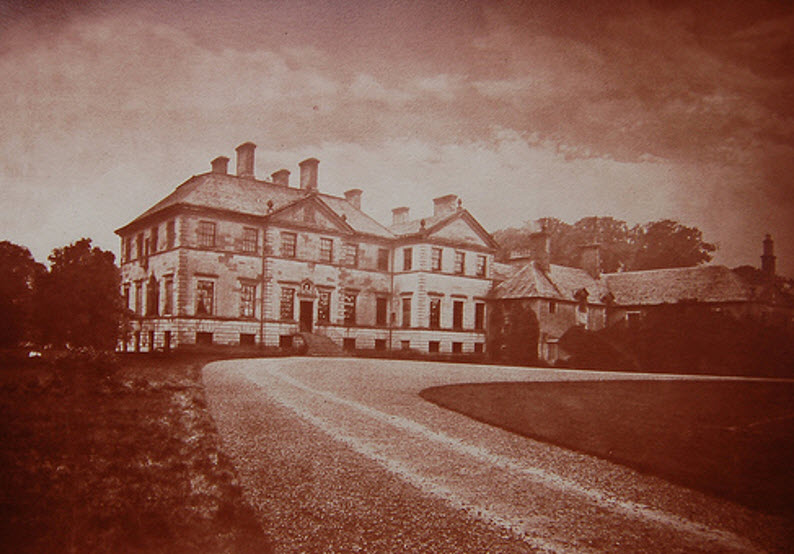
The family lived, with their household servants, at Craigiehall Mansion, a 17th-century mansion near Dalmeny, on the outskirts of Edinburgh
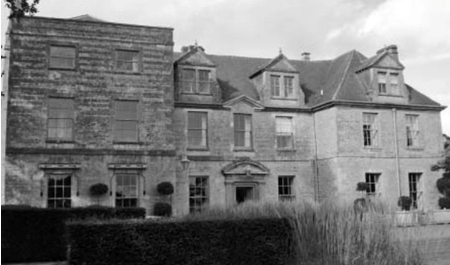
David went to boarding prep school at the Manor House, Great Haseley, Oxfordshire followed by Marlborough College from April 1903 to July 1908. He then read Modern History at Christ Church, Oxford.
As a young man, David Cross rode to hounds and was well known to Pytchley County. In 1914, he won his regimental races at the Curragh, Lord Annaly’s Cup at the Pytchley point-to-point races, and at Punchestown the two military steeplechases.
He had been gazetted 2nd Lieutenant in the 16th Lancers on 16 August 1911 and later promoted to Lieutenant.
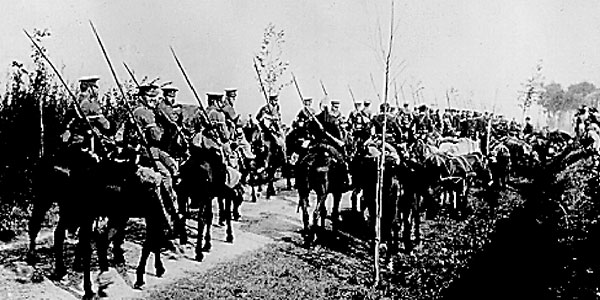
Lieut. Cross was sent with his regiment to France at the outbreak of war in August 1914 and was wounded in October 1914, but after a few weeks back in England he rejoined his regiment.
David was twice mentioned in F.M. Sir John French’s Dispatches. (London Gazette, 17 & 18 Feb 1916) and awarded the Military Cross.
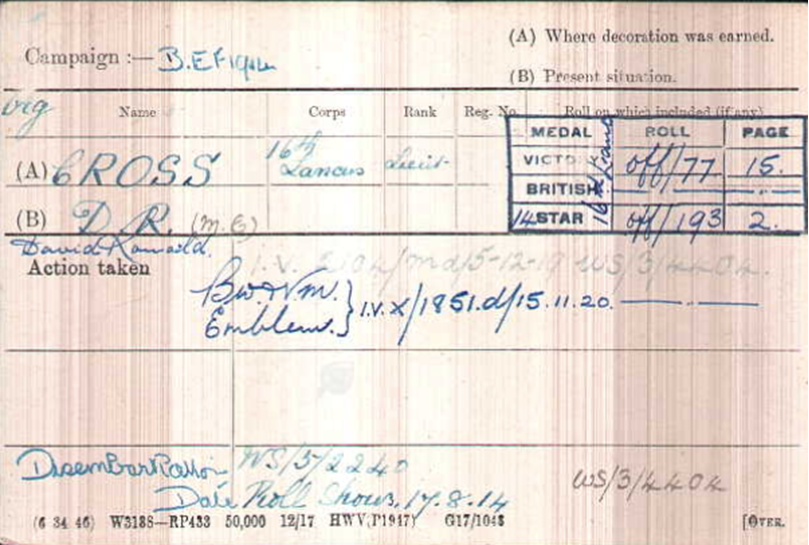
Lieutenant Cross, MC was killed in action near Ypres. Colonel Henry Graham, in his 'History of the Sixteenth, The Queens, Light Dragoons (Lancers)' describes the immediate events on the 21st.
"At 6 a.m. on the 21st one mine was fired, followed immediately afterwards by the other two, with the result that the [British] trench was completely destroyed. The enemy followed this up with a strong attack on the trenches on each side of that held by D Squadron. There was of course much confusion and a hand to hand combat, in which the enemy was finally driven back by A Squadron and the reserve troop of D with a machine gun. A counter-attack was made by the three reserve troops. They were unable to regain the lost trench, and a request for help was sent to two companies of French Infantry which were in support of the left section of the trench, but these refused to move without orders from orders from their own commanding officer, and when he came up he was unfortunately killed while giving the order to advance, No further attack was made until 9 a.m., when the line was reinforced by a squadron of the 20th Hussars and another Company of French infantry from the supporting line. The French were stopped at once by the heavy fire they were met with, all their officers and half their men being shot down in a few minutes. The 2Oth got a little further when they were brought up by an enfilade fire and the attack was broken off. No further attempt was made to regain the lost trench, but a new one was dug in rear of it.
This was the worst day which the 16th had during the whole of the war. When the roll was called it was found that Major Neave, Captain Nash, Lieuts. Beech, King and Cross, and seven men were killed, and Lieut. Patrick and 29 men wounded. Tn addition Lieut. Ryan and 11 men were missing, in all seven officers and 47 other ranks killed, wounded and missing."
David has no known grave and is commemorated on the Menin Gate Memorial.
Lieut. David Ronald Cross M.C. 16th (The Queen’s) Lancers