
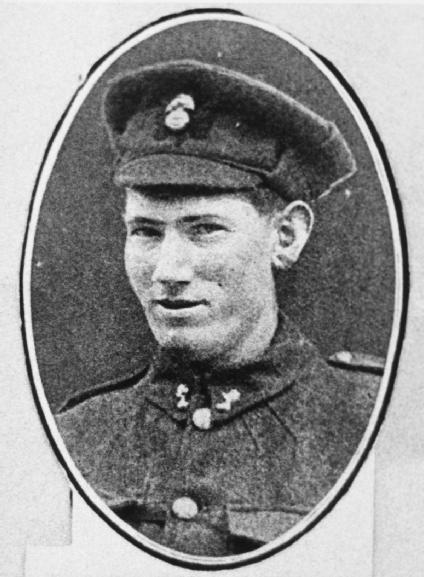
Cpl W Cosgrove VC
Early on 25 April 1915 the collier SS River Clyde ran ashore on V Beach, Cape Helles, carrying 2,000 troops who were to support the initial landings. The 1st Munster Fusiliers were amongst the first soldiers to attempt the assault on the Turkish positions and 70 per cent of the three companies who charged out from the River Clyde became casualties. Those who had succeeded in making it ashore were sheltered from the raking machine-gun fire behind an 8ft-high sandy bank, 10 yards from the shoreline. The way forward was barred, 25 yards on by belts of barbed wire entanglements in front of which lay the bodies of five Munsters who had been cut down by the intense Turkish fire. The exhausted survivors held their positions throughout the rest of the day and night and amongst them was Cpl. William Cosgrove, a 6ft 6in,16 stone giant of a man. On the following day a further attack was organised and Captain G B Stoney, the military landing officer, collected together various officerless parties who were to advance on the left of the village of Sedd el Bahr in support of an attack on the right being led by Lt-Col Doughty-Wylie. Leading the assault would be a party of Munsters who had been ordered to cut a way through the wire. Cosgrove, who was in this group, later described the wire entanglements which, ‘ran in every direction and were fixed to stout posts that were more than my own height'.
At about 1.30 the attack was launched and as Cosgrove again described, ‘Our job was to dash ahead, face the trenches bristling with rifles and machine-guns, and destroy the wire entanglements. Fifty men were detailed for the work ... but as we made the dash - oh such a storm of lead was directed on us, for the Turks knew our intention. Our Sergeant-Major was killed, I then took charge ... from the village came a terrible fire to swell the murderous hail of bullets from the trenches. The dash was quite 100 yards .... some of us got close up to the wire and we started to cut it with pliers....the wire was of great strength, strained as tight as a fiddle string, and so full of spikes or thorns you could not get the cutters between. A moment later I threw the pliers from me. "Pull them up", I roared, "put your arms round them and pull them out of the ground". I dashed at the first one, heaved and strained, and then it came into my hands. I could not tell how many I pulled up. I did my best and the boys that were left with me were every bit as good as myself. A machine-gun sent some bullets into me and I was wounded before I reached the trench though I did not realise it‘.
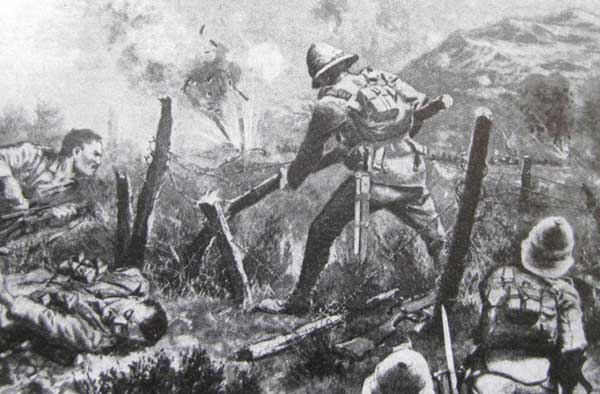
This extraordinary exploit in the face of what had seemed certain death was witnessed by many men, both onshore and on board the River Clyde. Referring to the courage of 'an Irish giant' the ship's surgeon, Burrowes Kelly, noted in his diary, 'The manner in which the man worked out in the open will never be forgotten by those who were fortunate to witness it'.
The wounded Cosgrove was sent to Malta Hospital where two operations were performed and later he returned to a camp in Ireland in order to recuperate.
His VC was gazetted on 23 August 1915 and, although he survived the rest of the war, he died in his mid forties in July 1936 as a result of the wounds he received during his heroic VC actions on the Gallipoli Peninsula.
Becoming a member of The Western Front Association (WFA) offers a wealth of resources and opportunities for those passionate about the history of the First World War. Here's just three of the benefits we offer:

Identify key words or phrases within back issues of our magazines, including Stand To!, Bulletin, Gun Fire, Fire Step and lots of others.

The WFA's YouTube channel features hundreds of videos of lectures given by experts on particular aspects of WW1.

Read post-WW1 era magazines, such as 'Twenty Years After', 'WW1 A Pictured History' and 'I Was There!' plus others.


