
India’s RAF Ace: Indra Lal Roy’s ten victories in 13 days
The history of the First World War is often told through the lens of vast European empires, but thousands of others travelled from elsewhere to join the fray. While over a million Indian soldiers served in the trenches and deserts of the Great War, only a fraction of them ever reached the cockpit of a fighter plane. Among this elite few was Indra Lal Roy, a young man from Bengal whose short but meteoric career would see him become India’s first flying ace. Born in Calcutta on 2 December 1898, Roy’s life was shaped by the global reach of the British Empire; his family moved to London in 1901, positioning him at the epicentre of a world about to be transformed by the invention of flight.
Roy was still a schoolboy at St Paul’s School in Hammersmith when the world descended into war in 1914. Like many of his peers, he was consumed by a desire to contribute to the effort, showing an early aptitude for the technical side of warfare by designing a trench mortar and submitting the plans to the War Office. Though his academic brilliance earned him a scholarship to Oxford, the quiet life of a scholar or the legal career of his father—a respected barrister—held no appeal. Roy was determined to join the Royal Flying Corps, even when his initial application was rejected due to defective eyesight. Demonstrating the tenacity that would later define his combat style, he sold his motorbike to pay for a private consultation with a leading eye specialist. Armed with a favourable second opinion, he successfully appealed the decision and was commissioned as an officer on 5 July 1917.
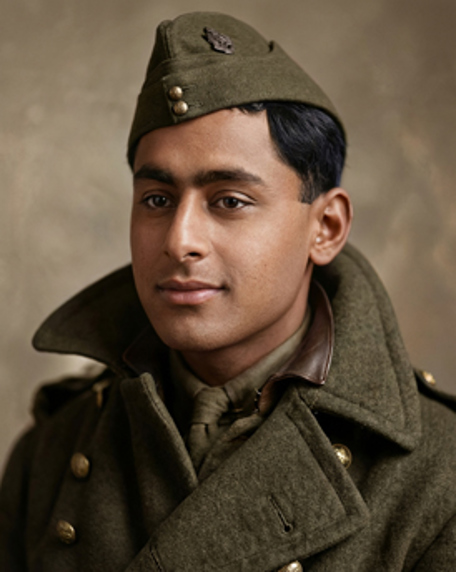
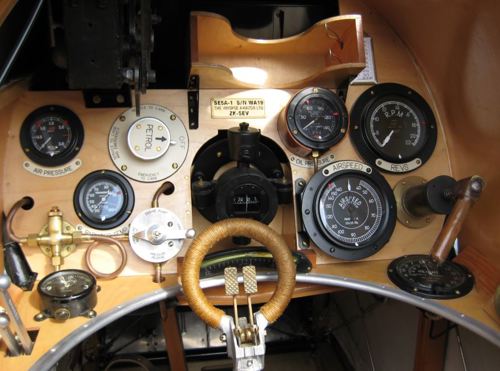
At just eighteen years old, Roy was posted to No. 56 Squadron, one of the most prestigious units in the British air service. He was tasked with mastering the Royal Aircraft Factory S.E.5a, a sophisticated scout plane capable of reaching speeds of 120 miles per hour. The aircraft was equipped with a synchronized Vickers machine gun that fired through the propeller and a Lewis gun mounted on the top wing.
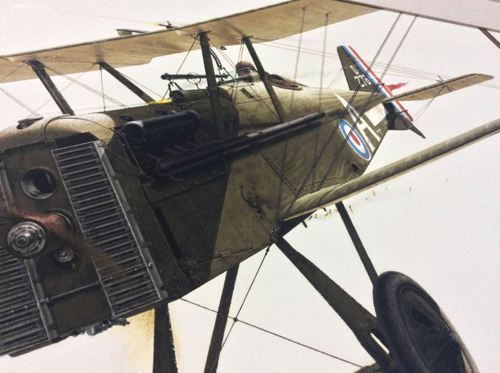
Unlike the notoriously temperamental Sopwith Camel, the S.E.5a was considered a stable and reliable platform, though no scout aircraft of the period could be flown without rigorous discipline and sound airmanship.
Indra Roy nearly lost his life on 6 December 1917, when he was shot down by a German scout over France. The crash was so violent that Roy was pulled from the wreckage unconscious and later declared dead by medical staff. He was moved to a hospital morgue and laid out among the fallen, only to shock the hospital staff hours later by regaining consciousness and frantically pounding on the door. After this literal return from the dead, he was sent to England to convalesce.
Even while grounded, his mind remained in the clouds; he filled notebooks with intricate technical drawings and sketches of aircraft. Despite being declared medically unfit for service, Roy spent months badgering his superiors for a return to the front. His persistence finally broke through their resistance in June 1918, when he joined the newly formed Royal Air Force as part of No. 40 Squadron.
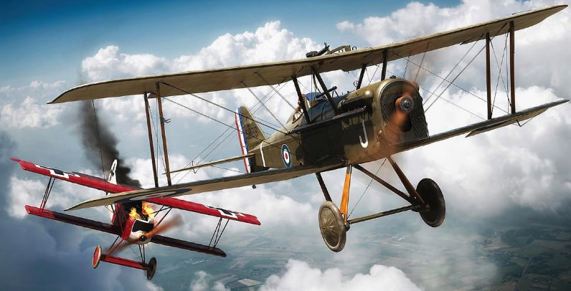
The pilot who returned to France was no longer a reckless teenager, but a focused and lethal hunter. In a staggering display of aerial prowess, Roy secured ten confirmed victories in a window of just over two weeks (just over 170 hours of flying time). His streak began on 6 July 1918, when he downed a German Hannover C. Two days later, he achieved the rare feat of destroying three enemy aircraft in a single morning, including two Hannover two-seaters and a Fokker D.VII—the finest fighter in the German arsenal. By 13 July, after shooting down a Pfalz D.III, he officially became a flying ace. He continued his relentless pace through mid-July, downing multiple Fokker D.VIIs and reconnaissance planes..
However, the high-altitude world of 1918 was a place of extreme attrition. On 22 July 1918, Roy’s flight of three S.E.5as was jumped by a formation of four Fokker D.VIIs near Carvin. In the swirling dogfight that followed, the British pilots managed to down two of their attackers, but Roy’s plane was struck and erupted in flames. He was killed when his aircraft hit the ground, ending his life at the age of nineteen.
He was buried by the Germans, who marked his grave with an inscription as shown below.
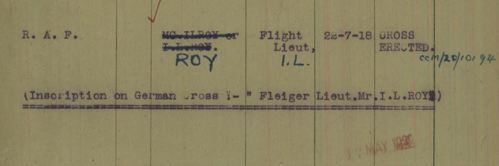
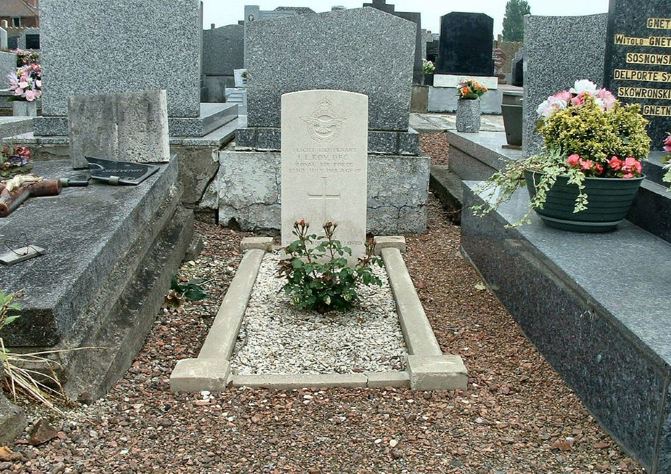
He was posthumously awarded the Distinguished Flying Cross, the first Indian to ever receive the honour. Today, he rests in the Estevelles Communal Cemetery in France.
Roy’s influence extended far beyond his own lifetime; his nephew, Subroto Mukerjee, would eventually serve as a pilot in the Second World War and rise to become the first Indian Chief of Air Staff, carrying the family’s aviation legacy into a new era of independence.
List of victories
| Date | Time | Unit | Aircraft | Opponent | Location | |
| 1 | 06-Jul-18 | 5.45 | 40 | S.E.5a (B180) | Hannover C (OOC) | Drocourt |
| 2 | 08-Jul-18 | 6.45 | 40 | S.E.5a (B180) | Hannover C (OOC) | Drocourt |
| 3 | 08-Jul-18 | 9.25 | 40 | S.E.5a (B180) | Hannover C (OOC) 1 | E of Monchy |
| 4 | 08-Jul-18 | 10.25 | 40 | S.E.5a (B180) | Fokker D.VII (OOC) | SE of Douai |
| 5 | 13-Jul-18 | 6.45 | 40 | S.E.5a (B180) | Hannover C (DES) 2 | W of Estaires |
| 6 | 13-Jul-18 | 20.05 | 40 | S.E.5a (B180) | Pfalz D.III (DES) | Vitry-Brebières |
| 7 | 15-Jul-18 | 20.05 | 40 | S.E.5a (B180) | Fokker D.VII (DES) | Hulloch |
| 8 | 15-Jul-18 | 20.05 | 40 | S.E.5a (B180) | Fokker D.VII (OOC) | Hulloch |
| 9 | 18-Jul-18 | 20.40 | 40 | S.E.5a (B180) | DFW. C (DES) | SE of Arras |
| 10 | 19-Jul-18 | 10.25 | 40 | S.E.5a (B180) | Hannover C (DES) | Cagnicourt |
Notes:
1. Shared with Capt George McElroy, Lt Gilbert Strange
2. Shared with Capt George McElroy, Lt Gilbert Strange, Lt F H Knobel
The above table is sourced from www.theaerodrome.com
Becoming a member of The Western Front Association (WFA) offers a wealth of resources and opportunities for those passionate about the history of the First World War. Here's just three of the benefits we offer:

With around 50 branches, there may be one near you. The branch meetings are open to all.

Utilise this tool to overlay historical trench maps with modern maps, enhancing battlefield research and exploration.

Receive four issues annually of this prestigious journal, featuring deeply researched articles, book reviews and historical analysis.
Other Articles


