
First World War soldiersʼ bottled messages found on Australian beach after 109 years
A chance discovery on a Western Australian beach has brought voices from the First World War back to life, as messages written by two Australian soldiers bound for the Western Front have been found more than a century after they were cast into the sea.
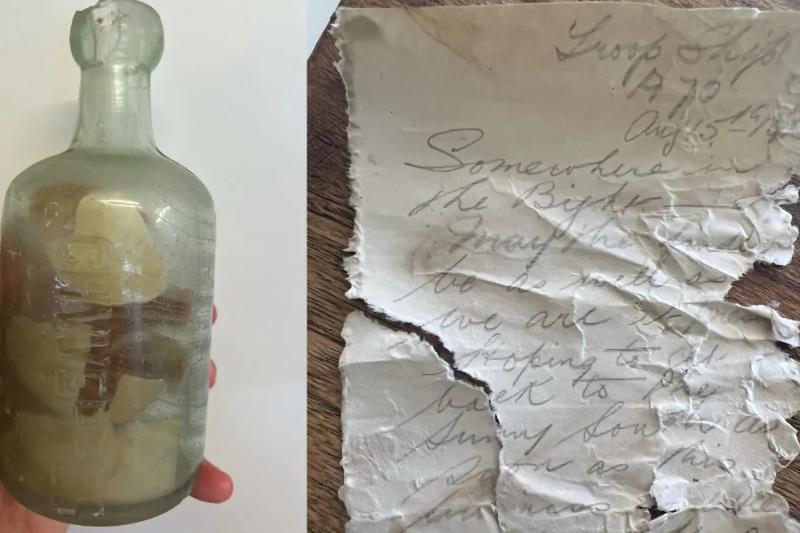
The Brown family discovered the Schweppes-brand bottle on 9 October whilst clearing rubbish from Wharton Beach near Esperance. Inside the clear glass bottle were two letters written in pencil by privates Malcolm Alexander Neville, 27, and William Kirk Harley, 37, dated 15 August 1916.
The soldiers had departed Adelaide aboard HMAT A70 Ballarat on 12 August 1916, bound for Europe where they would reinforce the 48th Australian Infantry Battalion on the Western Front. Just three days into their voyage, the two men penned their cheerful messages and cast them into the Great Australian Bight.
Private Neville wrote to his mother Robertina that he was “having a real good time, food is real good so far, with the exception of one meal which we buried at sea.” Despite the ship “heaving and rolling,” he assured her they were “as happy as Larry.” Harley, whose mother had already died by 1916, simply wrote “may the finder be as well as we are at present.”
The optimistic tone of these messages stands in stark contrast to the soldiersʼ fates. Private Neville was killed in action in France on 11 April 1917, less than a year after writing his letter. Harley was wounded twice but survived the war, returning to Adelaide where he died in 1934 of cancer his family believe was caused by German gas attacks in the trenches.
University of Western Australia oceanography professor Charitha Pattiaratchi believes the bottle likely washed ashore within weeks or a month of being thrown overboard, then remained buried in the sand dunes for over a century. Recent extensive erosion caused by huge swells along Wharton Beach probably dislodged it. The bottleʼs pristine condition and the legibility of the water-damaged but intact letters support this theory.
The discovery has profoundly affected both soldiersʼ families. Harleyʼs granddaughter Ann Turner described her family as “absolutely stunned,” saying “It really does feel like a miracle and we do very much feel like our grandfather has reached out for us from the grave.” Nevilleʼs great nephew Herbie Neville called the find “unbelievable,” noting how his great uncle “seemed pretty happy to go to the war. Itʼs just so sad what happened.”
The Brown family, who regularly patrol the beach clearing rubbish, have been able to trace and contact the descendants of both soldiers through social media. Deb Brown will keep the bottle and Nevilleʼs cover letter addressed to the finder.


