
Newly digitised and searchable: The Illustrated War News
As part of the desire of The Western Front Association's trustees to continually improve the offer we make to members, we are delighted to announce that a new feature has been launched which will add yet another very good reason to join The Western Front Association.
We have acquired, scanned and digitised the entire set of the weekly magazine 'The Illustrated War News'. These magazines are fully searchable by keyword. They can be accessed using the WFA's 'Searchable Magazine Archive' which is within the members' area of the website. Obviously you will need to 'log in' to the members area to locate these magazines.
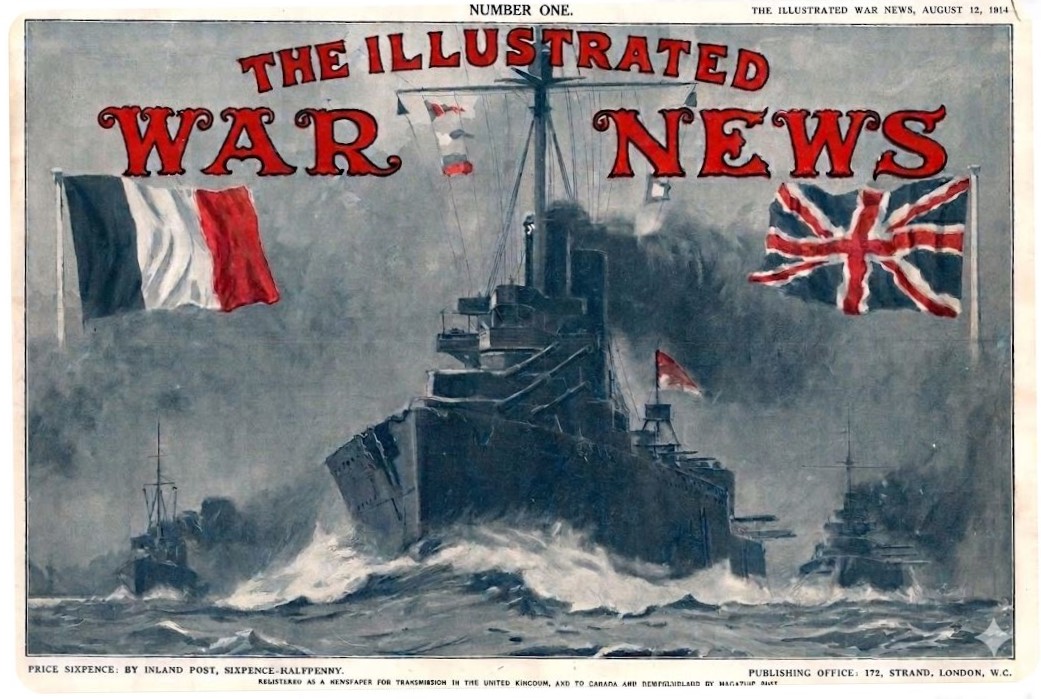
The History of The Illustrated War News
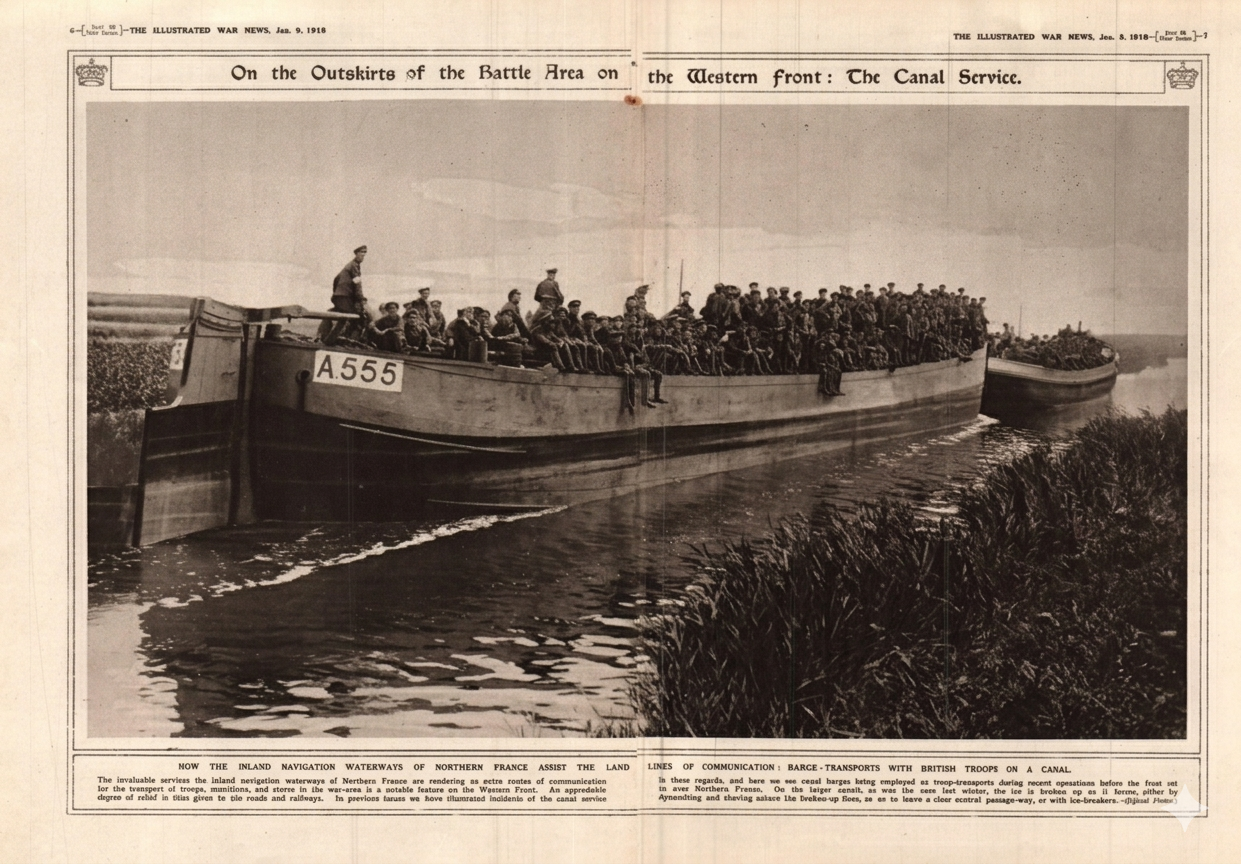
Each magazine comprised 48 pages (from 1916, this became 40 pages) of articles, photographs, diagrams and maps. It was published weekly between August 1914 and April 1918, and ran to 192 editions.
The magazine was very 'topical' in that it covered current news about the war, with a minimal 'time lag'. For instance, the Gallipoli landings of 25 April 1915 were covered in issue 39 (dated 5 May).
Short extract from example edition: Issue 39
In this edition (number 39 of volume 1), as well as a piece summarising what was known about the landings at that time, a photograph was published which shows captured Turks on a British warship.
The report in issue 39:
The East for the moment obscures the West
An Admiralty report
Allied forces have been landed both on the European and Asiatic sides of the Dardanelles. The particular task before our own men is the subjugation of the Gallipoli Peninsula, and to clear the defending troops from the difficult country and the forts that protect it, in conjunction with the gunfire of the Fleet.
Already we know officially that an army under Sir Ian Hamilton has landed on the toe of the peninsula, near Cape Tekeh and also near Eski Hissalik, and that that force, after establishing itself across from water to water, is already making some movement forward. The landing was accomplished with skill and courage in the face of an active resistance by the Turks, and over any amount of passive but unpleasant obstacles in the shape of submerged wire entanglements, deep pits with spikes at the bottom, and the like. A later and more detailed report from the Admiralty and War Office gives us some idea of the success of the disembarkation.
Troopships were concentrated about the end of the peninsula in the area first named, and also near Gaba Tepe. Landing was effected on several beaches, mainly with success, though at Sedd-ul-Bahr, there were difficulties. These overcome with great dash by our men, and landings were made good in the face of vigorous opposition.
The Australian and New Zealand troops did particularly well, showing the same spirit as their Colonial brothers the Canadians, landing and forcing their way forward with great gallantry in the Gaba Tepe district at Sari-bair, in the face of opposition.
The troops at the toe of the peninsula also advanced towards Krithia. Indeed, the success is palpable enough, and though the country over which our men must fight is made difficult by hills and ravines, and is heavily entrenched, it is certain that success will ultimately come to hand from this carefully planned and deliberate movement.
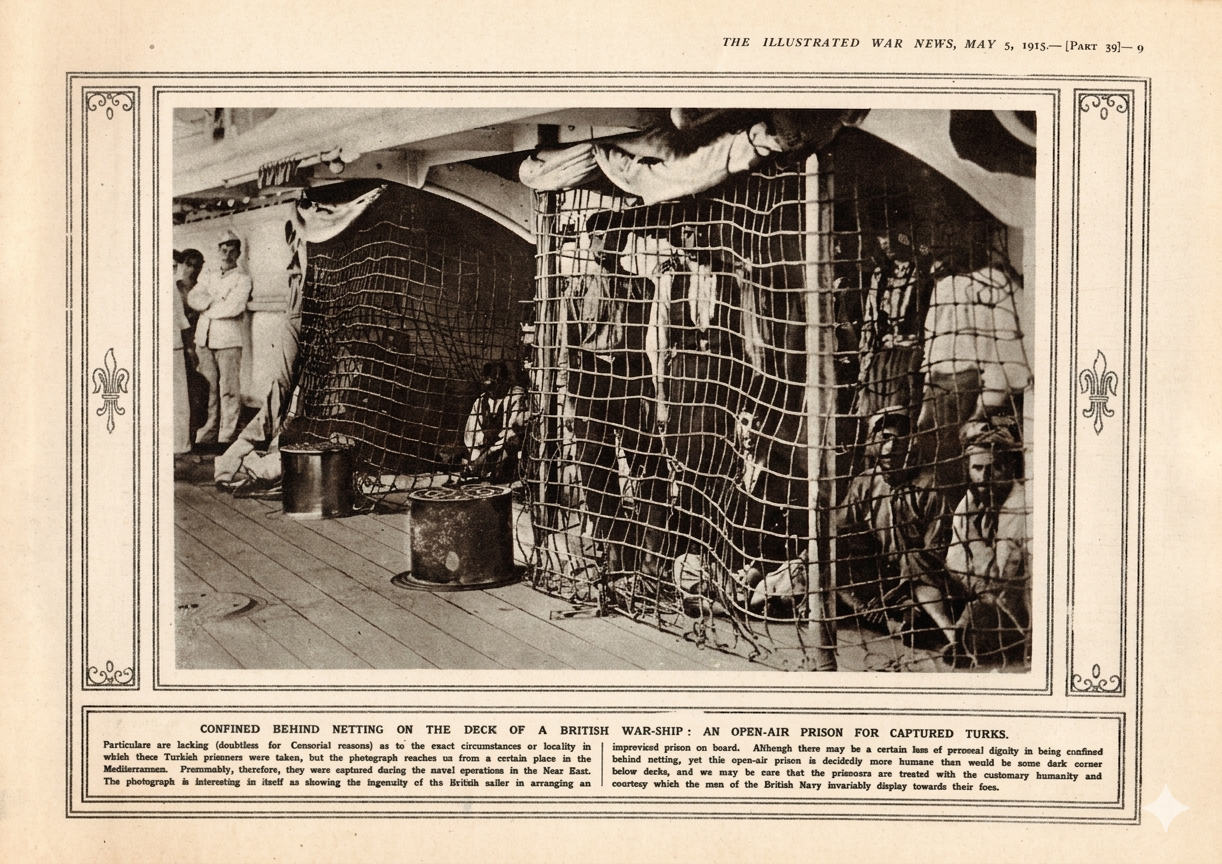
Caption to the above image
CONFINED BEHIND NETTING ON THE DECK OF A BRITISH WAR-SHIP: AN OPEN-AIR PRISON FOR CAPTURED TURKS.
Particulars are lacking (doubtless for Censorial reasons) as to the exact circumstances or locality in which these Turkish prisoners were taken, but the photograph reaches us from a certain place in the Mediterranean. Presumably, therefore, they were captured during the naval operations in the Near East.
The photograph is interesting in itself as showing the ingenuity of the British sailor in arranging an improvised prison on board. Although there may be a certain loss of personal dignity in being confined behind netting, yet this open-air prison is decidedly more humane than would be some dark corner below decks, and we may be sure that the prisoners are treated with the customary humanity and courtesy which the men of the British Navy invariably display towards their foes.
The wartime editions
Each weekly magazine initially cost 6d. (half a shilling), but during 1917 and 1918 the price increased to 9d. In today's money, this works out at between £2 and £2.50.
The first half of the magazine's production run (to 7 June 1916) came out in a horizontal (landscape) format, with a total of 96 editions published in this period.
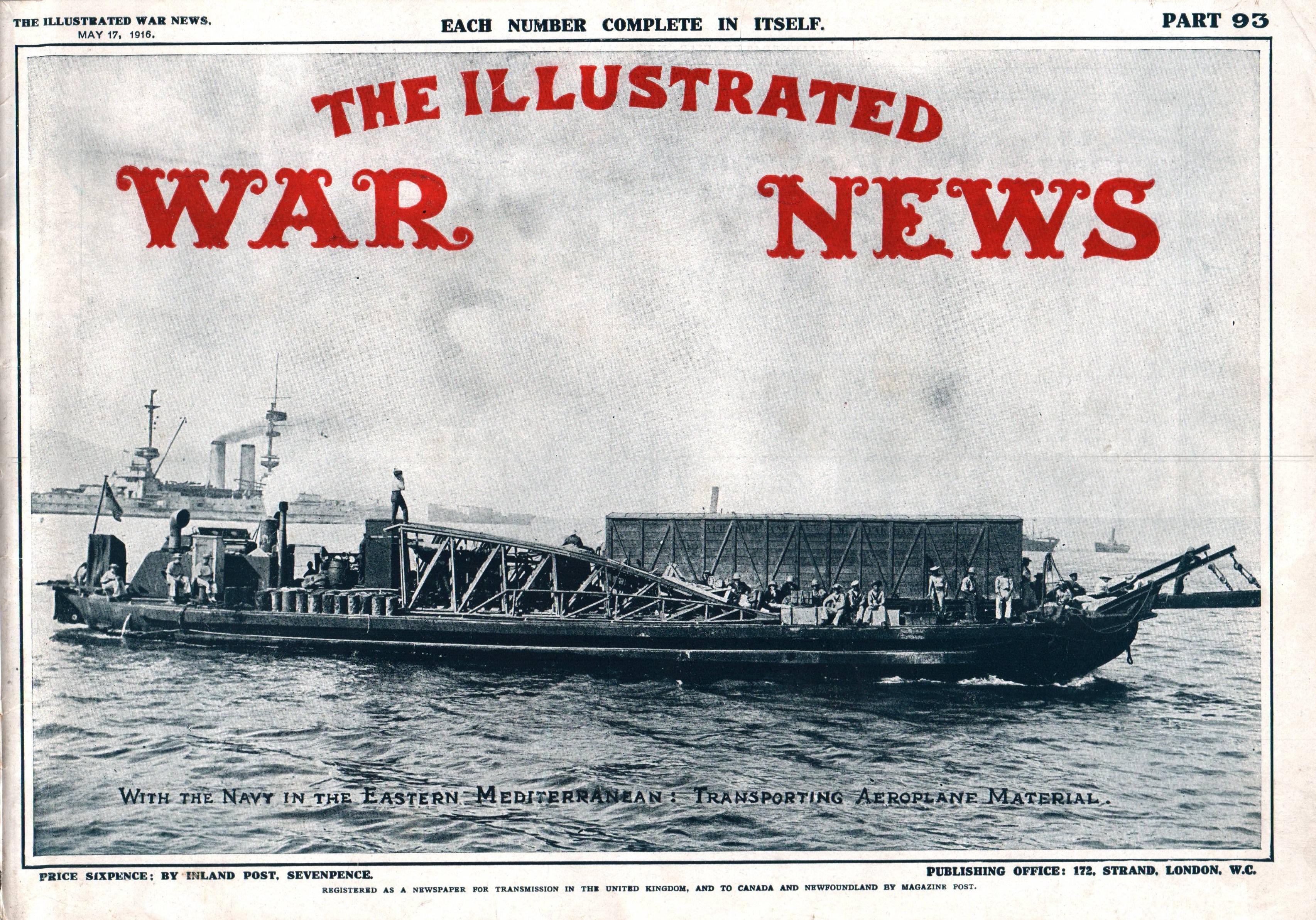
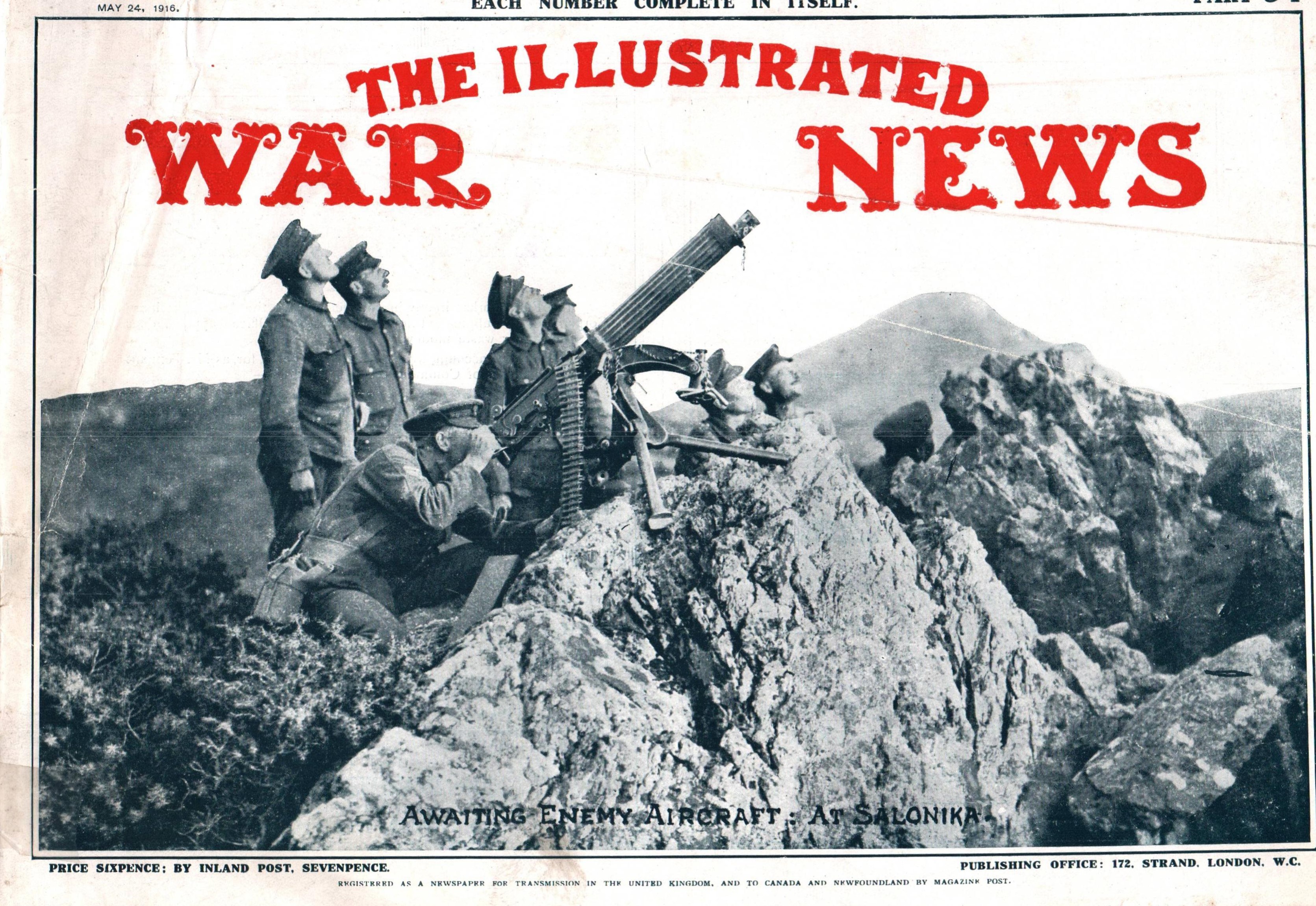
However, for reasons now unknown, on 14 June 1916, what would have been issue 97 was issued in a vertical (portrait) format. Confusingly, this vertical series re-commenced at issue number 1, and a further 96 editions were published in this format.
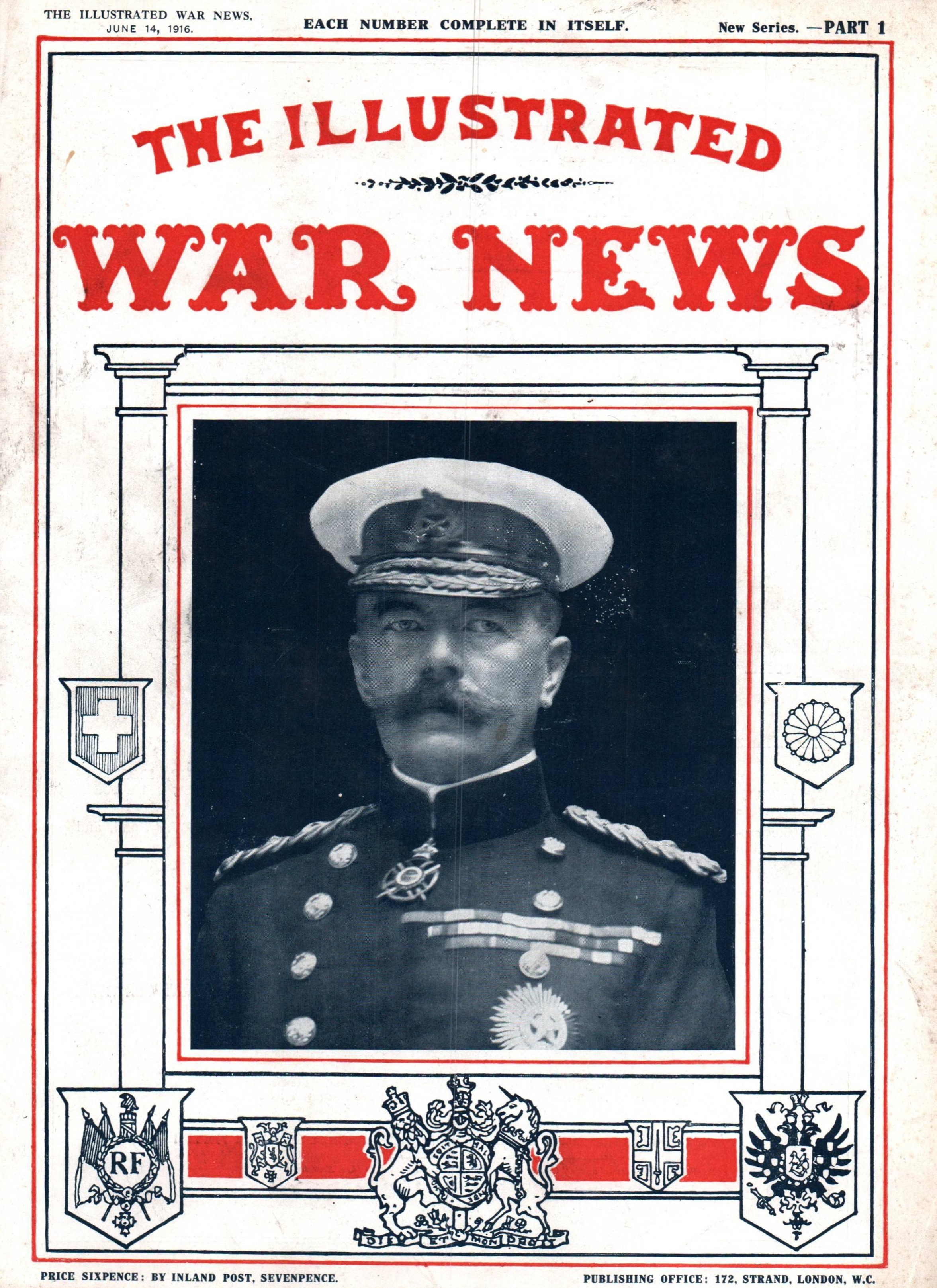
The last edition was dated 10 April 1918, when production ceased, (according to an editorial in this issue) due “to a serious shortage of paper”.
More about The Illustrated War News
The Illustrated War News was a war-time offshoot of The Illustrated London News, a publication which started in the 1840s. By 1900 it was owned and edited by Sir Bruce Ingram (1877-1963) who was a grandson of the ILN's founder. Ingram was Chairman of Illustrated London News and Sketch Ltd., Director of Illustrated Sporting and Dramatic News Ltd, and President of Illustrated Newspapers Ltd. He also served in the First World War, ultimately as a Captain in the Royal Garrison Artillery.
More about The WFA's 'Searchable Magazine Archive'
Using the Searchable Magazine Archive enables members to access tens of thousands of pages of content about the Great War across a dozen or so different publications.
Searching for words and phrases
It is possible (indeed recommended) to use the Searchable Magazine Archive to 'hunt out' material by using the 'search' function. Doing so, it is possible to locate and read matters that are of particular interest.
For example, searching for Baghdad you will find 64 instances of this word. Birdwood appears eight times and Gallipoli 230 times. But care needs to be exercised as typing the word Mons gives 319 results, but this includes 'Monster', 'Monsoon' and 'Commons' etc.- to find the town, you will need to use double inverted commas, (ie searching "Mons"): doing so will result in 66 hits.
Video help
Although originally created when we first developed the SMA, the following two videos may serve as useful reminders as to how to get the most out of the technology:
An overview of our new Searchable Magazine Archive > Video
A tour of the various buttons that you can use on our Searchable Magazine Archive > Video
Access The Western Front Association's Searchable Magazine Archive
To access all 192 editions of The Illustrated War News, simply log in to the members' area.
If you are not a member, please do join us.
Becoming a member of The Western Front Association (WFA) offers a wealth of resources and opportunities for those passionate about the history of the First World War. Here's just three of the benefits we offer:

Identify key words or phrases within back issues of our magazines, including Stand To!, Bulletin, Gun Fire, Fire Step and lots of others.

The WFA's YouTube channel features hundreds of videos of lectures given by experts on particular aspects of WW1.

Read post-WW1 era magazines, such as 'Twenty Years After', 'WW1 A Pictured History' and 'I Was There!' plus others.


