
Drawn on the Western Front: Paul Sarrut and the Indian Army
The first UK exhibition dedicated to the French artist Paul Sarrut has opened at the National Army Museum in Chelsea. Drawn on the Western Front: Paul Sarrut and the Indian Army brings together more than 50 original drawings and works on paper, many on public display for the first time in over a century. Entry is free.
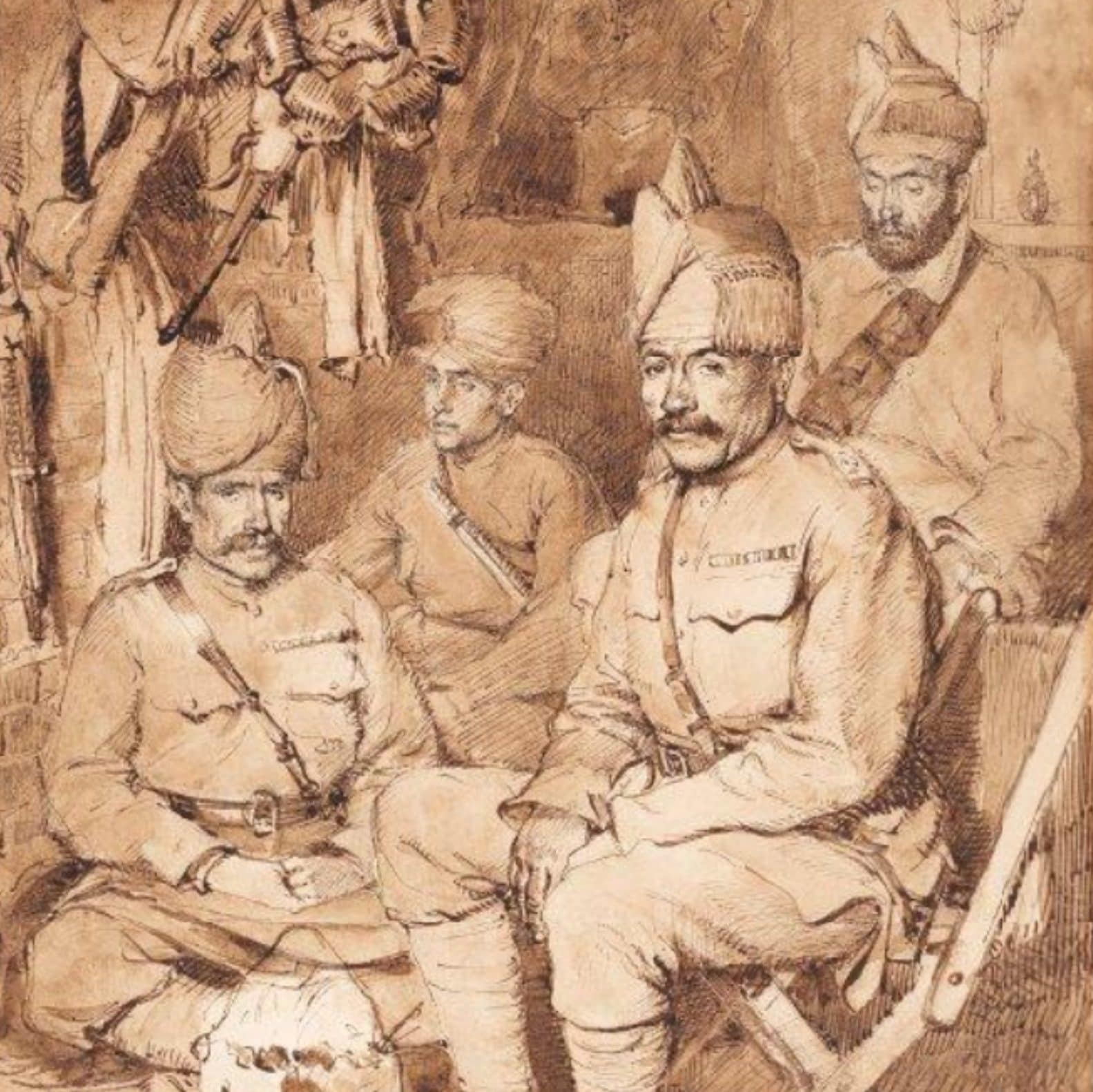
Sarrut was born in Grenoble in 1882 and trained at the École des Beaux-Arts in Paris. On the outbreak of war he joined the French army and was attached to the British Expeditionary Force as a liaison officer and interpreter, serving with British, French and Indian units. He lived among the men he drew, recording daily life at close quarters in camps, billets and medical stations.
The soldiers of the Indian Army left the deepest mark on his work. More than 140,000 Indian soldiers served on the Western Front, and Sarrut spent much of 1914 and 1915 with the 3rd (Lahore) Division. He was not an official war artist and worked to no brief. His sketches show men cutting hair, shoeing horses, reading newspapers and warming themselves around billet stoves – the ordinary hours between engagements that photographs and official art rarely captured.
Sepoy Harnam Singh
The best-known drawing in the exhibition is Sarrut’s portrait of Sepoy Harnam Singh of the 34th Sikh Pioneers, made at the camp at Cercottes on 7 November 1914, only weeks after his arrival in France. Sarrut noted on the sheet that Harnam Singh was a Tarkhan Sikh – a carpenter by trade. The portrait was reproduced in The Illustrated War News and as a postcard, and became one of the most familiar images of an Indian soldier of the Great War.
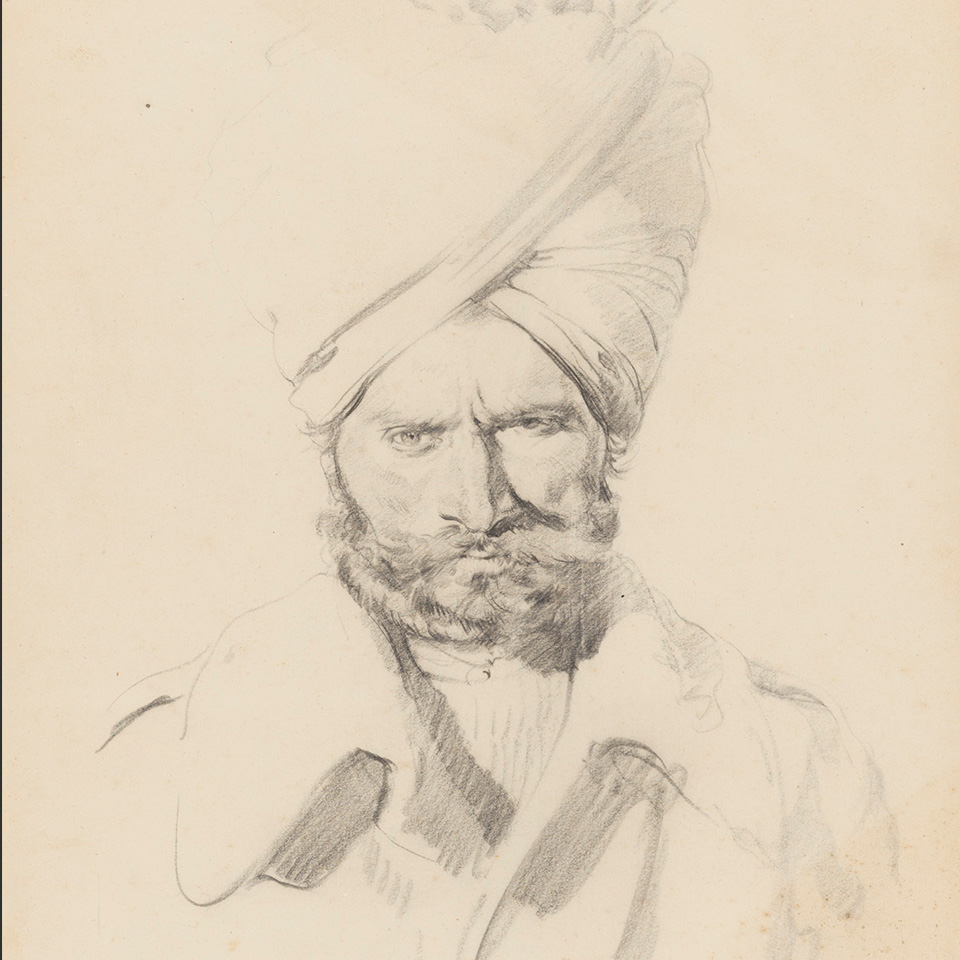
Harnam Singh did not live to see it published. He was killed in action on 24 November 1914, in the fighting that cost the 34th Sikh Pioneers dearly at Festubert. He has no known grave and is commemorated on the Neuve-Chapelle Memorial in the Pas-de-Calais.
WFA members can see the portrait as wartime readers first encountered it. The complete run of The Illustrated War News – all 192 issues published between August 1914 and April 1918 – is available to members through the WFA's Searchable Magazine Archive, and Sarrut's drawing of Harnam Singh appeared in the issue of 17 February 1915.
Beyond the drawings
The sketches are shown alongside uniforms, photographs, archives and medals. These include the Victoria Crosses awarded to Lieutenant Frank de Pass, the first Jewish recipient, and Sepoy Khudadad Khan, the first Muslim soldier and the first from the Indian subcontinent to receive the award. Visitors can also listen to extracts from the diary of Jemadar Kirpal Singh of the 34th Sikh Pioneers, read in Punjabi by his grandson, Dr Gurpreet Singh.
Visiting
The exhibition runs until 21 February 2027 in the Floor 2 gallery of the National Army Museum, Royal Hospital Road, Chelsea. Entry is free. Details at nam.ac.uk.
Latest news


