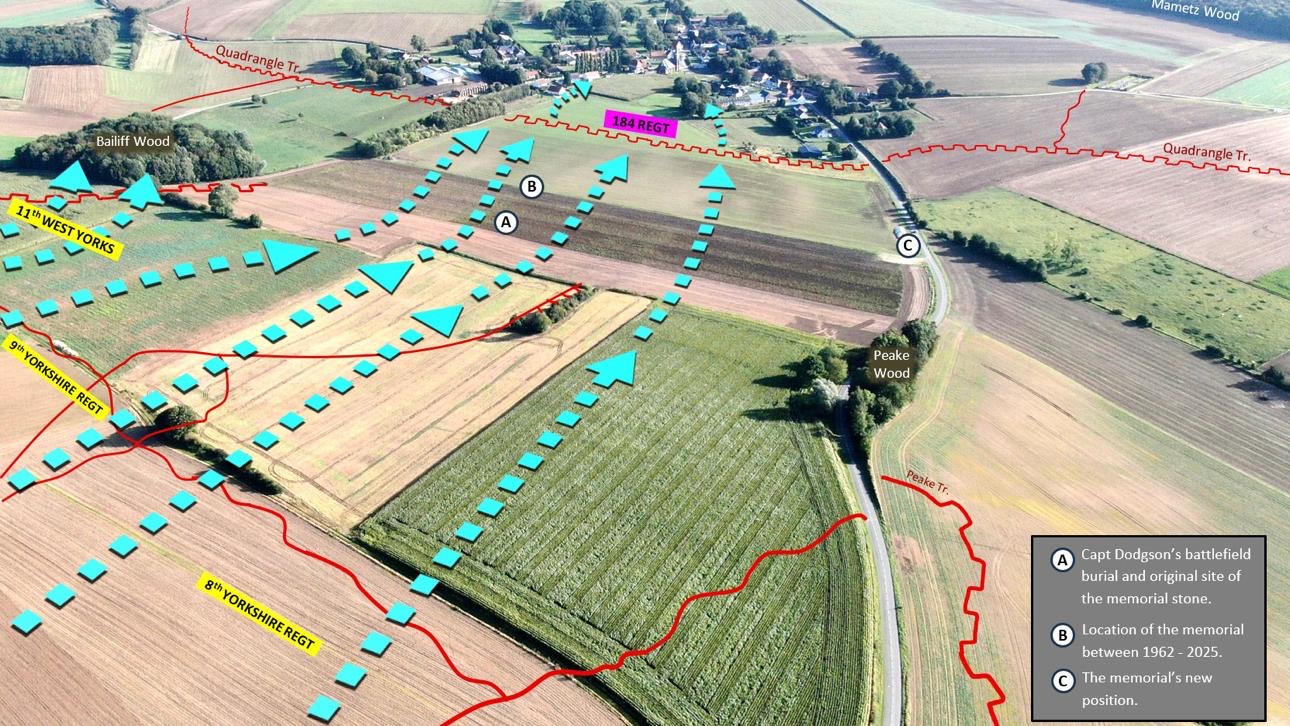
The Dodgson Memorial at Contalmaison: missing, found and now repositioned and rededicated
On the Somme battlefield, there are a number of 'private memorials', which were put up by grieving relatives within a few years of the end of the war. These have previously been listed and mapped by The Western Front Association.
One of these memorials commemorates Captain Francis Dodgson, of the 8th Battalion, Yorkshire Regiment (69 Infantry Brigade, 23rd Division) who fell in action just south of Contalmaison on 10 July 1916.
Francis Dodgson was a kinsman of Charles Dodgson, otherwise Lewis Carroll, who wrote "Alice in Wonderland".
'Toby' Dodgson
Francis (known to his family and friends as ‘Toby’) was born on 10 May 1889. He was one of three brothers; the others were Philip and Guy.
Rejected by the Military Academy at Woolwich because of insufficient eyesight, Toby studied at Cambridge. After graduating in 1911, he started as a clerk at the family stockbroking firm, Hope Dodgson.
In August 1914, the three brothers enlisted together with their two friends, Humphrey and Reggie Secretan. Toby was commissioned as 2nd Lieutenant into the Yorkshire Regiment (The Green Howards) and posted in the 8th Reserve Battalion. Philip joined the 7th London Brigade Royal Field Artillery as 2nd Lieutenant, while Guy became a junior officer in the Hertfordshire Regiment.
Toby was a somewhat reluctant soldier who had been badly affected by the death of his father (who had taken his own life), highlighted in a letter that he wrote to his fiancé Majorie in April 1915. He said that he had a wonderful, glorious day with her, adding that he could not believe that this time last year he was so unhappy and that he could scarcely believe it was true that he was so happy now. It is clear from Toby’s and Marjorie’s letters that their friendship quickly developed into a true love.
When the 69th Infantry Brigade received orders to embark for France in August 1915, Toby wrote a farewell letter to his mother.
‘As the future is so uncertain and one must of necessity run risks, I am writing these few lines before we leave England just in case the Fates decree that I should fall before the Hun. I write them to you, Mother dear, although I feel there is no need as I know you understand very well the sort of thing I would wish.’
He wrote that he would like Marjorie to have his books and ‘a certain amount of music’. He asked his mother to leave Marjorie a portion of the money that would come to him in case he would fall, because ‘she is one of the best’ and had ‘changed the aspect of everything for me’. He also wrote his mother that ‘It will depress me horribly if I see anyone wearing black!’
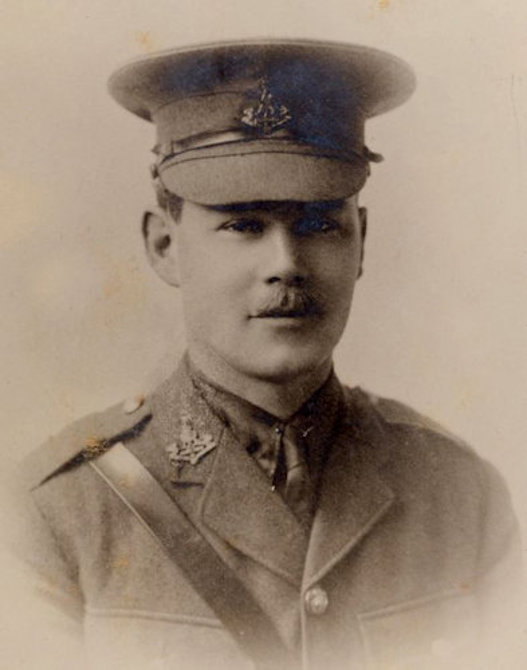
In September 1915 he wrote about the life in the trenches.
‘Just a line to let you know that we are in the trenches …. However, the Hun is not doing very much in these parts apparently and I think he is not keen on trying too much ‘strafe’. The worst part of this life is the lack of sleep, which is very trying’. He carried on by asking for a periscope and his canvas washing basin. Toby ended his letter by saying that ‘I am too sleepy to make much of an effort in the letter line, so excuse this scrawl and this perpetual demand for things’.
He bought an engagement ring for Majorie and when he was on his way back from his last leave, he wrote to Marjorie that, with or without the consent of her parents, they were to be married on his next leave. Sadly, that was never going to happen. Toby died on 10 July 1916 near Contalmaison.
Although Marjorie would marry another officer, she never forgot Toby and had his photograph hanging in her bedroom until her death.
Killed in Action
Captain Toby Dodgson was killed during the assault of Contalmaison on 10 July 1916, while leading B Company of the 8th Yorkshire battalion, which formed part of the 69th Infantry Brigade. The 8th Yorkshires suffered casualties from rifle and machine gun fire from the front and the left flank.
Toby was hit and seen to fall at about 5.00 pm at the foot of the slope of the valley, only 10 minutes after the attack had started. Private Angus later wrote
‘Captain Dodgson was leading and encouraging his men like an old veteran, but 100 yards from the goal he got hit in the head while leading his men over open ground’.
Toby was registered as 'missing believed killed' on the same day. In 1919, his mother visited France with her surviving son Philip, to pay her respects to her other sons, Toby and Guy.
Visit to the battlefield
They went to the spot where they had ought to find his cross. Although he had been reported missing, Philip had found Toby’s grave in September 1916. There was nothing to see, only a large newly dug patch of earth. Wishing to keep his grave where it was, Toby's mother had told the 'Graves Commission' earlier that she did not want him moved and hoped to buy the piece of ground. She was shocked to find the grave now gone and already transferred to the nearest cemetery. However, they could not find the grave there, only a heap of crosses thrown on the ground, with Toby’s name amongst them. The workers at the depot told them that they had dug on the spot and found nothing. His cross was to be put up in the cemetery as a memorial with those of others who had not been found.
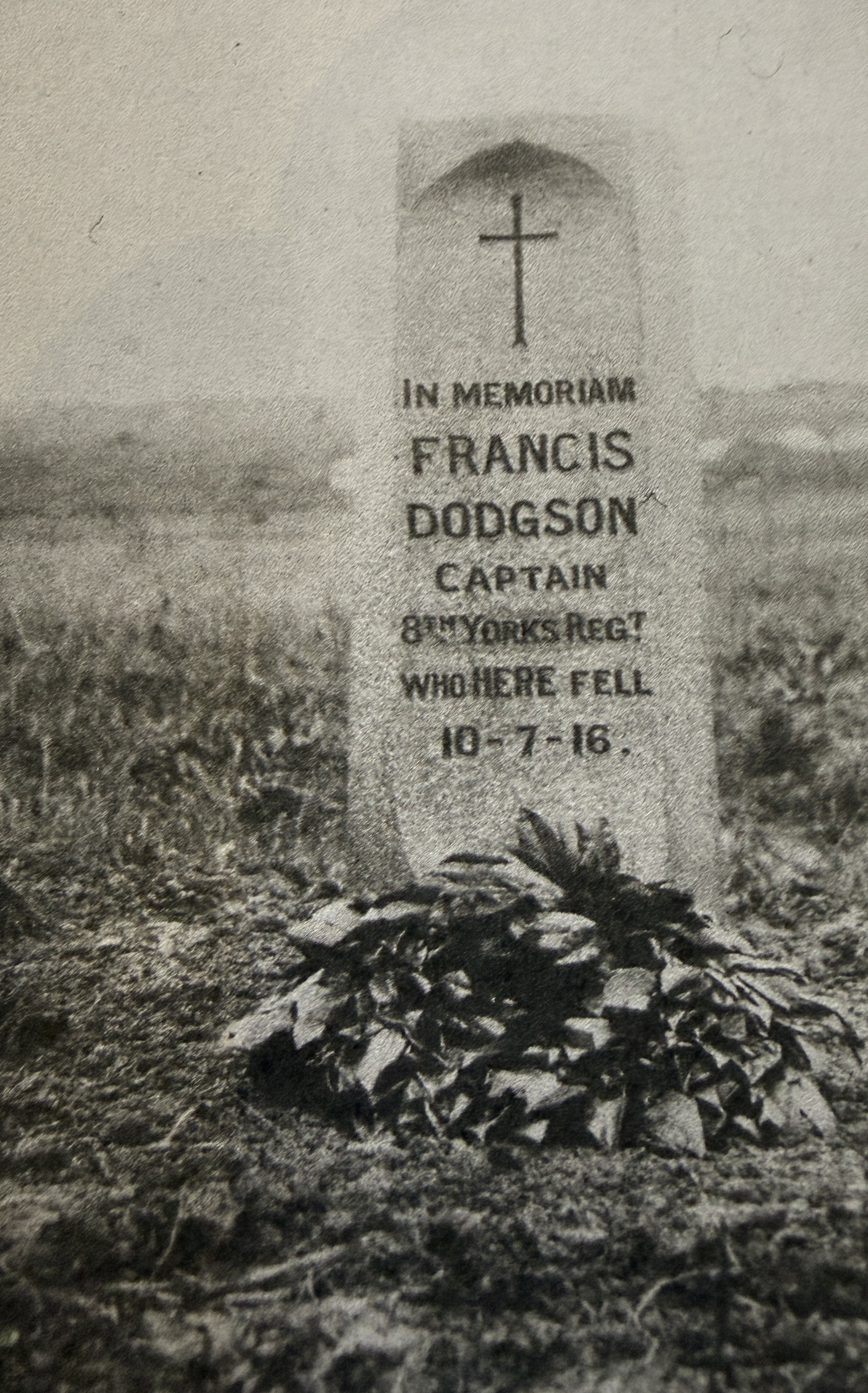
Toby’s mother and Philip were relieved that the workers had found no body. They knew that Toby was not buried exactly where the cross had been, but in the shell hole nearby. They did not tell this to the officer who had informed them, but went directly to a stonemason at Amiens, secretly knowing that Toby was still lying in his original location. They found a granite post which had come from a ruined building in Albert, had one side flattened to take an inscription and put it on the spot where Toby had fallen. Toby’s name was listed on the memorial of Thiepval since he was officially registered as still missing.
Body identified
In 1928, however, Toby's body was found and identified. He was buried in Serre Road Cemetery No. 2. The memorial remained where it was until 1962, when the field was broken up into smaller plots. To save it from possible damage, it was moved some 90 yards to the east, beside the track to Bailiff Wood.
Memorial goes missing in 2024
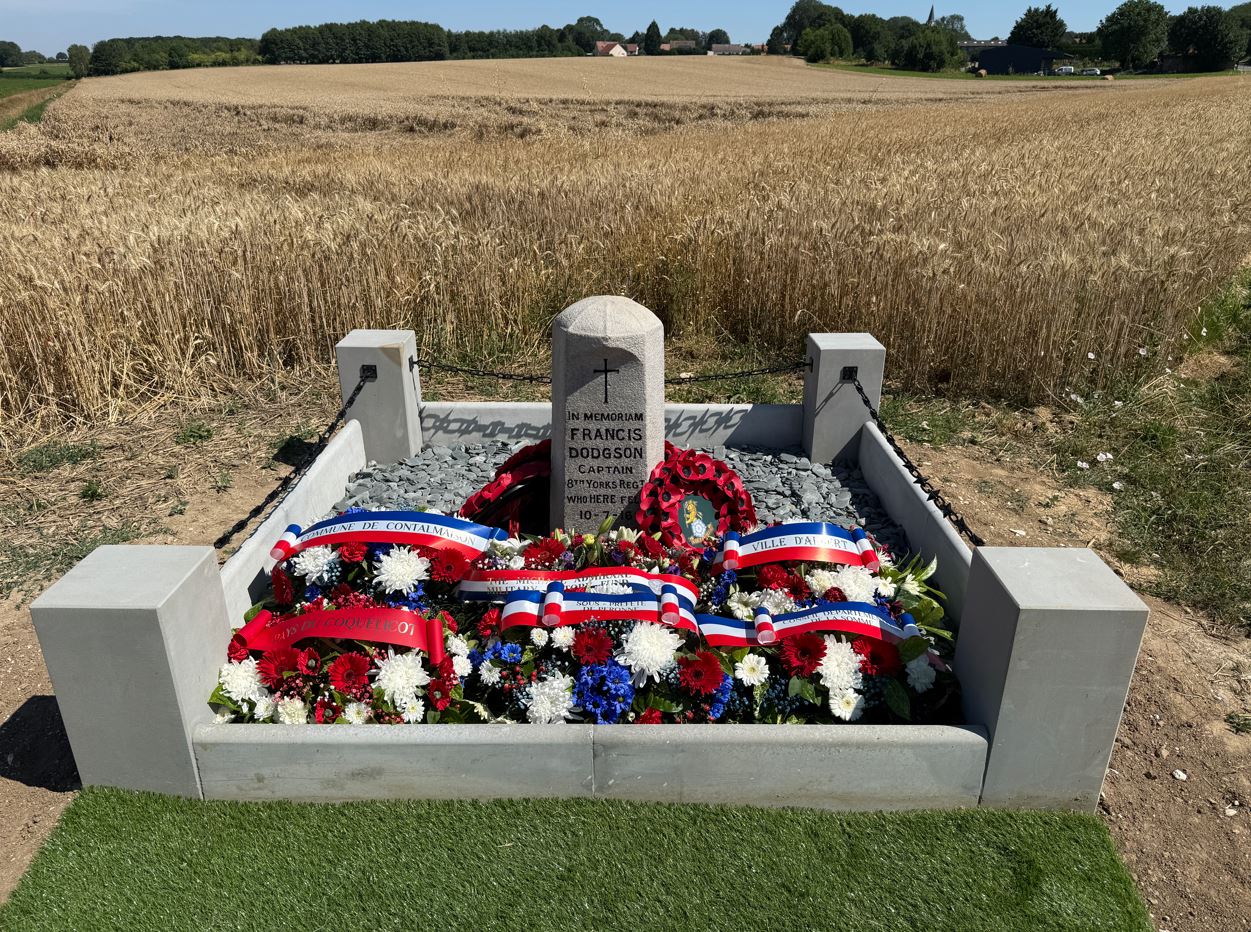
In 2024, the stone suddenly disappeared, but was recovered in 2025. In 2026, the stone was restored and transferred to the present location (which is less than 100 yards from the previous position) by the Michael Admiraal Military History Fund, with the help of Terry Berry of the Western Front Services Ltd.
Jocelyne Gougeon, mayor of Contalmaison, helped to restore the memorial and organise a ceremony, assisted by Céline Jasiak, director of the Tourist Office Pays du Coquelicot. This took place on 10 July 2026 - the 110th anniversary of Toby's death.
The story of the attack of the 8/Yorkshires
The plan was that two battalions of the 69th Infantry Brigade would assault Contalmaison on the 10th of July 1916 at 4.50 pm, with the 9th Yorkshires on the left and the 8th Yorkshires on the right. Just that morning, the soldiers had made their final preparations before going into battle. They had their last chance to write home and Toby sent a field postcard. The advance would start from Horseshoe Trench, some 1,200 yards west of the German positions.
The artillery barrages started at 4.00 pm and at 4.30 pm the 11th West Yorkshires attacked Bailiff Wood to secure the left flank of the main attack. This assault formation consisted of four waves per company, to be followed by waves of searching and consolidating parties. Toby had taken a position on the left flank of the 8th Yorkshires. At first, they took few casualties.
As the advance continued, the 9th Yorkshires came under heavy German artillery fire, but were nevertheless able to occupy the German first line trench, the Kaisergraben. The 8th Yorkshires, however, came under even heavier fire when descending the slope of the valley, about halfway Contalmaison. They suffered several casualties from rifle and machine gun fire. Toby was hit in the head and seen to fall at about 5.00 pm at the foot of the slope of the valley, only 10 minutes after the attack had started.
During the last part of the advance, between the Kaisergraben and the garden hedges surrounding the outskirts of the village, the 8th Yorkshires suffered terrible casualties. In only a few moments, 4 officers and 100 other ranks were hit, reducing the effective strength of the 8th Yorkshires to 5 officers and 150 men. Nevertheless, both battalions were able to secure the village and consolidate their positions, while withstanding several German counterattacks. As a result, 260 enemy men, 8 officers and 6 machine guns with ammunition were captured.
According to the British Official History, the casualties suffered by the 69th Infantry Brigade were heavy, but not excessive considering the importance of the operation. 39 officers and 816 other ranks were killed, wounded and missing, roughly half of the attacking force. The 8th Yorkshires lost 12 officers and 347 other ranks, including Toby.