
At the going down of the sun. Where do these words come from?
"They shall grow not old, as we that are left grow old.
Age shall not weary them, nor the years condemn.
At the going down of the sun and in the morning
We will remember them".
These very famous words are just a part of a poem by Laurence Binyon that he called The Fallen. It was first published in the Times newspaper on 21 September 1914. As this was very early in the war, it was written as a reaction to the high casualty rates of the British Expeditionary Force at Mons and Le Cateau, but the four famous lines have now taken an existence of their own that apply to all war casualties:
British poet and scholar, Laurence Robert Binyon was born in Lancaster on 10 August 1869. He was educated at Trinity College, Oxford and won the Newdigate Prize for his poem "Persephone" whilst there. After university he worked as a curator in the Oriental Department of the British Museum. Too old to join the BEF, he went to the Western Front as a Red Cross medical orderly and returned to the British Museum after the war. After his retirement in 1933, he was appointed Norton Professor of Poetry at Harvard University followed by the appointment as Byron Professor of English Literature at Athens University. In his lifetime, he wrote numerous works on Far Eastern Art, several plays, a translation of Divine Comedy by Dante and the first part of an Arthurian trilogy called The Madness of Merlin, the latter only published in 1947 after he had died.
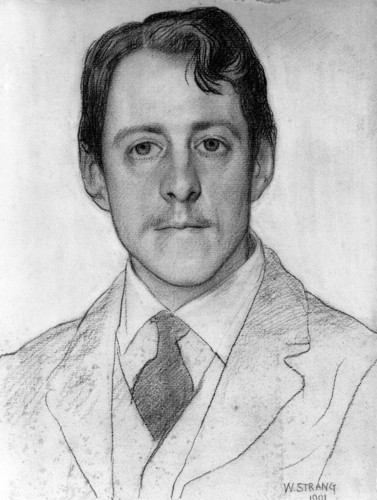
He died on 10 March 1943 and is buried at Saint Mary's Church, Aldworth, Berkshire.
For The Fallen
With proud thanksgiving, a mother for her children,
England mourns for her dead across the sea.
Flesh of her flesh they were, spirit of spirit,
Fallen in the cause of the free.
Solemn the drums thrill: Death august and royal
Sings sorrow up into immortal spheres.
There is music in the midst of desolation
And a glory that shines upon our tears.
They went with songs to the battle, they were young,
Straight of limb, true of eye, steady and aglow.
They were staunch to the end against odds uncounted,
They fell with their faces to the foe.
They shall grow not old, as we that are left grow old;
Age shall not weary them, nor the years condemn.
At the going down of the sun and in the morning
We will remember them.
They mingle not with laughing comrades again;
They sit no more at familiar tables of home;
They have no lot in our labour of the day-time;
They sleep beyond England's foam.
But where our desires are and our hopes profound,
Felt as a well-spring that is hidden from sight,
To the innermost heart of their own land they are known
As the stars are known to the Night;
As the stars that shall be bright when we are dust,
Moving in marches upon the heavenly plain,
As the stars that are starry in the time of our darkness,
To the end, to the end, they remain.
Laurence Robert Binyon, 1869-1943
Becoming a member of The Western Front Association (WFA) offers a wealth of resources and opportunities for those passionate about the history of the First World War. Here's just three of the benefits we offer:

The WFA regularly makes available webinars which can be viewed 'live' from home. These feature expert speakers talking about a particular aspect of the Great War.

Featured on The WFA's YouTube channel are modern day re-interpretations of the inter-war magazine 'I Was There!' which recount the memories of soldiers who 'were there'.

Explore over 8 million digitized pension records, Medal Index Cards and Ministry of Pension Documents, preserved by the WFA.


