
The Bangalore Torpedo
It is quite remarkable that research into weapons used on the Western Front in the Great War almost inexorably leads back to the Siege of Port Arthur in the Russo-Japanese War of 1904-05. Here the conditions so closely paralleled the trench warfare of the Western Front that almost all the same tactical problems arose. They were then forgotten until the reality of the eruption in late 1914 of widespread trench-warfare forced their reconsideration. One such, was the problem of the clearance of extensive barbed wire defences.
The Siege of Port Arthur certainly illustrated the problem that the infantry met when they encountered concentrated barbed wire defences of a depth of 18 feet, or more. There were five possible solutions to the problem. One, blow up the wire with shellfire. Two, drag the wire away with grappling hooks. Three, cut gaps through the wire by hand using wire cutters, axes or specially adapted rifles. Four, throw some sort of pathway over the top of the wire. Or, Five, destroy the wire with direct application of explosive charges. Shell-fire was shown to be largely ineffective as the explosions merely threw the barbed wired coils into the air, only to have them fall back to earth in even more tangled and impenetrable masses; later on in the war, the introduction of armoured barbed wire made it even more difficult to destroy. Dragging the wire away by hand, when it was properly anchored, was almost impossible. Clearance could be achieved with large caterpillar vehicles, but their presence was a 'turkey shoot' for even the most inexperienced of artillery gunners. Cutting with wire cutters, or especially adapted rifles, was efficient but took a lot of time and made discovery by the enemy, and retaliation, almost certain. Throwing a ladder-like pathway over the wire was hazardous in itself, as the infantrymen had to be standing up to do it. But to cross the wire on the pathway was even more hazardous, as the profile of the soldier struggling across the pathway was even higher. Removal by contact explosive was the only really viable option, but that required specially tailored explosive charges.
Genesis of Bangalore torpedo
In 1907, learning from the Port Arthur experience, Indian Army Engineers, stationed at Madras (The Bengal, Bombay and Madras Sappers), experimented at the army barracks in Bangalore on the possible ways of destroying belts of barbed wire defences. After a series of practical trials, they developed a methodology which was both highly efficient and of relatively low risk for the infantryman. It was called, The Bangalore Torpedo. (Bangalore is a city in Karnataka State in southern India and, during the period of the Raj, was an important base for the Indian Army).
The device the Indian sappers developed comprised of a long narrow tube, 2.5 inches in diameter and 6.5 feet long, with a wooden pointed head at one end, and at the other a wooden firing handle with fuse and a safety pin. Both the head and firing handle could be readily removed and additional 6.5 foot sections could be added to make the required length of explosive charge. The tube containing the explosive was made of light tin sheeting so that any splinters that did survive the explosion could not travel far and endanger the bomber. The approximate 12 pounds of explosive charge in the 6.5 feet tubes could be made up of dynamite sticks or gun cotton slabs. The loading of the tubes with the explosive charges could be done in the field. Also, as mentioned earlier, several 6.5 inch tubes could be joined together by means of sockets to make up the required length i.e. 13 feet, 19.5 feet, 26 feet, etc. To this tube, at one end, was attached the head - 8 inches long - and, at the other end, the 13 inches long firing handle, complete with the fuze and safety pin. No wiring between the tubes was required; the explosion of the first tube was activated by the firing device, and this explosion automatically set off all the other sections in series.
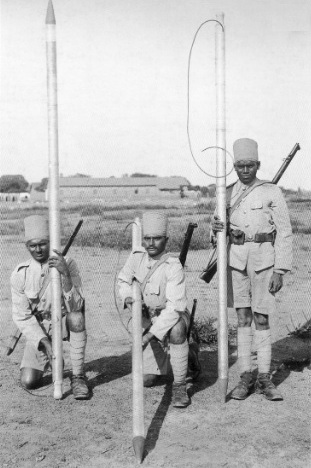
Contrary to what we usually see in motion pictures, the Bangalore Torpedo was not thrust under the base of the coiled barbed wire - in this event half the force would be absorbed by the ground - but rather threaded through the centre of the coiled barbed wire. In this way all the explosive force would be concentrated on the whole mass of the barbed wire barrier. The wooden head of the torpedo was pointed to facilitate its threading through the coils of barbed wire.
Conclusions
In determined and resolute hands, the Bangalore torpedo proved to be highly effective in creating the readily accessible breaks in the barbed wire defences that were essential for the rapid forward movement of the assault troops. But, where these breaks were too limited in width and depth, large numbers of men fell to the concentrated machine gun fire that the enemy deliberated focussed on these choke points.
In emergency situations, Bangalore torpedoes were fabricated in the war-zone workshops of the Royal Engineers from empty service tin cans previously used for biscuits, kerosene and the like. These homemade Bangalore Torpedoes proved to be efficacious if, perhaps, a little less predictable in performance.
Becoming a member of The Western Front Association (WFA) offers a wealth of resources and opportunities for those passionate about the history of the First World War. Here's just three of the benefits we offer:

The WFA regularly makes available webinars which can be viewed 'live' from home. These feature expert speakers talking about a particular aspect of the Great War.

Featured on The WFA's YouTube channel are modern day re-interpretations of the inter-war magazine 'I Was There!' which recount the memories of soldiers who 'were there'.

Explore over 8 million digitized pension records, Medal Index Cards and Ministry of Pension Documents, preserved by the WFA.


