
Allons! Sgt Clarence W Warren of the 15th Field Artillery
The doughboys of World War I have not gained the place in the popular imagination reserved for soldiers of the US Civil War and those of World War II. Their travails in the service of their country, the nature of the conflict and the stupendous effort exerted by the United States from 1917 to 1918 are perhaps overshadowed by these other two great conflicts. Whatever the flaws of the powers associated with the United States in the war, they were engaged in a struggle with enemies bent on the destruction of the French Republic and wide ranging territorial aggrandizement in Europe.
The American Expeditionary Force (AEF) helped to save Europe from hegemonic domination and helped put paid to three empires. Yet the doughboys are all but forgotten by their grandchildren and great-grandchildren, perhaps because the war was not "the war to end all wars." However, records and memorabilia that have escaped the ravages of time appear from time to time and reveal some aspects of the lives and heroism of US service members from so long ago. Sgt Clarence W Warren's records are such a case. [1]
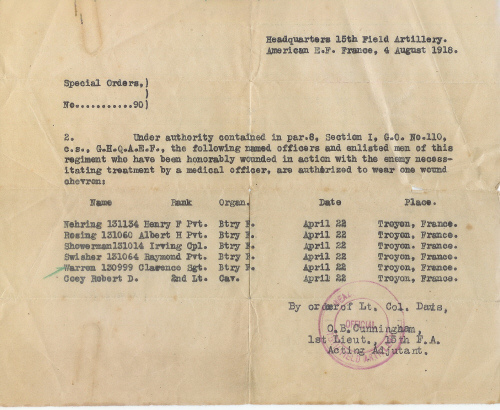
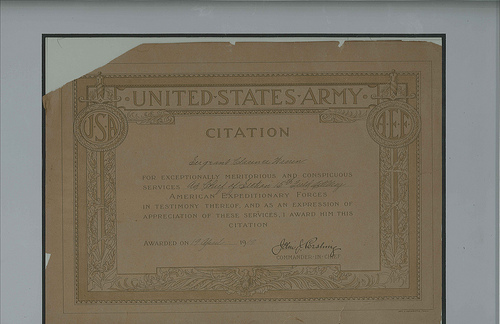
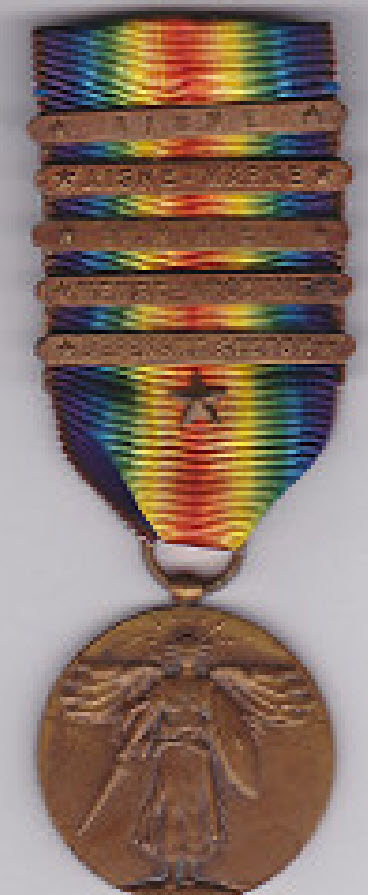
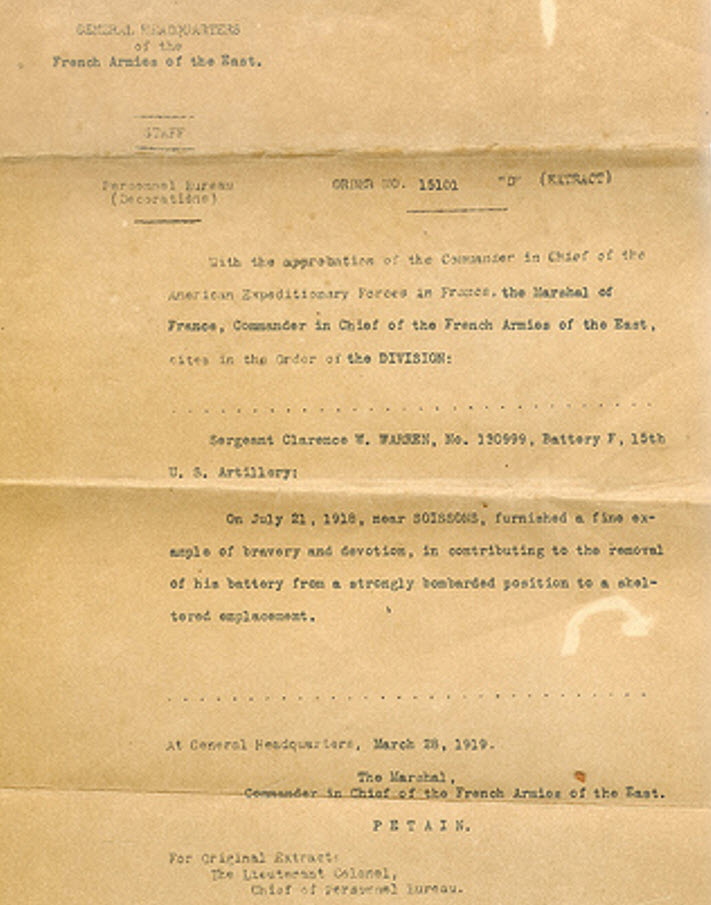
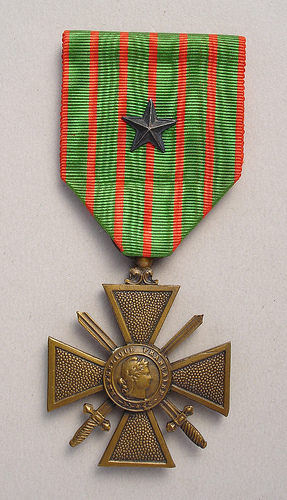
From his trove, hidden in a box for years, we can draw some conclusions. Warren lived in Pennsylvania and was probably a draftee. He became an artillerist and was assigned to Battery F, 2nd Battalion, 15th Field Artillery, 2nd Division. His extant official papers show he was wounded, decorated by the United States and by France, and ended the war as chief of section in his battery. His unofficial memorabilia indicate he was an athlete, wrote home, and while in Paris after the war, picked up and saved some pamphlets commemorating American service in France. He may have owned a camera and left many (regrettably unlabeled) photos of his service that do show some interesting details of the emergence of the shoulder sleeve insignia (SSI) in the US Army. And, he was sufficiently proud of his service to procure a Signal Corps photo depicting his battery in action at Belleau Wood.
Warren's records, at the National Personnel Records Center, were destroyed by fire. However he received a letter in 1955 addressed to him in Bradford, PA. A search of the county's draft registration records reveals that Clarence W Warren enrolled for the draft there.
After the armistice, American soldiers participated in a limited occupation of Germany. While the great mass of the Army was demobilized, this process took some time and Warren did not return home until 1919. To keep the soldiers' morale up the Associated Powers sponsored a huge athletic completion involving soldier-athletes from all the victorious armies. Warren's name appears on a broadsheet printed in Paris in 1919 for the games. He was on the US Track and Field Team. Two letters sent home at this time are addressed to his father. Warren also picked up and saved two European-printed pamphlets. One commemorated the service of the 2nd Division and the other is collection of doughboy art and poetry. [3]
Warren's photos show his fellow soldiers in the United States prior to going overseas.
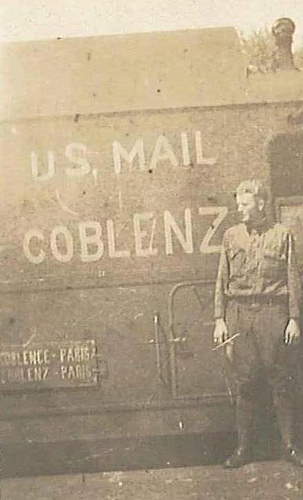
Others reveal they were taken in the Coblenz Bridgehead, the area of Germany occupied by the 2nd Division.
US World War I divisions were organized around four infantry regiments. The 2nd Division was unique in that two of its regiments were of the United States Marine Corps - the 5th and 6th Marines.
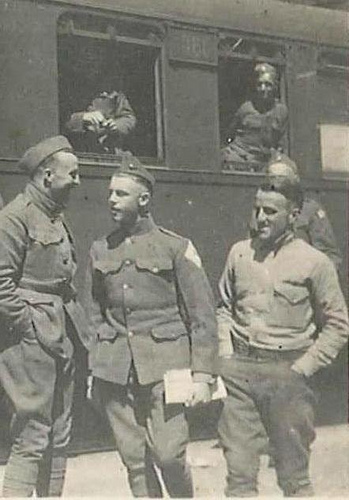
The photo above shows Marines of the division at a railroad station. The center standing figure is clearly wearing the diamond shaped patch of the 6th Marines. The Indian Head and Star insignia of the 2nd Division is embroidered on the patch's yellow field. SSI were not standardized in design as are their modern equivalents.
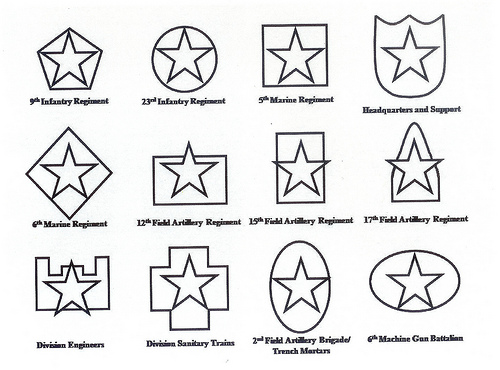
In the 2nd Division, each regiment or other troop organization had a distinctive shape as shown above. In addition, regimental battalions were designated by color: 1st battalion, red; 2nd battalion, yellow; 3rd battalion, blue.
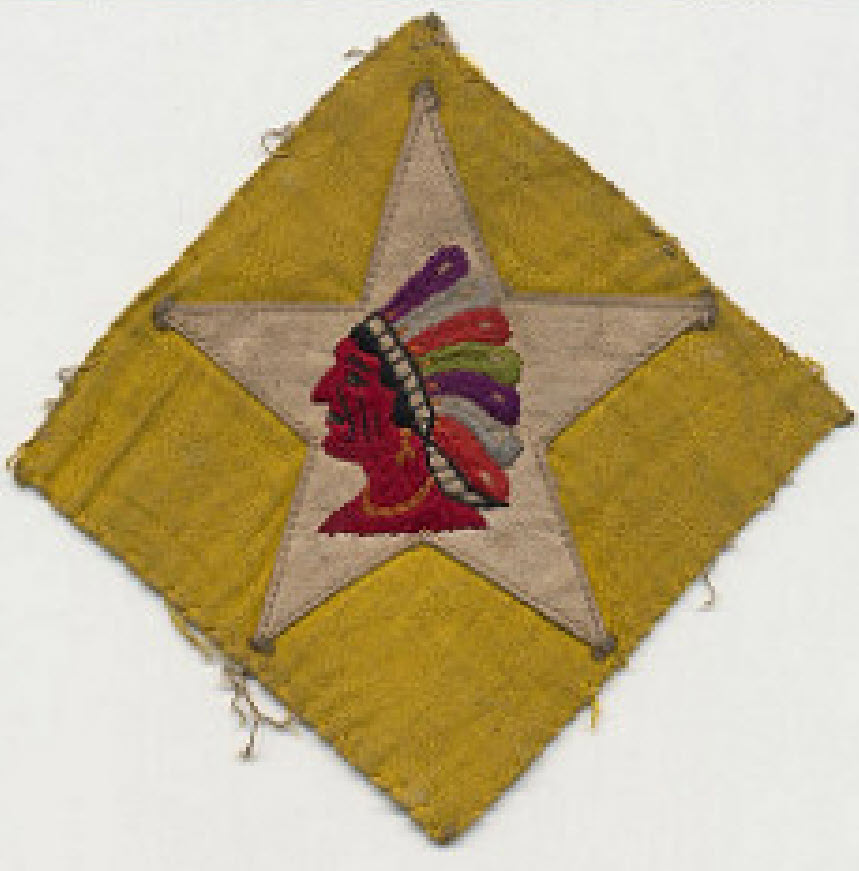
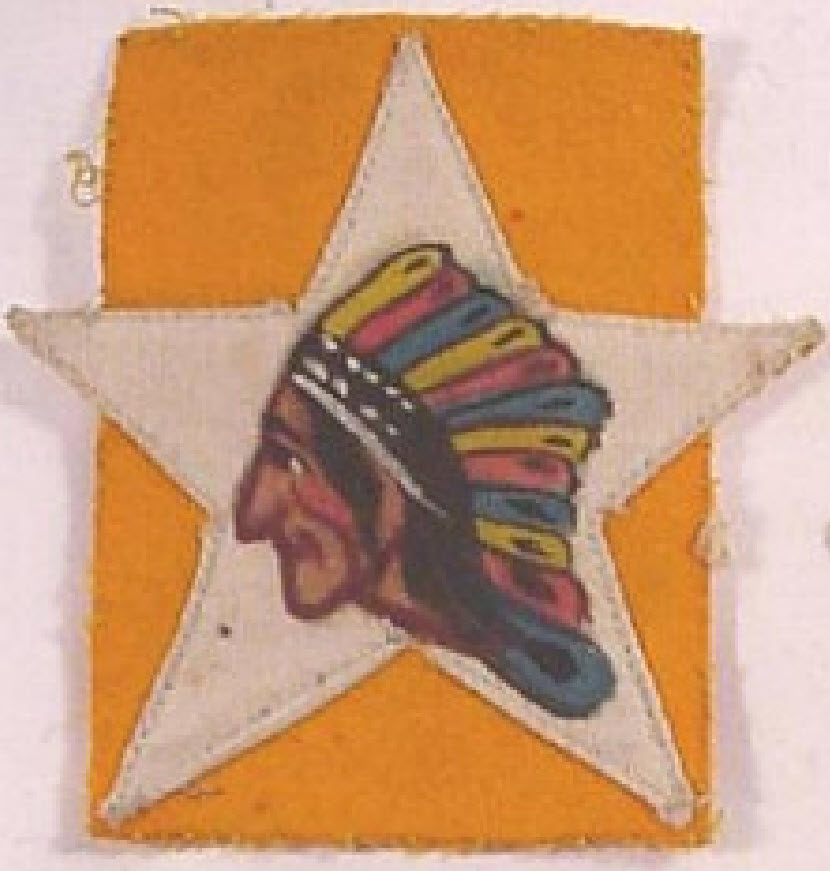
An example of the patch distinguishing the 2nd Battalion, 6th Marine. with a differing example of the distinguishing SSI of the 2nd Battalion, 15th Field Artillery, home of Warren‘s Battery F.
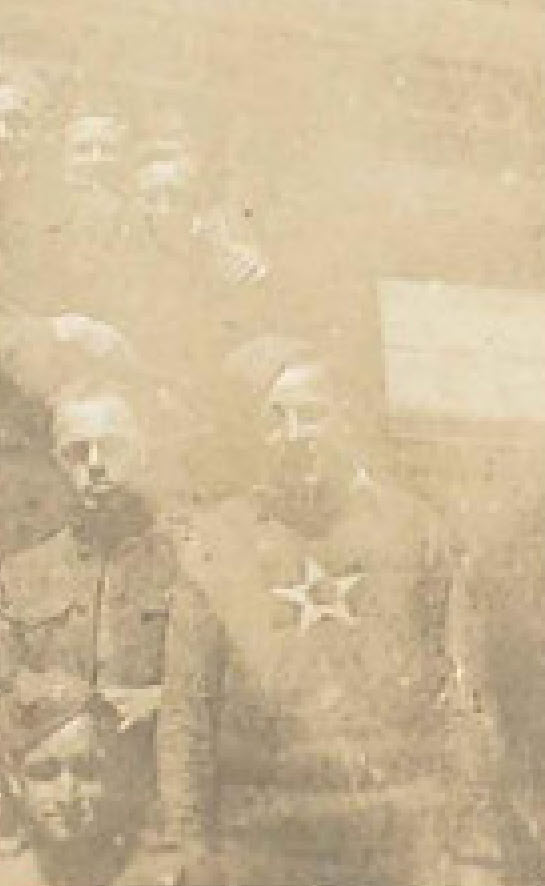
Another example of non-standard SSI wear is shown above. A Marine, standing on right, is wearing the divisional insignia on a sleeveless sweater.
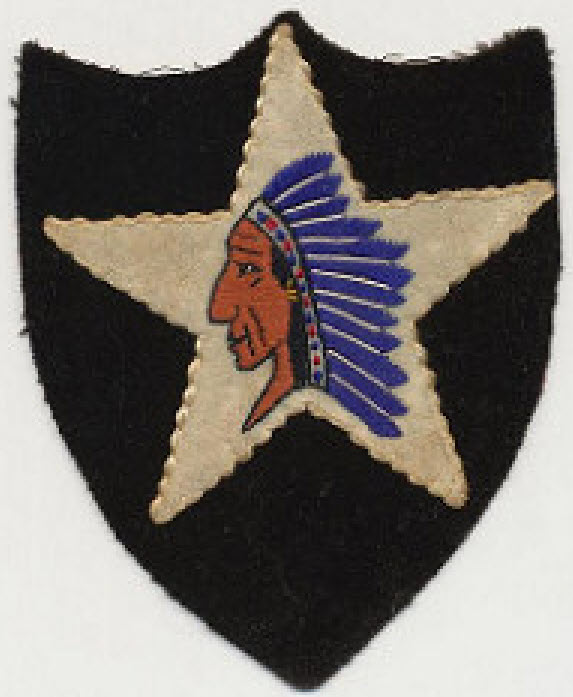
The SSI worn by the divisional troops. Note its resemblance to the modern SSI of the 2nd Division.
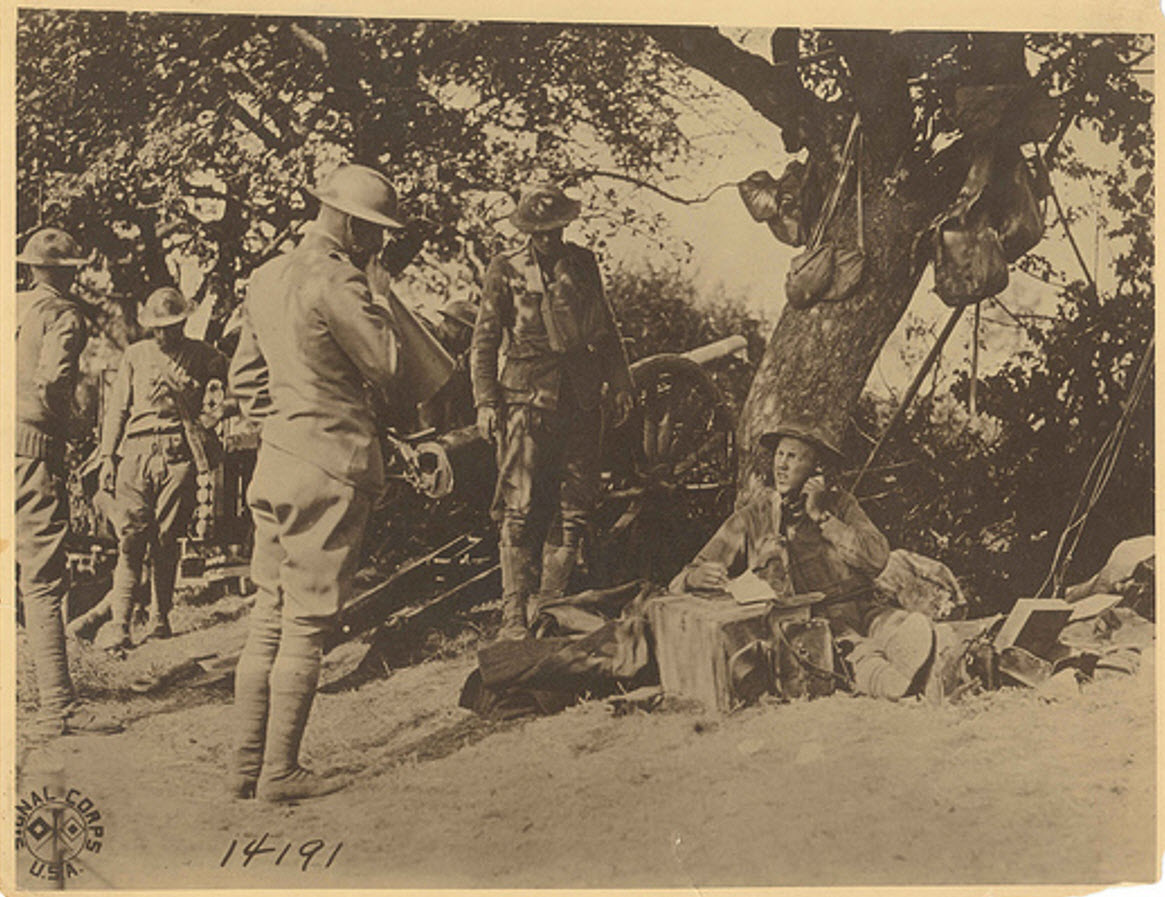
The above shows Signal Corps photo 14191, depicting Battery F, 2nd Battalion, 15th Field Artillery, in action during the Battle of Belleau Wood. Warren's name is written in a large hand on the reverse and may depict him in the field as part of the crew of a 75mm gun. This photo has been used as an illustration in the World War I section of a 15th Artillery website. [5]
The author expresses his gratitude for the assistance rendered by Past President and Company of Military Historians Fellow Lt Col William K Emerson, USA, (Ret), and Company member Col David Johnson.
References
1 World War I pitted the Allied Powers against the Central Powers. The U.S. fought on the side of the Allies but chose to "associate" with them to avoid being tied to the political structure of the peace; see John M. Lindley "Anglo-American Relations," The U.S. in the First World War, An Encyclopedia, Anne Cipriano Venzon, ed., (NY: Garland, 1995), 41. Germany was the arch-villain in the struggle. The most readily available treatment of German war aims is in Barbara W. Tuchman, The Guns of August (New York: Dell, 1963), 361.
2 Letter, Thomas R. Freaney to C. W. Warren 31 July 1955, Warren Papers, Author's Collection. Bradford, Pennsylvania, draft records available at the web site, Ancestry.com http://search.ancestry.com/cgi-bin/sse.dll?db=WW1draft&rank accessed 14 November 2010; Special Orders 90, 15th Field Artillery, 4 August 1918, Warren Papers, Author's Collection; U.S. Army Citation, Clarence W. Warren, 14 April 1919, Warren Papers, Author's Collection; Silver Star: E-mail William K. Emerson to author, 17 October 2010; Robert W. Wyllie, "The Romance of Military Insignia" and unsigned article, "American Decorations and Insignia of Honor and Service," National Geographic, 36, no. 6 (December 1919): 499 and 505; Croix de Guerre: Orders 15101, Headquarters, French Armies of the East, 28 March 1919, Warren Papers, Author's Collection.
3 Progamme, Inter-Allied Games, Sunday, 6 July 1919; Warren Papers, author's collection; Letter, "Red" to Dear Dad, Beaufort, Luxembourg, 26 November; Letter 1918, Warren Papers, author's collection; Letter, "Red" to Dear Father and All, Wallendorf, Germany, 26 January 1919, Warren Papers, author's collection; The Second Division, American Expeditionary Forces (Neuwied am Rhein, Germany, February, 1919), Warren Papers, author's collection; I Was There With The Yanks in France (Paris: The Lafayette Co., 1919), Warren Papers, author's collection.
4 Colours of battalion SSI, Organization and Insignia, 87.
5 Copy of Signal Corps Photo 14191, Warren Papers, author's collection. The picture may also be found at the web site http://www.landscaper.net/worldwar1.htm, accessed 17 November 2010.
Becoming a member of The Western Front Association (WFA) offers a wealth of resources and opportunities for those passionate about the history of the First World War. Here's just three of the benefits we offer:

The WFA regularly makes available webinars which can be viewed 'live' from home. These feature expert speakers talking about a particular aspect of the Great War.

Featured on The WFA's YouTube channel are modern day re-interpretations of the inter-war magazine 'I Was There!' which recount the memories of soldiers who 'were there'.

Explore over 8 million digitized pension records, Medal Index Cards and Ministry of Pension Documents, preserved by the WFA.


