
The 16th (Irish) Division and the Gas Attacks at Hulluch, April 1916
Before the Battle of the Somme...
The genesis of the 16th (Irish) Division lay in the formation of the Irish Volunteers before the war to undertake the defence of Home Rule for Ireland, if necessary, by force. When the war broke out they were urged by John Redmond, the leader of the Irish Parliamentary Party, to join the British army and fight in the defence of small nations, and, as a guarantee of the favourable implementation of Home Rule when the war was over. Many, but by no means all, responded positively to his appeal. About 24,000 Irish Volunteers (now calling themselves National Volunteers) enlisted. A total of 50,107 Irish men enlisted between August 1914 and February 1915. [1]
The 16th (Irish) Division had been formed with the new volunteers in September 1914 with its Headquarters in Dublin. But because 10th Division had priority in organising and first claim on accommodation and training areas, Headquarters of 16th Division was established at Mallow, Co. Cork.
The Division was a long time getting to the Front. Training was slow because of a shortage of weapons and equipment and because of difficulties in recruiting for the last Brigade (49th). [2]
Following months of training in Ireland, the Division left in September 1915 for a final three months of training at Blackdown near Aldershot in Surrey. Training was poor - it mainly consisted of route marching and limited target practice - and weapons were in short supply. After a Royal Inspection by Queen Mary on 2 December the 16th (Irish) Division, 47th and 48th Brigades (but not yet 49th Brigade - short of officers and behind in its training), arrived in France on 18 December. [3]
The early months of 1916 were spent preparing men for the ordeal of trench warfare. 16th Division’s first deployment was in the muddy trenches around Hulluch in the 1915 battlefield of Loos 4 The ‘Leichenfeld von Loos’, (the corpse field of Loos) as the Germans called it, had indeed proved a death trap for thousands of British soldiers. Rotting and rotted human remains were a common sight for the Irish soldiers new to the horrors of war. The Chaplain to 8th Battalion Irish Fusiliers, the famously courageous and greatly admired Father Willie Doyle, wrote in a letter home to his father: ‘Almost the first thing I saw was a human head torn from its trunk, though there was no sign of the body.’ (1 April 1916)
Warning of the impending attack
A German soldier who had deserted on the night of 23/24 April gave the first information about an impending gas attack. Aerial observation showed the presence of gas cylinders in the German trenches and swarms of rats invaded No-Man’s-Land as they tried to escape from gas leaks in the German trenches. [5]
Orders were given to reinforce the barbed wire, blankets soaked in ant-gas chemicals by Vermorel sprayers were placed over entrances to dug-outs and respirators were made ready. [6]
The available respirators were inefficient compared with later designs. They were flannel ‘PH Helmets’ (PH = Phenate Hexamine with which they were impregnated) and the soldiers had doubts about their effectiveness.
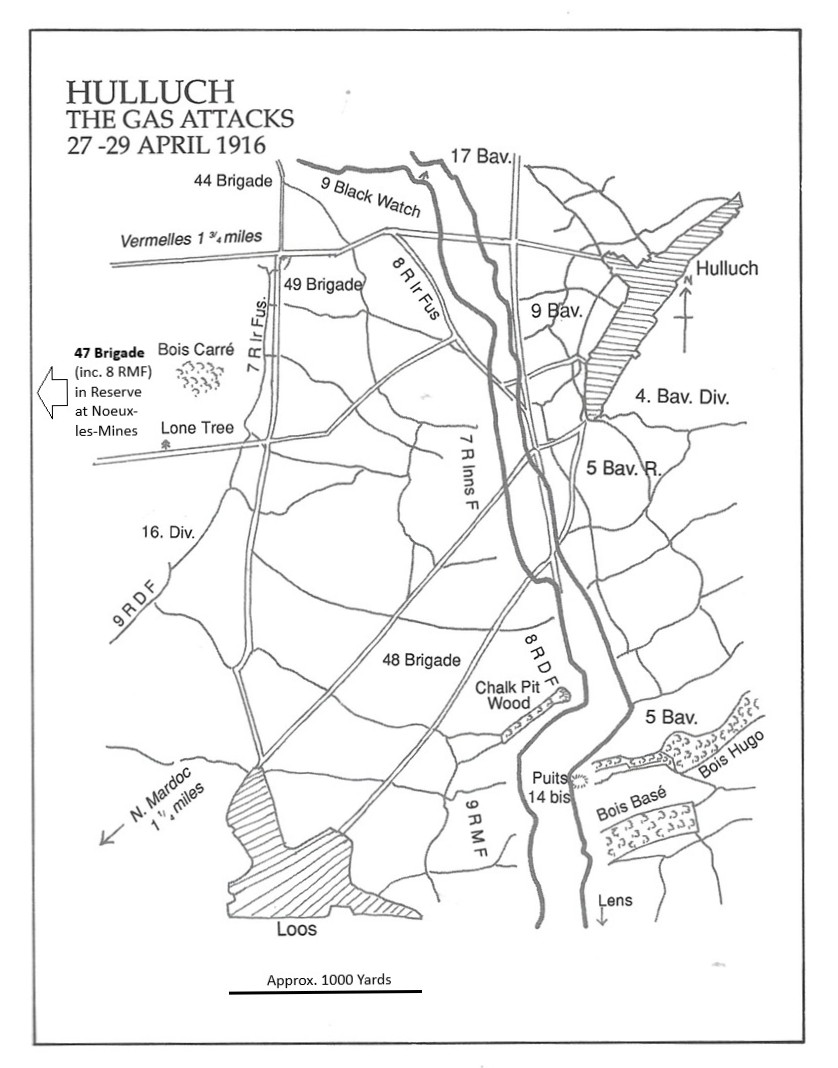
The first attack, 27 April 1916
At 05.00 on 27 April the Germans bombarded the Irish lines. [7] At 05.10 they released chlorine gas mixed with smoke. Visibility in the Irish trenches was reduced to three yards, such was the concentration of the cloud. At the same time German artillery bombarded the Irish communication trenches and rear positions - the latter with gas shells.
At 05.55 the Germans exploded two small mines under the Irish front line and one to the north under 15th Division’s front line, followed by a further intense bombardment and the release of another gas cloud. [8]
German infantry advanced and managed to get into the Irish front line trench. Although German shelling had blocked communication trenches and cut telephone wires, making the sending of orders extremely difficult, many Irish company commanders sent forward reinforcements on their own initiative and the German intruders were forced out of the Irish trenches. [9] Enemy dead counted in and in front of the British trenches amounted to 80.
Then the wind changed direction and blew the gas clear of No-Man’s-Land and back into the crowded German trenches. Now, British heavy artillery opened up - some from a considerable distance away - and caused many German casualties.
According to the ‘Official History’ the attack was over by 07.30.
The second attack, 29 April 1916
On 29 April there was another release of gas at 03.45. The German gas was carried over to the Irish lines on a light breeze - it took 45 minutes to drift across no-man’s-land and then, according to Lieut. Col. Edward Bellingham, the commanding officer of 8th Royal Dublin Fusiliers remained ‘stationary and concentrated over the trenches’. [10] This may have accounted for the greater number of gas casualties on the 29th than from the attack on the 27th. British air reconnaissance reported that the gas left a trail of dead vegetation down to the last blade of grass. [11] Fresh Irish troops were relieving those who had taken part in the previous attack and suffered casualties. 8th Munsters were in the process of taking over from 8th Dublins when this attack came and lost three officers and eighteen men killed, gassed and wounded. [12]
Small groups of Germans attempted to advance towards the Irish front line but were either shot down or forced to retire by rifle and-machine gun fire.
Once again, the wind direction changed and the gas blew back into the German trenches where troops were seen massing for an attack. Abandoning them, the Germans were caught out in the open by Irish artillery and dispersed. The Germans reported casualties in the 9th Bavarian Regiment as: 133 killed; 286 gassed, of whom 30 subsequently died. [13]
Clearing up
Then came the clearing up – and not just of the smashed trenches.
The men of 47th Brigade, most of who had been in reserve, were given the task of gathering and burying the dead. An officer of 7th Leinster Regiment, Lieutenant Lyon, shared in this terrible task. ‘They were in all sorts of tragic attitudes, some of them holding hands like children in the dark.’ He and his men found themselves pestered for the next few days by ‘half-poisoned rats by the hundred’.
Father Willie Doyle 14 described the scenes after the attack in a letter home to his father: ‘Many men died before I could reach them and were gone before I could pass back. There they lay, scores of them (we lost 800, nearly all from gas) in the bottom of the trench, in every conceivable posture of human agony; the cloths torn off their bodies in a vain effort to breathe while from end to end of that valley of death came one long unceasing moan from the lips of brave men fighting and struggling for life.’
Clearing up the mess continued uninterrupted by German attacks, and the Hulluch sector remained quiet for some time.
Irish casualties had been high: [15]
- Killed – 570
- Wounded –1410
Total – 1980
Of the total, 1260 had been the victims of gas of whom 338 had died.
8th Royal Dublin Fusiliers, alone, lost 368 ‘Other Ranks’ killed, wounded, gassed and missing between 27 and 29 April. 11 Officers are listed as killed, wounded and gassed and ‘Several other officers were wounded or gassed on duty.’ [16]
What had caused such high gas casualties?
The Vermorel sprayer-soaked anti-gas blankets were found to have been ineffective. The soldiers’ doubts about the ‘PH Helmets’ proved correct - many had been lethally inadequate. However, initially, senior officers preferred to blame the men for ‘bad gas discipline’. This was a nasty slur, tantamount to ‘It was all thick Paddy’s fault’. However, all the soldiers killed by gas were found to have had their helmets on correctly and the truth had to be admitted and, indeed, written into the ‘Official’ History. [17] The new kind of ‘box respirators’, worn by the Lewis gunners, were found to have worked well and production of them was increased.
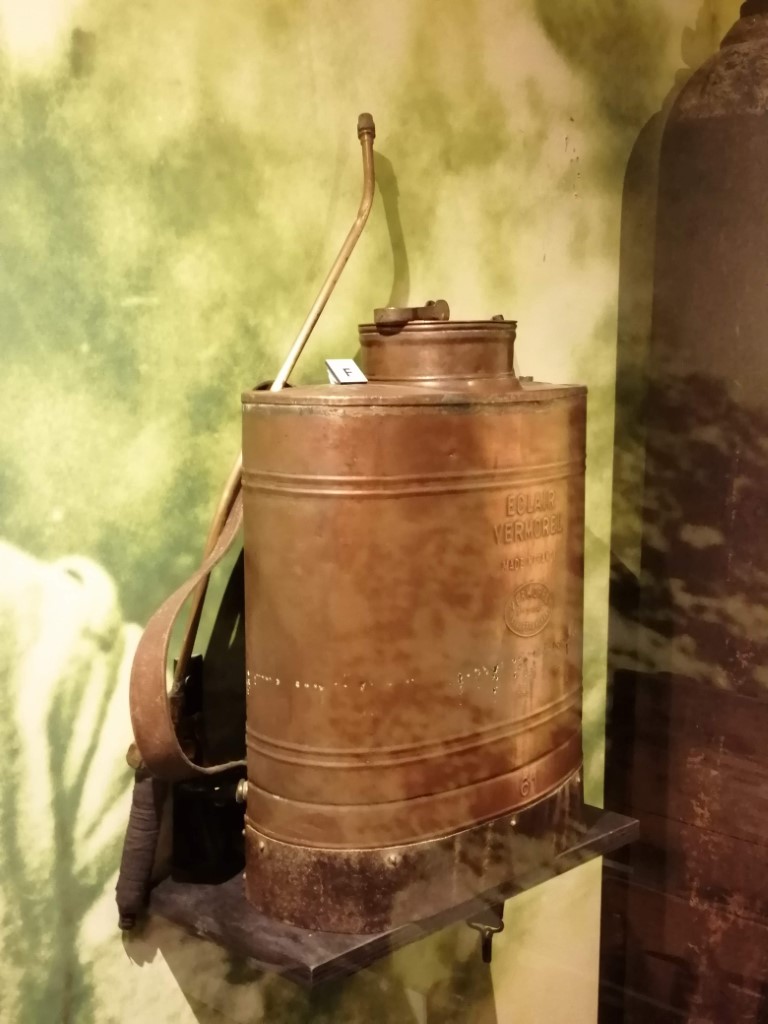
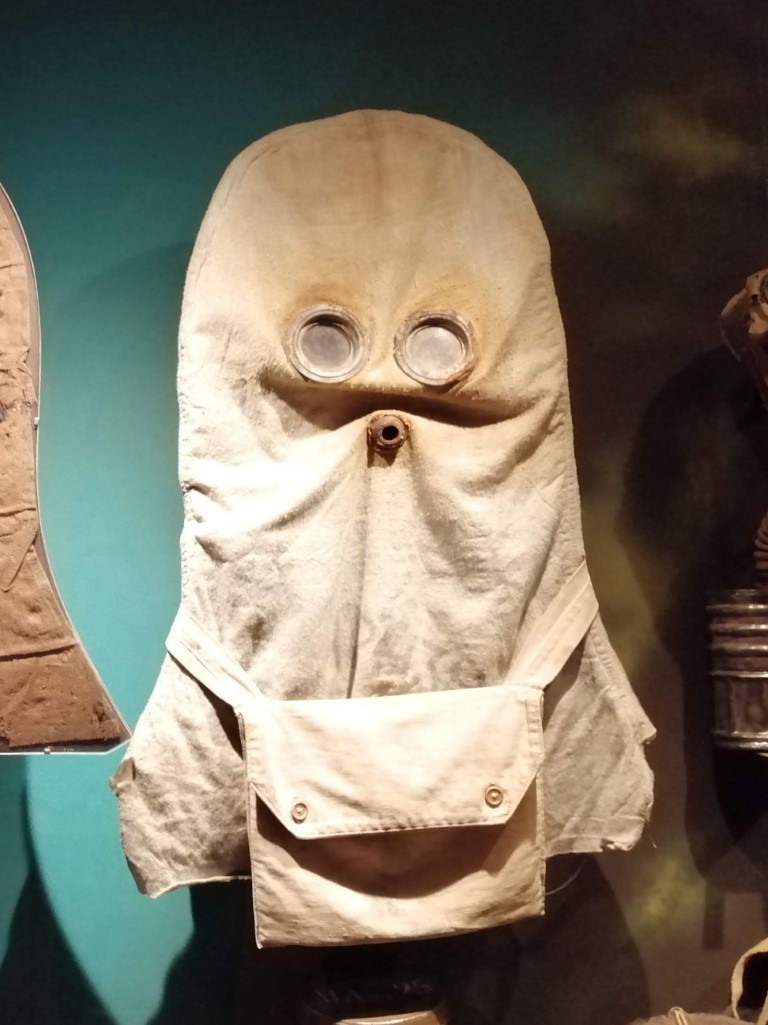
During the five months the 16th Division spent in the Loos sector it suffered at least 6000 (ie. 50%) casualties including 1496 killed. [18]
The ‘Easter Rising’ and the German placards
The 16th (Irish) Division recruited many former Irish Volunteer supporters of Home Rule. The 8th Battalion Royal Munster Fusiliers was recruited exclusively from among former Irish Volunteers.
On Monday 24 April the ‘Easter Rising’ had begun in Dublin. After the gas attacks the Germans in front of 8th Munsters raised placards. One read: ‘Irishmen! Heavy uproar in Ireland. English guns are firing on your wifes and children. 1st May 1916.’
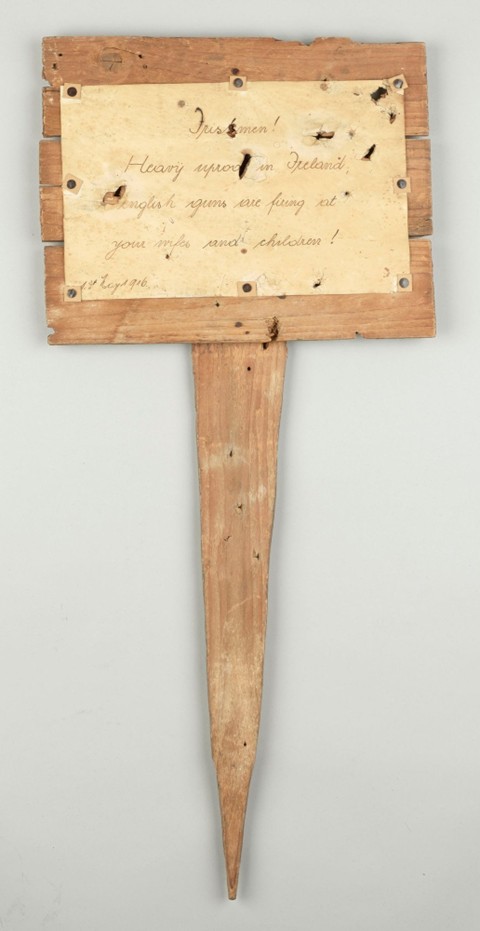
Another placard displayed news of the British defeat in Mesopotamia:
‘Interesting war-news of the April 29th 1916. Kut el Amara has been taken by the Turcs, and whole English army therein — 13,000 men — maken (made) prisoners’.
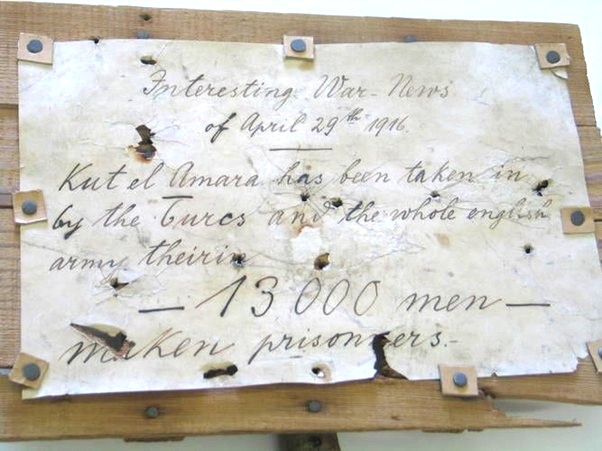
8th Munsters, nationalist to a man, fired shots into the placards. On 10 May ‘At 1 a.m. Lt. BIGGANE* went out to enemy’s sap at H25d49 (map reference – see map below). It was unoccupied. He brought back two notice boards put up by the Germans ….’ [19]
* Lieutenant Francis Biggane was killed in Flanders on 16th August 1917. He has no known grave and is commemorated on the Tyne Cot Memorial.
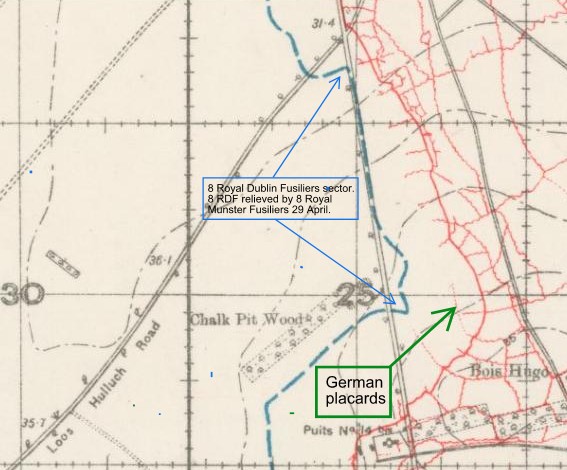
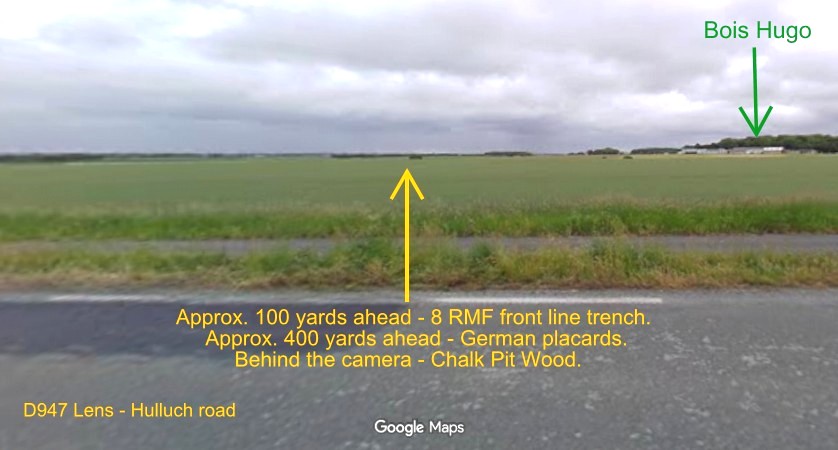
The captured placards were later presented to King George V by Lieut. Col. Williamson, CO 8th Munsters. Today, the ‘Dublin’ placard is housed at the National Museum of Ireland (Collins Barracks), and the ‘Kut-el-Amara’ placard is part of the Royal Collection Trust.
The Irishmen of 16th Division (and other Divisions) had no sympathy with the rebels in Dublin.20 However, many strongly disapproved of the manner of the executions of the rebel leaders. But their ‘contract with the British’ had been made and was honoured by all except a few of them until the end of the war. Sir Roger Casement had tried to form an ‘Irish Brigade’ out of the Irish Prisoners of War in Germany to take part in the Rising. [21] Only 56 (of out of Casement's figure of 2200) joined him. Only one accompanied him to Ireland via a U-Boat on 21 April 1916: Sergeant David Julian Bailey (alias Beverley), 2nd Royal Irish Rifles, who claimed that he only joined as a means of escaping captivity in Germany. Charges against him were withdrawn and he returned to the army. Robert Monteith, the commander of the Irish Brigade, who had served before the war with the Royal Horse Artillery, was also with Casement and Bailey. He was not a PoW and had come to Germany from the USA. He avoided capture and returned to the USA.
The worst of the fighting at Hulluch had been on 29 April. It was also the last, and bloodiest, day of the Easter Rising. 14578 Private John Naylor, 8th Battalion Royal Dublin Fusiliers, died on that day at Hulluch. His wife, Margaret, was shot on the same day in Dublin as she ventured outdoors to get bread for her three children. She died two day later. Private Naylor is commemorated at the Loos Memorial. [22] [23]
In September 1916 at Guillemont and Ginchy in the campaign on the Somme, the 16th (Irish) Division suffered heavy casualties and again in 1917 in the 3rd Battle of Ypres. In 1918 the Division bore the onslaught of the German attack around St Quentin and lost over 7,000 men. The survivors were withdrawn and the Division was reorganised. The reconstituted 16th Division now contained only one Irish infantry battalion and was disbanded in May 1919.
Throughout the war the Division lost over 28,000 killed, wounded and missing. [24]
1916 is remembered, quite rightly, for the sacrifice of the Ulstermen of 36th Division on the first day of the Battle of the Somme. The Division lost 1944 men killed. It is worth remembering that the 16th (Irish) Division actually lost more men killed in the same year at Loos and on the Somme – 2663. Such remembrance helps the justifiable ‘greening’ of the account of the First World War in Irish History.
Home – and two more wars
Some of the surviving soldiers (about 226) joined the IRA in the war for Irish independence on their return home.25 Others were forced to give, or gave voluntarily, advice about weapons and explosives. 33 were murdered in the counties that were to make up the Free State.26 Many suffered abuse from those who opposed the peace treaty with the British. Many more joined the National Army led by Michael Collins, C-in-C and Chairman of the Provisional Government, during the Irish Civil War (1922-3), fighting in support of the treaty that had created the independent Irish Free State. In fact, by May 1923 half of Collins’ National Army of 53,000 men and 20% of its 3,000 or so officers had fought in the British army in the First World War.27 Collins was concerned about their commitment, but they turned out to be as loyal to him as they had been to their former British commanders and, doubtless, some settled accounts with those who had maligned them for fighting on the ‘wrong’ side in the Great War.
Dochum Glóire agus Onóra na hÉireann
In memory of Private James Kidney, 8th Battalion Royal Munster Fusiliers
16th (Irish) Division in 1915
47th Brigade
- 6th Royal Irish Regiment
- 6th Connaught Rangers
- 7th Leinster Regiment
- 8th Royal Munster Fusiliers
48th Brigade
- 7th Royal Irish Rifles
- 9th Royal Munster Fusiliers
- 8th Royal Dublin Fusiliers
- 9th Royal Dublin Fusiliers
49th Brigade
- 7th Royal Inniskilling Fusiiers
- 8th Royal Inniskilling Fusiliers
- 7th Royal Irish Fusiliers
- 8th Royal Irish Fusiliers
References and notes
- Department of the Taoiseach, Republic of Ireland 2006 - ‘Irish Soldiers in the First World War’. Section – STATISTICS. Pages are not numbered. Also worth reading - Biagini, Eugeni - ‘A Long Way to Tipperary: the Irish in the First World War’ pub. The Historical Journal, Cambridge University Press, Review Article 2017. A review of five books published in 2015 and 2016 that contains a great deal of information and analysis taken from them including recruitment in 1914.
- Westlake, Roy - ‘Kitchener’s Army’ pub. Spellmount 1989. Pages 74-76.
- Johnstone, Tom - ‘Orange, Green and Khaki – The Story of the Irish Regiments in the Great War, 1914-18’ pub. Gill and Macmillan, Dublin 1992. Page 199.43. Ibid. Page 205
- Edmonds, Brigadier General J E Ed. - ‘Official History of the Great War’, ‘Military Operations France and Belgium, 1916, Volume 1’ pub. HMSO 1932. Page 193.
- Op. cit. Edmonds. Page
- Op. cit. Johnstone. Page 209.
- Op. cit. Edmonds. Page 194.
- Ibid. Page 195.
- Op. cit. Johnstone. Page 210.
- War Diary – 8th Royal Dublin Fusiliers WO-95-1974-3_01 National Archives.
- Op. cit. Edmonds. Page 196.
- War Diary – 8th Royal Munster Fusiliers WO95-1971-2 National Archives
- Op. cit. Edmonds. Page 198
- O’Rahilly, Alfred – ‘Father William Doyle SJ’ pub. Longmans Green 1922. Page 237. (Also Page 229 for earlier quote paragraph 4.)
Father Doyle SJ MC was killed in action n 16 August 1917 in the Battle of Langemark (3rd Ypres). His burial place in the battlefield was lost and he is commemorated on Panel 160 of the Tyne Cot Memorial (CWGC Website). - Op. cit. Johnstone. Page 212.
- Op. cit. 10 War Diary – 8th Royal Dublin Fusiliers
- Op. cit. Edmonds.
Page 196: ‘... the helmet was obviously insufficient protection against the strong concentration of gas which the enemy was able to produce...’
Page 197: It was not possible immediately to release the troops who had experienced the attack, but ... they were spared all possible fatigue during the following night and day ... and no after-effects were observed ... Their uneasy, and quite justified, feeling that the gas helmet was now a doubtful protection was allayed for the time being by the information that the particular helmets in question had not been properly impregnated with chemicals.’ The ‘information’ was, of course, yet another untruth, but it was a lesser one than that which had blamed the Irish troops for fitting their gas helmets carelessly. - Department of the Taoiseach, Republic of Ireland 2006 - ‘Irish Soldiers in the First World War’. Section – 1916: HULLUCH April 1916; THE EASTER RISING April 1916. Pages are not numbered.
- Op. cit. 11. War Diary – 8th Royal Munster Fusiliers.
The dimensions of the placards were: 81.0 x 36.0 x 2.0 cm (‘Dublin’ placard whole object) and 91.0 x 36.0 x 4.0 cm (‘Kut-el-Amara’ placard whole object). How readable could they have been from the Munsters’ front line except through officers’ field glasses? - Henry, William - ‘Galway and the Great War’ pub. Mercier Press, Cork, 2006. Pages 230-231. The ‘Galway Express’ quotes a young officer on leave, Second Lieutenant JF Roland, stating that the German posters ‘Needless to state …. had not the desired effect except that the Irish soldiers indulged in some “strafing” at the expense of the Germans.’
Also Op.cit. Johnstone Page 213 who quotes John Lucy, then a Sergeant with 2nd Royal Irish Rifles: ‘My fellow soldiers had no great sympathy with the rebels but they got fed up when they heard of the executions of the leaders.’ Lucy wrote a wartime memoir ‘There’s a Devil in the Drum’ which views the war from an Irish perspective and deals with the dilemma of Irishmen serving in the British Army and the tension and conflict which arose following the 1916 Rising. - Townshend, Charles - ‘Easter 1916 – The Irish Rebellion’ pub. Penguin Books 2006. Pages 116-117.
There is a massive amount of information and primary sources relating to the ‘Irish Brigade’ on the website irishbrigade.eu The author’s/editor’s email address is david@corisande.com - Royal Dublin Fusiliers Association archive.
- McGreevy, Ronan - ‘Easter Week 1916: The Gassing of the Irish’, Irish Times 16 April 2016. Passim.
- Op.cit. Westlake. Page 76.
- O’Connor, Steven ‘ ”It’s up to you now to fight for your own country”: Ireland’s Great War veterans
in the War of Independence, 1919-21. Veterans of the First World War: Ex-servicemen and ex-
servicewomen in post-war Britain and Ireland’ pub. Routledge, 2019. Chapter 6; page 2. https://hal.sorbonne-universite.fr/hal-03904948v1 - Taylor, Paul – ‘Heroes or Traitors – Experiences of Southern Irish Soldiers Returning from the Great War’ pub. Liverpool University Press 2015. Pages 28; 31.
- Cottrell, Peter - ‘The Irish Civil War 1922-23’ pub. Osprey Publishing Ltd. 2008. Pages 23.
Also, op. cit. Taylor, Page 210 (and footnotes/references). Taylor states, that it was officially estimated that approximately half of the 55,000 soldiers who enrolled in the National army were ex-servicemen and that Its Officer Corps between 1922 and 1924 included more than 600 veterans of the Great War
Precise figures, it seems, have been difficult to obtain. This may be because the National Army was in serious need of recruits and enquiries into their antecedents may have been deliberately cursory.
Becoming a member of The Western Front Association (WFA) offers a wealth of resources and opportunities for those passionate about the history of the First World War. Here's just three of the benefits we offer:

The WFA regularly makes available webinars which can be viewed 'live' from home. These feature expert speakers talking about a particular aspect of the Great War.

Featured on The WFA's YouTube channel are modern day re-interpretations of the inter-war magazine 'I Was There!' which recount the memories of soldiers who 'were there'.

Explore over 8 million digitized pension records, Medal Index Cards and Ministry of Pension Documents, preserved by the WFA.


