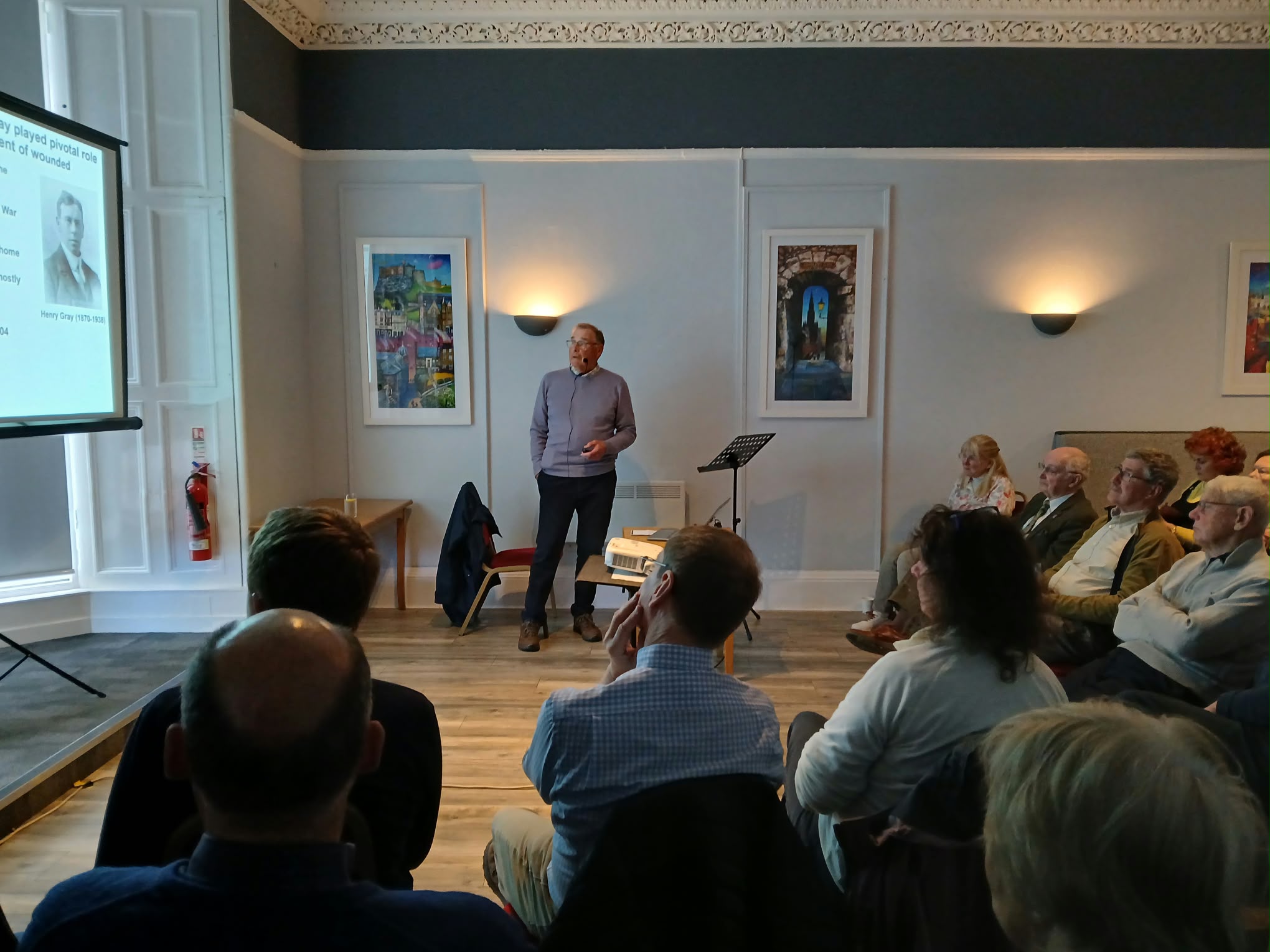
Tom Scotland looks at medical advancements on the Western Front.
Distinguished surgeon and author Tom Scotland RCSEd (Royal College of Surgeons of Edinburgh) delivered a quite brilliant presentation to Branch members at the Scots Guards Club in Edinburgh on Sunday 11th October 2026.
His lecture focused on medical advances on the Western Front during the First World War. In 1914, too many British soldiers were dying unnecessarily of wounds because of inadequate medical treatment. Advances in war surgery during the next four years, however, significantly improved the survival chances of wounded men, including even those suffering from penetrating chest and abdominal wounds. The conflict saw the widespread adoption of new medical practices like wound excision, blood transfusion, the use of the Thomas splint, and much earlier and effective surgical intervention in Casualty Clearing Stations.
Tom highlighted many unsung heroes of the medical services. These included men like Aberdonian surgeon Sir Henry Gray - an early advocate for cleaning out dead tissue from filthy and contaminated wounds. A practice which reduced deaths from septic infection and gas gangrene. The orthopaedic surgeon Robert Jones promoted the use of the Thomas splint to hold a fractured femur more effectively in position, thereby reducing fatal blood loss in a patient during transportation to hospital. And pioneers in blood transfusion like the Canadian, Lawrence Bruce Robertson.
The outcome of dramatic advances in treatment meant that the chances of surviving being wounded were much greater in 1918 compared with 1914.
It was another presentation which demonstrated that the men of the British Expeditionary Force did learn from hard-won experience, contrary to popular myth.