
Albert Troughton was shot at dawn on this day in 1915
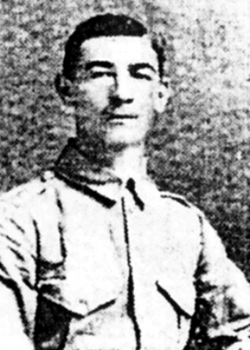
Albert Troughton was born in July 1891 in Foleshill, West Midlands, England, the son of Nathaniel Troughton (a coal miner) and Ann Elizabeth (née Warner).
At the 1901 Census, the family lived at 59 Eden Street, Coventry.
At the time of the 1911 Census (and, later, of their son’s death), Nathaniel, Ann and other members of the family lived at 14 Ash Grove, Stoney Station Road, Coventry. Albert was one of three boys and three girls. In the 1911 Census, he is described as a turner in the motor cycle industry.
At some point, he enlisted in the Royal Welch Fusiliers. At his court martial in 1915, he stated that he "had three years in 1/ R.W. Fus in November" 1914. If so, he must have enlisted in November 1911.
Albert had gone out to France with the 7th Division on 7 October 1914 and his 'character ... from a fighting point of view' was said to have been 'good'. This would seem to be a very generous assessment, as Troughton could have seen only a little action from 15 October. Atkinson's history of the 7th Division, for example, shows this. Nevertheless, Troughton was slightly wounded, though there is confusion about when.
Albert Troughton was prosecuted at his court martial by 2nd Lt J.B. Savage of his own regiment, and it was said that he deserted on either 18 or 19 October 1914 (days of very heavy fighting) from the area of Zonnebeke. He was finally arrested several months later in Boulogne (on 30 March 1915). In his defence, however, Troughton said that, at Zonnebeke on or about 23 October, he was slightly wounded on the wrist. Coming out of the trenches, he had been told that his younger brother, James, had been killed (he hadn't - see later). 'This seemed to leave me quite silly. I wandered about France and I did not know where I was going.' From the trial record, it seems reasonable to assume that Troughton gave evidence on oath, and so could have been cross examined. There is nothing to say he was. Savage might have questioned him on this, but if he did no record was made of it.
'This is a bad case' Haig wrote on the 13th; 'I can see no extenuating circumstances in this case' wrote Rawlinson two days earlier.
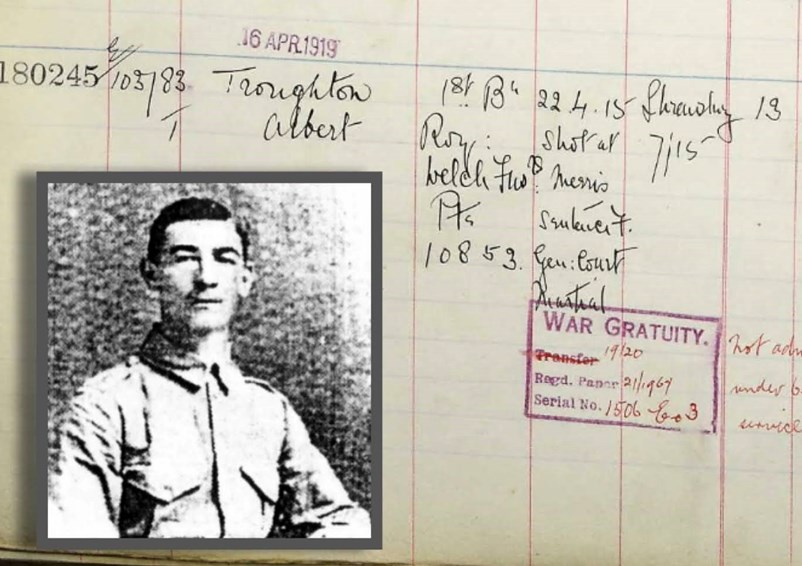
He is buried in Estaires Communal Cemetery, France.
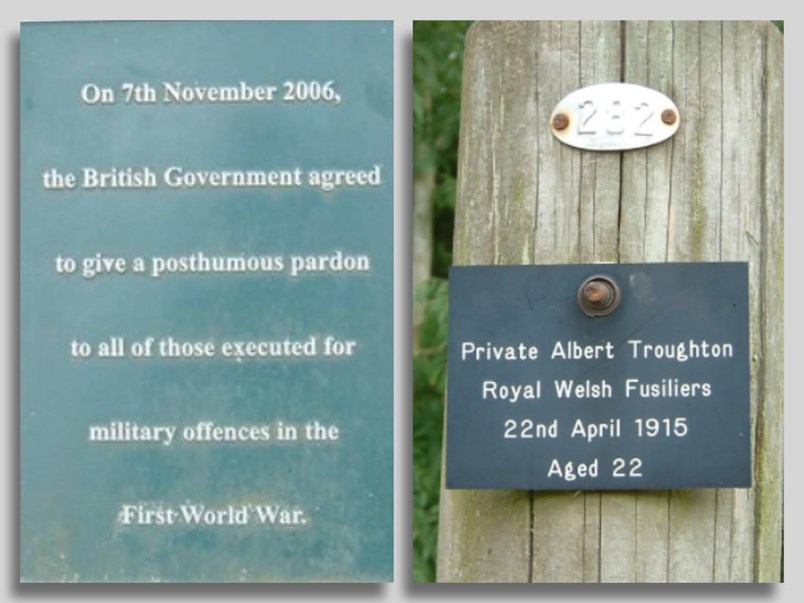
His younger brother James Troughton (born 1894) enlisted 1st September 1914 and served for over 5 years until demobilisation on 31 March 1920. He was wounded twice in late 1917, gassed and awarded the Military Medal on 12 December 1917.
10853 Pte Albert Troughton, 1st Royal Welsh Fusiliers