
Larrett Roebuck was killed in action on this day in 1914
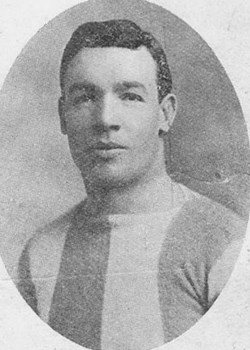
Larrett Roebuck was born 27 January 1889 at Jump, near Barnsley, in South Yorkshire. His father was Elias Roebuck, a miner, and his mother was Elizabeth (née Bailey). By 1901 the Roebuck family had moved to Rotherham and were living in Barker's Yard, off the main High Street, where he shared a cramped home with his parents, an uncle and two younger siblings.
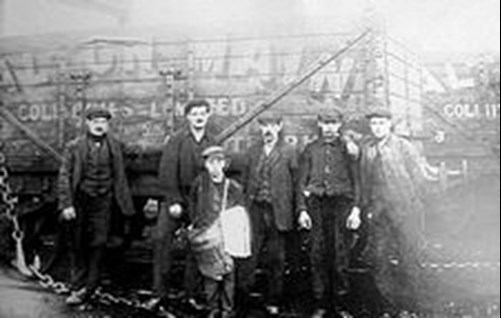
Life would have been harsh, and the family were probably in dire straits after Larrett's father died at the age of 40 in 1902. As the only possible breadwinner, it is likely that Larrett left school at the earliest opportunity; he was aged 13 when his father died which would have enabled him to start work underground, quite possibly at one of the many pits in the area. He is noted as a being a 'trammer' which is the term for a young mine worker; possibly he tended the pit ponies, a typical role for lads aged 14 or 15.
Life was to take a turn for the worse in 1904 when, in September, Larrett was sentenced to one month's imprisonment by the Rotherham magistrates for stealing a watch. The records state that he had no previous convictions, and they also show that he unaccountably overstated his age as being 17. Had he given his true age (15) he would have been dealt with under a different (and more lenient) system.
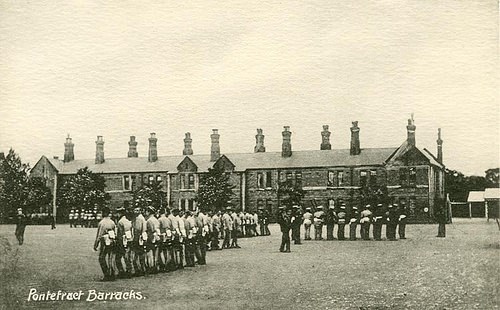
After being released on 4 October 1904, it is almost certain that Larrett found himself without a job, and as a result, on 14 November, he travelled to Pontefract and signed up in the York and Lancaster (Y&L) Regiment.
Larrett claimed to be 18 years old, but he was in fact just a few weeks short of his 16th birthday. It was not the only inaccuracy on his enlistment papers: he also declared he had never been in prison.
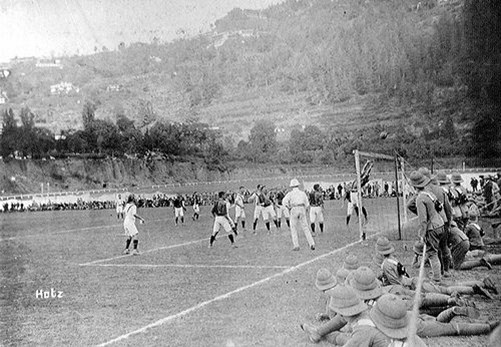
Over the next seven years, Larrett endured the harsh regime of a pre-war regular serving with the 1st battalion in India between October 1906 and December 1907. It is certain that during this period, Larrett honed his football skills.
Returning home, Larrett joined the 2nd battalion, stationed at Limerick, and was appointed to Lance Corporal on 28 December 1907.
On Saturday, 6 June 1908, Larrett married Frances Walker (she was named as "Fanny" on Larrett's army service records), the wedding taking place in Rotherham. The first of their children, John, was born in November that year.
Unfortunately, Larrett reverted to the rank of Private in April 1910 for "misconduct".
By 1911, they had been joined by six month-old Violet. Lucy was to be born later that year and Jesse the following year.
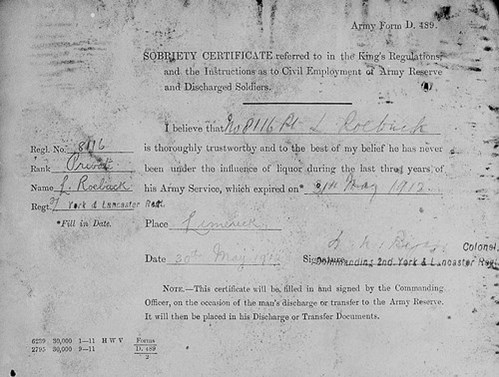
In late May 1912, Larrett signed a document agreeing to be discharged to the reserve. He was given a "sobriety certificate" which stated he was thoroughly trustworthy and had not been known to be under the influence of liquor.
He returned to South Yorkshire and it is likely he worked for a spell at the Silverwood Colliery where he joined the Colliery football team and began to make a name for himself as a talented full-back.
The Silverwood side had a good reputation, regularly entering the FA Cup qualifying stages from 1910 onwards, and over the years produced several players who went on to make the grade in the Football League. It is quite likely that Larrett played in some of the Colliery team's early FA Cup ties, and so he came to the notice of Huddersfield Town's scouts.
What is certain is that he initially joined Huddersfield on 1 March 1913. Larrett made his debut at left-back on 3 January 1914, with a 3-1 home win over Fulham, and he was to play in the same position in all the club's remaining games, including two FA Cup ties, that season.
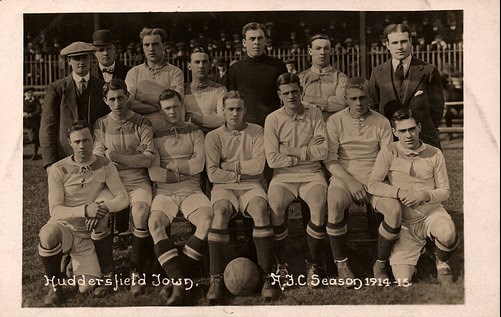
Larrett's 19th and last appearance came on 25 April 1914, in a 1-0 victory at Leicester Fosse (renamed Leicester City in 1919). Four days previously he had signed a new contract with Town for the 1914/15 season, to commence at an agreed rate of £2 per week.
However, with the war clouds gathering over Europe everything was about to change. When war was declared on 4 August that year there was great debate as to whether to continue with normal League football. In the event the game's authorities decided to carry on, hoping like many others that the conflict would "all be over by Christmas". As a reservist, Larrett, like many men around the country, was quickly mobilised by his regiment.
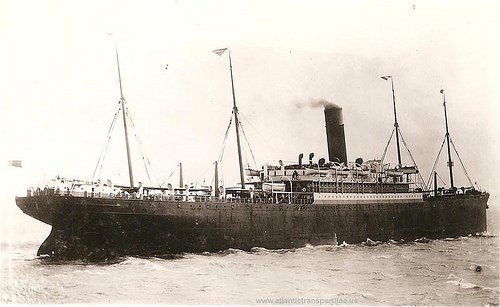
At the outbreak of war, the 2nd Battalion York & Lancaster Regiment, part of the 16 Brigade (6th Division) was stationed in Limerick. The order for mobilisation arrived at 10pm on 4 August 1914 and ten days later they returned to England to camps at Cambridge and Newmarket. Larrett was almost certainly recalled to Pontefract and, from there, presumably journeyed south by train to join his battalion. On 8 September 1914, the battalion received orders to prepare to leave Tilbury Docks on the SS Minneapolis "for an unknown destination" and, the following day, it disembarked at St Nazaire on the west coast of France.
From St Nazaire the battalion made its way up towards the front line. From surviving records, we know that Larrett was re-appointed to Lance Corporal during this time.
The regimental history records:
The Battalion reached Courcelles in heavy rain early on the morning of September 20th to learn that the Battalions which had been engaged in the Battles of the Marne and Aisne were much weakened and exhausted, and that the 16th Brigade was required to relieve next day the 7th and 9th Brigades to the north-east of Vailly. The relief was carried out late on the night of the 20th/21st, the Battalion taking over the trenches which had up to then been occupied by Battalions of the Lincolnshire Regiment and Royal Scots Fusiliers; and almost immediately the enemy opened a heavy shrapnel fire on the portion of trench occupied by "A" Company of the Battalion, causing a loss of three killed, one officer - Lieutenant Lethbridge - and eleven men wounded.
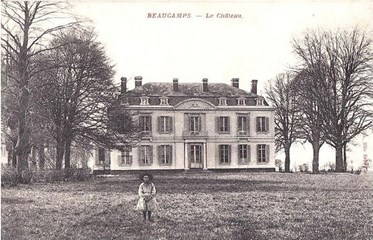
Larrett and his comrades were now faced with the grim reality of war. With both sides digging in, the "race for the sea" had begun as each opposing army moved northwards to try and outflank the other. In miserably wet and foggy conditions the British Expeditionary Force was looking to capture Menin when, on 18 October 1914, Lance-Corporal Roebuck was one of 40 men listed as killed or missing in action near Beaucamps-Ligny following an attack on an enemy position.
The Divisional history gives some details in its narrative:
'On the 18th October a reconnaissance in force was ordered, which was brilliantly carried out. The Buffs and the York and Lancasters on the right captured Radinghem without much opposition and advanced across a small plateau, three hundred yards in width, towards the woods in which stands Chateau de Flandres. They here came under a heavy cross-fire of machine guns and shrapnel, and were counter-attacked and driven back. The situation, however, was saved by Major Bayley's company of the York and Lancasters, which had worked around on the left and threatened the flank of the counter-attack, which thereon withdrew. The York and Lancasters suffered considerable casualties in this little action.'
More detail is provided in the battalion's war diary:
[By early afternoon] Village [Radinghem] taken without difficulty by 'A' Company. Line held up for short time by shelling of French and our guns. Centre of line on reaching high ground East of Radinghem came under heavy shell fire from southerly direction, but continued the advance with the remainder of the line across the Radinghem - Fromelles Road. Right of line coming under heavy cross fire of machine guns and shrapnel in the open, was forced to return back to the road. At the same time the remaining companies, having got into the woods of Chateau de Flandres tried three times to advance but were each time driven back by cross fire of machine guns, situated at southern boundary of the wood, and shrapnel and rifle fire. They eventually took up positions on the Radinghem - Fromelles Road, in conjunction with the Buffs.
Back home Larrett's family were officially informed of his 'missing' status but, as time went by, and despite several letters to the War Office asking for information, no further news was heard of his fate. Eventually Larrett's mother Elizabeth, now running the Britannia Inn in Shaftesbury Square, Rotherham, wrote to the local newspaper asking if any readers or soldiers home on leave could help. Her poignant appeal was published on 30 January 1915, shortly after what would have been Larrett's 26th birthday, in the hope that he had perhaps been taken prisoner or lay wounded in some unknown hospital bed. A week later these hopes were dashed when a Mrs G E Vickers contacted the Rotherham Advertiser in response. She forwarded copies of two letters from a Private W Worsman of the East Yorkshire Regiment, the son of a friend of hers, who was currently recovering from wounds in a Rouen hospital. In his first, dated 29 November 1914, Worsman had written to his own mother, saying:
You remember me telling you in my last letter that L Roebuck had got killed. You can now take it as granted from me that the worst has happened to him. I was talking to a chap from Rotherham the other day who is in the York & Lancasters; you will perhaps know him, they call him Callagan. He used to play football for the Little Bridge, and I believe he had a trial with the Town when he first came from India. He told me that L Roebuck got killed a month ago.
Worsman's second letter, dated 30 January 1915, then confirmed the story. He wrote that he had been talking to a soldier from Ickles named G Brierley, who was also recovering from wounds and was a mutual friend of Larrett Roebuck. Brierley had told Worsman that he had actually been beside Larrett when he was killed whilst they were making an attack.
Huddersfield Town AFC had meanwhile been sending Larrett's wife Marie £1 a week ever since he had been called up. With the confirmation of his death the Club's Secretary-Manager, Arthur Fairclough, wrote to her at the family home at 7 Marsh Street, Ickles, Rotherham, on 26th February 1915, stating that due to the Club's weak financial state they would unfortunately now have to cease making the payments. As wartime restrictions began to bite he wrote:
Dear Mrs Roebuck, I regret to say that we are not in a position to continue sending £1 per week to the end of the season. We are ourselves having to appeal to the League for assistance. This season we are losing money every week. My Directors will try to make you a grant of ten shillings a week for the next four weeks after tomorrow. I am forwarding you £2 five shillings [£2.25] from the Players – this money was subscribed for a present for Larry but we think that it will be better to forward this to assist you. We think Larry would wish this if we could communicate with him.
In August 1915 a pension was awarded to Frances of 22s 6d per week (£1.12p, or £113 equivalent value in today's money). This was to be paid until the children were aged 16.
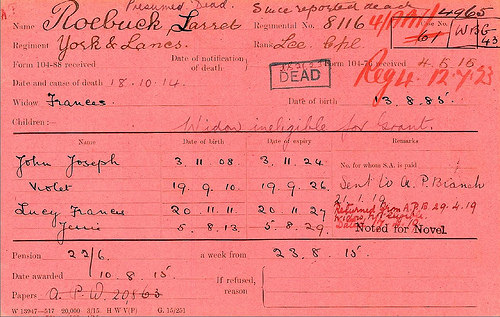
Larrett was officially recorded as 'presumed dead' on 18 October 1914. He was the first professional footballer from the English football league to be killed in the Great War.
34 men from the 2nd battalion, York and Lancaster Regiment are recorded as having been killed on 18/19 October 1914. Only two of these men have known graves. The 32 missing are commemorated on the Ploegsteert Memorial to the Missing. However, the discovery of the remains of 15 men led to the identification of a number of these missing soldiers. Unfortunately, Larrett was not among those who was identified and he will, therefore, remain 'missing'.
The 15 men from the York and Lancaster Regiment were re-interred in a ceremony on 22 October 2014, 100 years, virtually to the day, since they were killed. It is not impossible that Larrett may be one of the unidentified men who was buried in this ceremony.
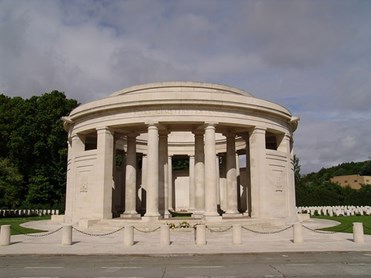
A longer version of Larrett's story can be read here.
8116 Lance-Corporal Larrett Roebuck, 2nd Battalion York & Lancaster Regiment