
Gilbert the Filbert
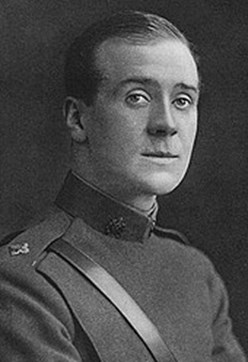
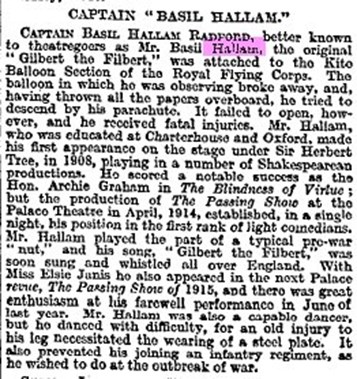
Captain Basil Hallam Radford, No 1 Army Kite Ballon Section, Royal Flying Corps was born on 3 April 1888 and lived on Cromwell Road, South Kensington. He was at the public school Charterhouse from 1903 to 1907. Basil Radford became an actor and went on stage as 'Basil Hallam'. He became a star of the Music Halls and was known in particular for his role in 'The Passing Show'. Basil was also one of Lady Diana Cooper's dancing partners.
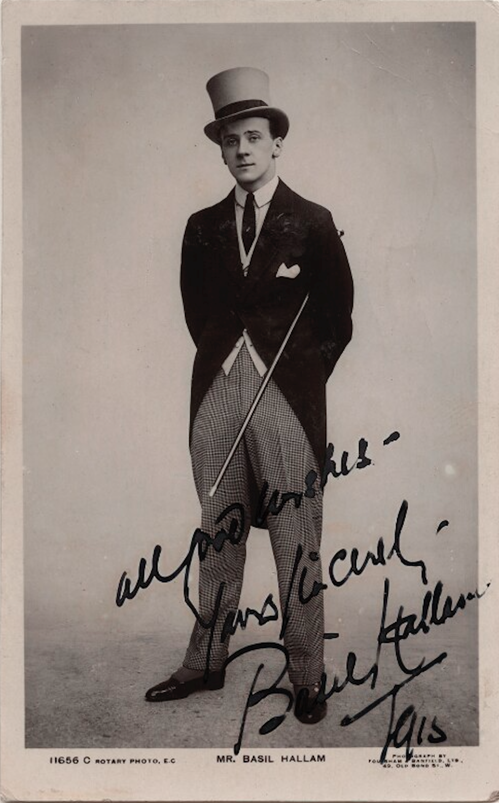
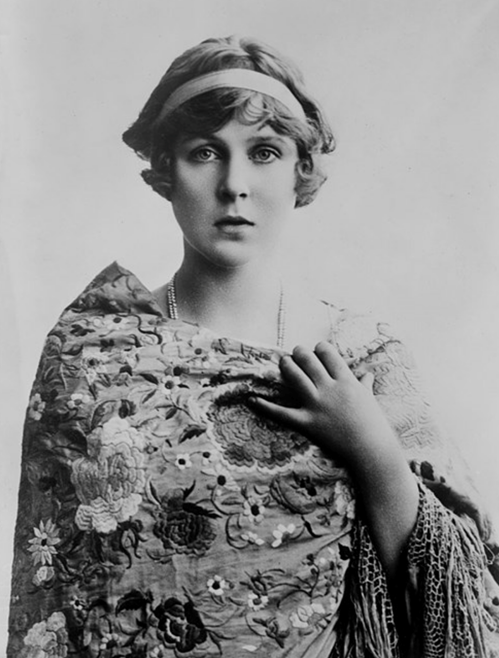
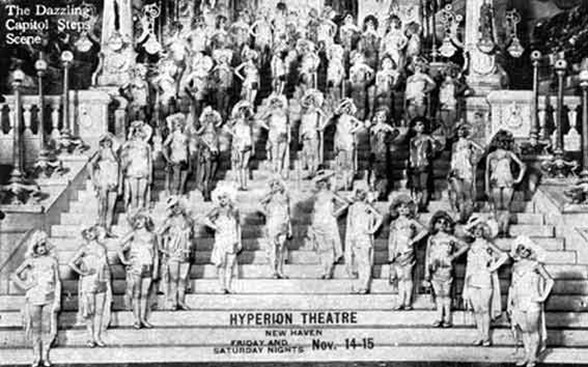
By early 1914 he had established himself as a popular and successful light comedian appearing in various productions before he created the persona 'Gilbert the Filbert'.
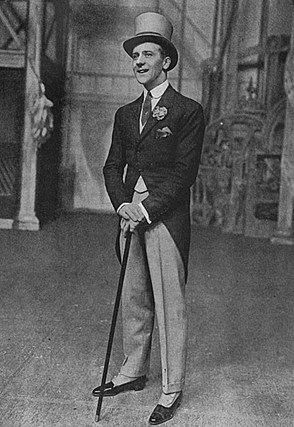
Possibly for medical reasons (he had a steel plate in his foot from an old injury) Basil didn't join up as soon as war began but, after being a recipient of numerous white feathers, often thrust upon him at the stage door, he decided to enlist. He became a Balloon Observer with a Kite Balloon Section of the RFC and his duties were to reinforce the work of observers working for Corps Squadrons.
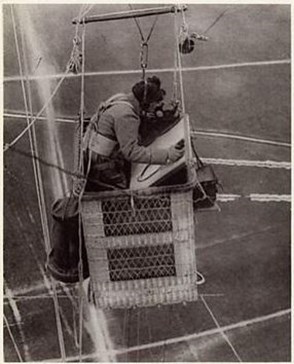
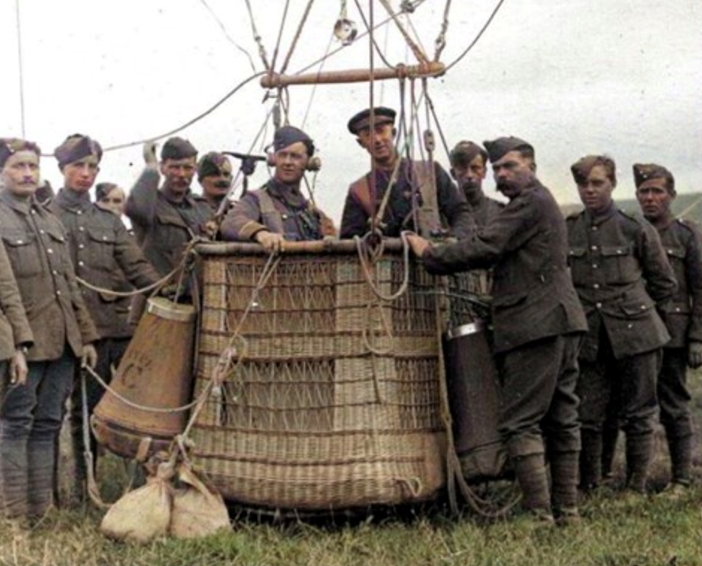
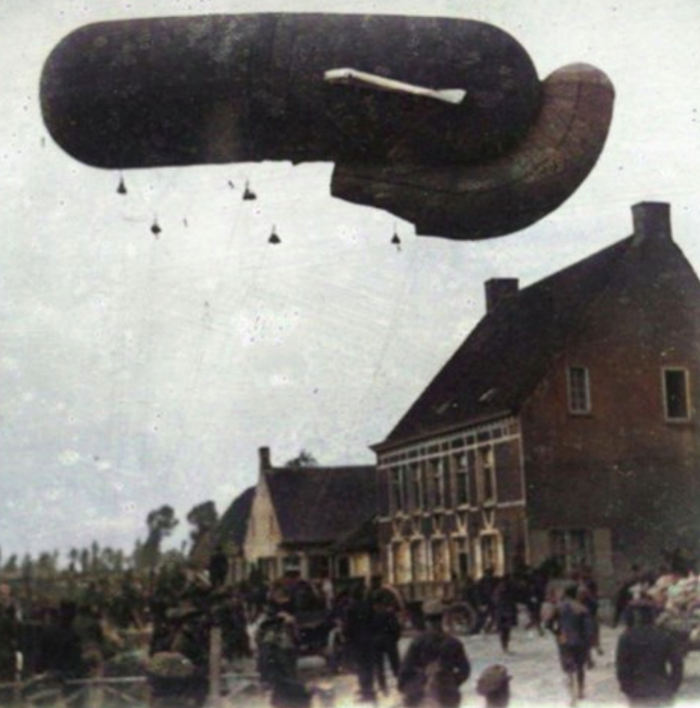
On the right two observers in the basket of a kite balloon pictured spotting activity on the ground below. The Kite Balloon section (often known as the balloonatics) was used by both the naval and military air service and then eventually absorbed into the newly formed Royal Air Force in 1918. 1918.
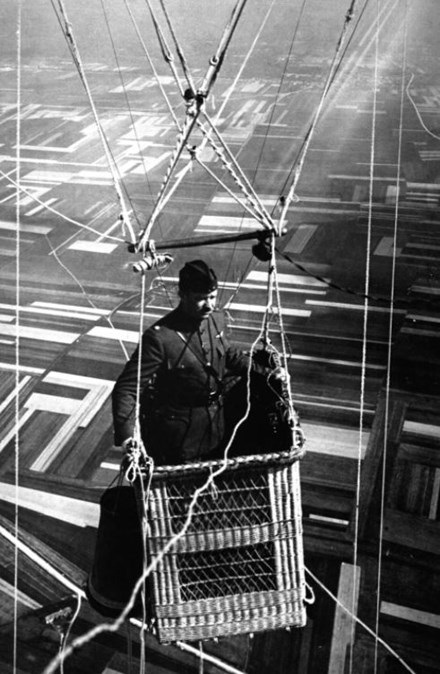
He was to meet his end on 20 August 1916. Instead of the usual two man crew, Radford had taken a third person, an old school friend from Charterhouse, up in the balloon. When faced with tragedy he gave up his parachute. Gerald Gliddon writes:
On 20 August Hallam, a member of No 1 Section, was due to make an ascent with 2/Lt P B Moxon who had previously been registering for V Corps together with a third man, Lt Geoffrey McCall. McCall, whose brother was a school chum of Hallam, had been invited along as a guest.
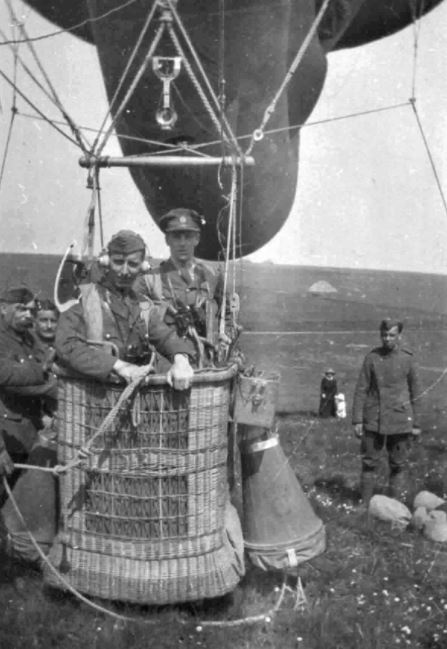
Sadly, and owing to a high wind, the balloon broke away from its moorings and began to drift towards enemy lines. The crew then proceeded to throw out their instruments and maps before planning to save themselves. Unfortunately, there were only two parachutes in the balloon and Hallam instructed Moxon and McCall to jump. This, of course, left him with the decision of either drifting out of control into enemy lines or to jump and hope.
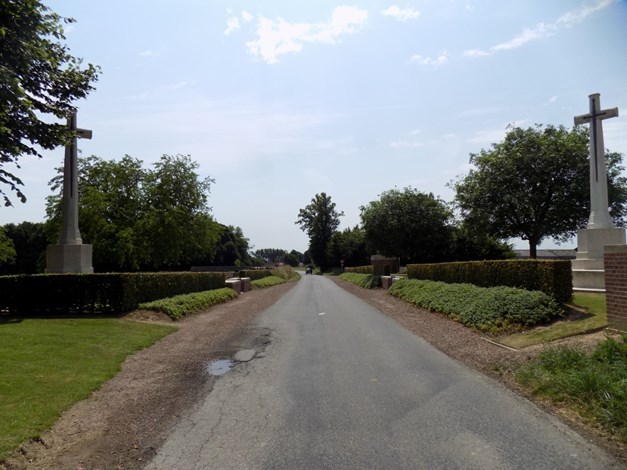
For a short period he was seen sitting on the edge of the basket before making his leap. The height was between three and six thousand feet and, not surprisingly, he didn't survive. His body was found on the Acheux-en-Amienois Road. In a letter to Lady Diana Cooper, Raymond Asquith, one of hundreds of witnesses to the tragedy, reported that Hallam's body was found dreadfully foreshortened and he was only identified by his cigarette case. Hallam's grave is to be found in Couin British Cemetery.
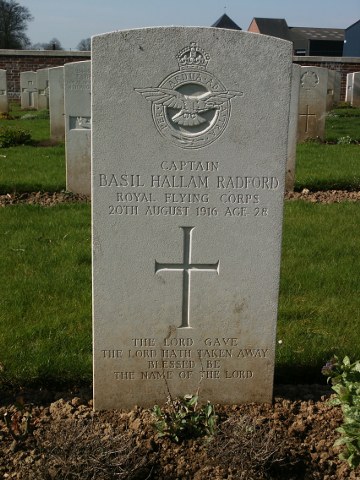
His death in action is described by Rudyard Kipling in The Irish Guards in the Great War, Vol 2 1916 - Salient and the Somme:
On a windy Sunday evening at Couin, in the valley north of Bus-les-Artois, the men saw an observation-balloon, tethered near their bivouacs, break loose while being hauled down. It drifted towards the enemy line. First they watched maps and books being heaved overboard, then a man in a parachute jumping for his life, who landed safely. Soon after, something black, which had been hanging below the basket, detached itself and fell some three thousand feet. We heard later that it was Captain Radford (Basil Hallam). His parachute apparently caught in the rigging and in some way he slipped out of the belt which attached him to it. He fell near Brigade Headquarters. Of those who watched, there was not one that had not seen him at the "Halls" in the immensely remote days of "Gilbert the Filbert, the Colonel of the Nuts."
Luci Gosling has added a little more information:
Elsie Janis, the American actress who was engaged to him, recounts a letter in her memoirs, received from one of the men who escaped successfully. Apparently Basil coaxed them into jumping and the young man wrote, "I never thought Gilbert the Filbert would give me the courage to face death."
Becoming a member of The Western Front Association (WFA) offers a wealth of resources and opportunities for those passionate about the history of the First World War. Here's just three of the benefits we offer:

This magazine provides updates on WW1 related news, WFA activities and events.

Access online tours of significant WWI sites, providing immense learning experience.

Listen to over 300 episodes of the "Mentioned in Dispatches" podcast.
Other Articles


