
Death from the Sky: The 28th Bttn AIF
On the main D929 road from Amiens to Albert, just after the bend in the otherwise arrow-straight highway that takes motorists away from the villages of Querrieu and Lahoussoye, is a turn off for Franvillers. Rarely visited by battlefield visitors (it is well behind the main front lines for the 1916 Battle of the Somme), the Communal Cemetery Extension is in fact nothing to do with the 1916 Battle, but contains the graves of 256 identified soldiers who all died in 1918. Over half of these are Australian.
The earliest burials in this ‘Extension’ (there are a small number of burials in the adjoining Communal Cemetery) date from late April 1918. These men are buried in Row A of Plot 1.
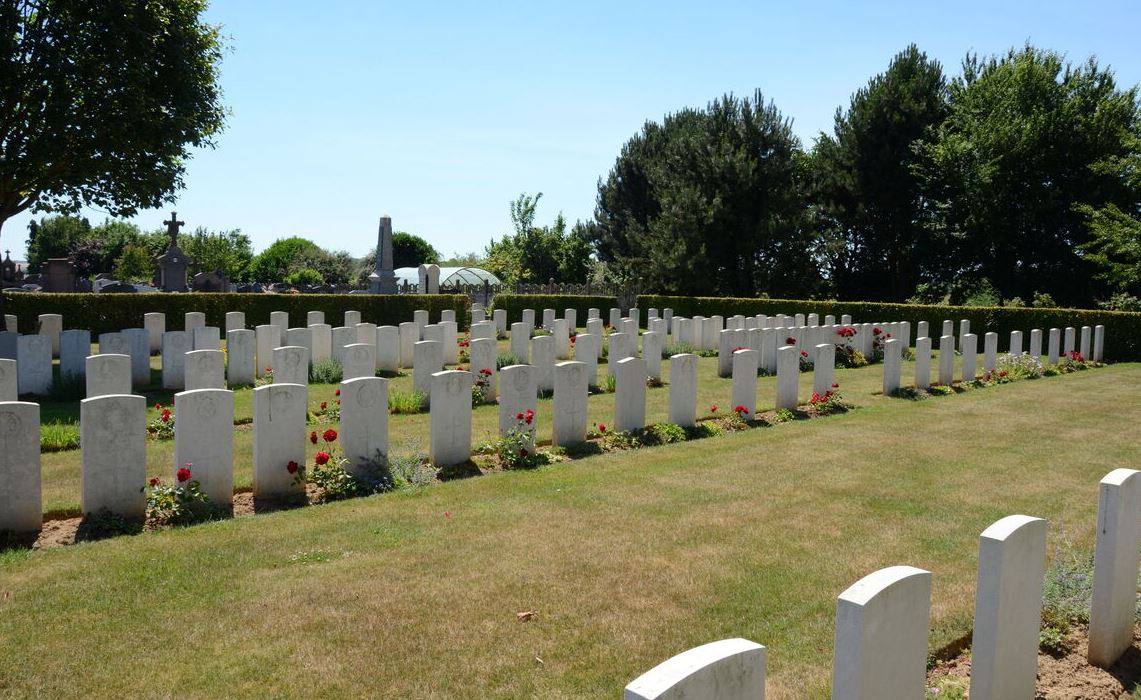
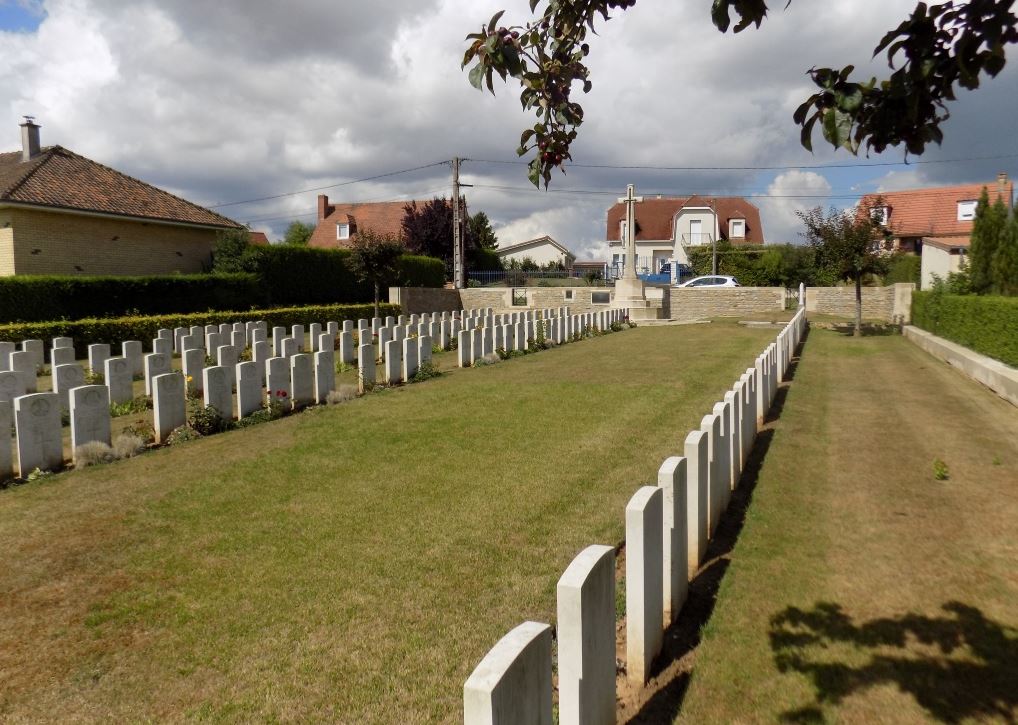
The chronology of the burials can be traced through all the rows of this small cemetery. The burials stop at 26 August 1918 on the back row (Plot 2, Row C). It is therefore possible to walk along the rows and follow the dates of the fatalities. But stepping back, and scanning the whole cemetery, the graves on the right of Row 'D' can be seen to be much closer together than the otherwise regular spacing that takes place. On a visit to this cemetery, this spacing drew my eye.
Row D
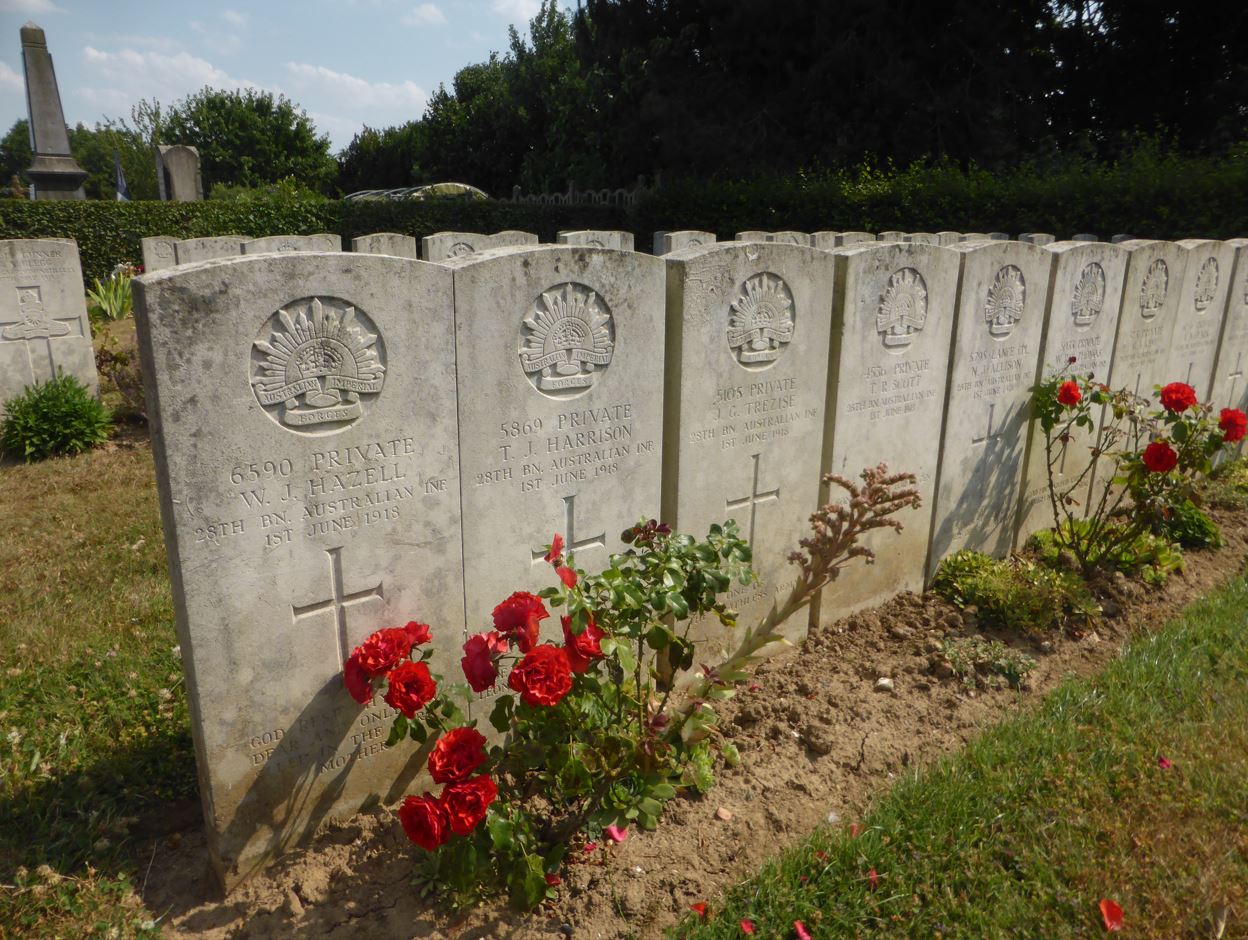
Looking at Row D, not only are some of the headstones almost touching each other, but they all give the same date: 1 June 1918. In addition, all the graves in the row at first glance seemed to be for men of the same Australian Imperial Force (AIF) battalion – the 28th.
This – I thought – deserved a closer inspection, so I went back to the start of the row and checked again, using the cemetery register to see if there was an explanation for this group of fatalities.
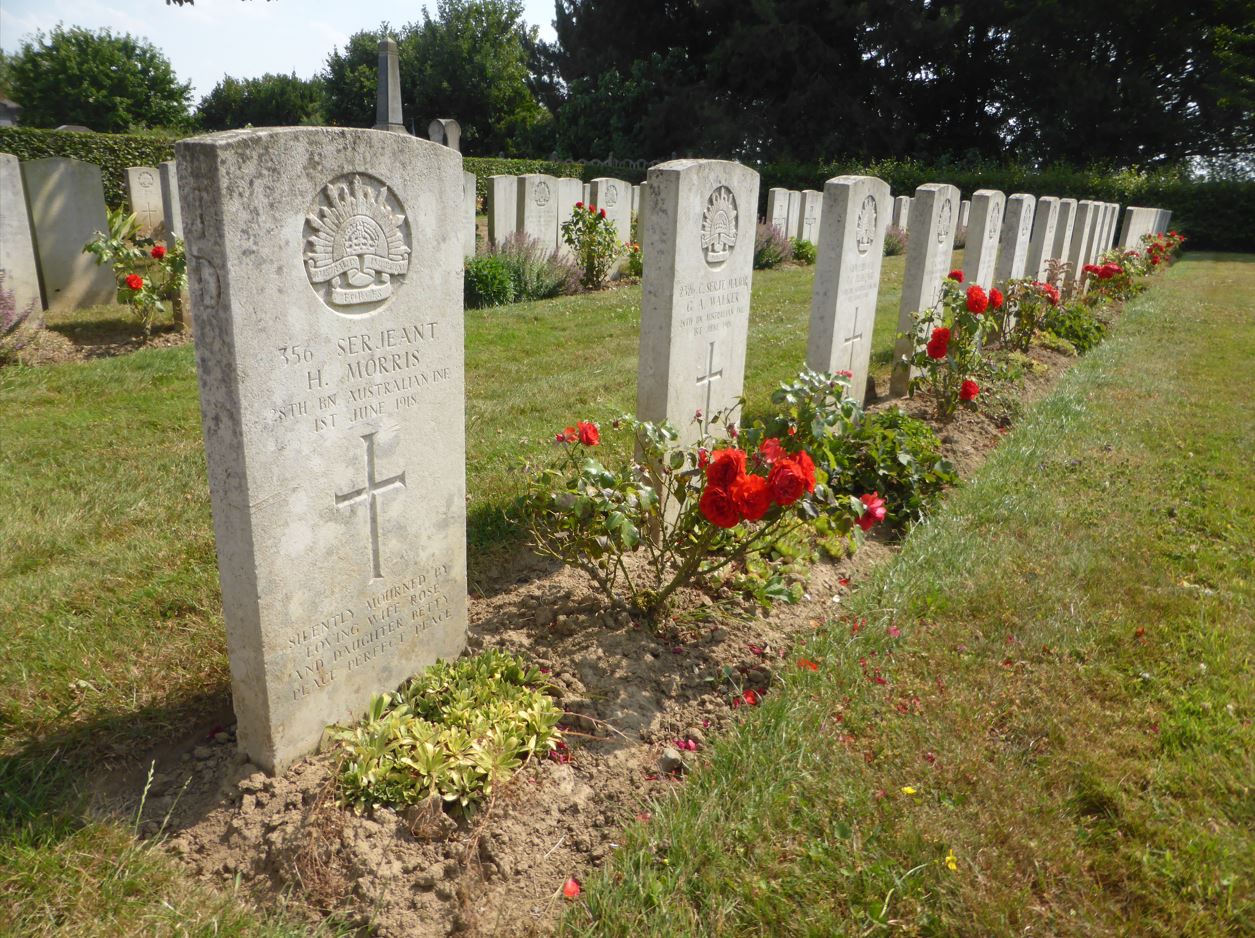
Grave 1 of Row D was that of Sergeant Herbert Morris, who was born in Headington, Oxfordshire (this I discovered later); next to him was a Company Sergeant Major, the remaining graves were of Privates (with three corporals and a lance corporal among them). Some of the graves carried the same reference number, suggesting two men were buried in the same grave, but in all cases the men buried here had separate headstones.
This closer inspection revealed a total of 26 headstones of this battalion, all dated 1 June. However, no explanation was forthcoming from the register. The date was not one on which a set-piece battle was taking place, and no other graves in the cemetery gave this date. There must have been some other explanation for these fatalities.
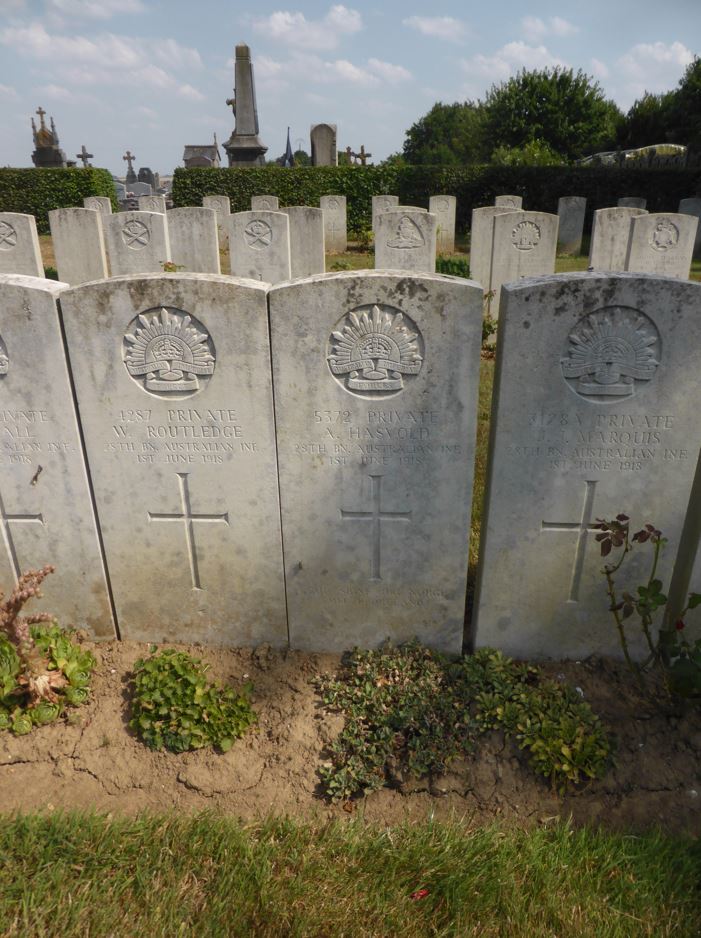
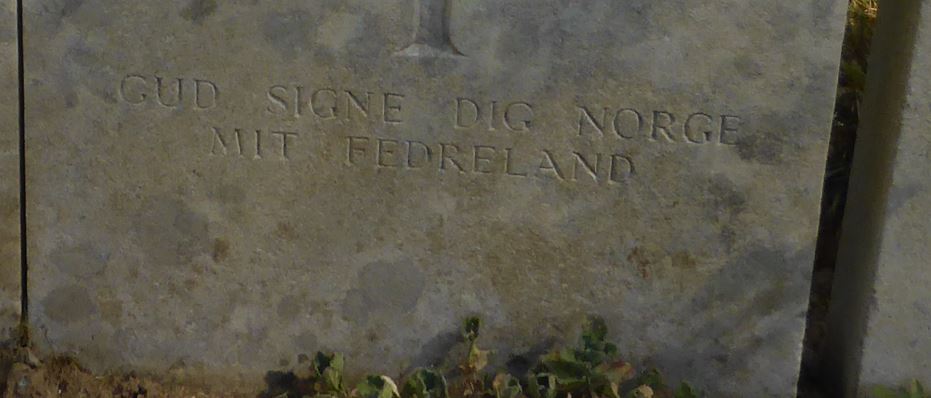
Further along the row one headstone in particular was highly unusual the personal inscription reading “GUD SIGNE DIG NORGE MIT FEDRELAND” (Translation: God Bless You Norway My Fatherland).
What happened?
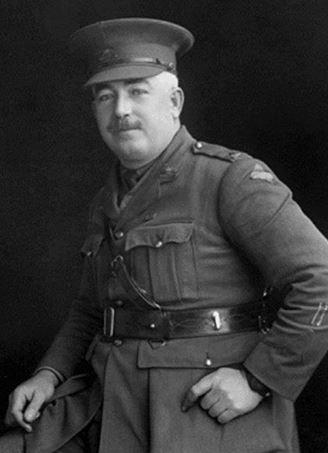
The 28th Battalion AIF was commanded by Lt Col Patrick Currie, aged 35 in 1918 he looked much older.
The battalion formed part of 7 Brigade, 2nd Australian Division. They had served in the later stages of the Gallipoli campaign, as well as at Pozières in 1916 before supporting attacks at Bullecourt and at Third Ypres in 1917.
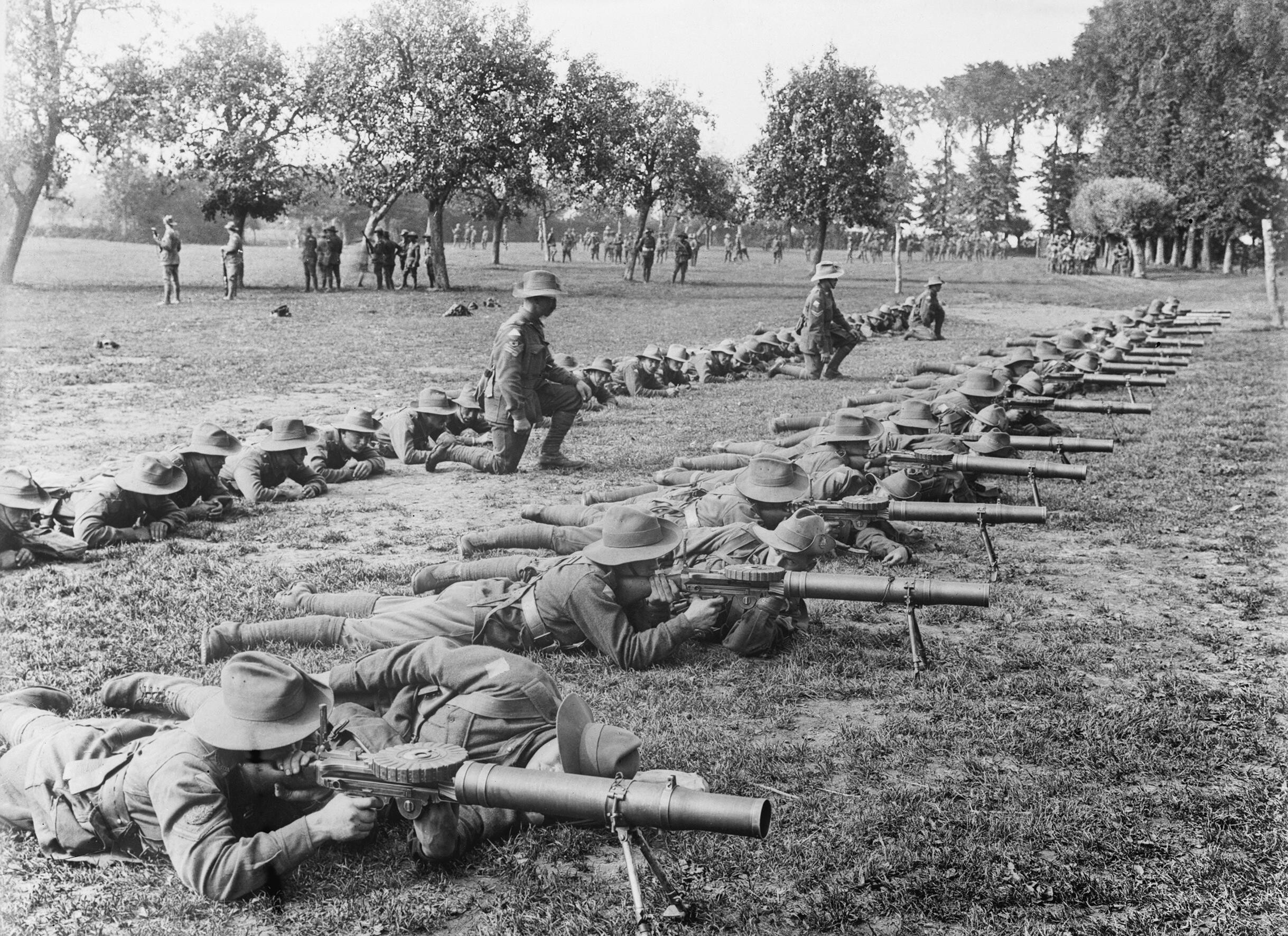
By 1918 the battalion was back on the Somme supporting an attack at Ville-sur-Ancre in May 1918. This was on 19 May, the battalion incurring four fatalities during this operation.
The battalion war diary notes they were ‘in the line’ again from 21 May to 25 May, then in Brigade reserve.
On 28 May the diary observed that the enemy continued to gas the vicinity of Marret Wood (actually Marett Wood – south of the Amiens-Albert Road) and one enemy aircraft was seen to crash at Franvillers. The following day, they noted ‘Two of our squadrons flew [over] the enemy lines in the direction of Bray and dropped bombs’. On 30 May the diary records ‘Great activity in the air. In an encounter, an enemy aircraft was seen to crash near our transport line at Frechencourt Wood’. Similar aerial activity was remarked on for the last day of the month.
During the whole month of May, fatalities to the battalion amounted to just twelve other ranks.
Death from the sky
Perhaps this aerial activity should have been more carefully noted, as - during the battalion’s relief - they were hit by bombs from a German aircraft. The war diary relates the events as follows:
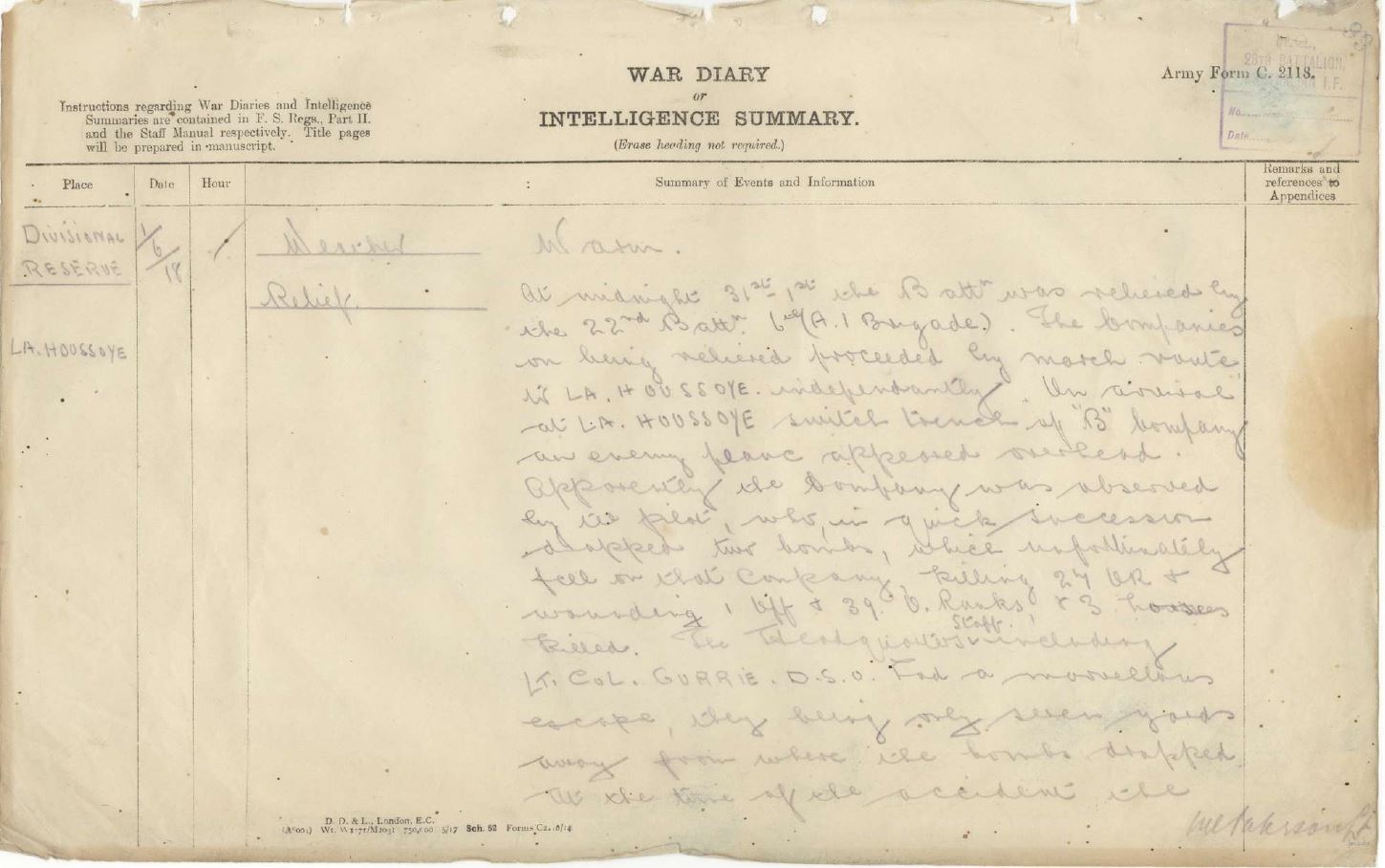
La Houssoye. 1 June 1918. Weather: Warm.
At midnight 31st/1st the battalion was relieved by the 22nd Battalion… The companies on being relieved proceeded by [route march] to La Houssoye independently. On arrival at La Houssoye Switch Trench [by] “B” Company an enemy place appeared overhead. Apparently the company was observed by the pilot, who, in quick succession, dropped two bombs, which unfortunately fell on that Company killing 27 other ranks and wounding 1 officer and 39 other ranks and three horses killed. The headquarters staff, including Lt Col Currie DSO had a marvellous escape, they being only seven yards away from where the bombs dropped. At the time of the accident the men were in excellent spirits after their time at duty in the trenches and brigade reserve. The affair cast a gloom over the whole of the battalion. The bodies were buried in Franvillers Cemetery.
The diary goes on to describe how the next few days were passed in Divisional Reserve at La Houssoye.
The fatalities
Buried alongside each other, and sometimes in ‘combined graves’ the men of the battalion who were hit by this unexpected disaster and who are buried at Franvillers Communal Cemetery Extension are detailed below. They are listed in the same order as they are buried in Row 'D', from left to right.
Photographs of Original graves
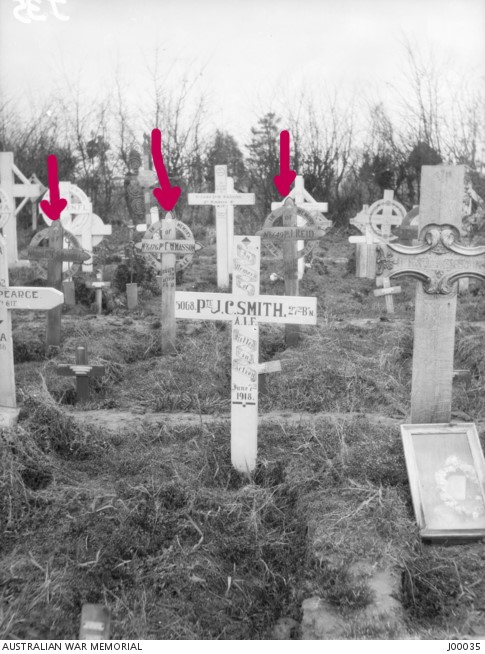
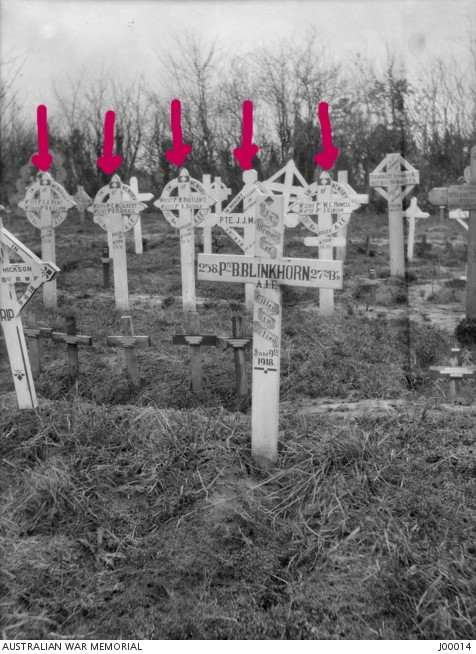
Remarkably, we are able to see the original graves of some of these men. A project was undertaken immediately after the war to photograph the graves of men of the 27th Battalion. In the background of some of these 27th Battalion men, the graves of the men of the 28th Battalion in Franvillers Cemetery can, if the photographs are enlarged, be identified.
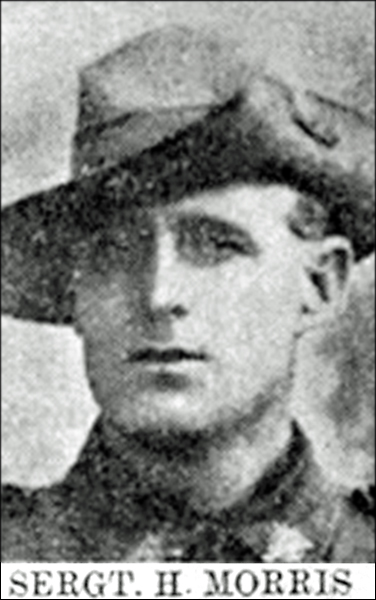
356 Sgt Herbert Morris
Probably the most 'colourful' of the men buried here, Herbert was born in 1886 and joined the Royal Navy on 2 January 1903. He was serving on HMS Drake when, on 12 April 1908, he married Daisy Elizabeth Ada Heath at St. John's Church, Weymouth. This was probably the most honourable thing he could have done as - six months later - the first of his children was born. Richard Herbert Samuel came along on 18 October 1908, and was later followed - in March 1910 - by Frank Mark.
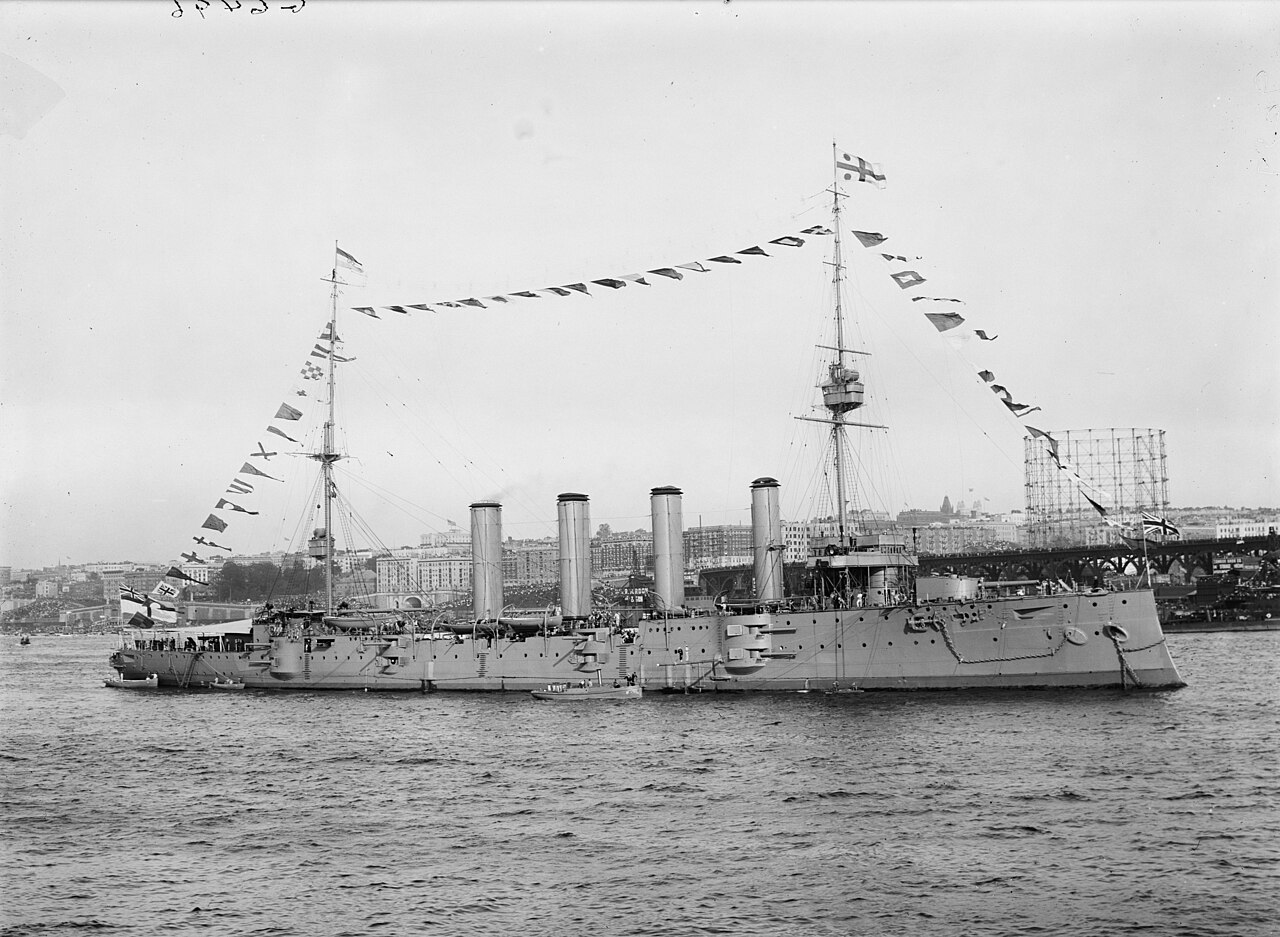
It would seem Herbert regretted his marriage. Three years later, in late 1911, HMS Drake departed for Australia: she was designated as the new flagship for the Australian Squadron of the Royal Navy. But on 30th January 1912, Able-Bodied Seaman Morris jumped ship whilst in Fremantle. Despite being reported in the Western Australian Police Gazette, it is probable that he successfully 'disappeared' and began a new life, without his wife and sons, in Western Australia.
When the war came along, Herbert was working as a brick-layer; he enlisted in the AIF on 2 March 1915.
By early 1917 Herbert was serving in France but, having caught dysentery, was transferred to the UK where he was sent to the 1st Southern General Hospital, Edgbaston. This may have been where he met Rose Warren, as they married in late 1917. It is doubtful that he divorced his first wife, so this was almost certainly a bigamous marriage.[1]
2326 CSM George Archer Walker
Like Privates Kent and Barge, George Walker was an early recruit, signing up in March 1915 and sailing on 13 October 1915 for Egypt, where he arrived on 19 January 1916. Within a week, he was promoted to Sergeant. After being shipped to France in March, he was promoted to Company Sergeant Major in October.
George was allowed leave in England in April 1917 but on returning to France, was admitted to hospital 'sick' in June, but soon re-joined the battalion. Between February and May 1917 he was temporarily promoted to Regimental Sergeant Major.
He was wounded on 20th of September 1917, but remained in France. After convalescing, he re-joined the battalion in March 1918.
When he was killed he was 27 years of age, and left a wife, Mrs Alice Maud Walker, who resided at 21 Harvey Street, Boulder, W.A.
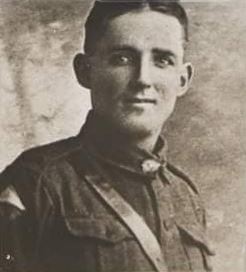
5101 Pte Thomas Chester Trelease
Thomas (but known by his middle name Chester) Trelease was born in 1889 in Liskeard, Cornwall. He arrived in Fremantle, Australia in June 1913, on the ship Osterley.
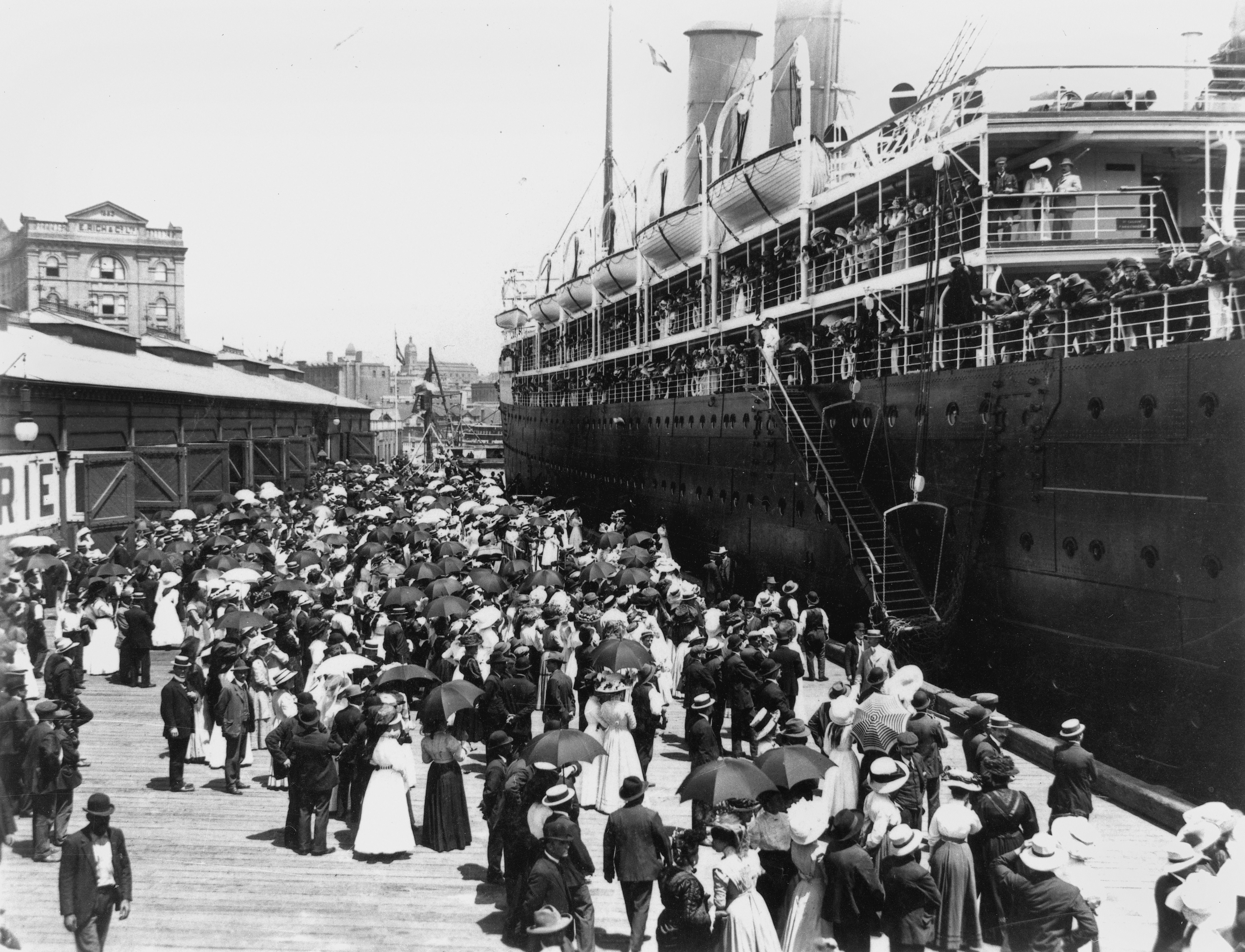
He enlisted in the AIF on 22nd February 1916 in Perth, WA (claiming that he was born in Michigan, USA which cannot at this stage be explained) and embarked with the 28th Infantry Battalion, 13th reinforcements on the HMAT Seang Bee on 18th July 1916.
Arriving in the UK on 9 September, he was absent without leave for 24 hours in October (which resulted in forfeiting nine days pay). Chester arrived in France on 3 November where he was held - presumably to undertake extra training - in Etaples for several weeks. He joined the 28th Battalion on 13 January 1917. Within five days he went sick with 'Trench Foot' and subsequently returned to the UK. While recovering, he was in trouble again for being absent without leave for four days. This resulted in him receiving 'Field Punishment Number 2' and a loss of pay.
Chester returned to France, re-joining the battalion in late October 1917.
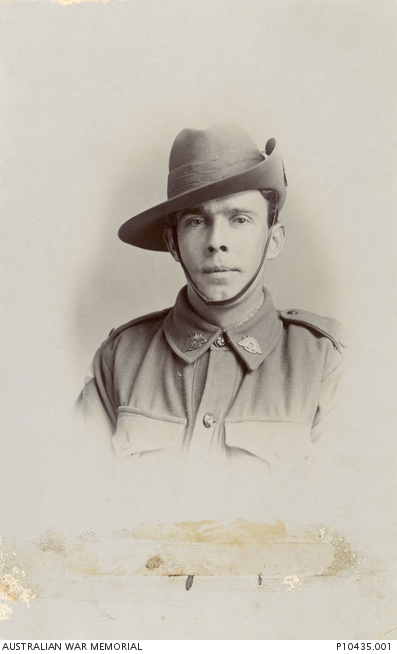
6548 Pte Edward Russell Bates
Born in Auckland, New Zealand in 1887, Edward was the son of Frederick and Annie Bates and the husband of Ruth Bates, of Perth, Western Australia. He enlisted in the AIF relatively late, in November 1916. Departing Fremantle in January 1917 he arrived on HMAT A28 Miltiades at Devonport in March but, en-route, he had been transferred for a while to a hospital ship. After undertaking training in the UK he arrived in France in November 1917.
Among the personal effects returned to his wife, Ruth, after the war was a damaged watch, which can only have assumed to have been what he was wearing when killed.
228 Cpl William Barge
William was the son of William and Susan Barge. Born in Manchester in 1895, the family moved to Coombe Farm, Dorset. Aged 16 in 1911, he went - seemingly on his own - to Australia, where he enlisted on 4 March 1915. He served briefly in Gallipoli and then was, with the rest of the battalion, moved to Egypt. In Egypt he as 'admonished' for being absent from tattoo.
Arriving in France in March 1916, William was wounded in May 1916, re-joining the battalion after treatment in the UK in March 1917. William was promoted to Corporal in May 1917. After falling sick in early 1918, he rejoined his battalion again in March 1918.
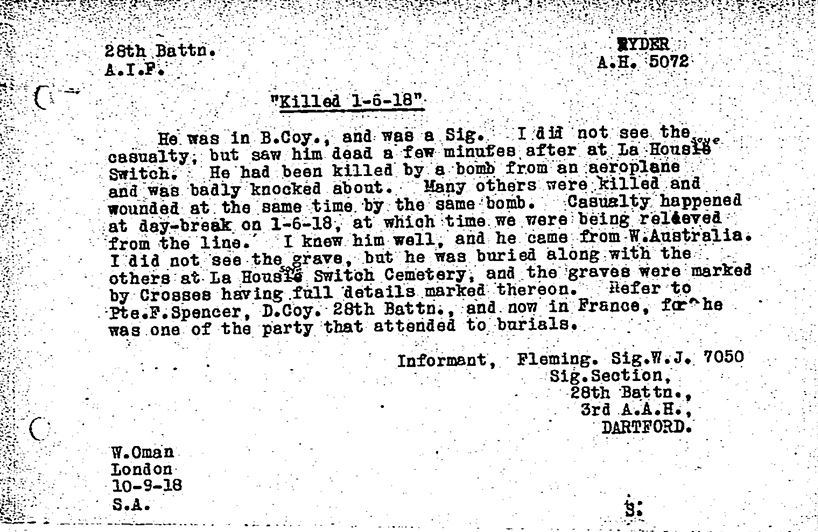
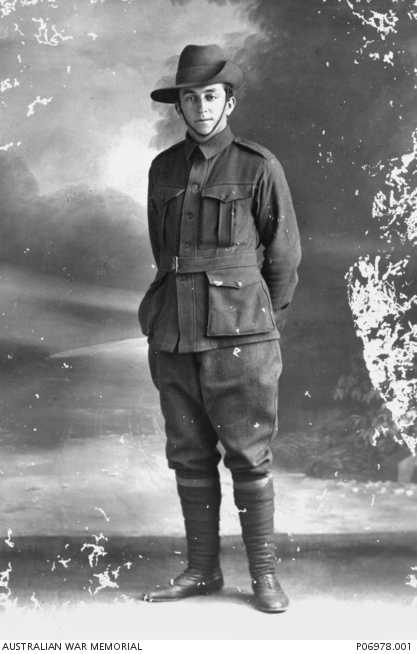
5072 Pte Arthur Henry Ryder
Arthur was the son of Benjamin and Charlotte Ryder, of Balmoral, Southern Line, New South Wales, Australia. Before the war he worked as a station master.
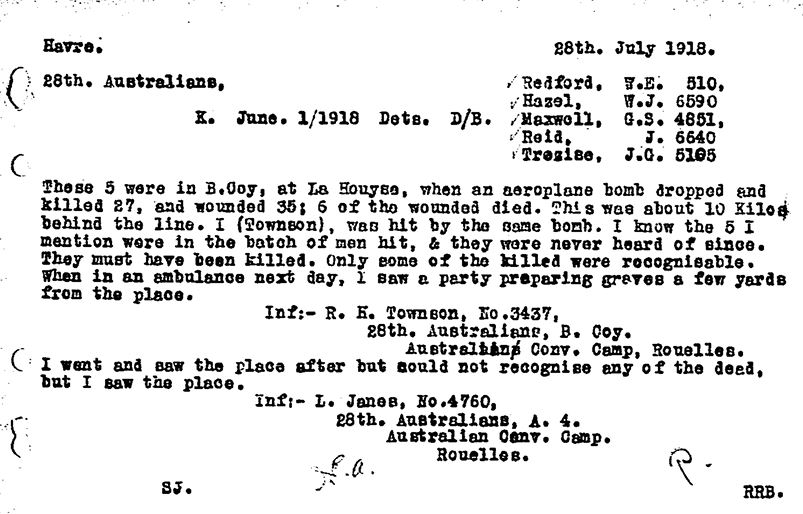
Within the Australian Red Cross Society Wounded and Missing Enquiry Bureau files are a number of brief reports for some of the men killed on 1 June. An example of two of these reports are shown below. It will be seen the first of these refers to Pte Redford, who was also among those killed.
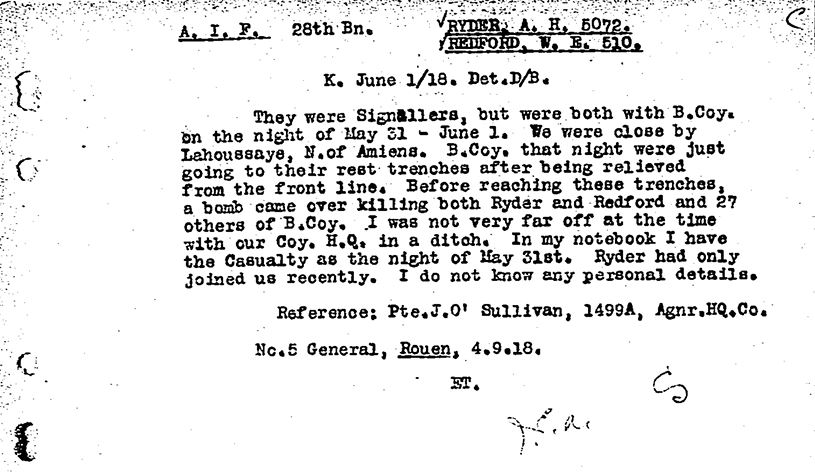
510 Pte Wesley Ernest Redford
Wesley joined the AIF in March 1915, again he was another 'digger' born in the UK (he was a native of Watford, born in 1895). Apparently working on the railways in Australia (his trade was a 'Sleeper Cutter') he was sent to Gallipoli, arriving on September 1915.
After moving with his battalion to France he was wounded in late July 1916, evacuated to the UK and returned to his unit in November of that year. In October 1917 he was seemingly harshly punished with Field Punishment number 2 for seven days for 'smoking in billets'. He enjoyed a week's leave in Paris in March 1918 before re-joining the 28th Battalion.
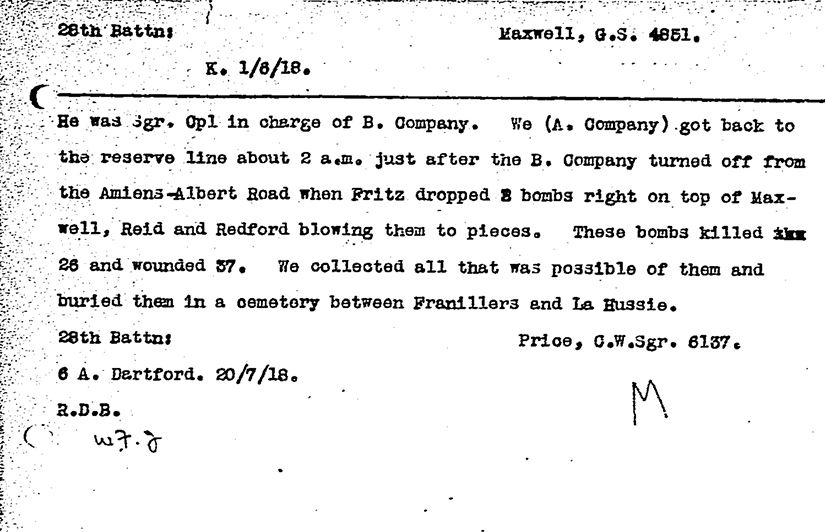
4851A Cpl Gerald Saville Maxwell
Native of Bendigo, Victoria, Australia, Gerald was the son of William and Stella Maxwell of Upper Fenton St., Devonport, Tasmania. Aged just 20 and a Corporal, he must have had a strong personality to be a NCO among tough, older men. A pre-war clerk he joined up in January 1916 therefore missing the Gallipoli campaign. Moving from Egypt to the UK for training, he joined the battalion in France in December 1916, therefore missing the Somme campaign.
Frederick was wounded in action on 28 September 1917, but was seemingly treated in France, so it was probably not a severe injury. He was promoted to temporary Corporal in mid-May, just a couple of weeks before his death.
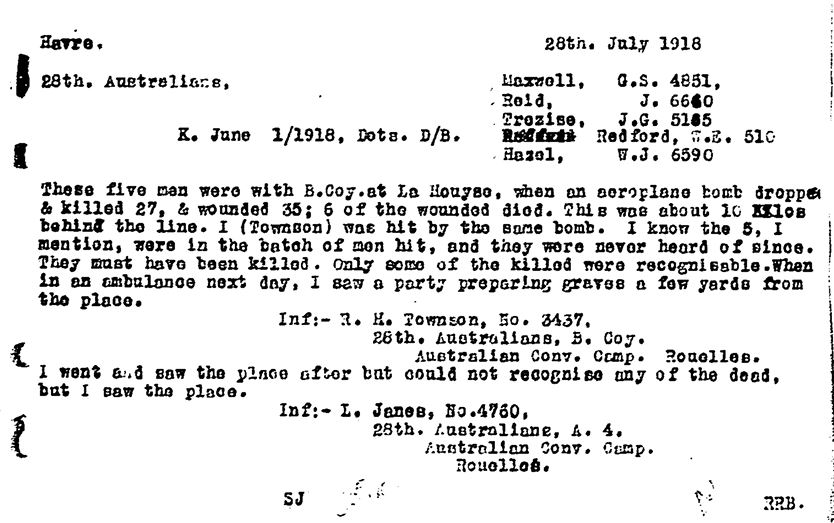
The Australian Red Cross Wounded and Missing Bureau file report suggests he was known as 'Max' but also hints at the devastation that was wrought by the bombs.
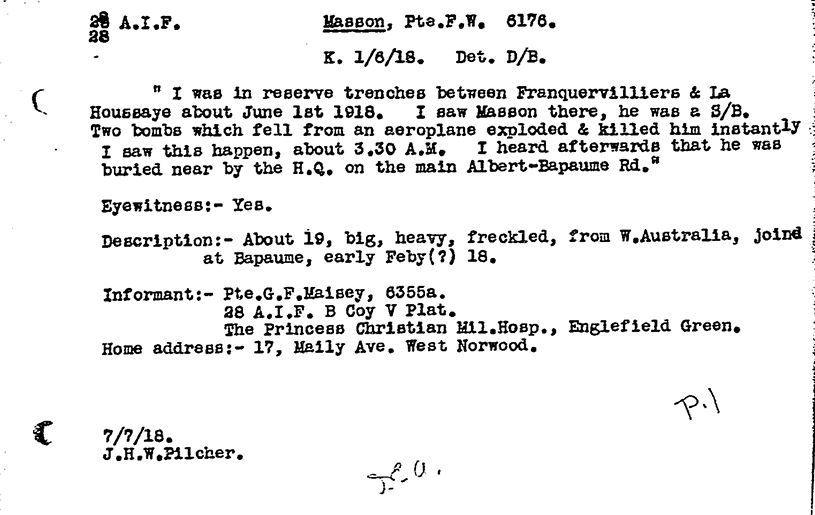
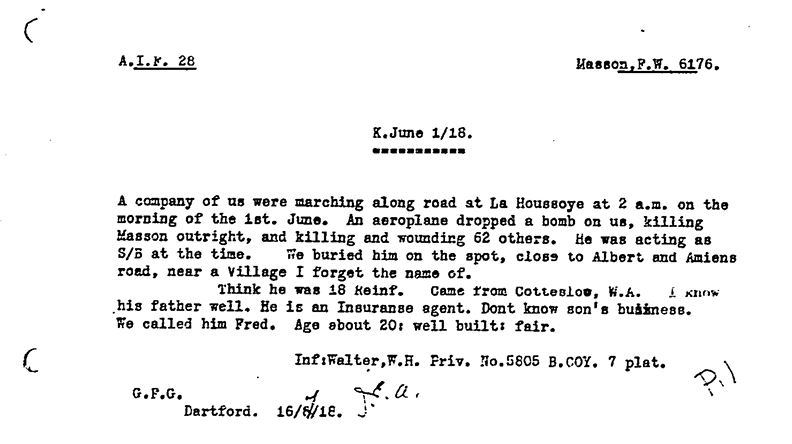
6176 Pte Frederick William Masson
A native of Northam, Western Australia, in pre-war life Fred (as he signed himself on his attestation form) was a Baker. He signed up aged 18 in September 1916. Fred arrived on the troopship in the UK in January 1917 but was soon hospitalised with an ingrowing toenail. After discharge, he arrived in France in May 1917. He was 'absent without leave' for nine days in March 1918 until reporting back on 20 March - this resulted in him forfeiting pay as a punishment.
Once again, there are reports from the Red Cross Society detailing what happened to him on 1 June.
6640 Pte John Reid
Born in Wemyss, Fifeshire (Scotland) John signed up for the AIF in October 1916. His profession was noted as 'Carpenter'. Along with Edward Bates he sailed on SS Miltiades, arriving in the UK in March 1917. He joined the battalion in France on 22 October 1917. A note on his service file indicates the 'accident' (as they called it) occurred just half a mile from where he was buried.
His wife, Isabel M. Reid, of 216 South Street, Fremantle, received a few of his personal effects after the war.
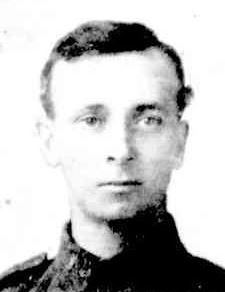
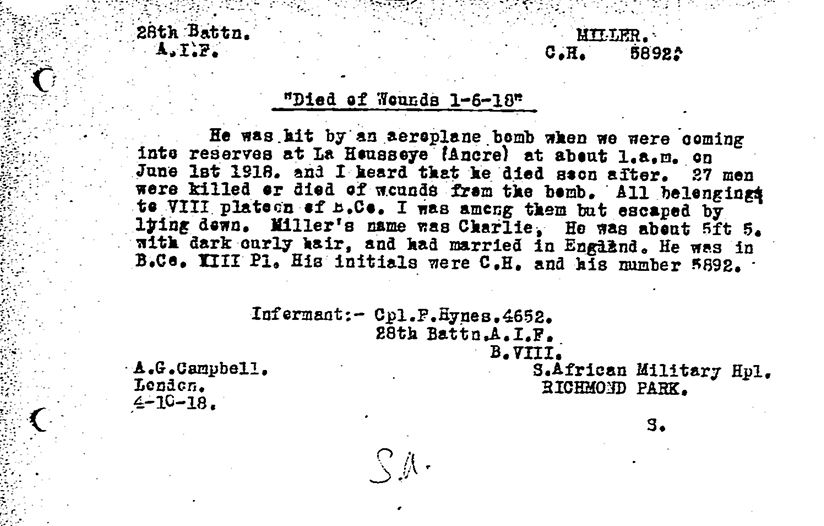
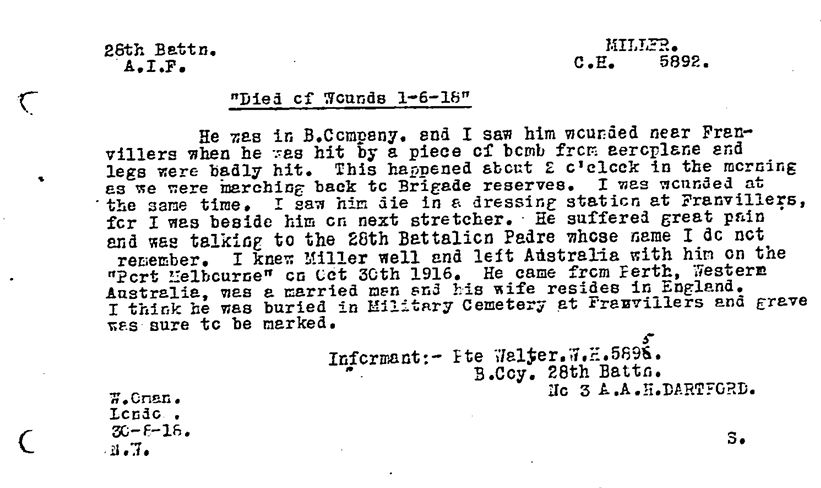
5892A Cpl Charles Hampden Miller
Charles was born in Sydney, NSW and signed up for the AIF in May 1916. On his attestation papers his wife's address is given as being in Surrey, in England. Upon arriving in France in April 1917, he transferred from the 27th Battalion to the 28th Battalion (which resulted in the letter 'A' being added to his number). Wounded in the scalp on 20 September 1917, he rejoined his unit six weeks later.
Two of the Australian Red Cross Wounded and Missing Bureau files are revealing:
In row 'D' is, at grave number 12, Private Arthur Hawkes of the London Regiment (who was also killed on 1 June 1918). After the grave of Private Hawkes is a gap, then the rest of the row has the following graves, which are much closer together than the left half of the row.
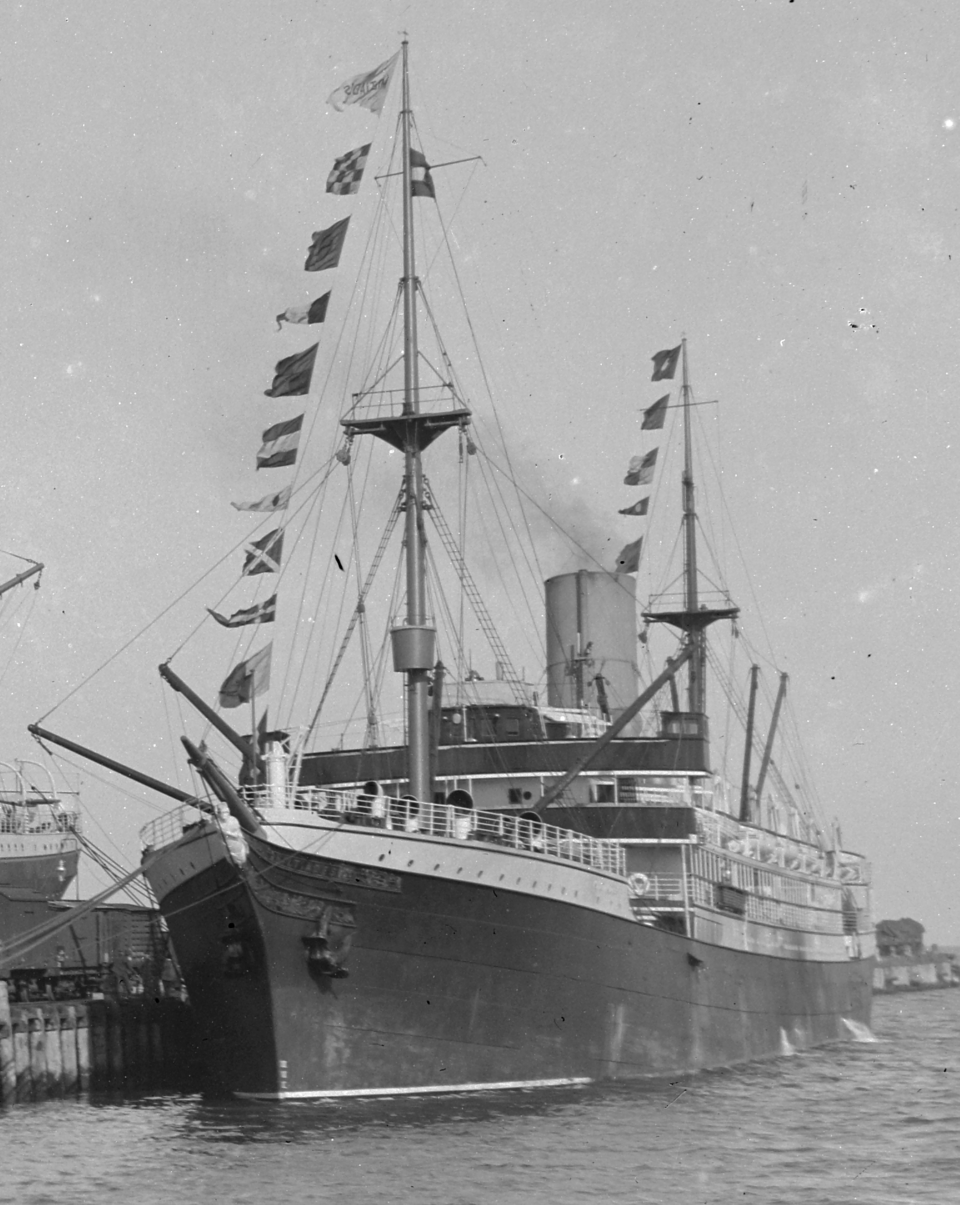
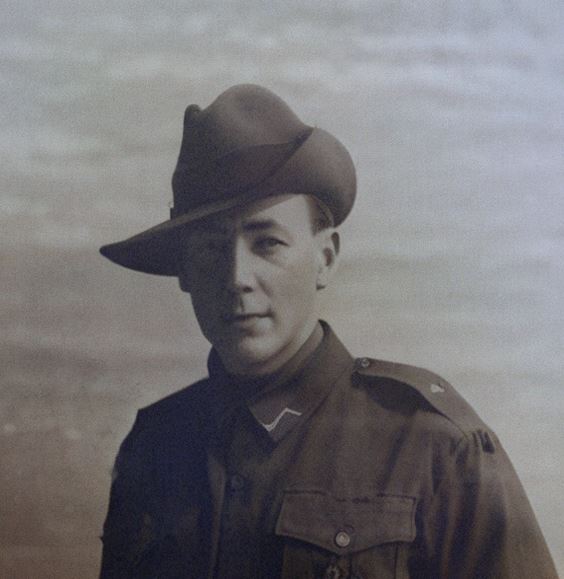
6590 Pte William James Hazell
Born in 1896 in Cranbrook, Western Australia, William was a labourer who signed his attestation papers with a cross when he joined up in September 1916. Another passenger on SS Miltiades. He joined the battalion in France in July 1917. He did not trouble the authorities with any 'crimes' but was noted as being 'sick' on several occasions, lastly with diarrhoea in January 1918.
5869 Pte Thomas Johnson Harrison
Thomas enlisted at Blackboy Hill, Bunbury, Western Australia in 1916 aged 23 years and then departed on 10 October 1916 for Plymouth, England, arriving on 20 December 1916.
After suffering a gunshot wound to the foot, Thomas was evacuated through 5th Australian Field Ambulance to the 49th Casualty Clearing Station before arriving at No 3 Static Hospital in Rouen. After receiving treatment, he spent time at No 2 and No 11 Convalescent Units before returning to his Battalion on 14 August 1917. He was again wounded, this time gassed, when his trench was hit by gas shells on 29 October 1917 and was evacuated via Boulogne to Venice Street Auxiliary Hospital in Liverpool on 21 November 1917.
Having spent time convalescing at Venice Street Hospital, he was transferred to Harefield’s Hospital and several more convalescent units before he went AWOL for nine days in London, only reporting for duty in Bulford on 27 January 1918 and was therefore fined 10 days’ pay.
During his stay in Bulford he reported sick and was isolated with scabies for six days, and eventually rejoined his Battalion in France on 21 May 1918 just twelve days before his death.
Thomas was the son of Leon and Elizabeth Harrison, Primrose Cottage, Gordon Road, Tideswell in Derbyshire. Two of his brothers also served.
5105 Pte John Gordon Trezise
John, a 26-year-old shop assistant, enlisted in March 1916. Born in Broken Hill NSW, he left Fremantle on the 'Seang Bee' (the same vessel that transported Pte Trelease (see above) in July 1916, arriving in Plymouth on 9 September. Wounded in action on 4 October 1917, he was treated in France and re-joined the battalion on 5 February 1918. Allowed leave in England from 9 to 27 February, he had a 'clean' disciplinary record.
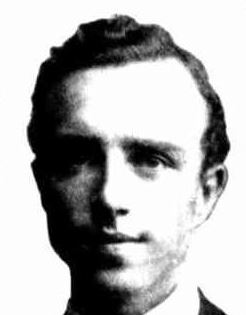
4536 Pte Thomas Richard Scott
A labourer before the war, Thomas signed up, aged 23, in February 1916. He was a native of Capel, Western Australia. Departing his homeland in March 1916 he first landed in Alexandria on 2 June before arriving in Plymouth ten days later. Proceeding to his battalion, via Etaples, he joined the 28th 'in the field' on 30 September 1916. Evacuated to the UK in mid-November with piles, he was back in Etaples by mid-January 1917. Reporting sick only a month later, he was this time treated in France and was back with the battalion in late April.
5795 L/Cpl Norman John Allison
A 21 year old Blacksmith, Norman signed his attestation forms in June 1916. The passage from Fremantle to Plymouth took place between 10 February and 2 December 1916. He suffered from tonsillitis in February 1917 and joined his battalion in France in March 1917 but was soon admitted to hospital suffering from pneumonia, necessitating evacuation to the UK where he stayed until July. Wounded in action on 4 October he was again back in the UK for a long period, which included a period of treatment for syphilis; eventually returning to his battalion on 8 May 1918.
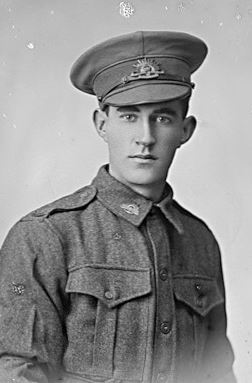
5933 Pte William Robert Stephen Thomas
Another soldier from Capel, WA it is possible William knew Thomas Scott who was also from this town. However the notable matter pertaining to this soldier is that he seemed to have enlisted twice. First of all in September 1915 using the given names William Robert Stephen, he went absent in May 1916 and was discharged. His service record suggests that he promptly re-enlisted using the given names 'James Howard Clark' but retaining his surname of Thomas. This second enlistment took place on 8 June. Whatever the reason for this 'second attempt', his father seems to have gone along with it, as he counter-signed the enlistment papers, given his son was under the age of 21.
After arriving in the UK on 2 December 1916 William proceeded quickly to France, arriving in Etaples on 22 December, but was soon hospitalised with (suspected) Mumps. Joining his unit (presumably he did not have Mumps) he then suffered from Trench Foot in February which resulted in him being sent back to the UK. He recuperated for a lengthy period, re-joining the 28th Battalion on 18 October. Wounded in the arm and gassed in early November, he was back in the UK shortly afterwards.
Discharged from hospital in March he promptly went absent without leave for 3 days. He rejoined the battalion on 15 May 1918 but was killed little more than a fortnight later.
323 Pte George Albert Kent
The 25 year old George Kent signed his attestation papers on 4 March 1915, one of the earliest recruits of those men to be killed (William Barge joined on the same day - they both have very early regimental numbers).
Embarking for Gallipoli he landed on the peninsula on 4 September, spending four months there before arriving at Alexandrea, via Mudros in early January 1916. Marseilles was his next destination, where he disembarked on 21 March but was admitted to hospital in France in May with influenza on 1 May 1916. Returning to the battalion, he was again in hospital in October (Gastritis), which later was re-diagnosed as dysentery. He eventually found himself in hospital in Dartford in January 1917 and then in Wareham for recovery. He remained in England with the 70th Battalion for six months.
Eventually he found himself back at the front in the 38th Battalion in October 1917 but was then sick in hospital with bronchitis in January 1918 which necessitated another return to England. Proceeding to France, he went through Etaples in early May and re-joined his old comrades in the 28th Battalion on 15 May.
6056 Pte Victor Albert Clark
Victor, a 25-year-old farmer from Bordertown, South Australia, signed up for the AIF in June 1916. Departing Fremantle some months later (November 1916) he arrived in Devonport on board SS Argyllshire in January 1917. By 30 April he was at the Etaples base in France and then joined the battalion.
Victor avoided any wounds during the rest of the year, but in January 1918 was admitted to hospital with frostbite. After discharge from hospital he went absent without leave for eight days from the convalescent depot in England, which cost him 24 days pay.
He re-joined the battalion in France on 15 May only to be killed a few days later.
4979 Pte Edwin Middleton Gilbert
Born in Battersea, London, Edwin was 29 years old when he enlisted in November 1915. He described himself as a farmer. Edwin was the third of the men to be killed on 1 June who departed his homeland on the Seang Bee - the departure being in July 1916. His time in the UK was quite brief; the ship arriving in Plymouth in September 1916, he was in France on 3 November. Only 9 days later he went into isolation at Etaples with Mumps. After recovery, he found himself in the 38th Battalion, with which unit he was wounded in March 1917.
Sent back to England, he went to hospital and was discharged in May and went to a convalescent camp which - luckily for him - turned into an extended stay in the UK. Eventually he was re-classified as fit to serve at the front and went back to France in October, re-joining the 28th Battalion with which he served until killed on 1 June 1918.
6543A Pte Albert Henry Boxall
Albert Boxall was among the oldest of the men to be killed on 1 June, being aged 31 when he enlisted in October 1916. He detailed his trade as 'Farm Labourer'. Yet another passenger on the Miltiades, he arrived in Devonport in March 1917. Training in the UK kept him out of France until November 1917. He joined the 28th Battalion on 8 December 1917 and the letter 'A' was added to his regimental number.
He went to hospital 'sick' on 6 May 1918 but was soon discharged. He re-joined the battalion on 28 May, only four days before the attack by the German aircraft that killed him and so many of his comrades.
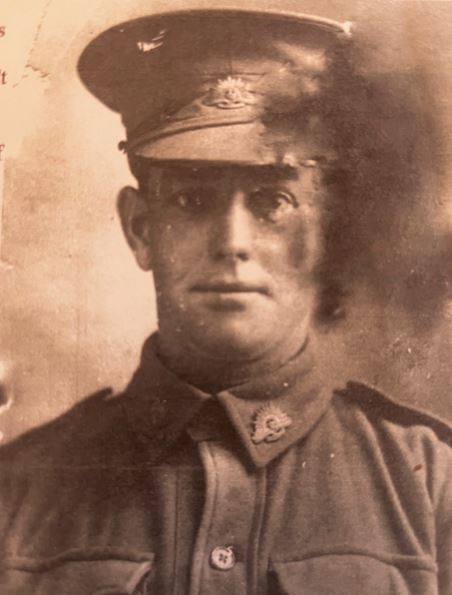
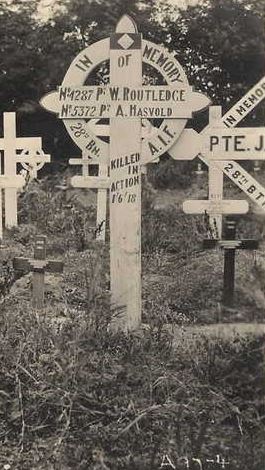
4287 Pte William Routledge
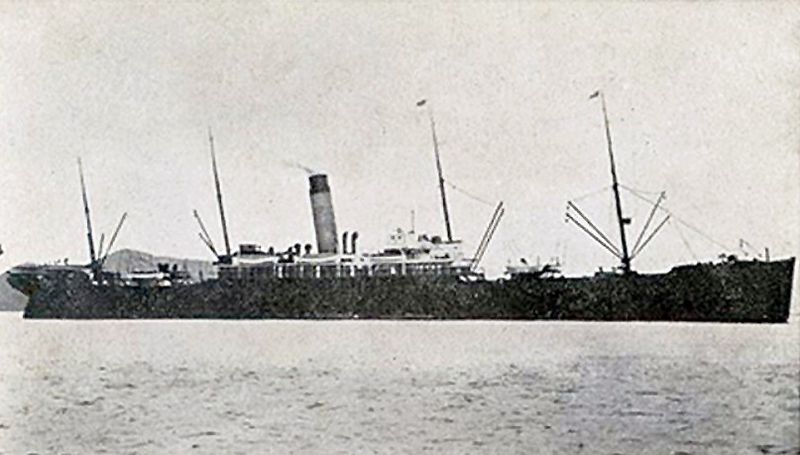
Born in 1873 in Cumberland, William was - by a significant margin - the oldest of the 1 June fatalities, being 42 when he joined up. Describing himself as a miner, he enlisted in the AIF in December 1915. In April 1916 he found himself on the SS Minnetonka - a pre-war transatlantic liner. He arrived in Plymouth in June and was rapidly in France, being in the Base Depot in Etaples by 26 July. From there, he proceeded to join the battalion serving for a year before taking leave in England in July 1917.
Avoiding illness and wounding, he served in the battalion until his death on 1 June 1918.
The CWGC record his age as 42, but given he was that age when he enlisted, his actual age when he was killed was 44.
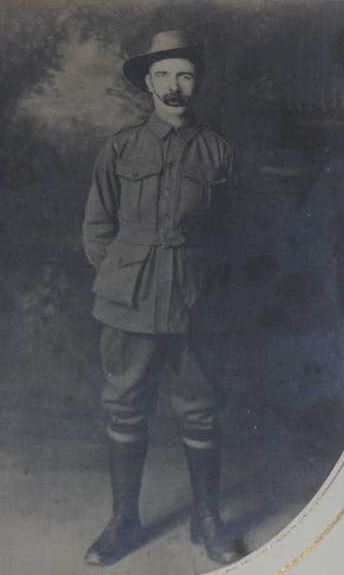
5372 Pte Askel Hasvold
Askel, aged 29, enlisted in the AIF in February 1916. He described his employment as a 'lumper' (a manual labourer hired to load and unload cargo). Yet another soldier to use the SS Miltiades he arrived in Plymouth in September 1916 and joined his battalion in France in early December of that year. Wounded in action on 3 May 1917 he was hospitalised in the UK until June but was then re-admitted with Dermatitis. He rejoined his battalion in November 1917.
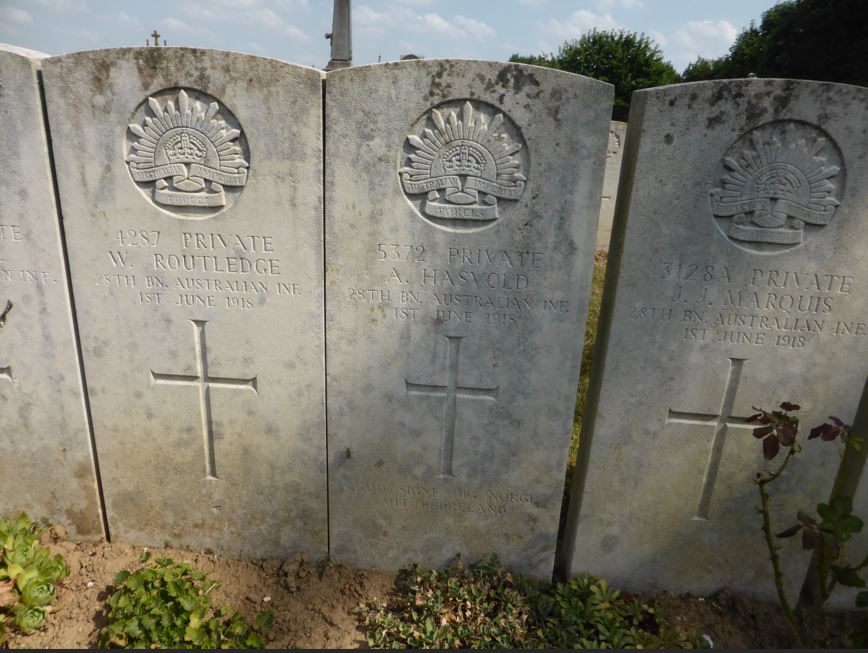
3128A Pte John Joseph Marquis
Another man born in the UK, John hailed from Newcastle. Enlisting - aged 23 in July 1916 and describing his trade as a Farmer, John remained in Australia until November and then boarded the SS Argyllshire on 9 November (it will be noted that one of his co-passengers was Pte Clark mentioned above).
Although not noted on the CWGC records, within his service file is a reference to a brother, Frederick William Marquis, who was killed in September 1918. Both brothers served together in the 28th Battalion.
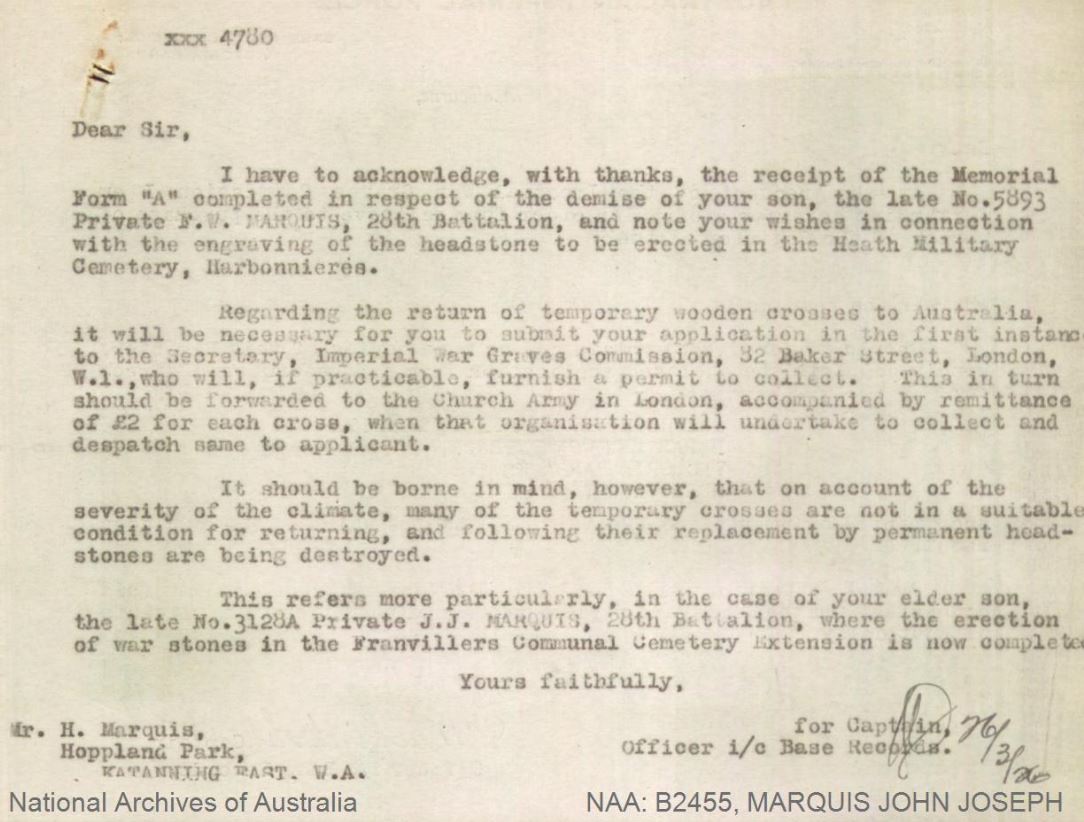
John was absent without leave for just two days whilst in England (losing six days pay) and went out to France in October 1917. Joining the battalion, the letter 'A' was added to his number and he served with the 28th alongside his brother until February 1918 when he went sick. Returning to the battalion in early May he served a further month before being killed.
3119 Pte William George Howell
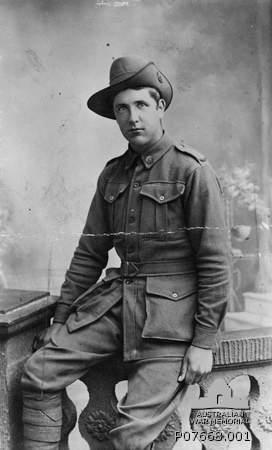
Another farmer, the 29 year old William enlisted in July 1916 and departed Fremantle on the SS Argyllshire in November. He arrived in Devonport in January 1917 and was in the UK until October, joining his battalion via Le Havre. He did not suffer wounds or illness until his death on 1 June.
4737 Pte James Gibson
19 year old James Gibson, a clerk from Balmain NSW signed up for the AIF on 10 February 1916. Leaving Australia in April he arrived in the UK where he undertook training until September. Arriving at Etaples on 16 September, by the 26th he was with his battalion in Belgium. Evacuated to the UK in November with Trench Foot, he spent the whole of 1917 in the UK, presumably deemed unfit for front line duties in France. However on 8 January 1918 he had returned to the 28th Battalion with which he served until being killed on 1 June.
At the end of Row 'D' are the graves of five men - two from the Machine Gun Corps and three Australians. All of these men were killed after 1 June 1918.
Querrieu British Cemetery
Less than five miles away from Franvillers is Querrieu. Famous for being the site of Rawlinson's Headquarters during the 1916 Battle of the Somme, it also has a military cemetery. In Row B, graves 26, 27 and 28 are three more men from the 28th Battalion AIF who were killed on 1 June 1918.
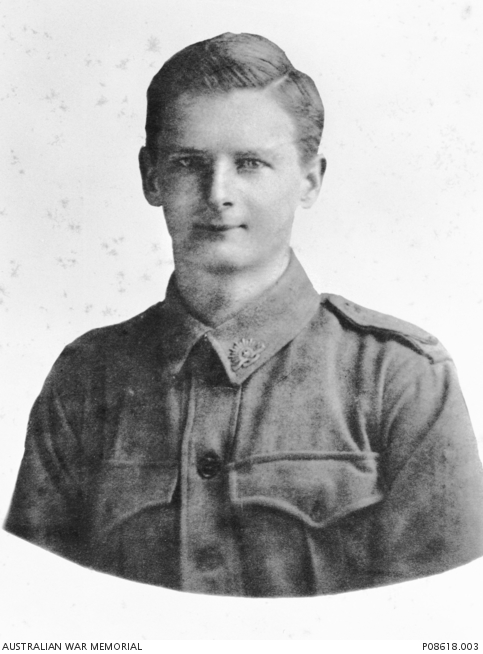
5934 Pte John Alexander Thompson
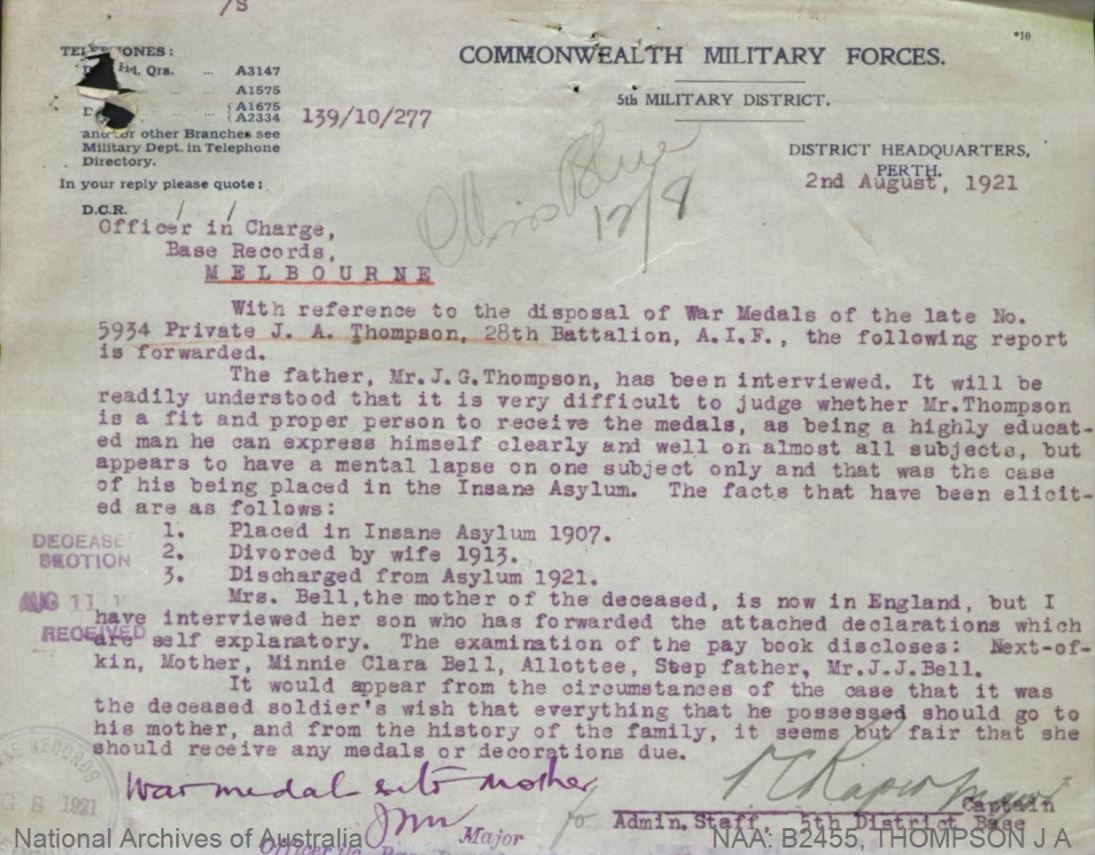
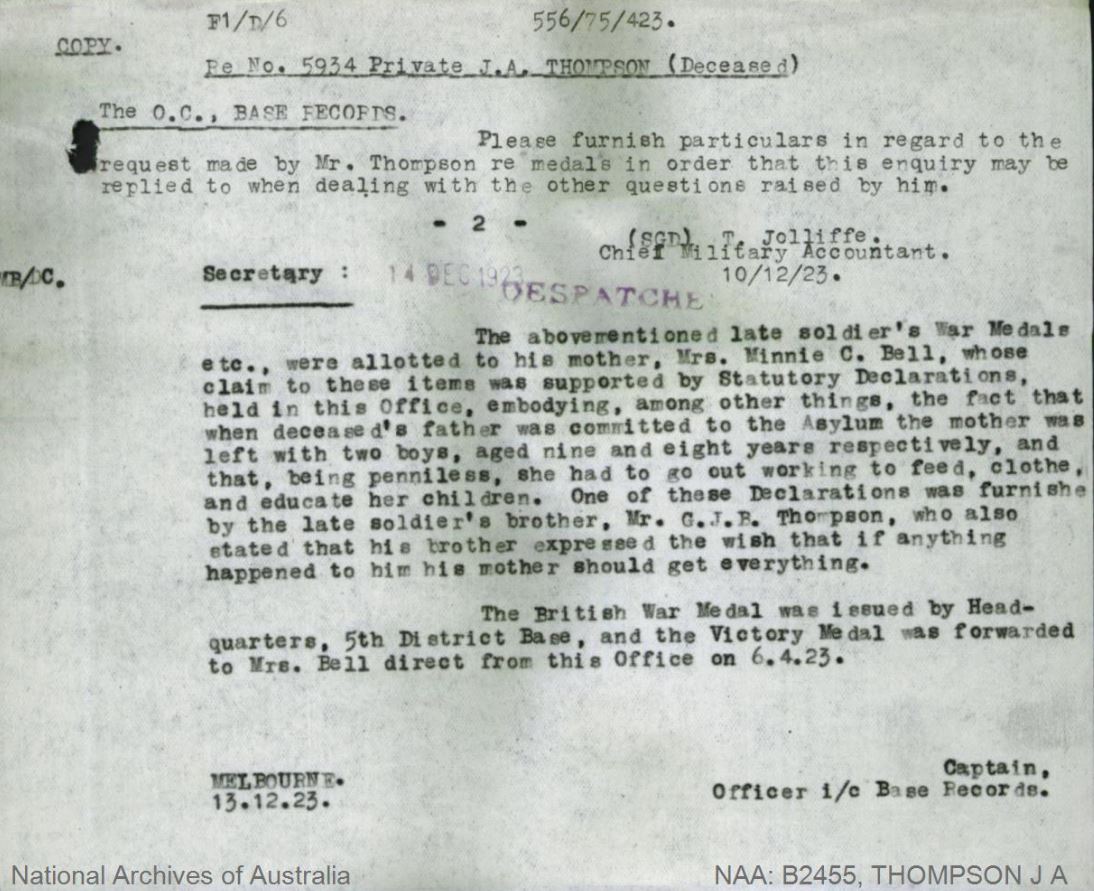
Seemingly the youngest of the men to be killed on 1 June 1918, John gave his age as 18 when he enlisted on 13 June 1916. He gave his occupation as a 'Postman'. There is evidence to suggest that he had overstated his age by about two years. His older brother (George) had declared his age to be 18 and 10 months when he signed up in January 1916. This puts George's date of birth as around March 1897. When John enlisted in June 1916 it is likely he was 16 (the sources available are not exact). The fact, however, that his mother reported John to be 18 years old when he was killed in 1918 however further supports the case that he signed up 'under age'.
Leaving Fremantle in October 1916, he arrived in the UK in December and was with the battalion in France in January 1917. Within a week, he was hospitalised with a Hernia but making a quick recovery, re-joined his battalion in February. March saw him in hospital with Trench Foot and a recurrence of the Hernia problem. During his convalescence he overstayed his leave by 12 hours, for which he received 'admonishment ' in May 1917
He did not return to France until April 1918. Although there's no documentary evidence to support this, it is quite possible that this was because his 'true' age may have been discovered and he was therefore held back until he was old enough to serve in France. He arrived at Etaples on 25 April, where he was held for a few weeks, joining the battalion on 28 May. Four days later the aerial bombing took place and he received severe wounds.
His service file tells us he suffered 'compound fractures in both legs' which resulted in his death.
Within the service file are two documents which may indicate the reasons why he joined up 'under age'.
5563 Pte Herbert James Brewer
Born in Melksham, Wiltshire Herbert was aged 26 when he enlisted in April 1916. His trade, he said, was 'farm hand'. Leaving Fremantle in late September 1916, he arrived in Plymouth on 21 November and was in France a month later. On 3 January he was absent from tattoo roll call and was punished with "14 days cc" which must be assumed to be 'confined to camp'.
It seems he sailed fairly close to the wind as twice, whilst in France he was found to be absent without leave. Both of the records commence with the words 'when on active service' which makes clear that this was a more serious offence than absence from camp in the UK. The first absence was noted at 11pm on 31 October whilst in the reserve lines (he turned up in the transport lines 12 hours later) and the second was a four-day over-stay of leave in March 1918.
These crimes could have been quite severely punished, but he 'got away' with 21 days' Field Punishment number 2 on both occasions and a loss of pay.
The records again show that he died of his wounds in the 5th Australian Field Ambulance.
4663 Pte George Anderson
A Yorkshireman, born in Leeds, George was aged 31 and a motor driver when he enlisted in the AIF in February 1916. Boarding the SS Minnetonka in April a few weeks later he was in Plymouth. Training in England took place from June to September when he went out to join the battalion in France. Problems with 'sore feet' hospitalised him in Boulogne in late January, but he was back with his battalion by 1 April. He was granted leave in England in August 1917 and had a further period of leave, in Paris in January 1918.
The service file details the wounds he received from the bomb as to his 'Face, Femur and Leg'. It notes he 'died of wounds' at the 5th Australian Field Ambulance, which perhaps explains why he was buried at Querrieu.
Vignacourt British Cemetery
The last fatality of the bombing of 'B' Company of the 28th Battalion is buried in Vignacourt British Cemetery.
2111 Pte Thomas Augustine Carter
Enlisting in May 1915
Injured in a motor traffic accident on 20 December 1916 he had a spell in hosital.
Having passed through the 5th Australian Field Ambulance, Thomas was transferred to the 61st Casualty Clearing Station, he was suffering from 'bomb wounds in both thighs'. Unfortunately, it seems little was able to be done for him, and he died of his wounds on 1 June. Poignantly, one of the personal effects returned to his widow was a medal awarded for prowess in the boxing ring.
Conclusions
With thrity deaths on a single day ? this was the 28th Battalion's worst day of war? To check - unlikely but may have been one of worst days.
Of those killed, the 26 in row D were presumably killed instantly or near instantly on 1 June. The three others buried at Querrieu died of wounds later on that day.
Carter?
Not surprisingly there were many other men who were wounded besides the 30 who were killed. The Australian Red Cross Wounded and Missing Enquiry Bureau Report for Private Miller gives an indication of the numbers:
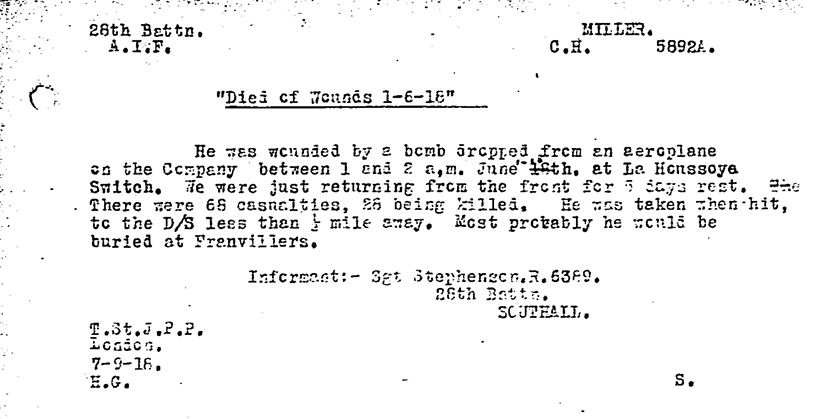
It is rare to have a first hand account of burials, but here is a hint at what took place. Given many of the bodies would have been unrecognisable, this would have been a truly gruesome undertaking for those involved.
The men listed as killed here are not necessarily a representative sample of those in the AIF. But some were early recruits and had served in Gallipoli and on the Somme in 1916. Many suffered from numerous ailments and were frequently hospitalised. possibly more often that would be be expected.
The crime rate detailed in the service records seems quite high, but it is difficult to get a sense of whether this is 'typical' for the men in the AIF. Not entirely surprisingly, a large proportion of the men detailed were born in the UK.
Sources
The brief biographies have been extracted from the service files which, unlike for British soldiers, are intact. This is a valuable source for anyone wishing to research individuals who served in the AIF. The records can be found by using the 'name search' function on the National Archives of Australia website.
Images have been sourced from the Australian War Memorial website (which also provides details of the 27th Battalion grave photography project) and Virtual War Memorial Australia.
The "Wounded and Missing Enquiry Bureau reports" are available from the AWM website: Australian Red Cross Society (ARCS)
References
[1] Fuller details of Herbert Morris can be found on the Tipton Remembers website.


