
Identifying William Smith M.M. – a 25 year search
This search involved several false dawns, including that of service records becoming available on microfilm at Kew, followed much later by online availability, and finally the WFA’s rescue of pension cards and ledgers, which sadly all came to nothing. In the end the search came down to gambling at the last chance saloon, playing the infamous London Gazette Game.
Family Background
My maternal grandmother, Maria Livingstone, married Andrew Makinson in 1902, and settled into Dale Street West, in the Lancashire railway town of Horwich. I was aware from an early age that she had four brothers who served in the Great War, two of whom, Andrew and William Livingstone, were killed in action. It came as a surprise to later learn that my mother also had a cousin, William Smith, who she had never mentioned, but who had been awarded the Military Medal while serving in the Royal Scots.
This latter information came from another of my mother’s many cousins, my godmother, Marjorie Smith, the daughter of Maria Livingstone’s sister Catherine Ethel, who had married a Frederick Smith. Already knowing that Marjorie Smith had just one sister, and no brothers, it was clear that the elusive William Smith had to belong to another branch of the family.
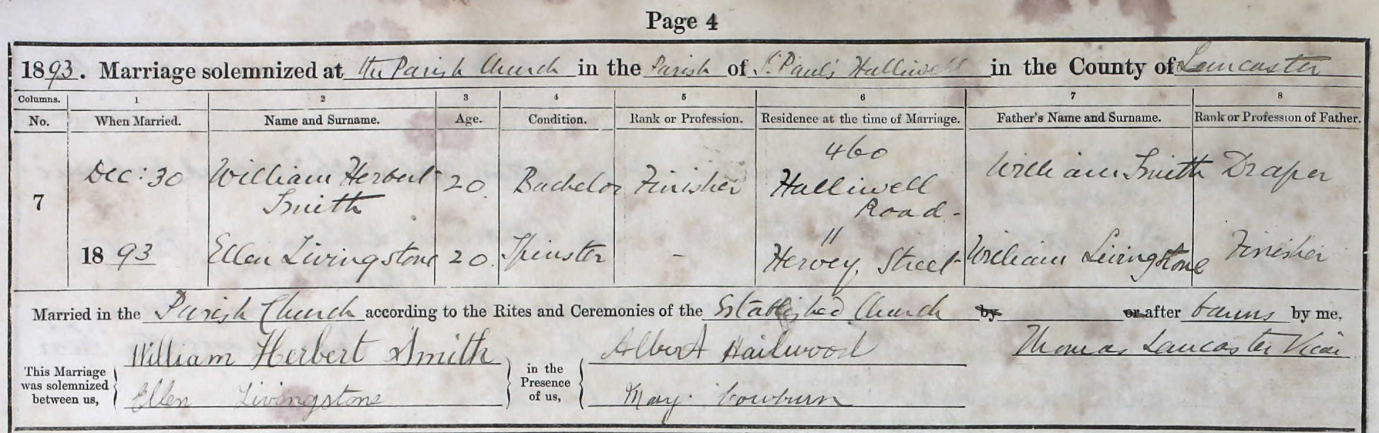
The Livingstones were a large family, from Halliwell, Bolton, and needless to say it was soon established that another of Maria’s sisters, Ellen Livingstone, had also married a Smith, this being William Herbert Smith, at St Paul’s Parish Church, Halliwell.
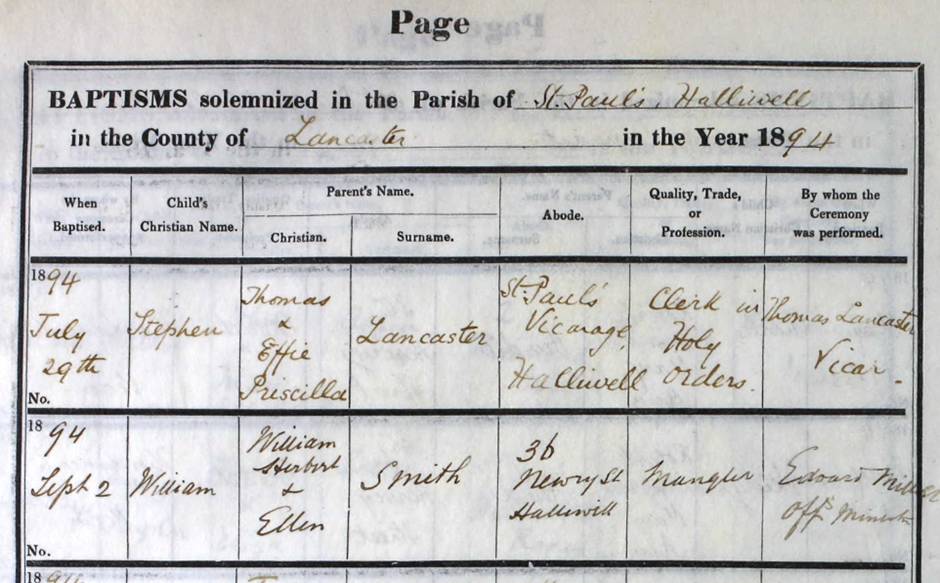
A further search of the records for St Paul’s Halliwell revealed their son William, the subject of this research, was baptised on 2 September 1894. This separated him from the other 120 William Smiths whose births were registered in the Bolton district between 1880 and 1899, and who would thus also have been eligible for Great War service.
It was then a relatively simple matter to obtain William Smith’s birth certificate for further proof of identity from his mother’s maiden name.

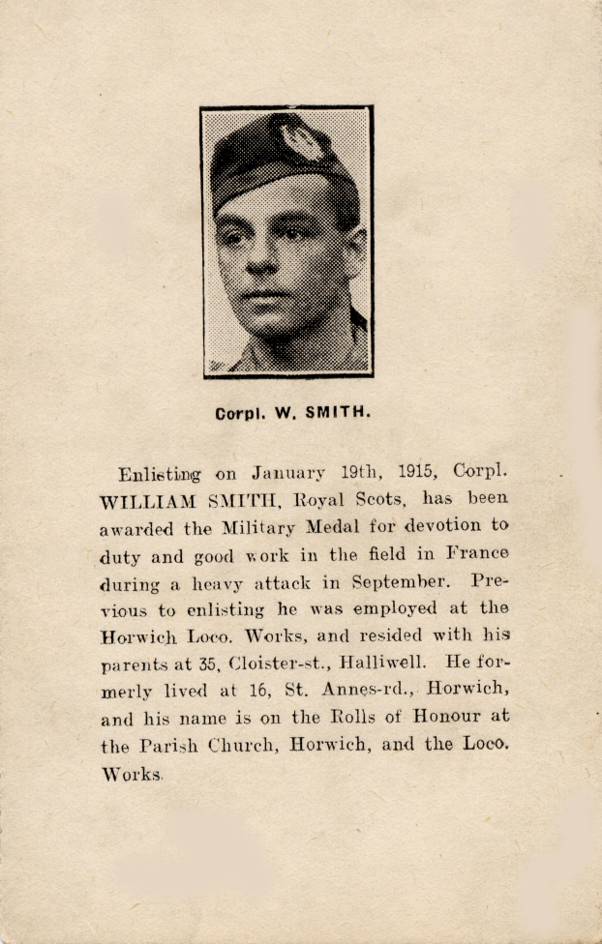
No further progress was made until my godmother died, several years later, and I was offered some of her ‘surplus’ papers which included priceless photographs of three of my great uncles, as well as a card, evidently published by a local newspaper, most likely the Bolton Journal, containing a photograph of William Smith and a reference to his Military Medal award. The postcard sized item is reproduced below:
There was a similar card for my great uncle, William Livingstone, bearing his picture and a caption subsequently found in a microfilm copy of his Bolton Journal obituary. Also enclosed was the original photograph of William, which had ‘retn to Horwich office’ and ‘1/2 col for Jnl’ written on the back in pencil, indicating that the photograph had been loaned to the paper for publication.
Returning to William Smith, the address of 35 Cloister Street, Halliwell was significant, as this address was given in another Bolton Journal obituary as that of ‘a sister’ of my great uncle Andrew Livingstone, who was killed in action at Moeuvres, near Cambrai, on 11 September 1911, while serving with 2/4 Battalion, Loyal North Lancashire Regiment. This sister was evidently William Smith’s mother Ellen.
The Smith family could be found in the 1901 census residing at 2 Garside Grove, the address given by my grandmother, Maria Livingstone when she married. By now there was also a daughter Edith Alice, born in 1896, and a son Percy born in 1899.
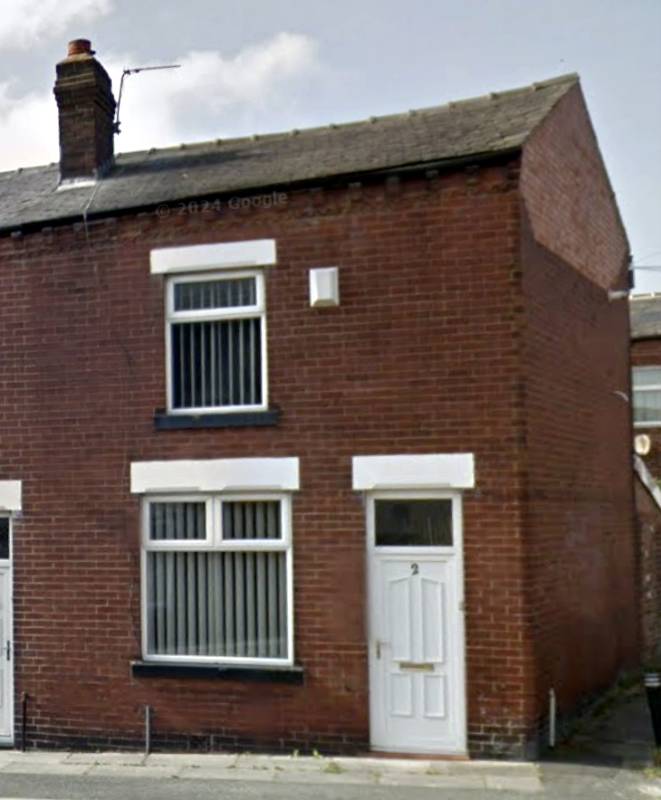
By 1911 the family had moved to the nearby railway town of Horwich, and were living at 13 Factory Hill, with an additional daughter Lily, born in 1907. Despite its rather grim sounding name this address was on the fringes of the countryside, with excellent views.
The address on the card, of 16 St Annes Road, was also given by William’s brother Percy when he himself enlisted in the army, and he gave the address of 35 Cloister Street for his next of kin in his attestation papers.
It was indeed fortunate to have William Smith’s address, as there were 14 William Smiths resident in Horwich in the 1911 census.
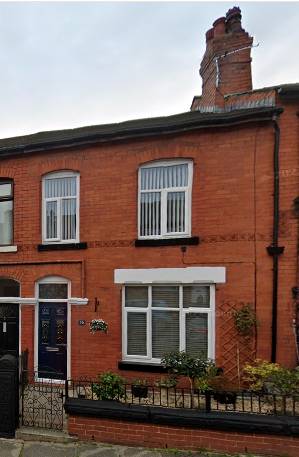
Having now established beyond reasonable doubt the identity of my mother’s mystery cousin awarded the Military Medal, the next step was to establish more about his military career.
Military Service
There were rather a lot of William Smiths who served in the Great War, so identification of this particular man wasn’t straight forward, in fact it only took about twenty years, several visits to the National Archives, and many keyboard attacks, with little or no ground gained, to finally gain the objective.
William’s service record has not survived in the burnt series, WO 363, being lost with the majority of records when the London storage warehouse was bombed during WW2. His record was also not found in the so called ‘pension series’ WO 364, assembled after the war to try to fill in gaps left by losses from WO 363. (Note that searching the microfilm at Kew for William Smiths was not an overly rapid progress. Another unfortunate loss from the bombing raid was the complete set of citations for the Military Medal).
Despite William’s name evidently being recorded on the Roll of Honour at Horwich Parish Church, this document seems to no longer exist and certainly couldn’t be located twenty years ago. Whether the Horwich loco works Roll of Honour still exists is also somewhat of a mystery.
The Horwich Old Boys’ School Roll of Honour, reproduced in M.D. Smith’s book ‘More About Horwich’ did list a William Smith, but he was serving in The King’s Own Royal Lancaster Regiment, and not the Royal Scots, so could be eliminated, although changes of regiment for William Smiths are far from unknown, as will be seen later. Although this man’s WO 364 record showed he had also been a loco works employee, as indeed were most of the Horwich workforce, he had enlisted in 1914, rather than 1915, so was definitely not the right William Smith.
Series WO 363 contains the record of yet another William Smith from Horwich, but he served in the Royal Engineers, living at 47 St John Street on enlistment, and 36 Winter Street when discharged, so again a different William Smith.
Identification of William Smith was proving difficult, with the Medal Index records showing a mere 91 men of that name serving in the Royal Scots (Lothian Regiment), but this number could seemingly be reduced to just three of whom were awarded the Military Medal. Of these, two held the rank of Corporal, while the third was a Sergeant.
A possible way to establish further identification was to attempt to locate the announcement of these three awards in either the London Gazette or perhaps the Edinburgh Gazette, this being a Scottish regiment. As those who have searched for a Gazette entry will be aware, the records are notoriously difficult to locate from the index, with potentially thousands of William Smiths referenced between 1915 and 1919, and of course the year of the award was unknown.
The medal index cards for these three candidates were examined, and that for the man with service number 53039 appeared to be of particular interest.
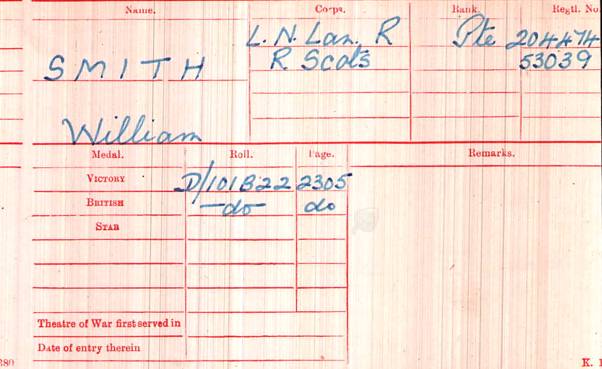
Although he was reported in the photocard to have enlisted in January 1915, he seemingly hadn’t qualified for the 1914-15 Star, not having entered a theatre of war before 1916. Significantly the index card shows this man had prior service in the Loyal North Lancashire Regiment, a very likely first choice for a Horwich lad, but seemingly his highest rank was that of private, rather than a corporal.
The corresponding card for the Military Medal showed he was an acting rather than a full corporal, and carried no mention of his prior service with the L.N.L.R. Most unhelpfully it failed to indicate the date on which the award was Gazetted.
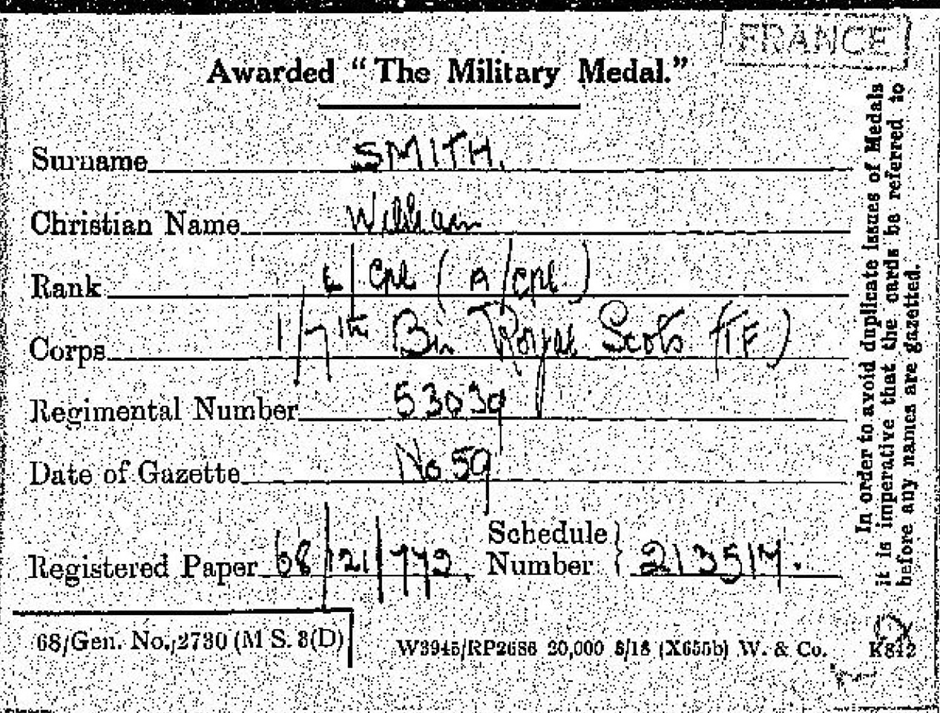
Those familiar with the London and Edinburgh Gazette will be aware of the ‘simplicity’ in finding an entry, particularly without a publication date. With little clue as to the year of the award, and with multiple attacks using varying search options all repelled, the following strategy was adopted.
Entering the number 53039, his service number in the Royal Scots, as the sole Gazette search argument, and pressing ‘enter’ a little harder than usual, and hoping for a miracle, several completely irrelevant records were found, along with the following reference to the Edinburgh Gazette Supplement of 17th March 1919, issue 13418, page 1178, in the list of men of the Royal Scots awarded the Military Medal.
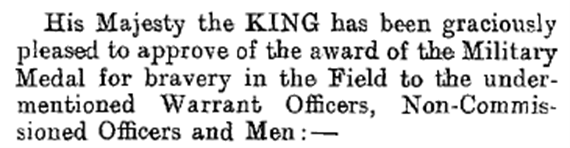
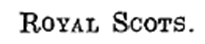

The cynical at this stage would suggest that one of the two other William Smiths awarded an M.M., and serving in the Royal Scots, was also from Horwich, but this was disproved by more Gazette hunting, using the by now favoured ‘hit hard and hope’ method.
Returning to the medal index card, there are in fact two errors. The first is that his highest rank was recorded as private, which was proved incorrect by the corresponding medal roll entry.
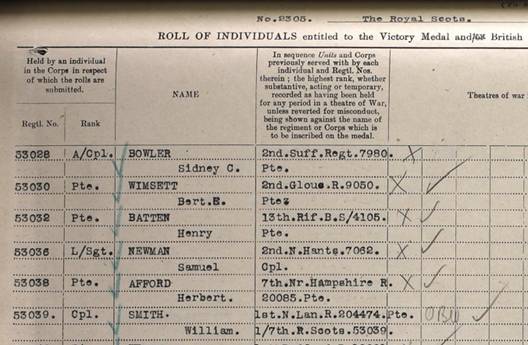
The second error in the medal index card is that the award of the 1914-15 Star is missing. The 1914-15 Star Medal Roll, recorded by the 7th Battalion Royal Scots, shows quite clearly that he entered France and Flanders (Theatre 1) on 3 April 1915, as private 204474, Loyal North Lancashire Regiment, and so was clearly eligible for the award.
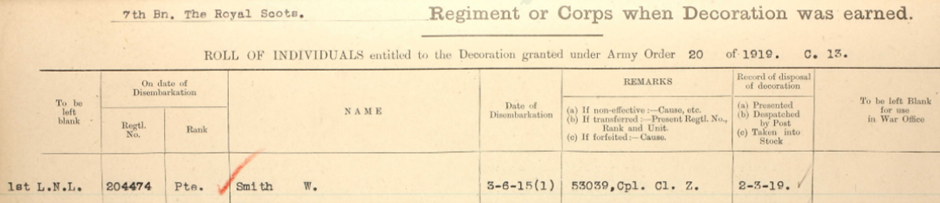
Knowing that William was assigned to 1 Battalion L.N.L.R., and disembarked in France and Flanders in June 1915, it is quite possible that he served at the Battles of Loos in September 1915, the Somme in 1916, and Passchendaele in 1917, before later transferring to the 1/7 Battalion Royal Scots, one of a mere 35 wartime battalions of the regiment.
Investigation of when he came to be transferred to the Royal Scots and when the Military Medal was awarded, would take a little more time.
William was fortunate in not being one of the original members of 1/7 Royal Scots, who served at Gallipoli from June 1915, their appearance there being delayed by their involvement in Britain’s worst ever rail disaster, at Quintinshill, near Gretna, on 22 May 1915, when they lost 226 killed and 246 injured, many killed in the fire that engulfed the wreckage.
It is extremely likely that William joined this battalion in France, sometime after its arrival from Alexandria on 17 April 1918. The battalion war diary does not record his name alongside his M.M award, although this was clearly the usual battalion practice, but he was probably one of those stated as having been presented with their medal ribbons on 8 January 1919 at Montignies-Lez-Lens, a small town near Lens in France.
The Heavy September Attack in France
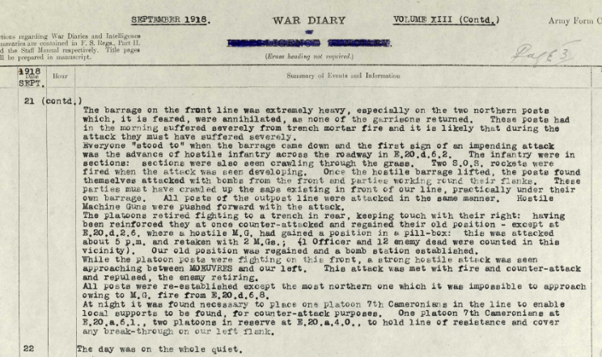
In September of 1918 the battalion were initially in the Bullecourt area, near Arras, and he may have earned his Military Medal for an attack on the Hindenburg Support Line on 2 September, or more likely during what was evidently a heavy German attack near Moeuvres on 21 September, or perhaps during a British attack on the Canal du Nord, between Moevres and the Graincourt Road, on 26 September. Ironically the last two locations were very close to where his uncle, Andrew Livingstone, had lost his life just a few days previously, on 11 September 1918, and Andrew now lies in Moeuvres Communal Cemetery Extension.
The entry for the Battalion War Diary for 21 September, considered to be the most likely date, is shown below, split across two pages.

Post War Activity
Unfortunately efforts to find William Smith post war have so far been unsuccessful. The 1921 census shows his parents living with their daughter Edith Alice, and son Percy, at 514 Wigan Road, Bolton, Percy being a machine moulder at the L&Y loco works, so his brother was clearly still working at Horwich Works.
William couldn’t be found in the 1939 Register, despite this being searchable by his established date of birth. There are two likely possibilities, either he died young, or he emigrated, quite likely before 1921, but neither of these theories are easy to prove.
Canada was a popular destination for my family, but all seven William Smiths recorded in the 1921 Canada census as born England in 1894 were eliminated by an immigration date prior to 1919, or by place of birth established from Form 30A Ocean Arrival records, which also covered the period from 1919 to 1924.
New Zealand and Australia are other options, and perhaps he will be located in the next ten years or so.
Edith Alice, the elder of his two sisters, married William Horace Evans, and is referenced by her married name in the will of her uncle, James Edward Livingstone, another of the four Livingstone brothers who served in the war, he being in the Royal Garrison Artillery and gassed towards the end of the war. His younger sister, Lily, died in 1913.
After William’s mother Ellen died in late 1932 or early 1933, his father remarried to a Florence Gleeson at Halliwell St Thomas in 1933, and died in 1945.
Various family probate records were examined in the vain hope that William would be mentioned.
Percy Smith
William’s younger brother Percy was baptised on 2 February 1899 at St Matthew, Bolton, the son of William Herbert and Ellen Smith, and he really deserves a story of his own, free from the shadow of his decorated elder brother, and has extensive surviving military records in both series WO 363 and 364.
He attested at Warrington on 26 April 1915, as private 18801, South Lancashire Regiment, claiming to be nineteen years and ninety days old, a crofter living at 16 St Anns Road, Horwich. He was discharged on 21 May 1915 as ‘not being likely to become an efficient soldier’, a medical revealing that he was under age and had insufficient chest expansion; not too surprising for a sixteen year old.
Undeterred he enlisted at Bolton on 12 June 1915, as private 5433, 1/12 Battalion Loyal North Lancashire Regiment (L.N.L.R.), a Pioneer Battalion. The men of these battalions were trained as conventional infantry, but also had additional skills in entrenching and road making.This was the same battalion that his uncle, Andrew Livingstone, originally joined, before transferring to the 2/4 Battalion, despite being rather old for an infantryman.
Percy was assigned the new number of 1478, seemingly at his medical on 22 June 1915, and landed at Le Havre with this unit, exactly a year later, on 22 June 1916. In early November he was once more found to be under age, and for his sins ordered to catch the 3.45am train from Etaples on 3 November, and report to the regimental depot at Preston, being then placed in army reserve rather than discharged.
His records were then amended to state he would be eligible for overseas service on 12 January 1918, which would be at age 19. He returned to France on 30 March 1918, having now surpassed the minimum age requirement, and with a temporary posting to 9 Battalion L.N.L.R., before immediate transfer on the following day to the 4 Battalion, South Staffordshire Regiment, and with service number 235278. This infantry battalion, along with many others, would have been under strength following the opening of the German Spring offensive.
He contracted influenza on 10 July, and was admitted to no 53 Casualty Clearing Station at Bailleul, then transferred to no. 16 General Hospital at Le Treport, on the coast, before being returned to England on 18 August. This seems to heve been the end of his war, being demobilised on 18 March 1919.
His medal index card and medal roll entry reflect his overseas service with both the 1/12 Battalion, L.N.L.R. and 4 Battalion, South Staffordshire Regiments.
His medal roll index entry is unusual, showing he was awarded the expected British War Medal and Victory Medal, but that these were returned in September 1923, re-issued in December 1929, before being returned undelivered, and subsequently re-issued in February 1930. There must be an interesting story here. His medals would be expected to be impressed with his Loyal North Lancashire service number of 1478, rather than for his later service with the South Staffs, but perhaps they weren’t originally issued with the number and regimental details to Percy’s satisfaction.
Percy was evidently back at the loco works by 1921, and he married Caroline Pinblett at Saviours Church, Bolton, in 1923. He had left the works and was a grocery shop assistant at Lowndes Street, Smithills by 1939. The entry in the 1939 register gives his date of birth as 12 January 1899, which quite surprisingly tallies exactly with one of his many dates of birth documented in his extensive army records.
Summary
William Smith is one of the most common names, and certainly not the easiest to research. This study was a reversal of the usual approach, the photograph coming first, rather than last.
This particular William Smith was readily identifiable in genealogical records thanks to information on his postcard portrait. His service in the Great War was reconstructed despite the absence of such useful sources as a service record. Another useful resource, and absent in this particular case, would have been an absent voters list, some examples giving service number and regiment details.
With such a common name, and being born in Bolton, he and his brother Percy could easily have slipped through the net of men from my home town of Horwich known to have served in the Great War, but they should now be on the extensive list held by the excellent local history centre, ‘Horwich Heritage’.
The value of rolls of honour, in particular those which include survivors, cannot be underestimated, and that of Horwich Old Boys School, thankfully incorporated in ‘More About Horwich’ by M.D. Smith has many times proved invaluable to the author, for both identification and elimination purposes.
Surviving cards, in all probability printed by the newspaper company, must now be rare, but are to be treasured, not least for the quality of the photographs, which has been found to be vastly better than can be obtained from either newspaper archives or microfilm.
The eagle eyed might have noticed that William appears to be wearing the badge of the Cameronians, rather than that of the Royal Scots. This may well be explained in a future update, perhaps in another ten or so years.
Project for the Next 25 Years
My fourth great uncle, not previously named in this article, was Benjamin Livingstone, who survived the war as a sergeant in 12 Rifle Brigade, having previously served in the Boer War. Family lore tells that he was presented with an inscribed silver watch by the family of a wounded officer that he brought in, but which was sadly stolen while he was working as a Cunard steward on the trans Atlantic crossings between Liverpool and New York. Although the watch is most unlikely to re-surface, it would be fascinating to find more details of the rescue operation, and perhaps the answer lurks somewhere in an unpublished officer’s memoir…
Becoming a member of The Western Front Association (WFA) offers a wealth of resources and opportunities for those passionate about the history of the First World War. Here's just three of the benefits we offer:

The WFA regularly makes available webinars which can be viewed 'live' from home. These feature expert speakers talking about a particular aspect of the Great War.

Featured on The WFA's YouTube channel are modern day re-interpretations of the inter-war magazine 'I Was There!' which recount the memories of soldiers who 'were there'.

Explore over 8 million digitized pension records, Medal Index Cards and Ministry of Pension Documents, preserved by the WFA.
Other Articles


