
Statistics of the Military Effort of the British Empire During the Great War 1914–1920
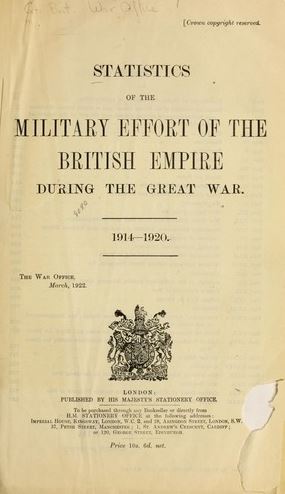
Statistics of the Military Effort of the British Empire During the Great War 1914–1920 is a monumental 880-page official government report published by the British War Office in March 1922.
What is it?
It is arguably the most comprehensive, data-driven record ever compiled, detailing the human, material, and financial expenditure of the British Empire during the First World War.
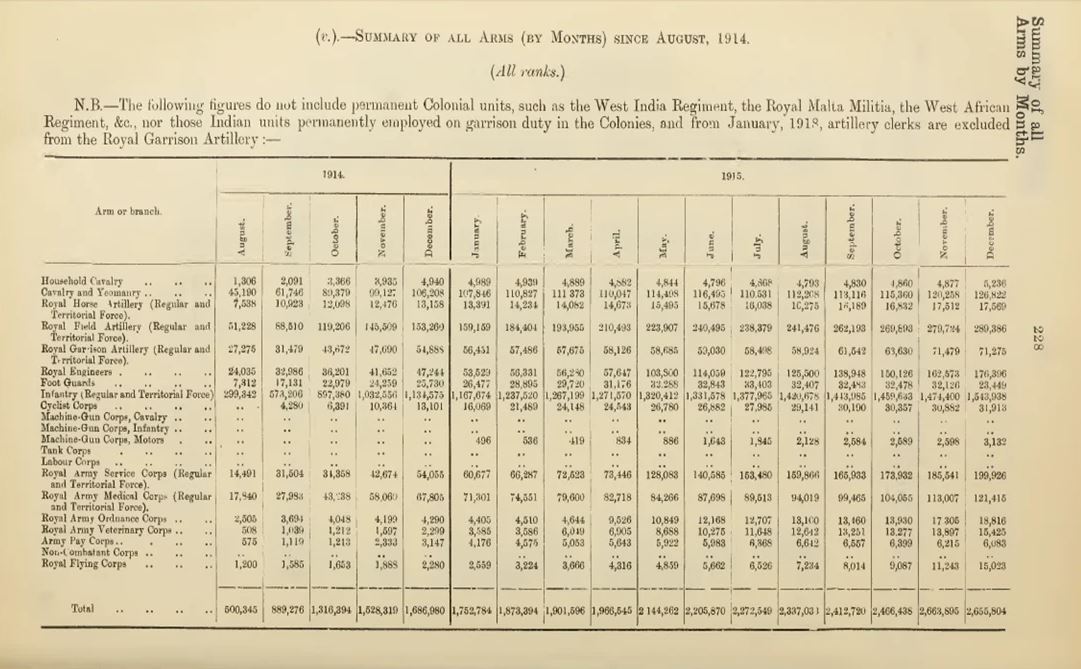
The volume outlines the drastic expansion of the British military, which transformed from a small, professional force in August 1914 into a global mass army. By November 1918, the total strength of the British Army alone had reached 5,336,943 men. Over the course of the entire war, the report details that nearly 8.6 million personnel served across the British Empire’s forces.
How is it displayed?
The publication is meticulously divided into 32 distinct thematic sections. Rather than a fluid historical narrative, the information is primarily laid out in hyper-detailed data tables and statistical summaries covering three core subjects:
Strength and Recruitment
Monthly enlistment tallies for the UK, showing the initial 1914–1915 volunteer rushes and the subsequent transition to mandatory conscription.
Detailed data logs on the deployment and employment of Labour Units and Native Personnel overseas.
Structural tracking of individual branches, detailing how the Infantry, Artillery, Cavalry, Machine Gun Corps, and Tank Corps shifted in size and configuration.
Casualties and Health
Comprehensive casualty logs broken down by specific fronts (e.g., Western Front, Gallipoli, Mesopotamia) and specific major engagements (e.g., The Somme, Arras, Passchendaele).
Medical data sets, including losses sustained specifically on torpedoed or shelled hospital ships.
Data nuances demonstrating the complexities of tracking wartime fatalities, such as accounting for tens of thousands of personnel designated as "Missing" who were later presumed dead.
Logistical and Social Data
Munitions logs summarising total weapon manufacturing output and shell expenditure, detailing the financial cost of specific mass artillery bombardments.
Animal tracking statistics concerning the millions of horses, mules, and camels purchased, shipped, and lost in service.
Military discipline data, incorporating exact metrics for court-martials, punishments, and crimes within the ranks.
Domestic logs, including a complete chronological registry of German air raids and naval coastal bombardments hitting the UK mainland, alongside civilian casualty data.
Accessing the Text
The original 1922 HMSO printing was issued in a highly restricted batch, making physical first editions extremely rare. Today, the records are utilised heavily by genealogists and military historians, and can be accessed in several formats. The version we display here has been sourced from the Internet Archive.
The published document was extracted from other works which are held in The National Archives, namely "Armies at home and abroad, 1914-1920" (WO 161/82) and "Summary of statistics, 1914-1920" (WO 394/20)
Blind Spots
The document is considered highly reliable, but some data should be treated as a "close approximation" rather than absolutely and unequivocally correct.
The "Missing" Personnel Problem:
The report's monthly casualty tables are heavily flawed regarding fatalities. For example, during high-casualty months like July 1916 (The Somme), thousands of men were initially categorised simply as "Missing". The 1922 data often fails to properly redistribute those missing men into the "Killed in Action" column once their deaths were later confirmed.
Double-Counting the Wounded:
Field hospital records were chaotic. A soldier wounded at the front line might be counted once by his battalion, once at a dressing station, and again at a base hospital, leading to slightly inflated injury metrics.
Imperial Data Variances:
While data for UK, Canadian, and Australian troops is highly robust, records for Native Labour Corps, African colonial units, and certain Indian Army non-combatant branches are less thoroughly tracked and occasionally underreported.
Becoming a member of The Western Front Association (WFA) offers a wealth of resources and opportunities for those passionate about the history of the First World War. Here's just three of the benefits we offer:

Identify key words or phrases within back issues of our magazines, including Stand To!, Bulletin, Gun Fire, Fire Step and lots of others.

The WFA's YouTube channel features hundreds of videos of lectures given by experts on particular aspects of WW1.

Read post-WW1 era magazines, such as 'Twenty Years After', 'WW1 A Pictured History' and 'I Was There!' plus others.


