‘The Devil’s Orchestra’ and a Lutyens masterpiece
Mention the architect Sir Edwin Lutyens and you think of the Memorial to the Missing at Thiepval, the Cenotaph in Whitehall, many military cemeteries, the building of Imperial New Delhi and much more.
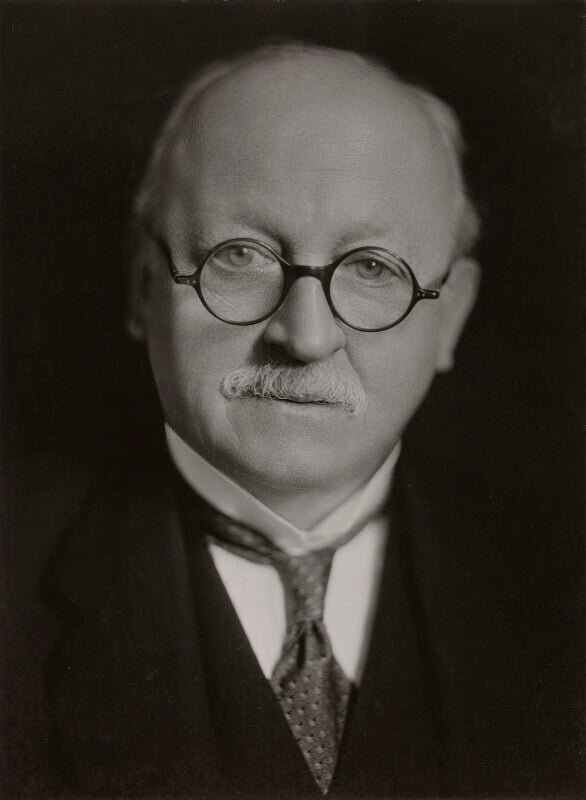
But there’s one work which is celebrated and very special – and largely hidden away unless you make a special arrangement to see it.
It is one of his final works, and is said to be unique.
It’s a Roll of Honour for the 3,544 men of the Norfolk Regiment from Norwich who died in the First World War – an oak cabinet with sixteen panels, 12 double-sided and hinged, and four fixed and single-sided. Each panel is painted with the names of the war dead.
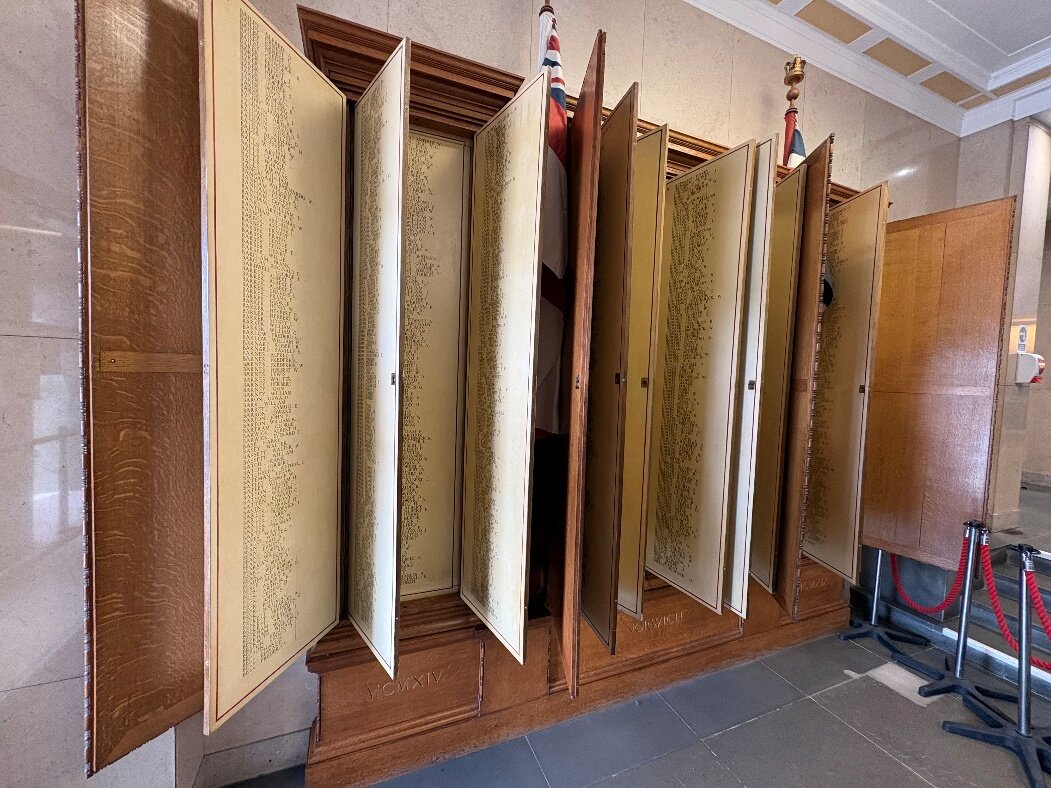
Lutyens was commissioned to design the cabinet because the main city war memorial which he designed and which now stands outside City Hall above the market place didn’t have enough room for all the names.
The cabinet was built by a local skilled carpenter, Walter Burridge. Lutyens made a few alterations to the original version and exceeded the agreed budget of £500. He waived his fee and paid the difference himself. Building and hand-painting the complex panels took much longer than anticipated.
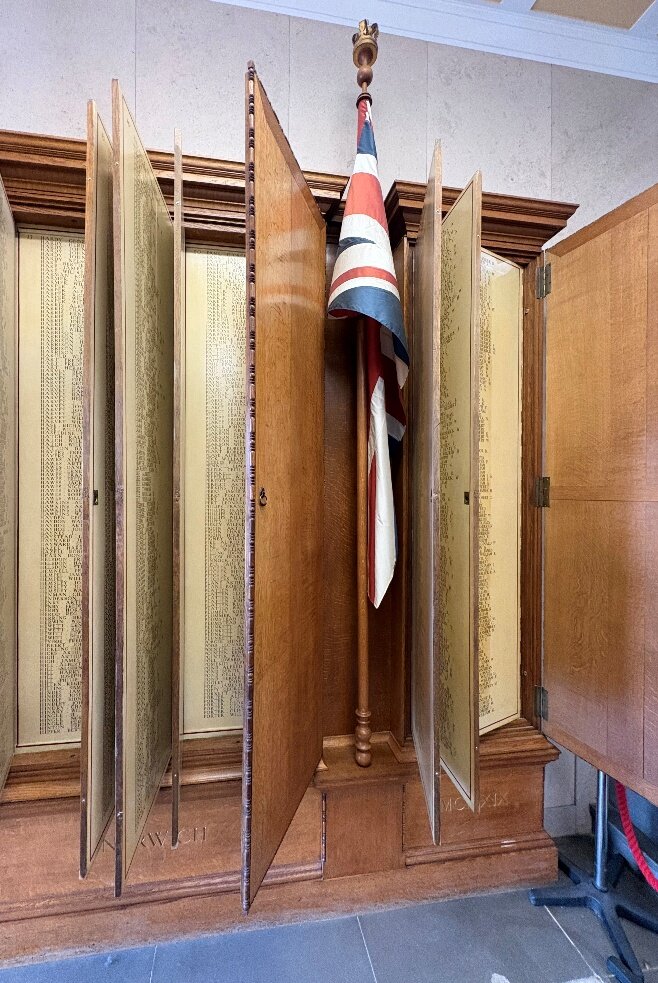
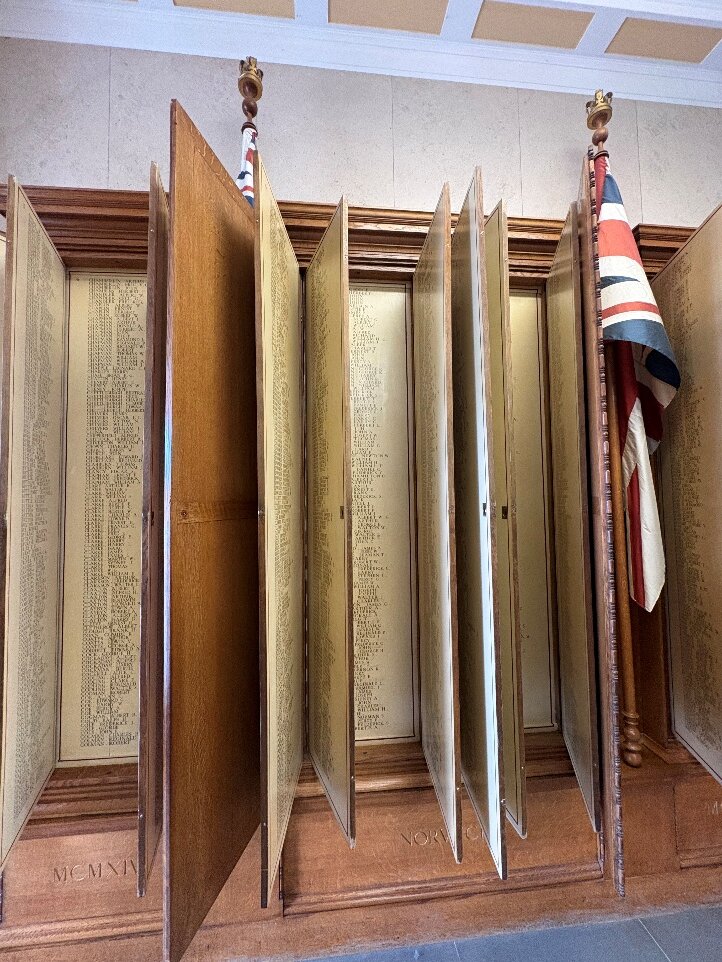
By the time the Roll of Honour was finally delivered in January 1931, the War Memorial Committee was embarrassed over how long the project had taken. They needed to put it on display immediately and chose the Castle Keep as a quick solution. It was installed there without ceremony.
The Museum Committee and Castle trustees originally agreed to accept the installation only on the strict understanding that the arrangement was temporary. In fact, the museum trustees openly said that they didn’t feel the Castle was the most appropriate or permanent setting for a municipal civic archive of the war dead.
The long-term vision was always to house this significant civic tribute in a major municipal building. However, City Hall where it stands today was not constructed and opened until 1938, seven years after the Roll of Honour was completed.
Because it lacked a proper civic home in 1931, it remained in its “temporary” spot inside the Castle Keep for 85 years.
Over time, the panels deteriorated, and a £50,000 restoration project was launched, supported by Norwich City Council, Norfolk Museums and Archaeology Service and the Norwich Memorial Trust.
It was finally unveiled in the main foyer of City Hall on Armistice Day, 2016. This position was chosen because it’s as close to the War Memorial as possible.
But Norwich Council recognises that this isn’t the best home for it, because it’s near the main doors and therefore subject to changes in temperature and humidity. It will be moved in the next couple of months, to the opposite side of the foyer, and there are longer-term plans to create a space with proper environmental controls to keep the Roll of Honour safe and secure.
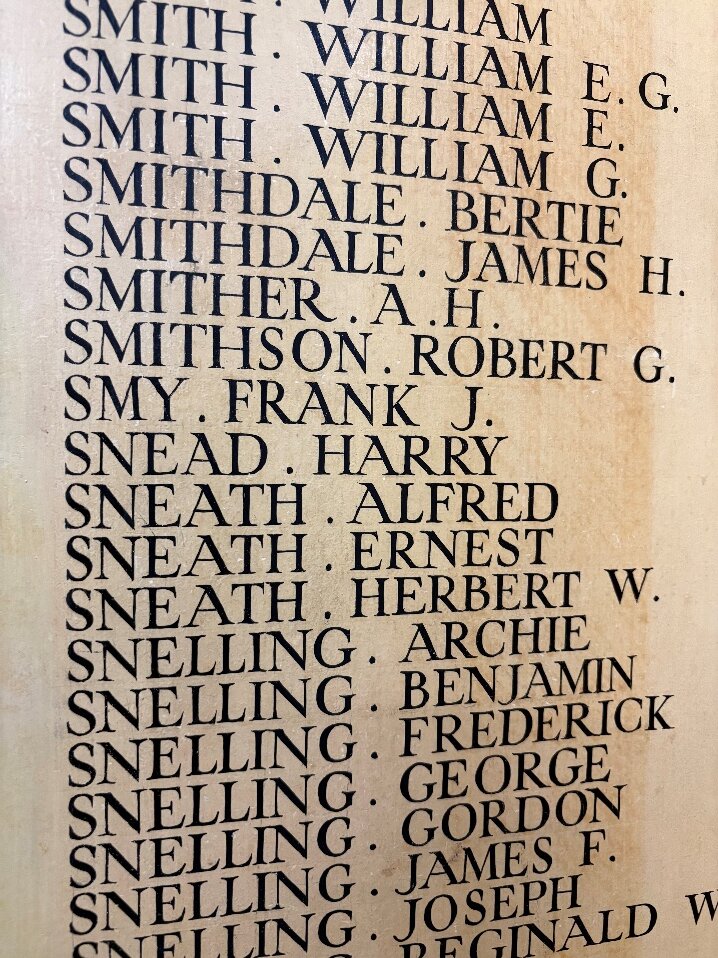
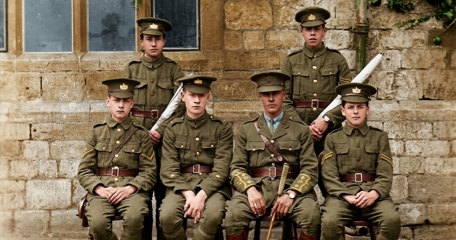
I was lucky, in that I saw the Roll of Honour at its original home in the Castle Keep many years ago, when I was researching the story of my father’s grandfather, Private Ernest Edward Sneath, of the 1st Battalion, Norfolk Regiment, 15th Infantry Brigade, who was one of the early casualties.
He was an ‘Old Contemptible’ and was killed on September 15th, 1914, having endured the Retreat from Mons. He died near the village of Missy-sur-Aisne on the north bank of the river Aisne, where the Germans had entrenched on the wooded heights above.

I found some stunning accounts of what my great grandfather would have gone through. A surgeon from New Zealand, Lieutenant Arthur Martin, left this description in A Surgeon in Khaki, published in 1915:
Dawn was breaking and shafts of grey light and shadow were thrusting through the darkness. Then, like a clap of thunder, the German batteries opened up, and from that moment till nightfall, we lived through one of the most hellish artillery duels that any mortal man could imagine. A tornado of shot and shell swept across that beautiful Aisne valley.
It seemed as if all the fiends of hell were let loose. The noise was deafening, ear-splitting, the bursting of the shells, the mighty upheavals of earth where the shells struck, the falling trees, falling masonry, crashing church steeples, the rolling and bounding of stones from walls struck by these titanic masses of iron travelling at lightning speed, the concussion of the air, the screeching, whistling and sighing of the projectiles in the flight, made an awful scene of destruction and force.
Add to all this the snarling, type-writer note of the Maxims, the angry phut of the Mauser bullet as it struck a house or a gate, and the crackling roars from our Enfields – truly it was the Devil’s Orchestra, and the Devil himself was whirling the fiery baton. The steeple of the village church was struck fairly by a German shell, and with a mighty crash the stones were hurled madly on to the road down which we had just passed, and killed one of our horses. Another shell plunged right into the old church and sent its roof in a clattering of hail over the surrounding houses.
A stone house at the top of our alley-way got another shell and was levelled to the ground, killing two women who were inside. The corner of the building in which we were located was struck by a passing shell and a huge hole was ripped out of the solid masonry. Shrapnel burst over the house, in the garden in front, on the doors of the house, on the roof and down the alley. Our Red Cross flag and Union Jack were badly holed with shrapnel…
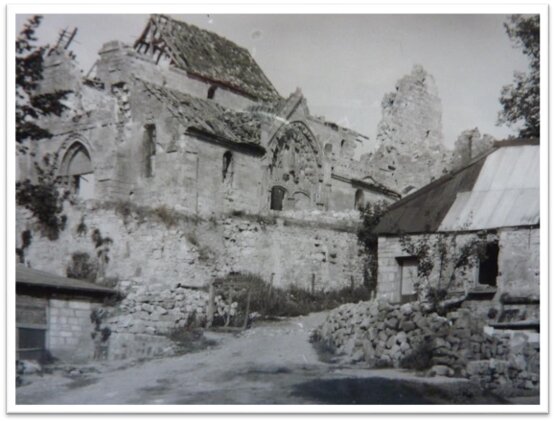
On one of my research trips, I came across a privately published account by a young Frenchman in Missy called Paul Tourigny, who kept a diary. He said that Sunday, September 13th, was a ‘hard day for the English’, as many were killed by machine gun fire from weapons the Germans had hidden in the wood:
Ambulance men carrying dead and wounded were going down our street to two houses which had quickly been turned into First Aid posts.
The dead were buried temporarily in gardens. A cross on their graves showed their names and service numbers, and the number of their Regiment.
The village was under fire, but Paul left home at eight in the morning to find milk for his eight-month-old sister. The firing was so intense, he could not return until four in the afternoon. He was told to stay in the cellar. The Mayor had ordered everyone off the streets.
The village looked like a fortress, said Paul, with barricades everywhere in the streets. Holes in walls and houses are used to fire on the slope where the Germans are hidden in the ground like rabbits. The English, too, have started to dig trenches at speed, in gardens and around the village.
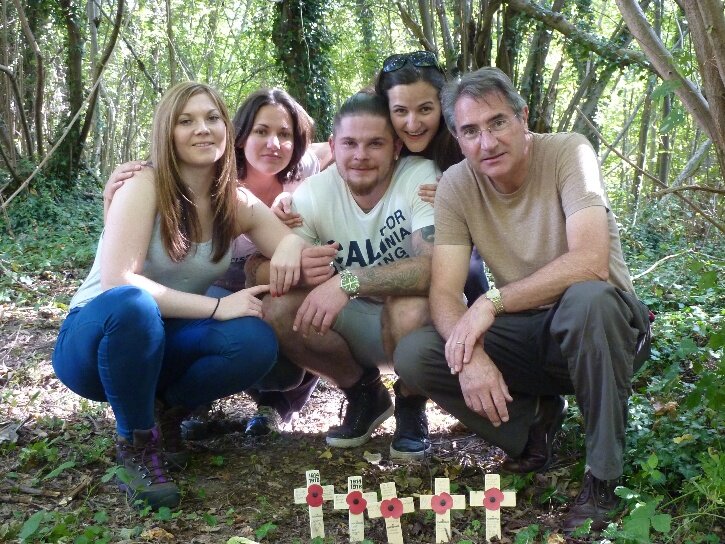
In September, 2014, on the centenary of Private Sneath’s death, I organised a small family pilgrimage including my wife, daughters, a nephew and niece.
We planted crosses near where I believed he died.
He has no known grave, but his name is on the memorial to the missing at La Ferté-sous-Jouarre beside the river Marne, which he would have crossed a few days before he died.
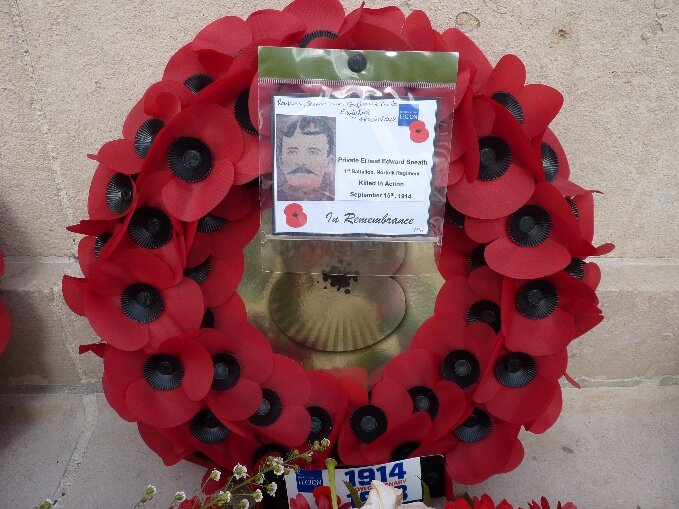
We left a wreath.
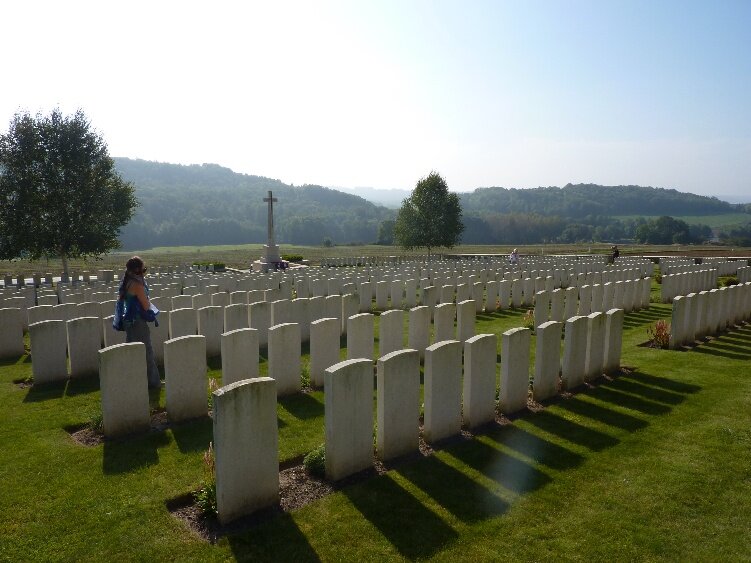
We also visited a concentration cemetery at Vendresse, which contains burials from September, 1914, some on the very day Private Sneath died, and some unknowns.
He might be there.
We will, of course, never know.
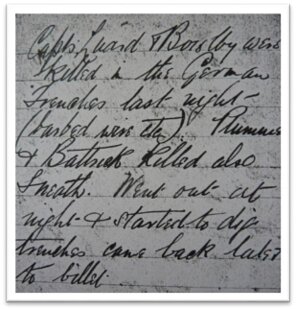
I suppose the nearest I could get to Private Sneath was finding a diary in a cardboard box in the Norfolk Regimental Museum in Norwich which had been kept by a Lance Corporal Butcher.
On September 16th, 1914, L/Cpl Butcher wrote:
Feel pretty queer as last night I was trampled into a bog and am still coated with mud. Also had a smash in the right eye with a rifle butt and have a slight cut and black eye. Capts Luard and Bowlby were killed in the German trenches last night (barbed wire etc). Plummer and Battrick killed also Sneath. Went out at night and started to dig trenches came back later to billet.
It was therefore particularly poignant when I was able to see the Roll of Honour more recently, courtesy of the City Council, at its home in Norwich City Hall, and to note that Private Sneath’s name looks pristine, just as it must have done in 1931. And it’s chastening to think that Private Sneath’s story is merely one of 3,544. Each man named on those panels would have a similar story to tell. So too would the other 2,741 Norfolk Regiment soldiers from other parts of the county who died in World War One, and the 900,000 or so from elsewhere in Britain and from the Empire.

Footnote
Norwich City Hall is freely accessible, but you need to make an appointment to see the Roll of Honour. You can book through the City Council’s main number (0344 980 3333). The City Council is also amending its information webpage for the Roll of Honour (Norwich War Memorial – a place of remembrance and reflection) to promote access. In addition, there’s a video on YouTube.
Becoming a member of The Western Front Association (WFA) offers a wealth of resources and opportunities for those passionate about the history of the First World War. Here's just three of the benefits we offer:

Explore over 8 million digitized pension records, Medal Index Cards and Ministry of Pension Documents, preserved by the WFA.

Featured on The WFA's YouTube channel are modern day re-interpretations of the inter-war magazine 'I Was There!' which recount the memories of soldiers who 'were there'.

The WFA regularly makes available webinars which can be viewed 'live' from home. These feature expert speakers talking about a particular aspect of the Great War.