
One wife, two brothers
It happens so often. A gentle stroll in a country graveyard leads to a surprising twist. In this case, it began with a single headstone in a village churchyard in Kent. Poignant in itself, but research suggests there’s more to it than it seems – a story about two brothers who married the same woman.
The graveyard is at St Mary’s church in Elham, not far from Folkestone.
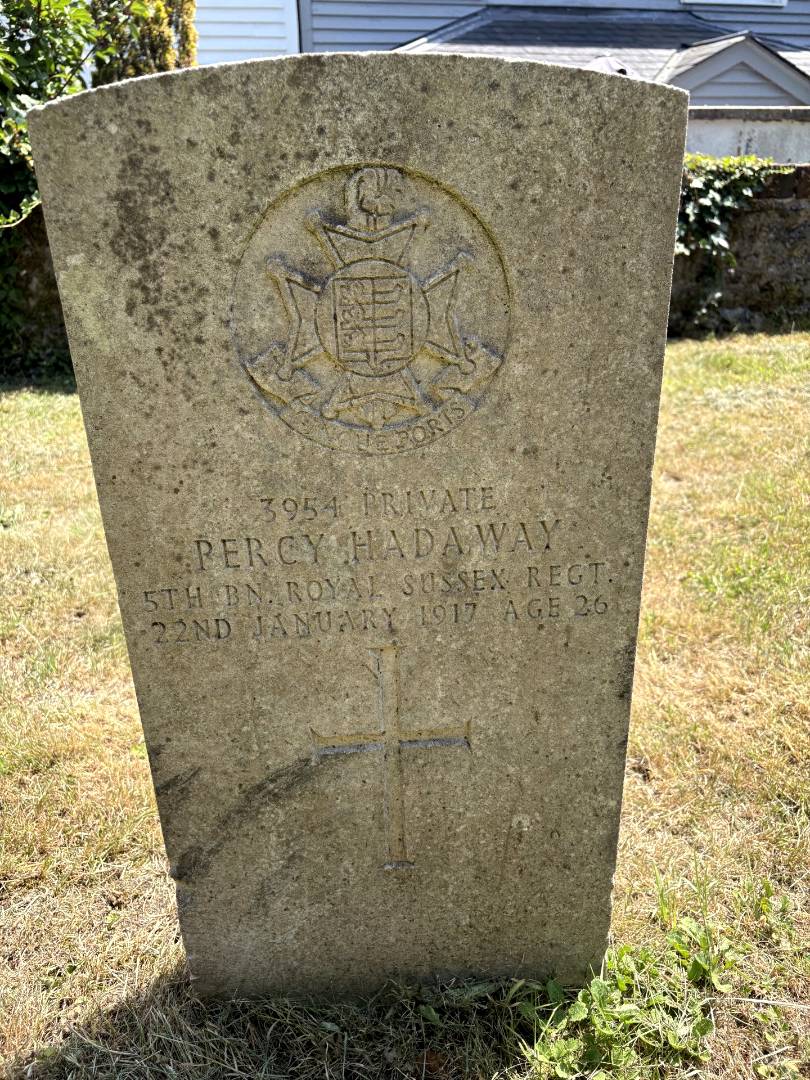
It contains a Commonwealth War Graves Commission stone marking the burial place of Private Percy Hadaway, of the 5th Battalion, Royal Sussex Regiment.
He died on January 22nd, 1917.
He was 26 years old.
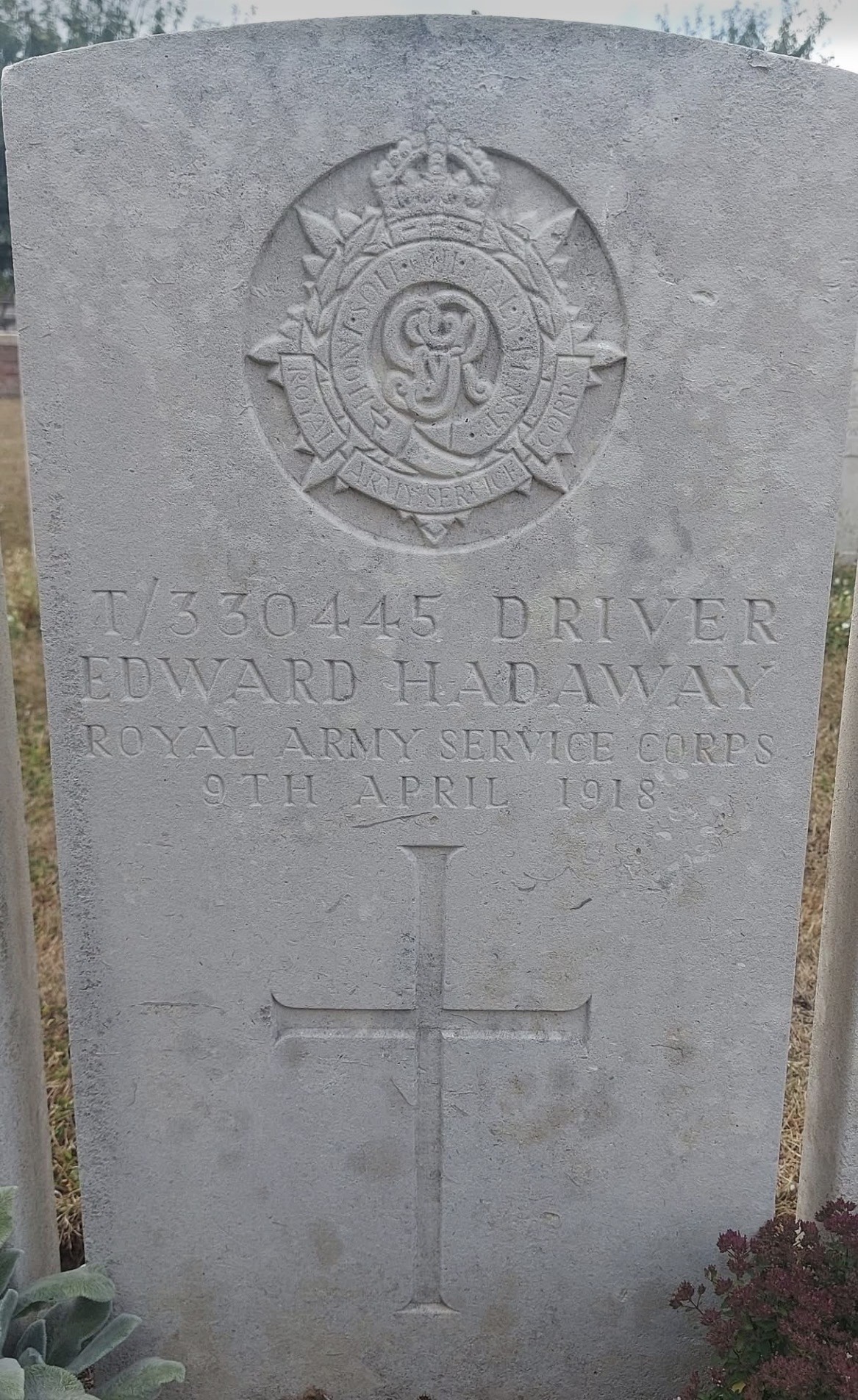
His older brother, Driver Edward Hadaway, of the Army Service Corps, died on April 9th, 1918.
He’s buried at Nine Elms British Cemetery at West-Vlaanderen near Poperinge in Belgium.
He was 30 years old.
We know for certain that Percy and Edward were brothers, because the CWGC records name their parents: James and Caroline Hadaway, who lived at 4 Keeler’s Mansion on Elham High Street, a building which still exists.
They had four other brothers, two of whom died before them.
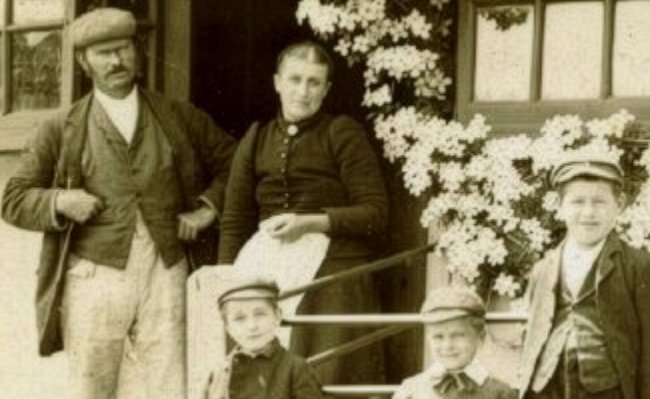
Remarkably, the Elham Historical Society (EHS) has a photograph in their Archive showing the family, said to be dated about 1900, outside their home. Three of the boys are in the picture. It’s likely that Percy or Edward – possibly both – are included.
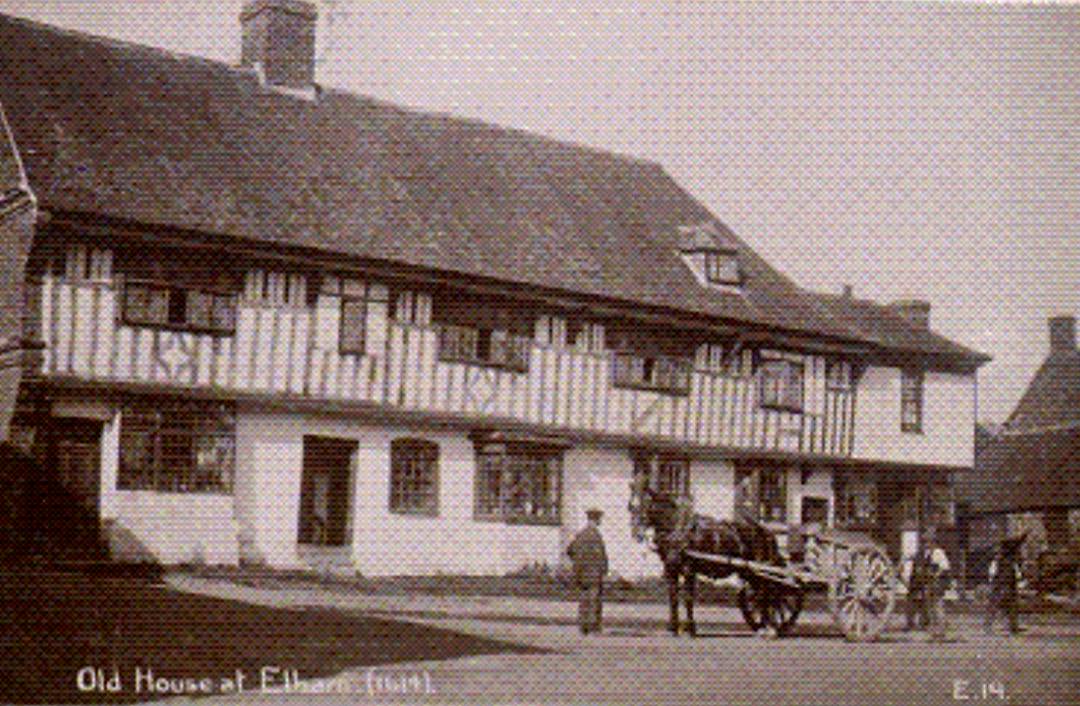
The building still exists today as The Abbot’s Fireside. At the time, it was known as Keeler’s Mansions, and was divided into four rented cottages. The Hadaway cottage was on the far right.
But research suggests that Percy and Edward had more in common than simply being brothers; it looks as if they were also married to the same woman. This is almost certainly not unique, but it must be very unusual. It might be worth further study to find out how common it was.
We do know that the woman in question was Harriet Elizabeth Woods, who was born and baptised in Brentford in west London in 1894. She lived at Page Yard in Chiswick. Somehow, she met Percy, who was described as a farm labourer in the 1911 census, and they were married in the early summer of 1916. By then, Percy had enlisted in Folkestone.
Percy’s service record was destroyed in WWII, but notes prepared by historian Paul Reed for losthistory.net suggest that he would have been with the 5th Battalion Royal Sussex Regiment during the Battle of the Somme, at Bazentin Ridge, Ovillers, Pozieres, and then the Ancre Heights.
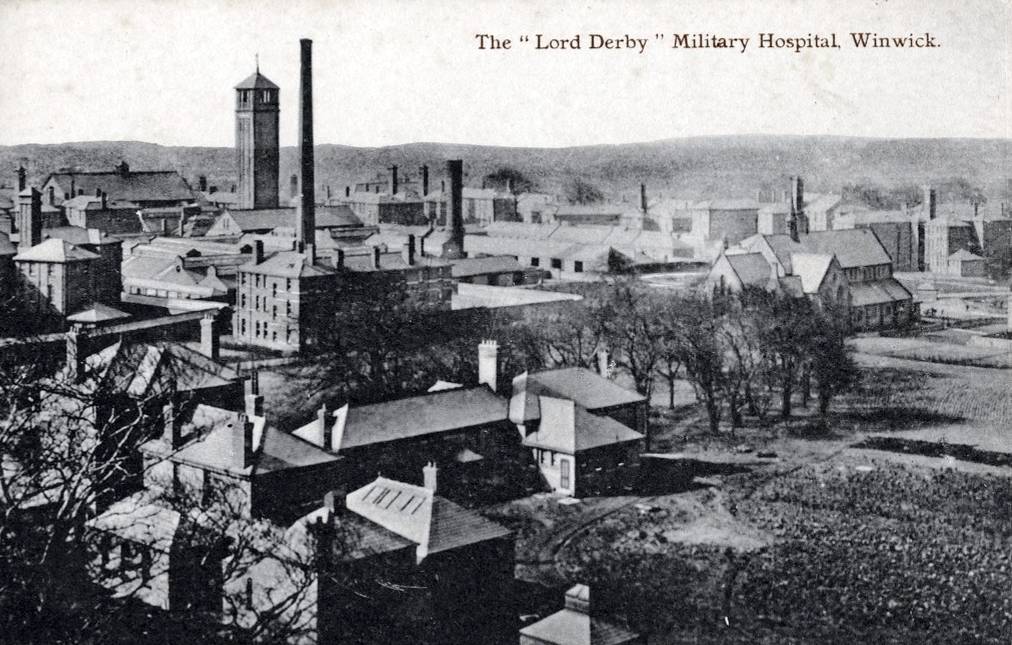
At some stage, he was wounded and repatriated, to the Lord Derby War Hospital at Winwick in Lancashire. He died there on January 22nd, 1917, and the death certificate, uncovered by the Elham Historical Society, said his death was caused by a gunshot wound to his left foot and septicaemia.
The reference is very specific. He was wounded three months and 17 days before he died; he contracted septicaemia 15 days later. In other words, Percy was wounded on or about October 1st, and was treated in hospital from mid-to-late October, 1916.
His funeral in Elham was reported in the Folkestone, Hythe, Sandgate and Cheriton Herald:
The remains of Private Percy Hadaway (Sussex Regiment), who died from wounds received at the front, took place in St. Mary's Churchyard on Saturday last, with military honours. The band of "The Buffs" was in attendance and played the "Dead March" as the body was borne on the shoulders of a detachment of Dragoon Guards (Carabineers) from Canterbury from the deceased residence in High-street to its last resting place. Amongst those who followed were the widow (Mrs. P. Hadaway), Mrs. Hadaway (mother), Mr. Edward Hadaway, Mr. Stephen Hadaway (uncle), Miss Finnis, Mr. P. Marsh, Lance-Corpl. White ("Buffs"), and Pte. W. Goldfinch (Sussex Regiment).
The first part of the Burial Office having been recited in the church by the Rev. C. W. B. Cobbe (curate), the cortege proceeded to the churchyard. Three volleys were fired over the grave, and then "The Last Post" was sounded in a most impressive manner. Subsequently a muffled peal was rung on the bells of the church as a token of respect for the deceased soldier.
What happened next?
Five months after Percy was buried, Harriet married his brother Edward, who was listed among the mourners at the funeral. Their wedding took place on June 17th, 1917. Harriet was heavily pregnant. A child, Edward Joseph, was born exactly two months later, on August 17th, 1917.
This gives rise to two anomalies.
Firstly: who was the father?
Harriet would have conceived, approximately, in November, 1916. By then, her husband Percy had been wounded in France, repatriated, and was being treated in a hospital in the north west of England. Septicaemia had already been diagnosed.
The birth certificate for baby Edward Joseph, however, states the father was Edward Hadaway, and the service record for Edward records that he was on home service for 18 months, before he left for overseas duties on October 12th, 1917.
So was the father Harriet’s first husband, Percy, who was seriously ill at a faraway hospital, or Percy’s brother Edward who was present at his brother’s funeral, and became her second husband after Percy died? The child was called Edward.
The second anomaly arises from two certificates which refer to Harriet as ‘Holloway’ not ‘Hadaway’. One is the baby’s birth certificate which has the words formerly Holloway. The other is Edward and Harriet’s marriage certificate, which refers to Harriet as ‘Holloway’.
Clues might lie in two further documents. One is Edward’s service record, which also refers to Harriet as ‘Holloway’ but defines her, wrongly, as a ‘spinster’ rather than a widow. Another is Percy’s pension card, which acknowledges Harriet’s remarriage to Edward, but notes that she ‘remarried’ – and the pension was stopped.
We’ll never know what really happened. But given that the pension cards make it clear Harriet married the two brothers, where did the name ‘Holloway’ come from? It’s unlikely to be a clerical error, despite the similarity between the names, because it appears in multiple documents. Is it possible it was an invention, to call oneself a spinster and create a fictional unmarried surname, in an effort to avoid losing Percy’s pension on remarriage? If so, it didn’t work. The note on Edward’s pension card states: Remarried late husband’s brother. Pension stopped.
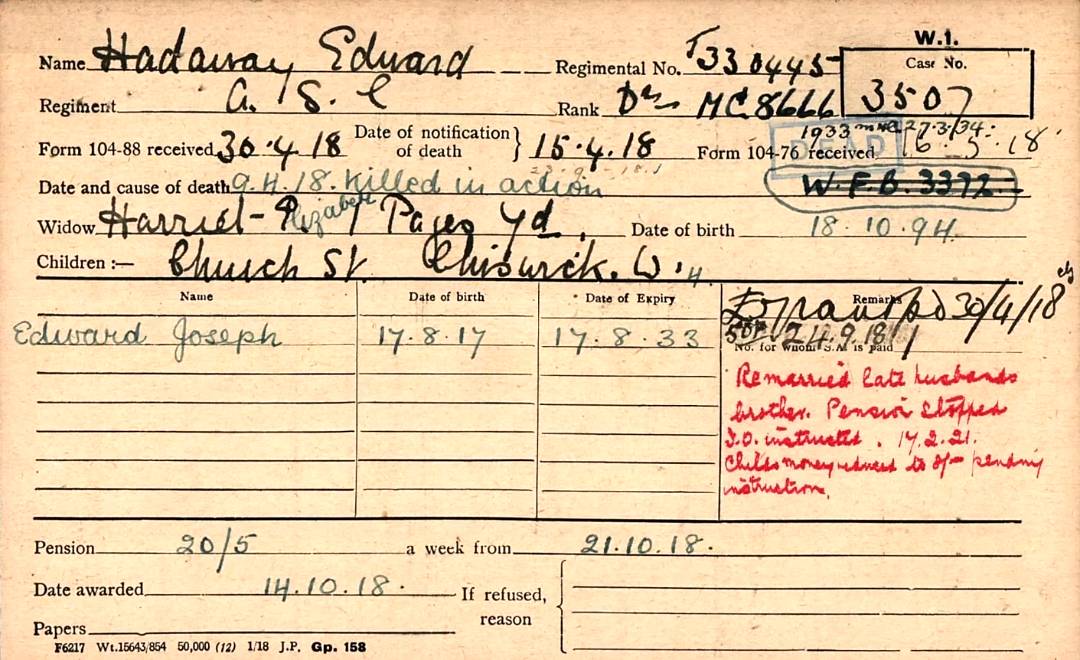
Whatever took place, Harriet had a troubled life. Edward, her second husband, was killed in action in Belgium in April, 1918, leaving her with a nine-month-old son. The boy, Edward Joseph, died aged 18 in 1936 and is buried in South Ealing Cemetery.
Before Edward Joseph died, Harriet remarried, in Hammersmith in 1922. Her third husband was Henry Frier, who had three children and together, they had a fourth. Henry died in 1937. A fourth marriage followed for Harriet – to Albert Hunt in Greenwich in 1943. She died there in 1951, aged 56.
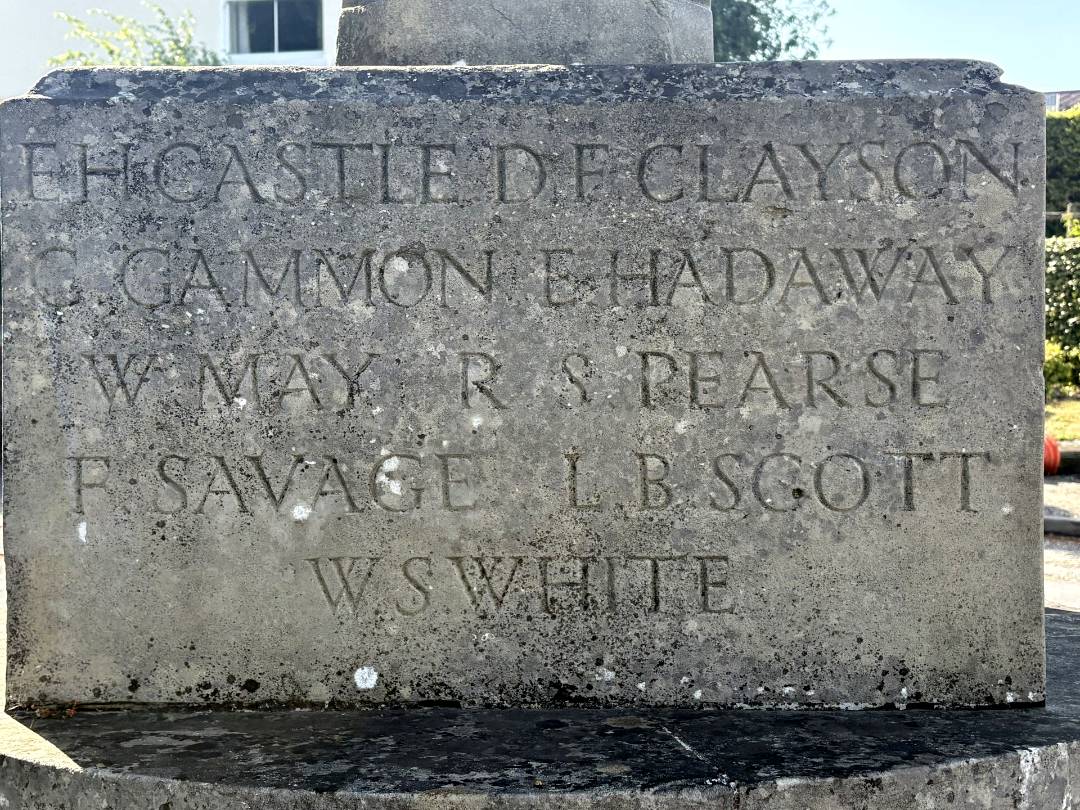
There is a war memorial on the High Street in Elham, not far from where the brothers lived.
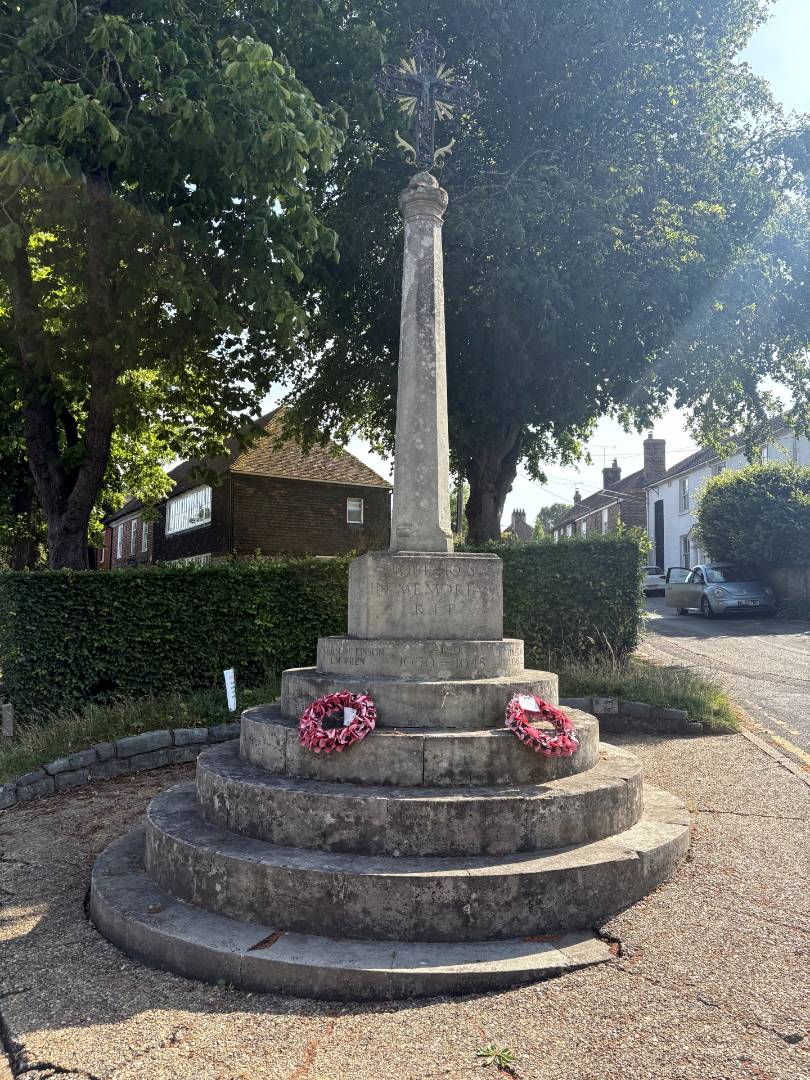
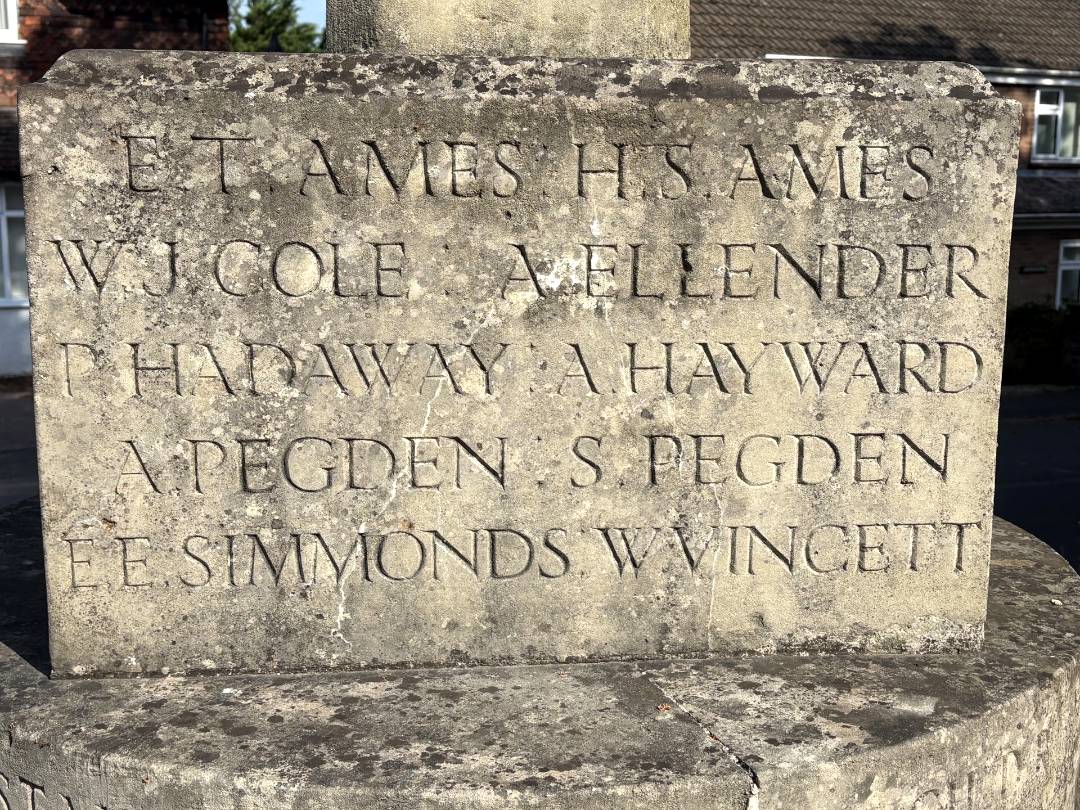
The brother’s names are engraved on the memorial – on opposite sides.
Footnote
I learned during research for this article that in some parts of the world an unmarried brother is expected to marry his deceased sibling’s widow. This is known as a ‘levirate marriage’, but knowing what we’ve learned, it’s unlikely to have applied in the case of the Hadaway brothers and Harriet.
Acknowledgements
This article couldn’t have been written without considerable help from the extraordinary contributors to the Great War Forum, who mostly work with nom de plumes; thanks, therefore, to RussT, Pat Twomey, knittinganddeath, Tawhiri, and Richard Cawthorn. Special thanks, too, to historian and genealogist Dr Alan Hawkins, to Michael Wallace for the photograph of Edward Hadaway’s headstone, to historian and author John A Taylor, to Bryan Badham and his colleagues in the Elham Historical Society (www.ehs.elham.co.uk), and to the excellent sussexhistoryforum.co.uk.
Becoming a member of The Western Front Association offers a wealth of resources and opportunities for those passionate about the history of the First World War. Here's just three of the benefits we offer:

Explore over 8 million digitized pension records, Medal Index Cards and Ministry of Pension Documents, preserved by the WFA.

The WFA regularly makes available webinars which can be viewed 'live' from home. These feature expert speakers talking about a particular aspect of the Great War.

Featured on The WFA's YouTube channel are modern day re-interpretations of the inter-war magazine 'I Was There!' which recount the memories of soldiers who 'were there'.


