
Roehampton orderly thrown off bus
The following story relates to the discovery of a relatively rare pension card, that of a civilian in the British Red Cross Society.
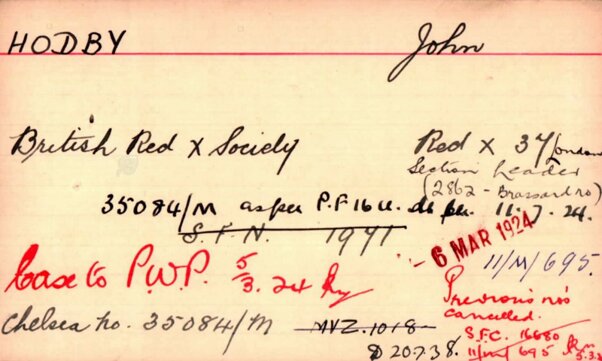
Even more unusually, this civilian has a service record in both series WO 364, Soldiers’ Documents from Pension Claims, and also the elusive series PIN 26, which contains roughly a 2% sample of pension award files from WW1. His service record shows that he met with a serious road accident on hospital duty with Queen Mary’s Hospital, Roehampton, in November 1917, which was clearly the reason behind his pension claim, and the following research was aimed partly at determining, as far as possible, what actually occurred.
Family History
John’s parents were John Hodby, originally from Sharnbrook in Bedfordshire, and Emily Parsons, a native of Farnham, Surrey, who were married in 1858 in Holborn.
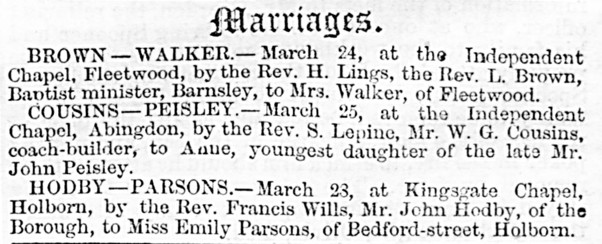
In 1871 John senior was recorded as a warehouseman in Islington, North London, and had four children. The family had moved South of the river before the birth of their son John junior 19/12/1873, registered in the St Saviour district of Southwark in early 1874. By 1881 John was a warehouseman living at 35 Delverton Road, Newington, and there were no further children. His death was recorded, aged 58, in the St Saviour district in 1889.
By the time of the 1891 census John was living with his widowed mother at the same address, and his occupation was given as a colour merchant’s clerk, so he was evidently in the trade involving dyes, pigments and paints.
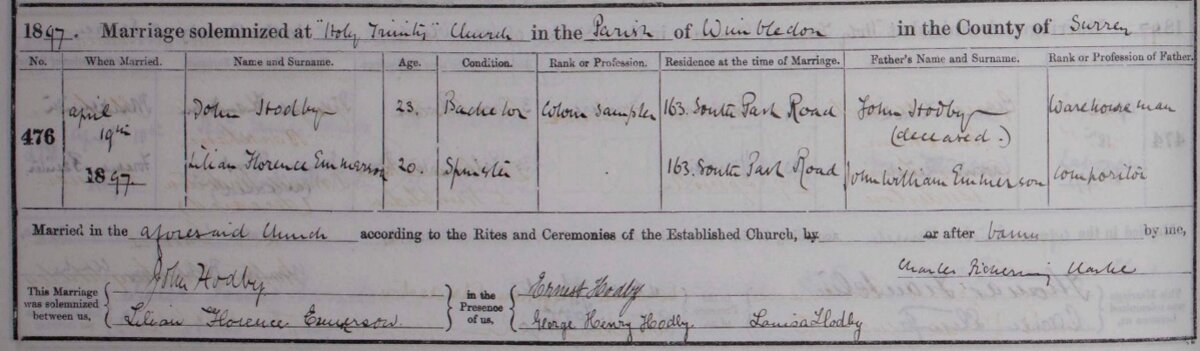
John married Lilian Florence Emmerson in 1897, his occupation given as colour sampler.
A move to the North East followed, with the births of daughters Dorothy Violet and Eva Lilian registered in the Tynemouth district in 1898 and 1899 respectively, before a return to the South and the birth of their third daughter, Freda Constance, registered in 1903 in the Kingston district. The 1901 census shows John as a colour traveller, lodging in Clerkenwell, while his wife remained with the children in Whitley Bay, Northumberland.
The 1911 census indicated there were by then no further children, and John was still in the paint trade.
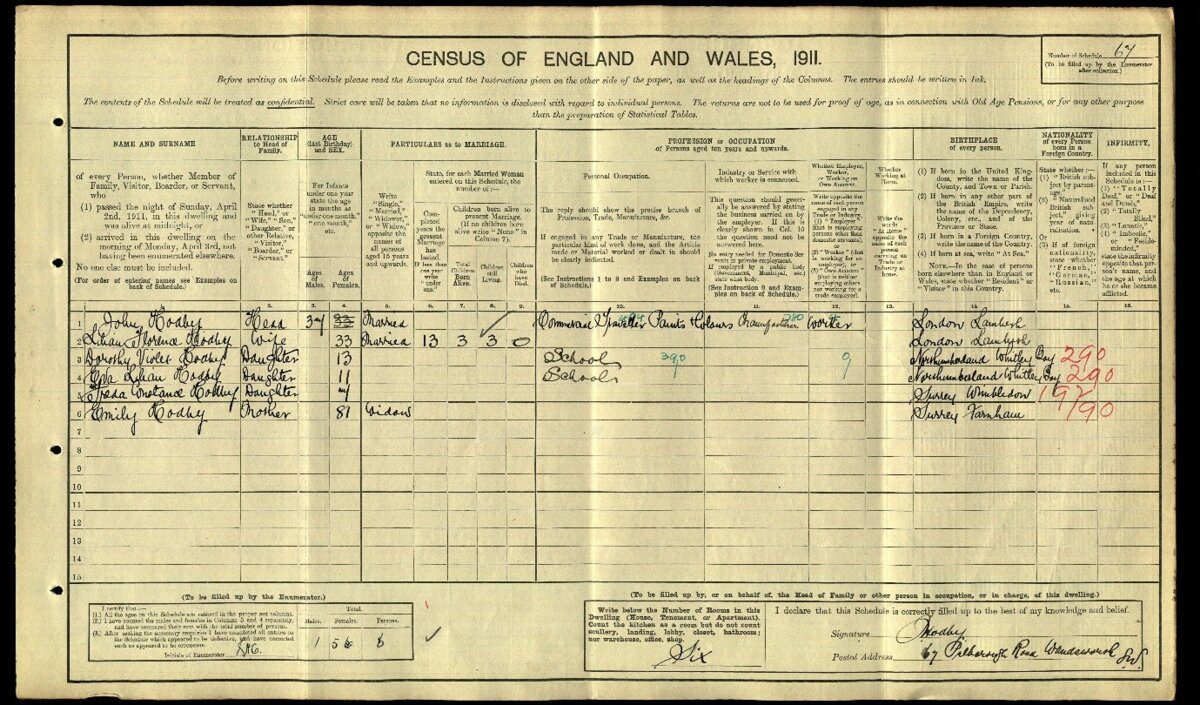
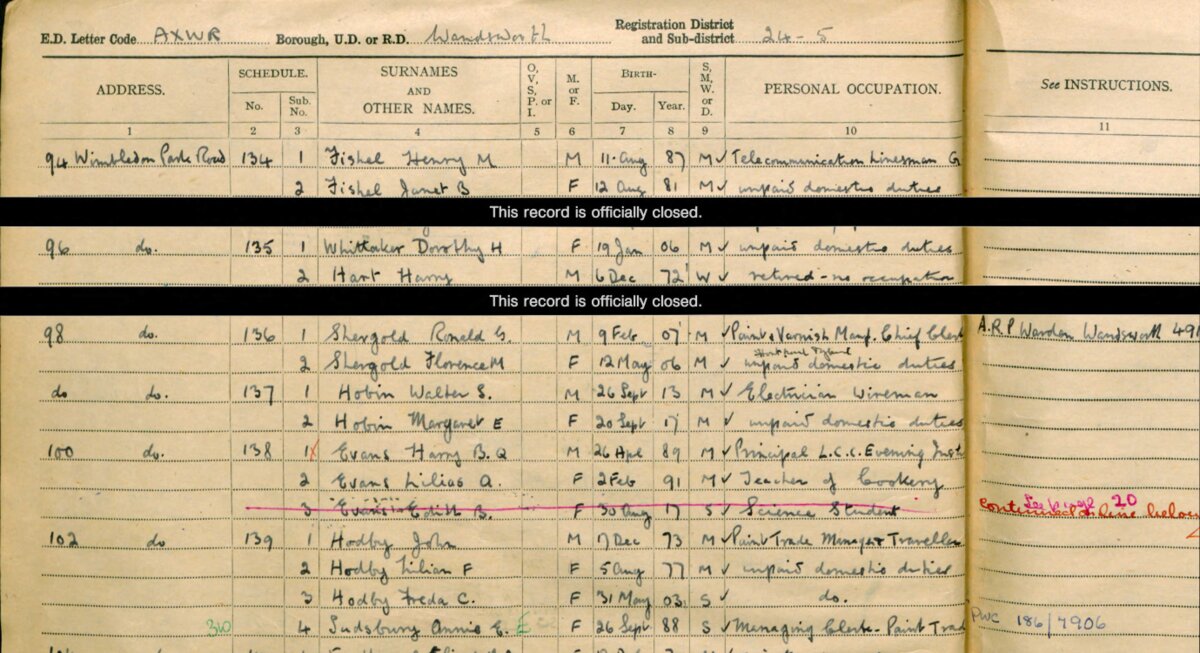
This was by no means the end of the family, with the births of Richard John and Josephine Ruth registered in the Wandsworth district in 1916 and 1918 respectively. Moving forward to 1921, the family were living at 102 Wimbledon Park Road, Wandsworth.
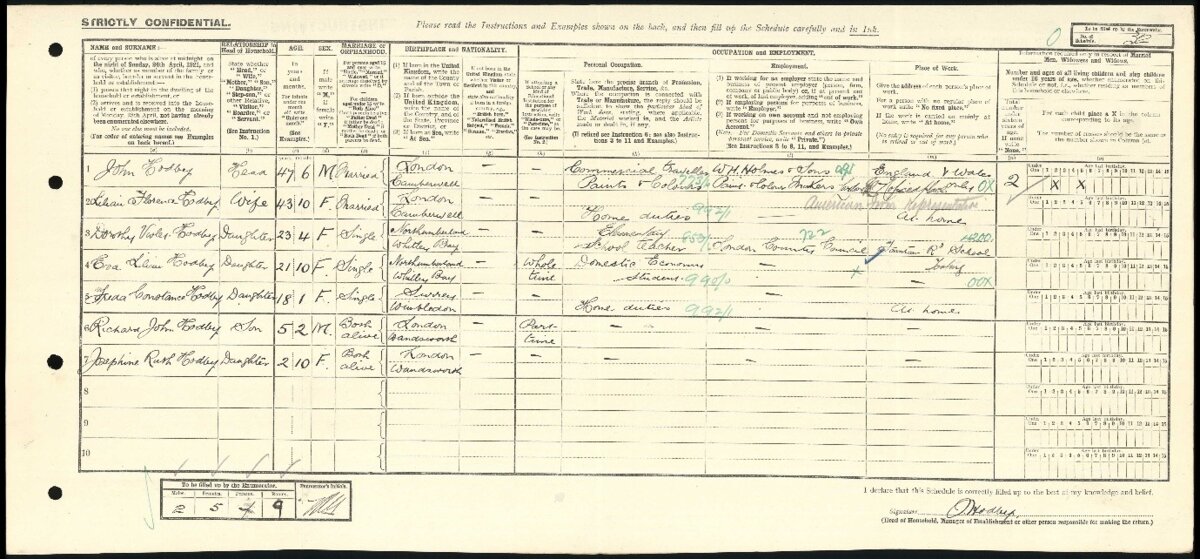
His employer, W.H.Holmes & Sons, was a paint and colour manufacturers, established in 1848 and based in Newcastle on Tyne, which would explain the earlier Whitley Bay connection.
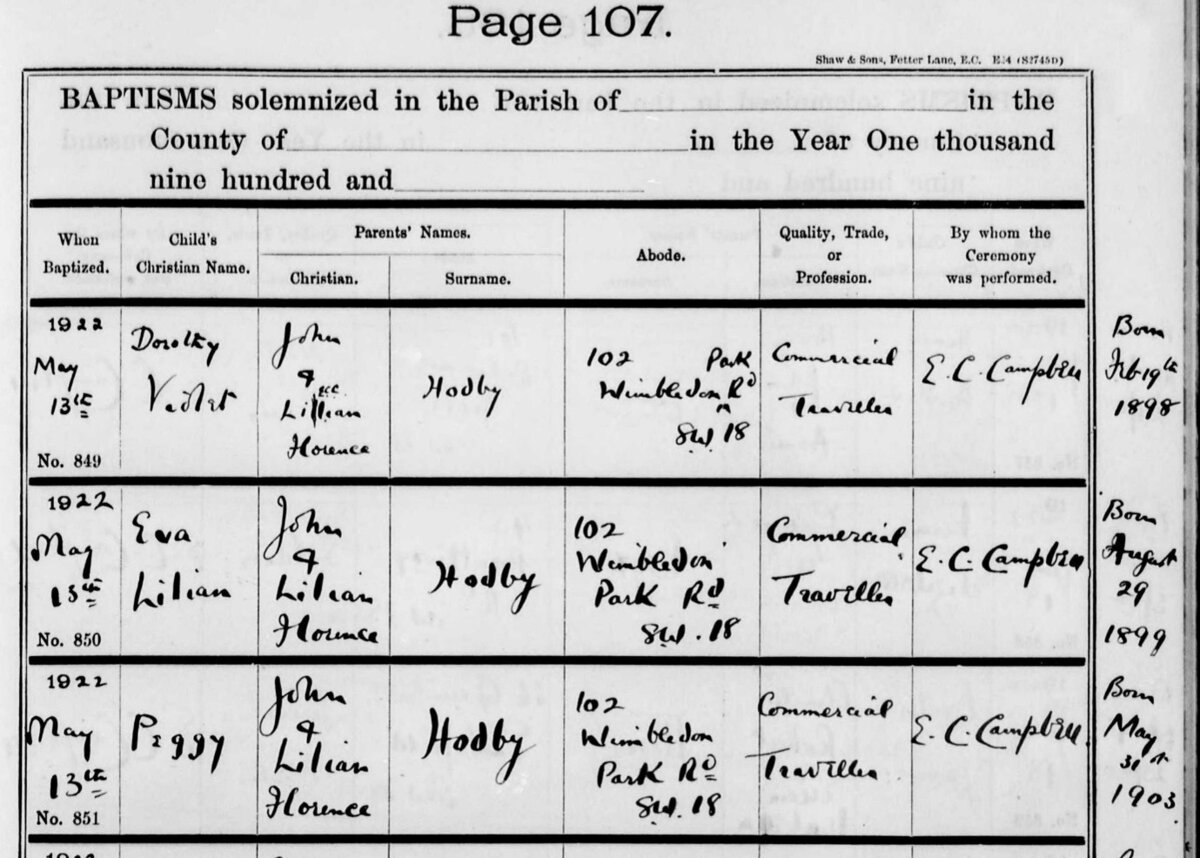
Although baptism records couldn’t be located for the two youngest children, the first three were baptised together on 13 May 1922, but with Freda Constance baptised as ‘Peggy’, a very unusual diminutive of Freda.
The War Years
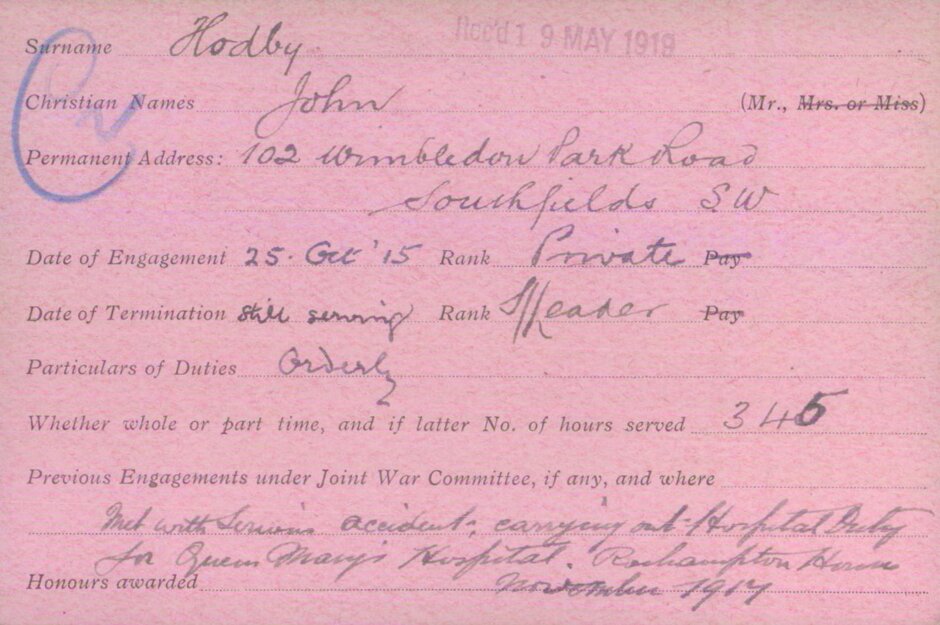
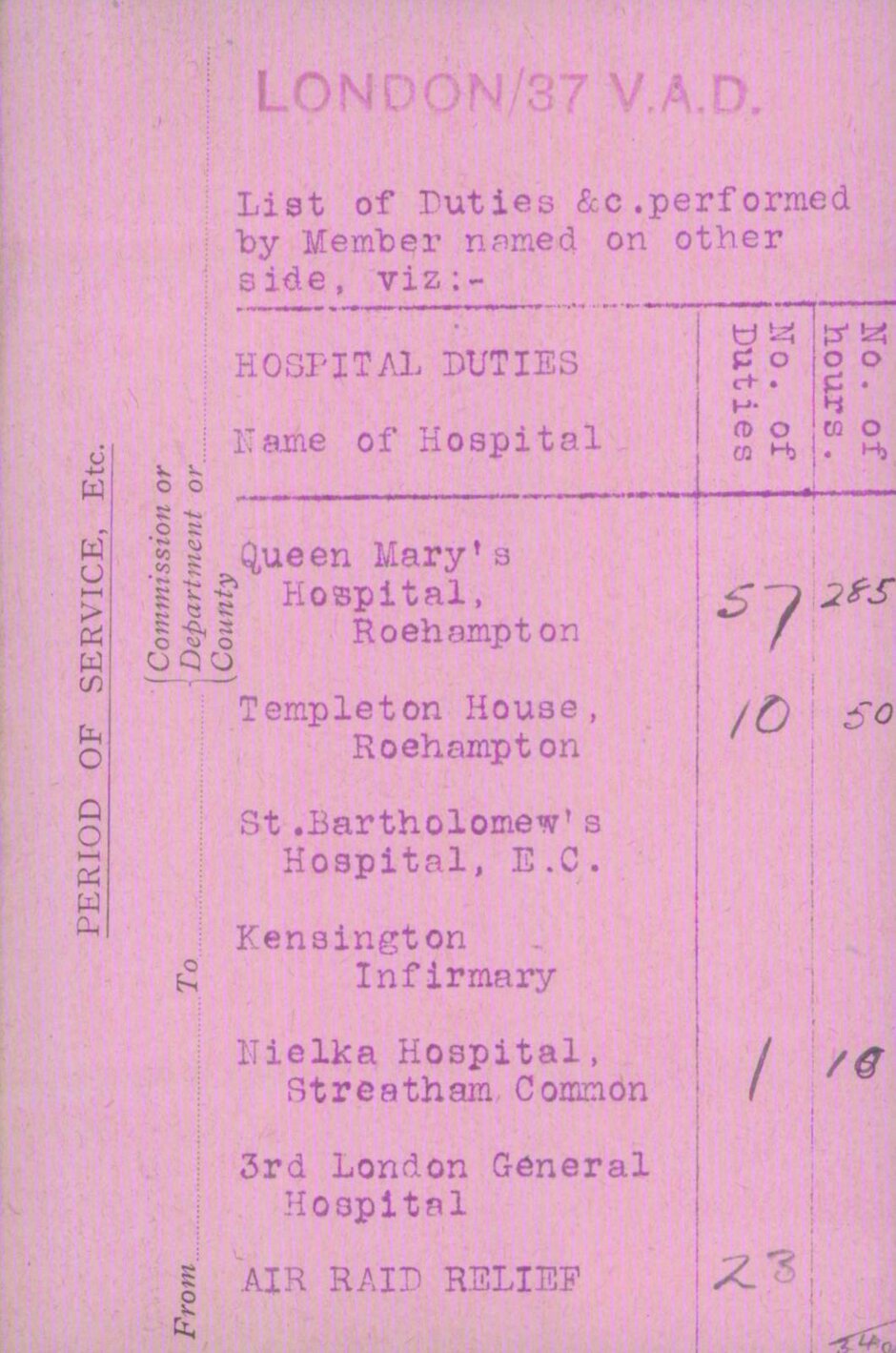
John’s record card shows service with the 37 London Voluntary Aid Detachment of the British Red Cross Society.
He also served at several other establishments, as shown below.
Queen Mary’s Hospital Roehampton
This hospital was established in June 1915, at Roehampton House, for the benefit of limbless servicemen, offering artificial limb fitting for amputees, as well as rehabilitation and training opportunities. By the end of the war the hospital had expanded to almost a thousand beds as its reputation continued to grow. The hospital is still famous today for its rehabilitation work in the Douglas Bader Unit.
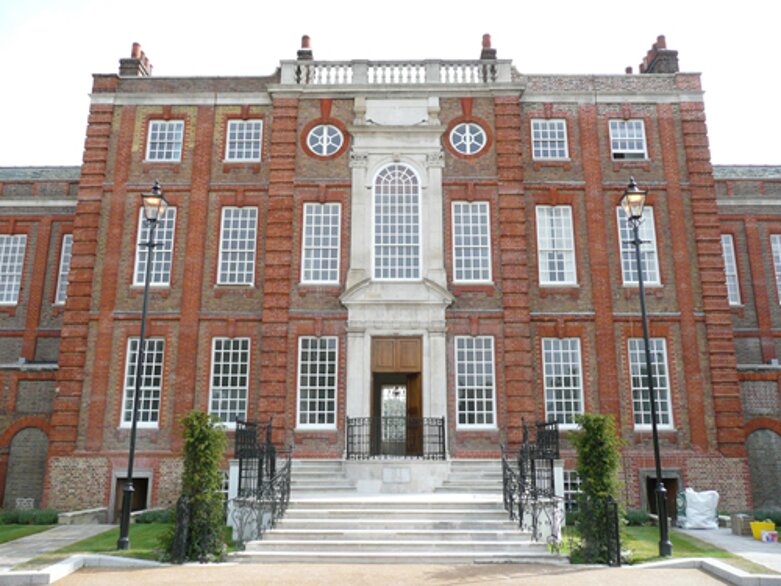
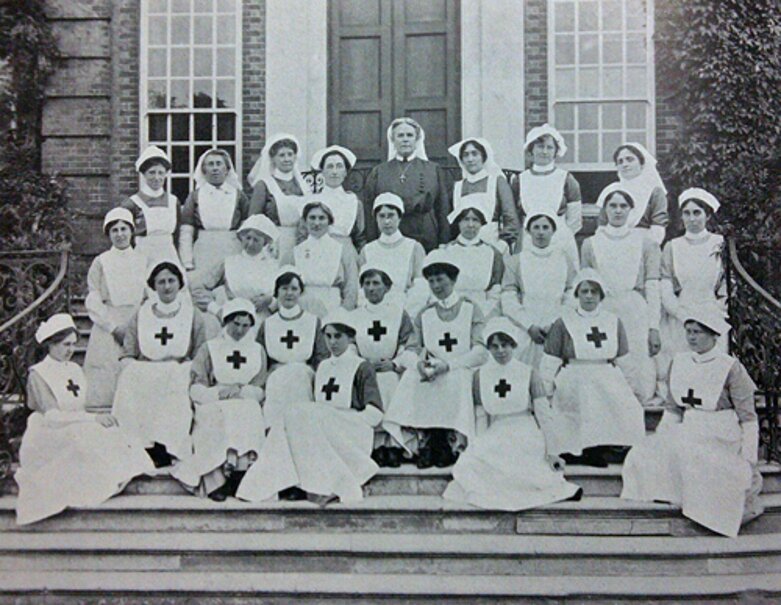
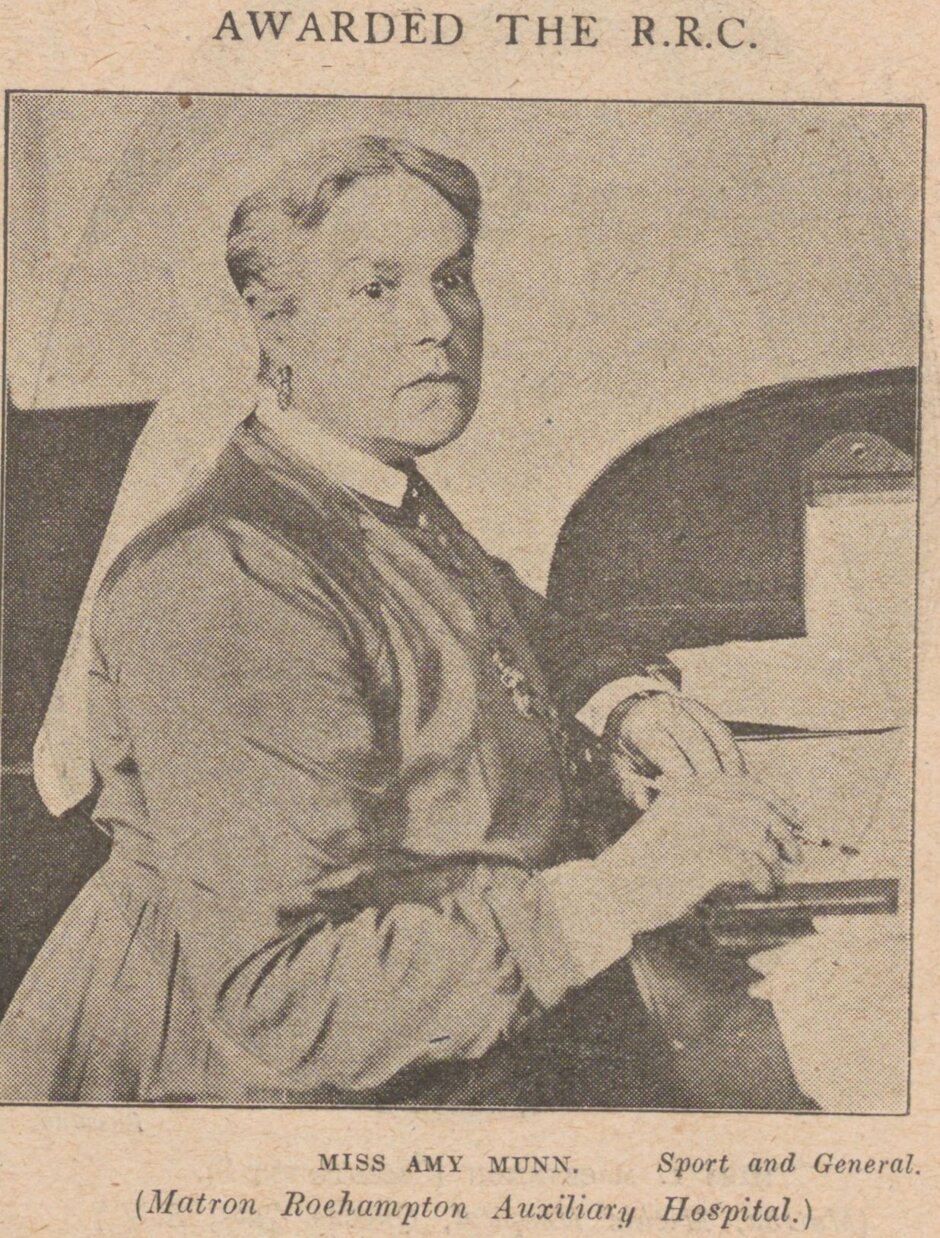
A report of the award of the Royal Red Cross to the matron appeared in the ‘Nursing Times’ on the very same date of John’s accident, and was discovered while searching for details of this event.
Amy Munn, a very popular matron, is instantly recognisable from the photograph on the hospital steps.
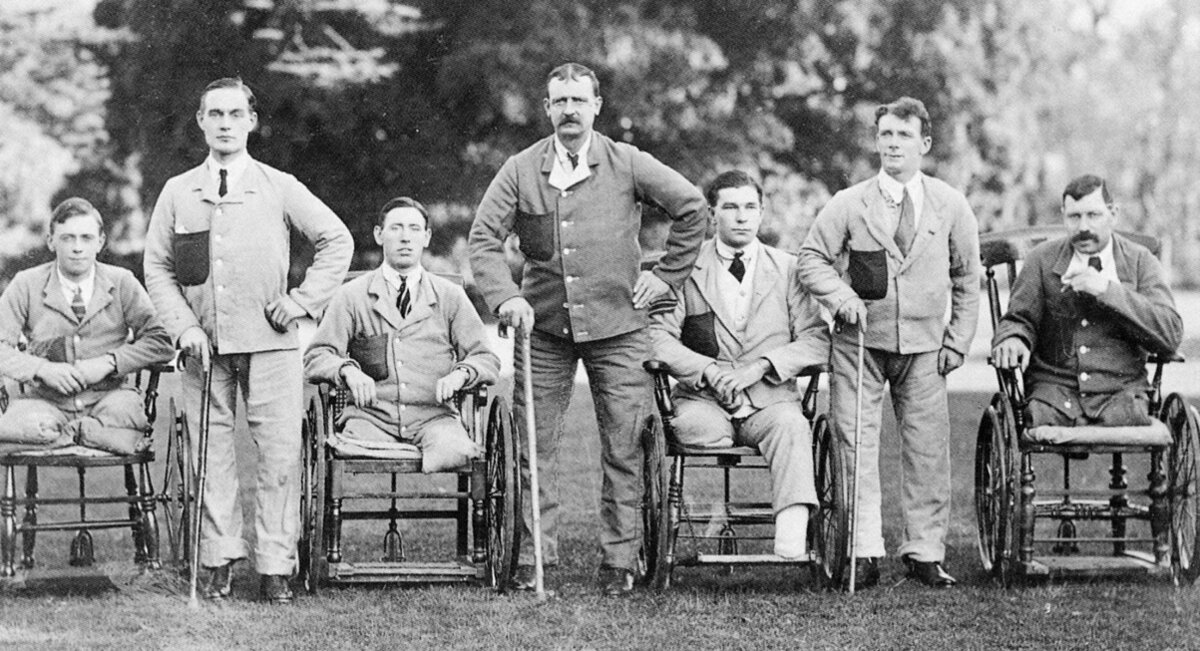
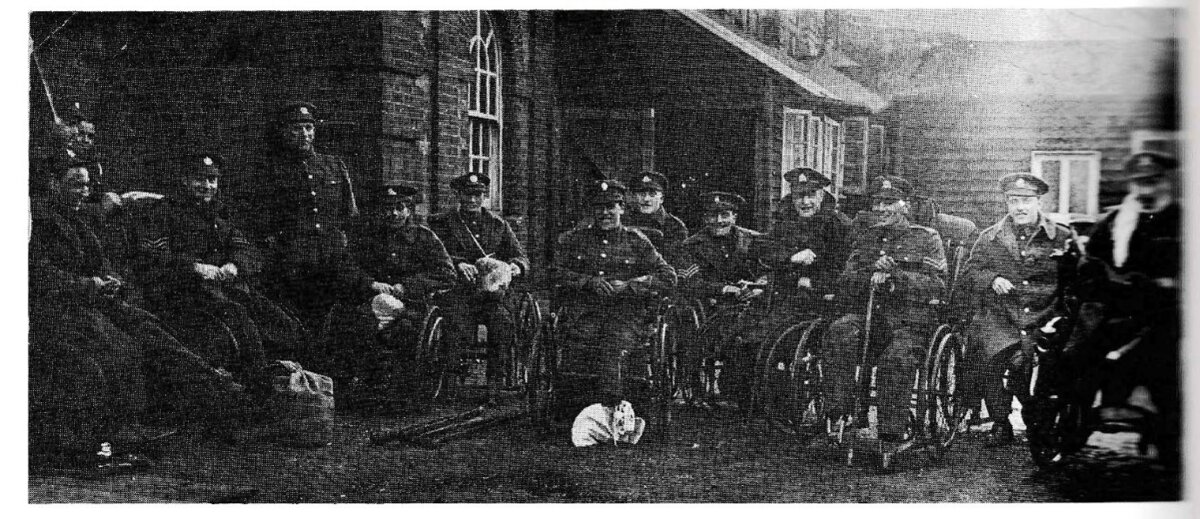
There are many surviving pictures of patients, the following group being perhaps one of the best known.
Service Record
A file relating to John Hodby’s accident of 10/11/1917, was unexpectedly found in series WO 364, often referred to as the pension records, or as the ‘unburnt’ series.
Even more surprising is that there is also a file in PIN 26/20618, a series of records supposedly selected to represent some 2% of pension files. This file is only available at National Archives, Kew, and hasn’t been accessed, but is perhaps unlikely to contain any more information about his medical condition and accident. The summary for the PIN 26 entry in the National Archives is ‘Section Leader John Hodby, Voluntary Aid Detachment, Official No: 37, Nature of Disability: fractured skull’.
His WO 364 file is of a very similar format to that of another civilian, a John Henry Golden, a fire brigade fireman, and whose pension card was researched by the author some time ago. Whereas Golden’s WO 364 file was cross referenced on the front cover with piece number PIN 26/5834, Hodby’s file does not contain a corresponding PIN 26 reference.
John Hodby’s WO 364 file consists of just three pages, as shown below.
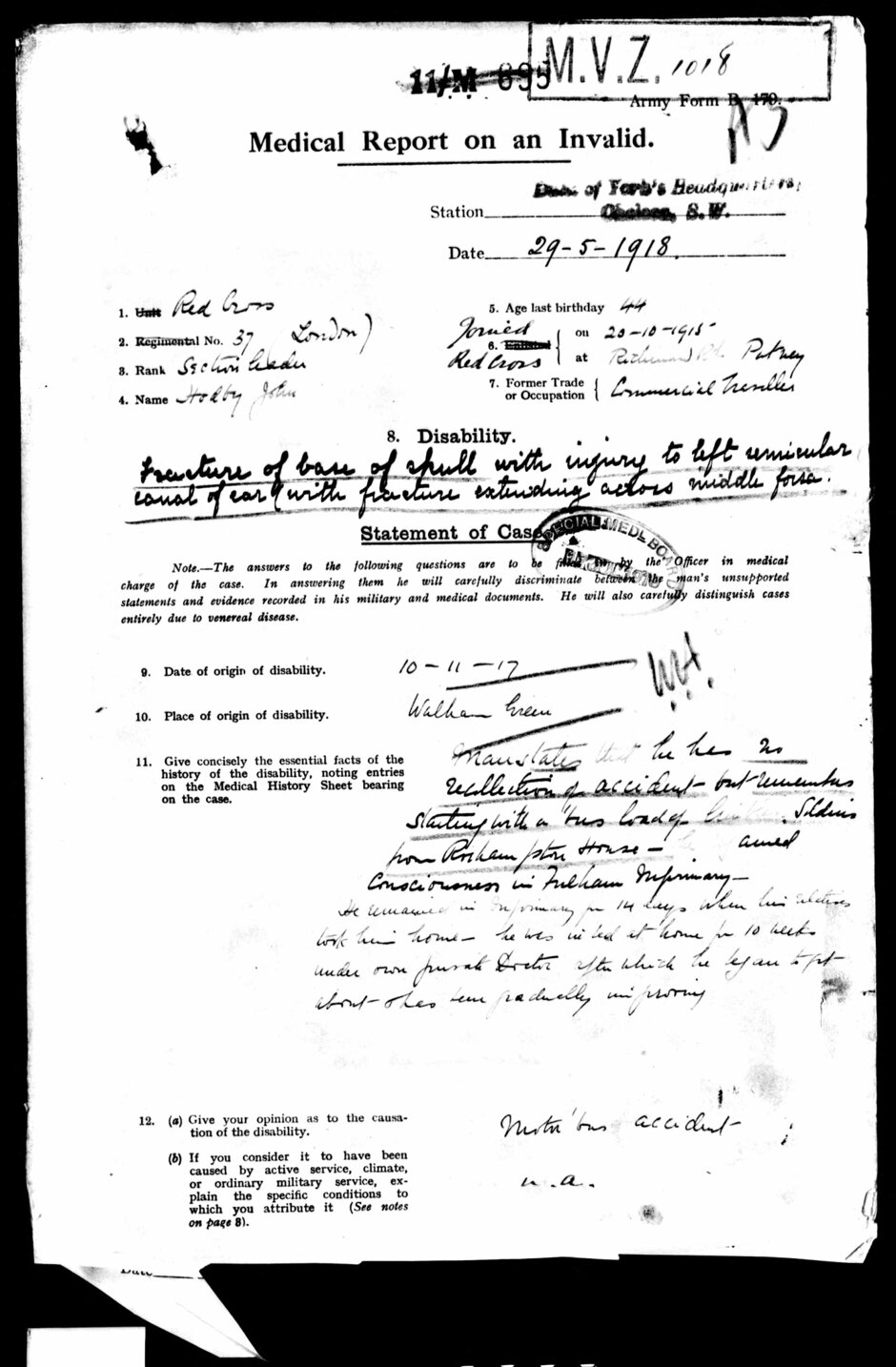
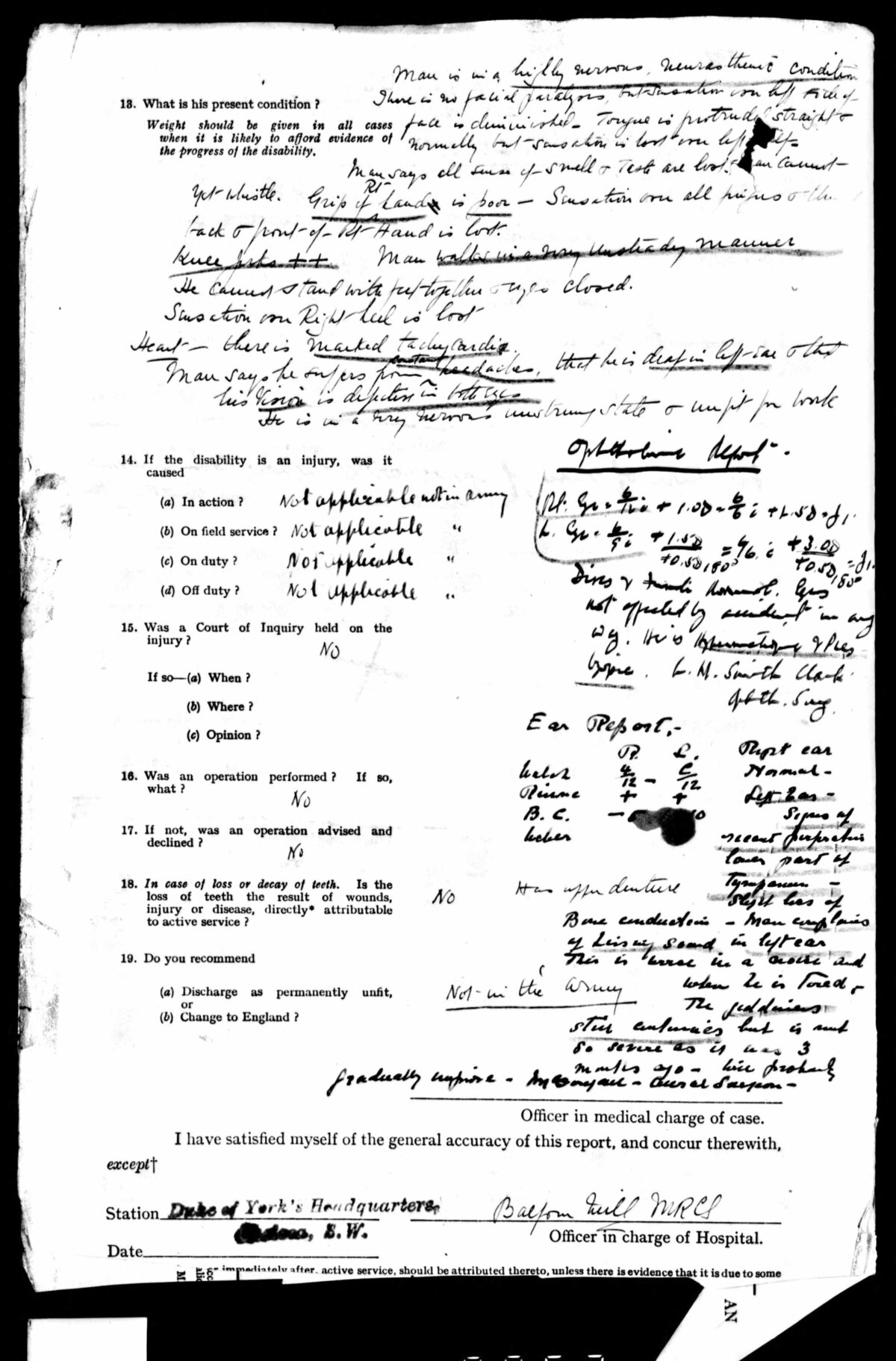
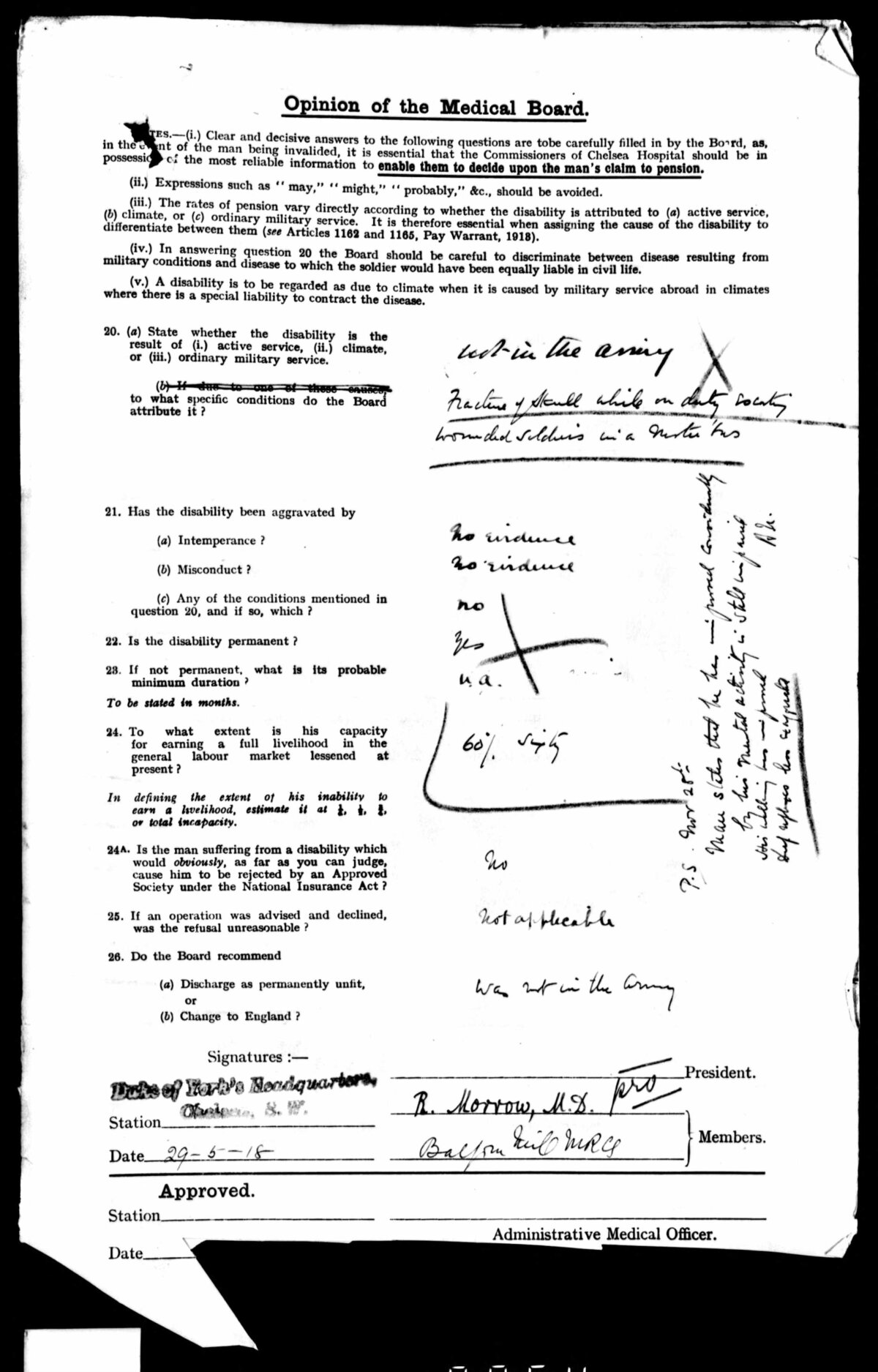
This record, based on the findings of a medical board from 29/05/1918, shows John Hodby served as a section leader in the 37 London Voluntary Aid Detachment of the British Red Cross, having joined at Putney in 1915.
He had clearly been involved in an accident, on 10/11/1917, of which he had no recollection, only recalling starting with a motor bus load of limbless soldiers from Roehampton hospital. It is apparent that he was engaged in escorting the passengers, and was not the driver of the bus. His injuries were severe, including a fractured skull, and he was left suffering from a nervous condition, and also had many physical problems, including loss of feeling in various limbs, loss of his sense of taste and smell, partial deafness, and defective vision. His record does state that by 28/11/1917 his condition had improved considerably although his mental condition was still impaired.
Search for the Accident Location
An initial search for newspaper coverage, based on such attributes as his full name, his surname only, and Roehampton, commencing with 10/11/1917, resulted in zero matches.
It did seem very likely that the accident would have been reported, at least in the local press, but that possibly the coverage failed to mention John Hodby by name. Various newspapers covering the vicinity of Roehampton Hospital were searched to no avail, so the quest was moved to Walham Green, the ‘place of origin of disability’ mentioned in his medical report, and thus presumably the scene of the accident. Walham Green is the historic name for the area now known as Fulham Broadway, and the only available online newspaper appeared to be the ‘Fulham Chronicle’, a weekly paper.
The following report appeared on the very last page of the edition of 16 October 1917, and is spread over two columns.

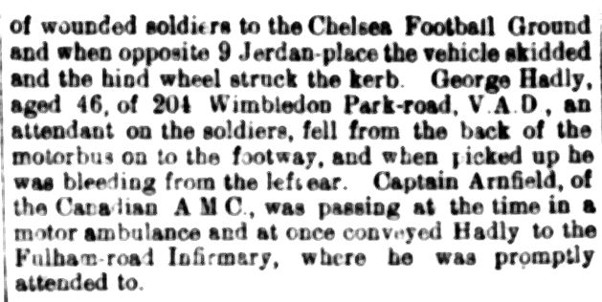
John Hodby had clearly morphed into ‘George Hadly’, thwarting any newspaper indexing. His age was recorded fairly accurately, and his reported address of 204 Wimbledon Park Road was exactly double that of his actual house number of 102.
This was undoubtedly our man, and conclusively proves, as suspected, that John wasn’t driving, but was accompanying the wounded soldiers. It is apparent that the bus had already travelled some four miles from Roehampton and would have been very close to its destination of Stamford Bridge when the accident occurred.
It was remarkably fortunate that an officer of the Canadian Army Medical Corps happened on the scene with an ambulance, but it hasn’t been possible to identify Captain Arnfield from the Canadian WW1 records, perhaps this is another example of an incorrect name being reported.
At this time Chelsea FC were playing in an unofficial league, termed the London Combination, as the Football League had been suspended during the war years. The attendance that day was 5000, and the result a 1-0 win to the visitors, Crystal Palace.
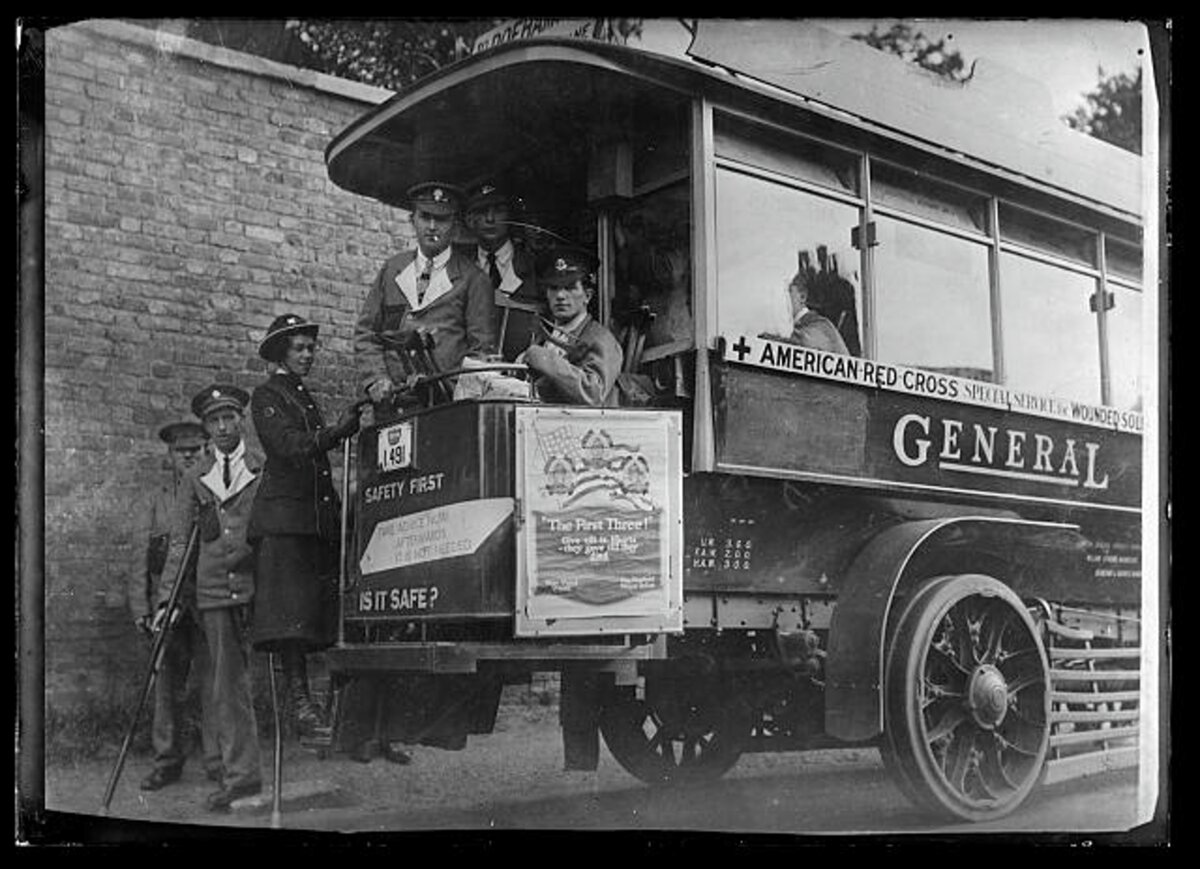
It is quite obvious why John would have been dislodged, as the bus would almost certainly have been the same type as that shown below, and he may well have been standing at the somewhat open rear.
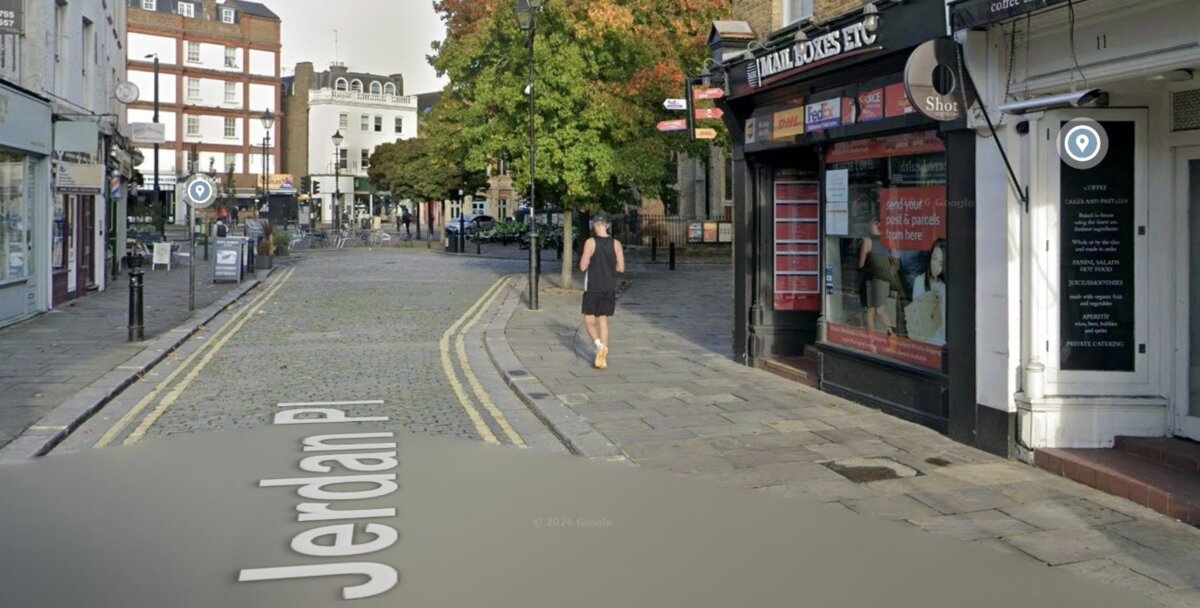
9 Jerdan Place, the scene of the accident is still in existence.
Memoirs of a fellow VAD
Sidney Noel Brown, a fellow VAD from Putney, and also employed at Roehampton Hospital is quoted in the book ‘The Roses of No Man’s Land’, by Lyn Macdonald.
‘On Saturday afternoons we used to take a whole bunch of them to Chelsea Football Club when there was a match. There were men there with no legs at all, lots of them, and they had to be carried on wheelchairs, put on the bus, carried again into the wheelchair when we arrived at Chelsea and then looked after during the match. So I was very used to it, and the Matron knew me, and I liked it there very much. They were a wonderfully cheery lot. As a matter of fact we had our own football club, which I organized myself, because the chaps were keen on football.’
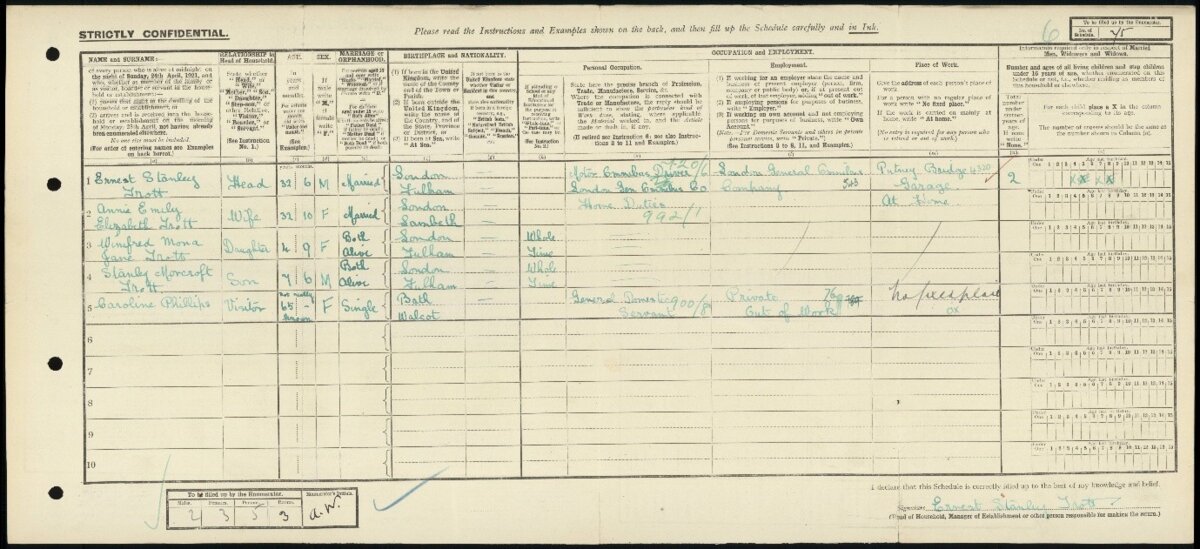
For the record, the bus driver from the accident, Ernest Knott, was still living at 41 Archel Road, Fulham, in 1921, and employed by the London General Omnibus Co.
Post War Years
Rather surprisingly, his Red Cross card, shown earlier, and dated 19/05/1919, indicates John to be ‘still serving’ at this time, despite the seriousness of his accident.
John must have continued to improve, as the 1921 census, also seen earlier, shows that he was back at work, and almost certainly with his pre-war employer.
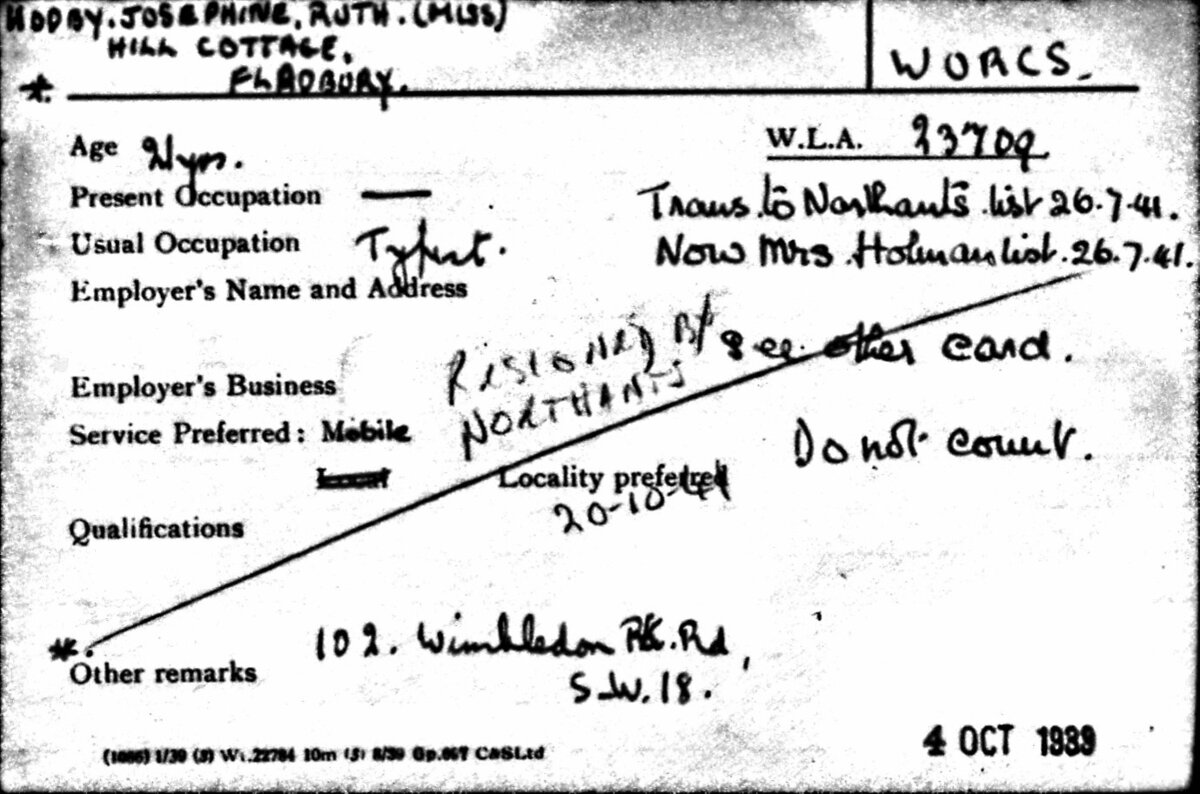
The 1939 register notes he was by then a paint trade manager and traveller, and still living at the same address in South London as that recorded on his Red Cross service card. His date of birth, given as 17/12/1873, means he would have then been aged 65, and have been aged 41 at the time he volunteered to join the British Red Cross Society.
His daughter Josephine Ruth followed in her father’s patriotic footsteps, and served in the Land Army in WW2.
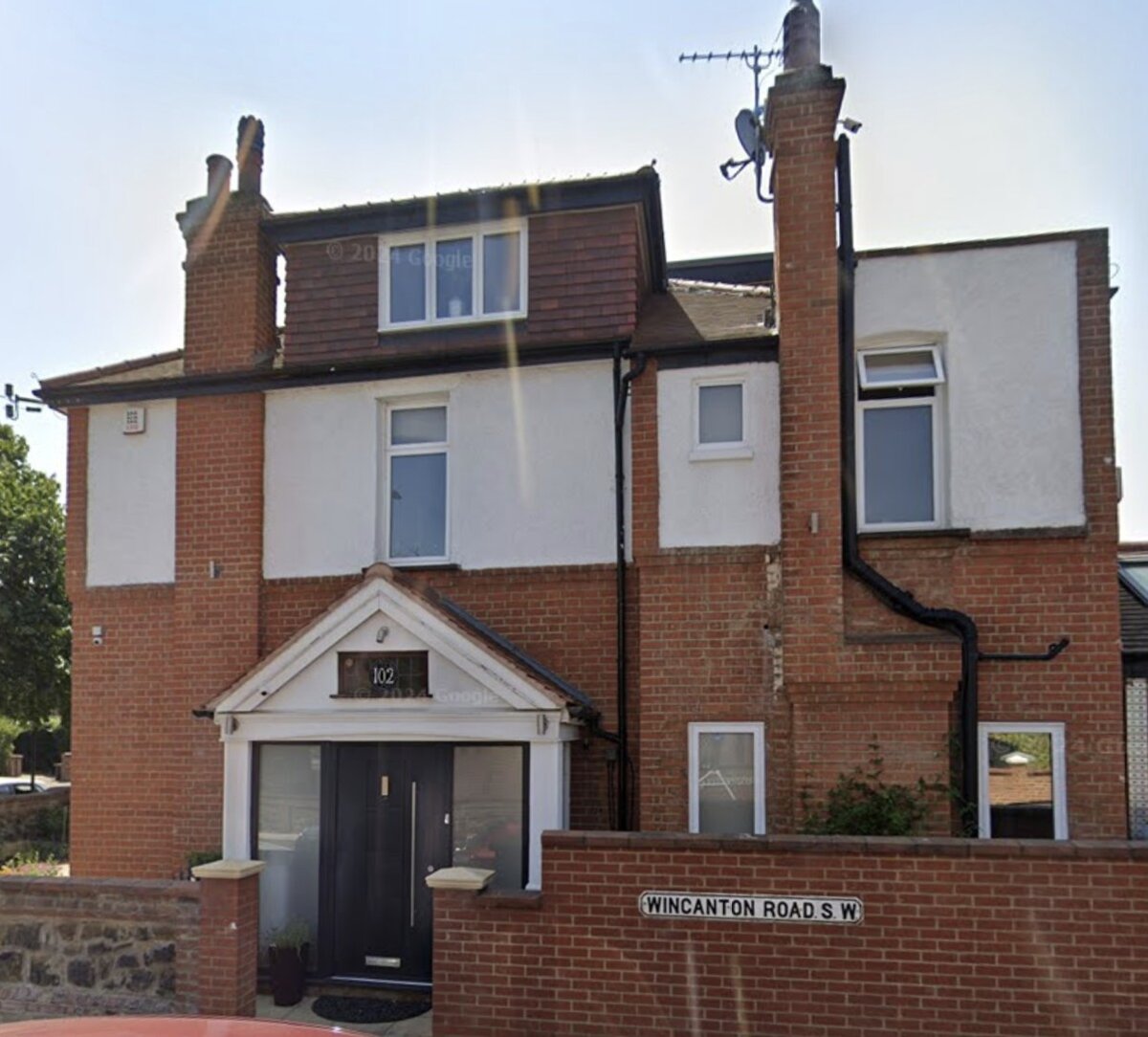
John remained at the same South London address after the Second War, and died in 1946.

His wife Lilian lived considerably longer, with her death recorded in 1969, but still in the Wandsworth district.
Summary
While it is rare to find a civilian pension card, civilian records in WO 364 are also unusual, and those in PIN 26 even more so. It was possible to discover the circumstances of John’s accident, from which he was fortunate to survive.
The important role played by men serving in the Voluntary Aid Detachments, often under the British Red Cross Society, and acting as hospital orderlies, stretcher bearers and ambulance drivers, is much less known than their female counterparts.
The value of wartime football matches, with regard to the morale of severely wounded servicemen cannot be underestimated, nor can the remarkable work of those who founded and ran the hospital for the limbless at Roehampton.
Becoming a member of The Western Front Association (WFA) offers a wealth of resources and opportunities for those passionate about the history of the First World War. Here's just three of the benefits we offer:

Explore over 8 million digitized pension records, Medal Index Cards and Ministry of Pension Documents, preserved by the WFA.

Featured on The WFA's YouTube channel are modern day re-interpretations of the inter-war magazine 'I Was There!' which recount the memories of soldiers who 'were there'.

The WFA regularly makes available webinars which can be viewed 'live' from home. These feature expert speakers talking about a particular aspect of the Great War.
Other Articles


