
Project ALIAS: A major scheme to locate men who served using a 'different' name
There are many fascinating quirks within the Pension Record Cards which have been saved by The Western Front Association. One particular aspect that came to the fore is the greater than expected use of aliases by soldiers. Without going into the reasons soldiers used pseudonyms,[1] the use of these aliases was noticed by several people using the WFA pension records.
However, there was also major difficulty in identifying these men. One of the reasons for this is the inconsistent way these records were written up by the Ministry of Pensions clerks nearly 100 years ago.
Initial research suggested that if we use the database of servicemen who are recorded by the CWGC, there should be over 3,600 'aliases' recorded on the pension cards.[2] However, randomly sampling the WFA's Pension Records suggested the number may be much higher
The other fundamental problem was the fact that some of the cards do not record the alias suggested by the CWGC. Quite often this may be because a pension may have been claimed and paid using the soldier's 'real' name rather than his 'army' name. Sometimes, even though an alias is recorded, it has not been picked up in the tagging/indexing process by Ancestry/Fold3.[3]
This provided the WFA with a fantastic opportunity to make a permanent difference to the whole subject of men who used aliases when joining the army during the First World War. We believed that it was possible, using the expertise, skill and knowledge of WFA members, to tackle the issue of identifying those men who used an alias.
What was envisaged was a project using volunteers to work down all known aliases from the CWGC and make these easily identifiable on the WFA's pension record cards which are published on the WFA's library edition of 'Fold3'. Using the data from the CWGC we would be able to tag the men for whom a pension record exists.
Here are some pension cards of soldiers who served using an alias.
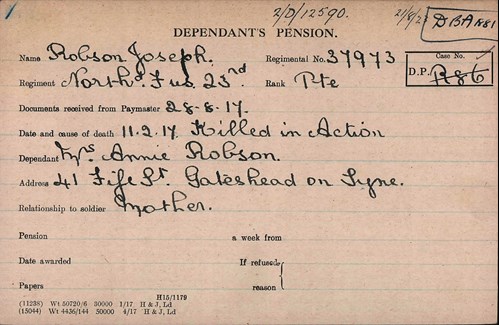
However, Joseph did not serve as Robson, Storey is his "army name". Nothing on this card suggests an alias. Evidence of the alias is available on the CWGC website. We wanted to make this card 'findable' using either the name Robson, or the 'army' name of Storey.
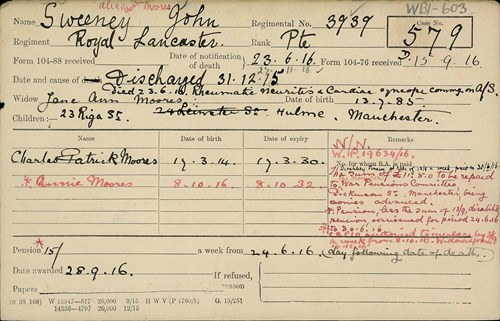
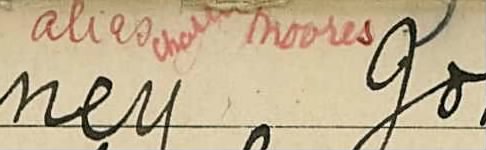
On John Sweeney's card, the alias (Charles Moores) is recorded in almost impossible to read writing between his Surname and Christian name (see below). Again, the alias is detailed on the CWGC web site. This was not originally tagged (indexed) as Charles Moores so it was envisaged that this would be able to be picked up from the proposed WFA project.
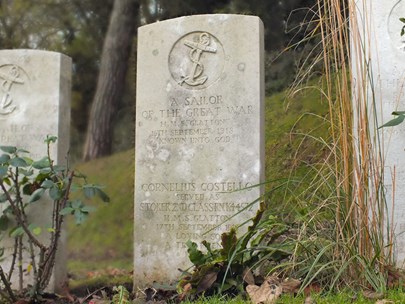
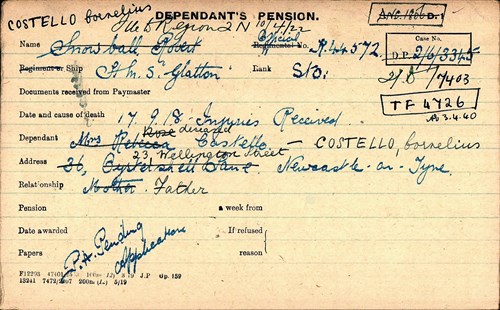
Cornelius Costello served as 'Snowball' in a particularly convoluted 'scam'. Again, this is fully recorded by the CWGC. His pension card is shown below. Despite the complicated back-story to Costello, the process to identify him as an alias and ensure his card was correctly indexed was straightforward.
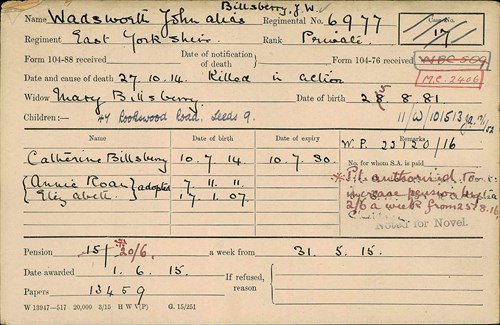
John Wadsworth of the East Yorkshire Regiment used an alias (Billsberry) which is clearly shown on the card. However he is not recorded as an 'alias' by the CWGC. We needed to ensure this - and other clearly detailed aliases - were picked up and recorded on Fold3. Because this alias is not recorded by the CWGC, this aspect was a potential part 2 to the proposed project.
What was envisaged here was a group of WFA volunteers coming forward (the numbers involved meant that about 50 volunteers would probably be able to do the bulk of the work within a few months). These volunteers were allocated groups of aliases extracted from the CWGC. The card(s) (there may be more than one card) for each soldier needed to be identified and checked. After checking, a database was completed which enabled the 'alias' to be recorded.
In addition to this, any alias names found in the WFA pension records which didn't appear in the CWGC database could be sent to the CWGC for possible inclusion in their records. This could form part two of the project.
By this method a far better overall picture of men who used an 'army' name instead of their 'real' name was picked up. It is possible that from this further research will be possible into the subject, and it is very likely a spin-off from this would be some in-depth study into men who used an alias when serving in the Great War. However the main purpose of this exercise was to make sure these men would be able to be much more easily found. This would be a lasting legacy 'in perpetuity' which current WFA members could bequeath to future generations.
So what happened?
During early 2020, 50 WFA members volunteered for the proposed project. The first phase of the project - named Project ALIAS - was completed in June 2020. A second phase was started immediately afterwards. Details about both of these phases can be found here
References
[1] There are numerous reasons for men using aliases, such as re-enlisting after a previous period in the army, wishing to enlist while under age (or over-age), previous criminal convictions needing to be hidden, running away from a failed marriage. There will of course be many other reasons.
[2] This is an oversimplification because the 3,600 includes a number of men who are not recorded by the WFA's pension cards, these are mainly Canadian, Australian and New Zealand fatalities who would not have been awarded a UK pension.
[3] The failure to index these names is actually not surprising in many cases because the alias is often unclear on the card.
Further Reading
Becoming a member of The Western Front Association (WFA) offers a wealth of resources and opportunities for those passionate about the history of the First World War. Here's just three of the benefits we offer:

Identify key words or phrases within back issues of our magazines, including Stand To!, Bulletin, Gun Fire, Fire Step and lots of others.

The WFA's YouTube channel features hundreds of videos of lectures given by experts on particular aspects of WW1.

Read post-WW1 era magazines, such as 'Twenty Years After', 'WW1 A Pictured History' and 'I Was There!' plus others.


